CNIL Email Tracking Pixels: Consent and Implementation Guide
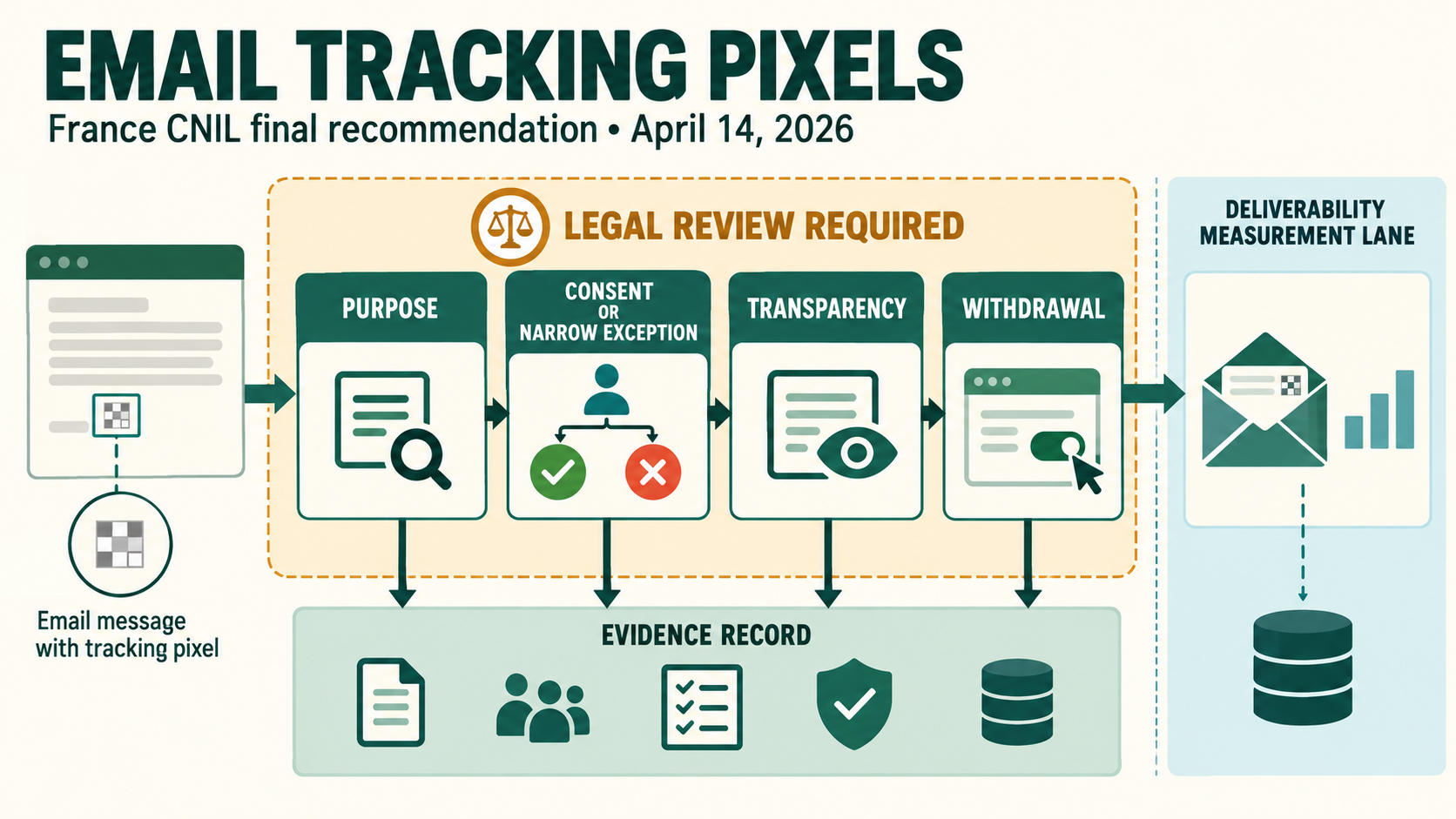
The CNIL recommendation does not say that every email pixel is forbidden or that every deliverability pixel is automatically exempt. Prior consent is the default under Article 82 of the French Data Protection Act. A narrow exemption may apply when the operation is exclusively necessary for a requested service, is limited to qualified deliverability or user-authentication security, collects only what is strictly necessary, and is operated with transparency, rights handling and demonstrable controls. This guide translates that rule into sender, platform and infrastructure responsibilities; it is technical compliance guidance, not case-specific legal advice.
The rule and its legal boundary
The recommendation applies Article 82 to tracking pixels embedded in email. The CNIL describes a pixel as an image or similar resource whose loading permits observation of an open or related behavior, often through a recipient-linked identifier. Prior consent must be free, specific, informed and unambiguous unless the operation exclusively enables electronic communication or is strictly necessary for a communication service expressly requested by the user.
| Use of the pixel | Consent position | Conditions or reason | Operational result |
|---|---|---|---|
| Campaign optimization, personalization, send-frequency or channel adaptation based on individual opens | Prior consent required | The pixel measures behavior for marketing optimization or personalization. | Do not insert or activate it for a recipient without a valid consent signal covering the stated purpose. |
| Cross-context profiling or targeting | Prior consent required | Open behavior contributes to an interest profile used on websites, applications or other channels. | Separate and clearly disclose the purpose; do not hide it under generic analytics wording. |
| General fraud or bot detection | Prior consent generally required under the recommendation | The broad fraud purpose is not the narrowly described user-authentication security exemption. | Use a non-terminal-tracking method where consent is unsuitable. |
| Individual deliverability measurement outside the strict exemption | Prior consent required | Any exemption condition is missing, including excessive data or a message not tied to a requested service. | Disable the pixel for non-consenting recipients or redesign the operation. |
| Deliverability-limited last-open date | May be exempt | Requested service; exclusive deliverability purpose; strictly necessary to reduce frequency or stop inactive recipients; minimized data and demonstrable action. | Retain, in principle, only the day of the latest known open, overwrite the prior value and document inactivity handling. |
| Security of user authentication | May be exempt | Pixel is limited to protecting an authentication process, such as an authentication or password-reset message, and the message relates to a requested service. | Do not extend this exemption to general advertising fraud, campaign analysis or unrelated security intelligence. |
| Global statistics from effectively anonymized data | Depends on collection source | Data validly collected under consent or exemption may be aggregated and effectively anonymized for global statistics. | Anonymization after excessive collection does not retroactively make the original collection exempt. |
Employees and professional addresses are not automatically outside scope. An invisible image is not exempt merely because the provider calls it operational analytics. The assessment follows the real purpose, message context, data fields, recipients, reuse and technical behavior.
Purpose-by-purpose decision flow
Proposed email pixel
        |
        v
Document exact purpose and every data field
        |
        +-- marketing optimization, personalization, profiling,
        |   broad fraud analysis, or non-minimal deliverability?
        |                         |
        |                        yes --> prior valid consent required
        |
        v
Is the message expressly requested or tied to a requested service?
        |                         |
       no --> consent required    yes
                                  |
                                  v
Is purpose exclusively limited to qualified deliverability
or user-authentication security?
        |                         |
       no --> consent required    yes
                                  |
                                  v
Collect only strictly necessary data, inform the person,
enforce withdrawal/rights, document action and audit vendors
Run this decision for each purpose, not once for the vendor or campaign. A single pixel may implement both exempt and consent-required purposes, but the platform must technically prevent the non-exempt operations until valid consent exists. When the pipeline cannot separate purposes, disable the pixel for non-consenting recipients.
The three implementation layers
| Layer | Owns the decision | Must implement | Must return as evidence |
|---|---|---|---|
| 1. Client or sender | Purpose, recipient relationship, message classification, consent or exemption decision, notice, retention and vendor selection. | Approved purpose register, consent language, recipient rules, inactivity policy, rights process and vendor instructions. | Signed approval, consent/exemption mapping, recipient population, retention decision and audit owner. |
| 2. Platform managing recipient data | Recipient records, consent state, segmentation, template assembly, pixel identifiers, preference center and event data. | Per-recipient gating, consent ledger, exempt/no-pixel modes, withdrawal propagation, purpose isolation, deletion and reporting. | Generated EML for each state, consent log, propagation receipt, event schema, retention job and deletion test. |
| 3. Sending infrastructure provider | MTA/API transport, queue, TLS, delivery logs and any transport-layer rewriting or asset proxying it operates. | Send only the approved MIME, avoid unapproved pixel injection, minimize infrastructure logs, secure identifiers and preserve transport evidence. | Message hash or template-diff evidence, queue ID, SMTP result, log-field inventory, retention and proof that no extra tracker was added. |
1. CLIENT / SENDER
   defines purpose, message class and consent or exemption rule
                         |
                         v
2. DATA PLATFORM / ESP
   resolves recipient state -> consented | qualified exempt | no pixel
   builds MIME, stores consent, manages withdrawal and event data
                         |
                         v
3. SENDING INFRASTRUCTURE
   accepts the approved MIME, sends through MTA/API, records transport evidence
   and must not inject or reuse tracking beyond approved instructions
                         |
                         v
RECIPIENT MAILBOX / TERMINAL
   remote resource request returns through controlled pixel infrastructure
                         |
                         v
DATA PLATFORM applies the same state again before recording any event
Keep these layers separate even when one supplier performs two of them. The client cannot transfer its purpose and consent decision to the platform. The platform cannot assume that the sending provider will manage recipient choices. The sending provider cannot treat possession of an approved message as permission to add its own tracking, rewrite identifiers for analytics or retain rich terminal-request data.
The interface between layers must be explicit. The client sends a versioned policy and recipient scope to the platform. The platform returns the generated message and consent decision evidence. The sending provider returns transport evidence and proof of unchanged content. Pixel requests return to the data platform or its processor, where consent or exemption state is checked again because messages already sent may be opened after withdrawal.
The deliverability exemption is narrow
For the CNIL exemption, the sender must demonstrate that individual open measurement is strictly limited to reducing frequency or stopping messages to inactive recipients, with related channel adaptation in the bounded circumstances described by the recommendation. The email must be requested or linked to a service requested by the recipient.
In principle, retain only the calendar date of the latest known open, without the hour, update it on each later open and delete the previous date. Collecting IP address, user-agent, exact time, device detail or other fields first and anonymizing them later does not preserve the exemption. The collection itself was broader than necessary.
The sender must act on inactivity. If the supposed deliverability field never causes frequency reduction, cessation, list cleaning or another documented permitted outcome, the necessity claim is weak. Record the inactivity threshold, communication type, resulting action, exceptions and review evidence.
The security exemption is not general fraud analytics
A narrowly user-centered authentication control may qualify, for example protecting an authentication or password-reset flow and observing whether the message was opened on a known user device. The message still needs to relate to a requested service and collection should remain minimized.
General bot detection, advertising-fraud analysis, inventory manipulation or broad behavioral security intelligence does not become exempt simply because the platform labels it security. If consent is unsuitable, redesign the control using server-side and transport evidence that does not access the recipient terminal.
Message class changes the exemption analysis
| Message example | Requested-service test | Pixel outcome | Reason to document |
|---|---|---|---|
| Order confirmation or invoice | Usually tied to a user action and functional service | A strictly limited deliverability pixel may qualify; promotional additions can change the analysis. | Preserve the trigger, template purpose and absence of promotional content. |
| Password reset or authentication code | Requested security workflow | Narrow authentication-security exemption may apply with minimized collection. | Prove the pixel protects the authentication process rather than measuring engagement. |
| Newsletter explicitly requested by the person | Can be a requested service | Strict deliverability-only pixel may qualify; optimization or personalization still needs consent. | Keep subscription evidence and pixel-purpose configuration separately. |
| Similar-products marketing without prior email consent | May be sendable under a separate marketing rule but is not thereby a requested service | Deliverability exemption generally does not follow automatically; pixel consent is normally required. | Email-send permission and terminal-access consent are separate assessments. |
| Abandoned-cart reminder | CNIL FAQ treats it as promotional | Pixel cannot rely on the transactional/requested-service exemption merely because a cart exists. | Classify by actual purpose, not the automation label in the platform. |
| Legal or contractual change notice | Can relate directly to a requested service | A minimized exempt pixel may be possible when all other conditions are met. | Avoid promotional blocks and record the legal or contractual communication purpose. |
A platform label such as transactional is not legal proof. Inspect the actual template and purpose. Adding offers or product recommendations to an order message can undermine its purely functional classification. Keep transactional and promotional templates, data, consent rules and evidence paths separate.
Who must do what
| Actor | Primary duties | Implementation evidence | Common failure |
|---|---|---|---|
| Sender or client organization | Define purposes, classify messages, choose lawful configuration, provide information, obtain and prove consent, honor withdrawal, limit retention and supervise vendors. | Purpose register, approved copy, consent ledger, processor contract, suppression state, tests and audit trail. | Assuming the ESP is solely responsible because it supplies the pixel. |
| Email service platform or list provider | Act on documented instructions when a processor; provide per-recipient controls, consent signals, pixel disabling, minimization, deletion, security and assistance. | Feature specification, API behavior, contract, subprocessor list, access controls, retention and deletion test. | A global open-tracking switch that cannot distinguish consented, exempt and disabled recipients. |
| Tracking-technology or image host | Limit processing to the contracted role, secure endpoints, minimize request logs and prevent reuse for undisclosed purposes. | Request schema, log configuration, retention, access records, regional flow and deletion evidence. | Keeping full IP, user-agent and timestamp logs while claiming a last-open-date exemption. |
| Infrastructure or MTA provider | Preserve transport evidence without silently injecting tracking; secure logs and follow controller instructions. | Template-diff evidence, MTA configuration, log fields, retention and change history. | Adding a measurement pixel, URL rewrite or third-party asset outside the approved campaign configuration. |
| Consent-management or preference-center operator | Present clear choices, record proof, propagate accept/refuse/withdrawal and avoid repeated pressure after refusal. | Versioned notice, user action, UTC time, address scope, purpose set, source, withdrawal and propagation receipts. | Recording one marketing checkbox but no separate evidence for non-exempt pixel purposes. |
| Sender and provider using data for their own purposes | Assess joint-controller or separate-controller status and allocate obligations transparently. | Article 26 arrangement or separate-controller terms, purpose allocation, user information and rights channel. | Calling every vendor a processor while contractually authorizing independent product improvement or list enrichment. |
The sender normally decides why recipients are tracked and therefore cannot outsource accountability through one contract clause. A provider acting only on documented instructions may be a processor. A provider that reuses pixel data for product improvement, list relevance, profiling or another own purpose may become a joint or separate controller for that operation. Record the factual role per processing activity.
Client or sender implementation
- Inventory every pixel, remote image, click redirect, embedded identifier, vendor and log destination.
- Map each purpose to message classes and recipient populations.
- Classify each purpose as consent-required, potentially exempt or disabled pending review.
- Write plain-language first-layer information and detailed privacy information.
- Define consent scope by address, account, purpose and, where needed, communication category.
- Segment recipients before message generation.
- Configure inactivity rules and prove that exempt deliverability data is actually used only for permitted actions.
- Implement refusal, withdrawal, access, deletion and objection handling.
- Review processor and joint-controller terms, subprocessors, transfers and retention.
- Test complete EML files and live endpoint behavior before every material platform change.
Maintain a register linking campaign or template ID, purpose, legal assessment, consent requirement, pixel host, fields collected, retention, vendor role, eligible population, withdrawal route, test evidence and owner. Marketing, privacy, deliverability and engineering should approve the same version.
ESP and platform implementation
The platform needs more than a global open-tracking checkbox. It should accept a recipient-level purpose signal, generate no optional tracking element without the corresponding state, support an exempt minimized mode, provide an untracked mode, and expose deterministic template evidence. Suppression must occur before MIME assembly and at the tracking endpoint.
Provide APIs and exports for consent state, version, source, withdrawal and downstream propagation. Keep purpose-specific data stores or enforce equivalent isolation. Prevent support staff, analytics jobs and product-improvement pipelines from reading exempt data for unrelated use. Offer tested deletion and processor-assistance workflows.
Infrastructure and tracking-host implementation
Image CDNs, reverse proxies, WAFs and web servers commonly log precise time, IP address, user-agent, query identifier and referrer before the application runs. An application that stores only a day-level last-open value can still violate its claimed minimization if edge and origin logs retain richer request evidence. Audit every layer and disable or transform unnecessary fields before storage.
Use opaque, unpredictable identifiers that do not reveal the email address. Restrict access, encrypt transport and storage, rate-limit abuse, separate tenants, monitor unauthorized export, define incident response and expire mappings. Do not cache a personalized pixel in a way that leaks one recipient's identifier to another. Do not silently rewrite templates or inject measurement at MTA level.
How to collect valid consent
Present each distinct purpose clearly before the choice. A global accept action can be offered when a second level permits specific choices; sufficiently connected purposes may sometimes be grouped, but the person must understand the scope. Do not preselect acceptance, bundle unrelated purposes, make refusal harder, or condition an unrelated service on optional tracking.
Consent can be collected where the address is obtained or by the party in contact with the person. Delegation does not remove the sender's proof duty. Audit the provider's interface and records. The CNIL FAQ says consent need not always be divided by email category, but the user must understand whether the choice applies to one category or all future email to that address.
Consent evidence and state model
| Consent record field | Why it is needed | Example evidence | Do not store |
|---|---|---|---|
| Subject and address scope | Shows whose terminal-access choice applies and whether it covers one address or account. | Internal subject ID plus normalized and encrypted or access-controlled email reference. | A public tracking identifier that exposes the address. |
| Purpose identifiers and version | Proves the exact pixel purposes presented. | open_personalization:v3 and cross_channel_profile:v2. | A single ambiguous analytics=true value. |
| Action and time | Distinguishes accept, refuse and withdrawal. | accepted at UTC timestamp through signup_form_v5. | Only the current state with no lawful audit history. |
| Notice and interface version | Shows what wording and choices were visible. | Immutable notice hash, locale and interface release. | A screenshot as the only machine-verifiable proof. |
| Collection source | Supports context and responsibility. | Account creation, newsletter signup or preference center. | Unnecessary device fingerprinting. |
| Propagation status | Proves downstream systems received withdrawal or refusal. | ESP suppression receipt, tracking gateway update and completion time. | Access tokens, password-reset links or raw secrets. |
{
  "subject_id": "internal-opaque-id",
  "email_scope": "[email protected]",
  "purpose_version": "open_personalization:v3",
  "state": "refused",
  "captured_at_utc": "2026-11-11T09:00:00Z",
  "source": "preference_center:v5",
  "notice_version": "pixel_notice_fr:v4",
  "downstream": {
    "esp": "applied",
    "tracking_gateway": "applied"
  }
}
The example is a minimum operational shape, not a mandatory CNIL schema. Retain only evidence necessary to demonstrate the choice and enforce it. Protect consent records because they connect identity, communication preferences and behavior. Keep refusal as a first-class state rather than treating absence of consent as an error.
Withdrawal must stop already-sent pixels
An email cannot be recalled after sending, so removing a pixel from future templates is insufficient. When consent is withdrawn, the tracking gateway must recognize every associated identifier and ignore later requests from previously sent messages. It must not update last-open state, emit an analytics event, enrich a profile or retain the request in another measurement store.
Provide withdrawal as easily as consent. A combined preference center may manage pixels, subscriptions and communication choices if it remains simple and avoids deceptive navigation. Propagate the change promptly to the ESP, image host, analytics service and downstream profile systems. Where personal-data processing relies on consent, assess deletion of previously collected data as well as stopping future collection.
The CNIL recommends recording accept or refuse so users are not asked on every send; not re-soliciting a person who refused for six months is presented as good practice, while the appropriate period still depends on the relationship and context.
Addresses collected before April 14, 2026
The transition described by the recommendation allowed clear information and an easy objection route for addresses collected before publication, in principle within three months from April 14, 2026. The FAQ identifies July 14, 2026 as the ordinary end of that period, subject to a documented and objectively justified reasonable extension in constrained cases.
By the current review date, do not treat the transition as a new implementation path. Verify whether compliant information was actually sent and opposition honored. If not, obtain consent where required or stop the consent-required pixel. Absence of opposition remains relevant only while the sending conditions remain unchanged and no new consent is otherwise required.
Tracked links are related but not directly covered
The July FAQ says tracked hyperlinks are not directly within this pixel recommendation, but the underlying principles still matter. A redirect containing a recipient identifier can collect click time, IP, user-agent and destination and can support profiling. Inventory it separately, determine the applicable ePrivacy and GDPR analysis, disclose purposes, minimize fields, honor rights and avoid assuming that a pixel decision automatically authorizes link tracking.
Separate open and click consent states when purposes or technologies differ. Disabling open tracking while leaving personalized redirect tracking active is not a complete privacy control.
Open evidence is technically unreliable
Mailbox image proxies, privacy protection, prefetching, security scanners, disabled remote images, offline clients and caching can create false opens, hide real opens or collapse multiple opens. Do not use an open as proof that a human read, understood or legally received content. Do not use absence of an open as sole evidence that an address is abandoned.
For deliverability, combine bounded open evidence with SMTP acceptance, bounces, complaints, unsubscribe, provider telemetry and controlled received-message tests. The exemption does not make open data more accurate; it only describes conditions under which terminal access may avoid prior consent.
Contracts, vendors and transfers
For processors, Article 28 terms should define subject matter, duration, purpose, data types, instructions, confidentiality, security, subprocessors, assistance, deletion or return and audit. For joint control, allocate information, consent, rights and security obligations transparently. Review international transfers and remote support access separately.
A vendor promise of GDPR compliance is not evidence that the configured product is compliant. Obtain the field schema, endpoint behavior, retention, log policy, consent integration, deletion test, subprocessor list and change-notification process. Re-test after platform migrations or feature changes.
Technical acceptance and audit controls
| Control | Pass condition | Test | Failure action |
|---|---|---|---|
| Pre-send segmentation | Every recipient resolves to consented, exempt or no-pixel before MIME generation. | Generate one message from each state and inspect complete EML. | Stop the campaign; do not rely on a footer link to cure prior collection. |
| Pixel endpoint after withdrawal | Requests for withdrawn identifiers produce no measurement, profile update or retained request event. | Withdraw, then request the already-sent pixel URL from controlled clients. | Disable processing at the edge and purge data where required. |
| Minimized exempt endpoint | In principle only last-open calendar date is retained and previous date is overwritten. | Inspect application state and raw infrastructure logs. | Remove IP, user-agent, precise time and hidden parallel logs or obtain consent. |
| Mixed-purpose separation | Exempt operations continue independently while consented operations are gated. | Refuse optional purposes and compare database/event outputs. | Split endpoints and identifiers when one pipeline cannot enforce purpose controls. |
| Preference center | Acceptance, refusal and withdrawal are simple, purpose-specific and equally effective. | Complete each path on mobile and desktop and count steps. | Remove dark patterns, unnecessary login and delayed propagation. |
| Vendor deletion | Sender can execute and verify deletion or suppression across subprocessors. | Run a test subject request and collect completion receipts. | Suspend the affected feature until contractual and technical deletion works. |
Run tests with controlled addresses and devices. Preserve the source template, generated MIME, tracking URLs in redacted form, network requests, application state, edge-log configuration, preference action, propagation receipts and deletion result. Never use a real customer identity for a destructive test without authorization.
Incident and change handling
Treat accidental pixel insertion, consent-state loss, overcollection, unauthorized vendor reuse and failed withdrawal as privacy incidents requiring containment and assessment. Stop affected sends or endpoint processing, preserve evidence, determine population and period, correct data, notify the controller and follow the applicable breach or regulatory process where required.
Every template, ESP, tracking domain, proxy, analytics pipeline or consent-interface change needs a privacy regression test. Maintain rollback to an untracked template and a server-side kill switch that blocks all optional event processing.
Implementation plan by workstream
- Legal and privacy: approve purposes, scope, roles, notices, consent/exemption analysis, retention, rights and contracts.
- Marketing and product: classify templates, remove unnecessary measurement and define inactivity actions.
- Platform engineering: implement recipient-level gating, purpose separation, withdrawal propagation and deletion.
- Infrastructure: minimize edge/origin logs, secure identifiers and verify no hidden collection.
- Deliverability: define bounded evidence, avoid causal claims from opens and validate provider telemetry.
- Quality assurance: test consent, refusal, exemption, withdrawal, previously sent pixels, EML source and data stores.
- Operations: monitor vendor changes, consent failures, retention jobs, incidents and periodic audits.
Current operating conclusion
As reviewed on November 11, 2026, the CNIL recommendation and July FAQ require a purpose-specific design. Consent is required for marketing optimization, personalization, profiling, broad fraud analysis and deliverability tracking outside the strict exemption. A sender claiming exemption should be able to prove requested-service context, exclusive permitted purpose, minimization, day-level last-open handling, actual inactivity action, transparency, rights handling and vendor control.
The safest technical architecture can produce three deterministic messages from the same template: consented tracking, qualified minimized exemption and no tracking. The selected state must be resolved before send, enforced again at the endpoint, and auditable without exposing recipient data.
Primary CNIL references
- CNIL: Email tracking-pixel recommendation announcement: April 14, 2026 publication, transition approach and links to the adopted recommendation.
- CNIL: Recommendation on tracking pixels in emails: Adopted rule, consent-required purposes, narrow exemptions, minimization, consent interfaces and actor roles.
- CNIL: Questions and answers on the email-pixel recommendation: July 22, 2026 operational clarification on providers, deliverability, security, message classes, links, consent, withdrawal and transition.