Email Sunset Policy: Suppress Inactive Subscribers Safely
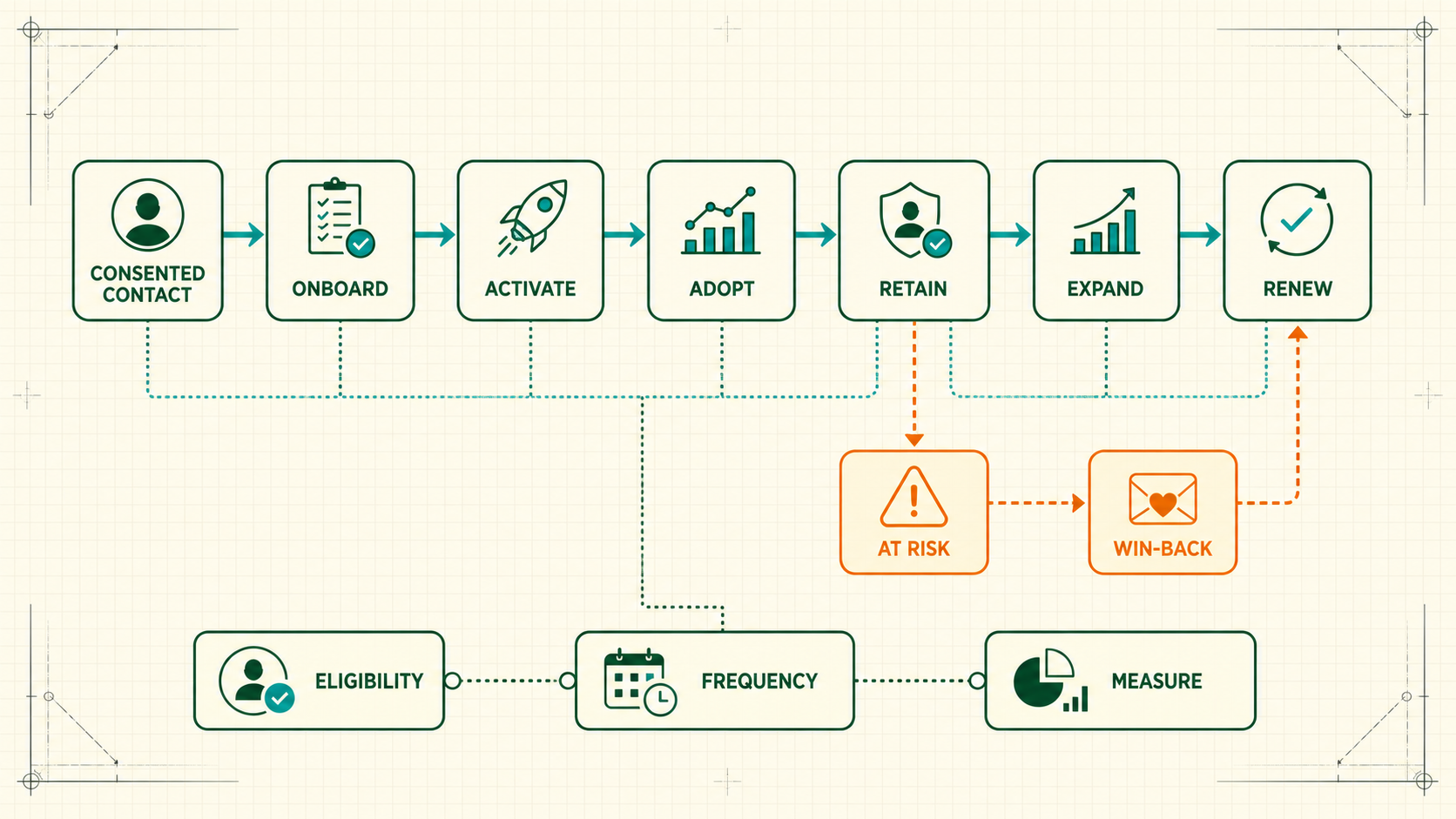
A sunset policy decides when a marketing program should stop emailing people who no longer show meaningful interest. It is not a single universal day count. Purchase cycles, product use, message cadence, consent scope and reliable engagement signals differ, so inactivity must be defined for each program and tested against real customer behavior. The rule must remain understandable to operators and subscribers.
Model inactivity as recipient states and transitions
A useful policy models states rather than running one occasional cleanup. A recipient can be active, declining, inactive-candidate, eligible for re-engagement, marketing-suppressed or address-suppressed. State transitions use consent, hard bounce, complaint, unsubscribe, purchase, service need, website or application activity and message engagement according to documented precedence.
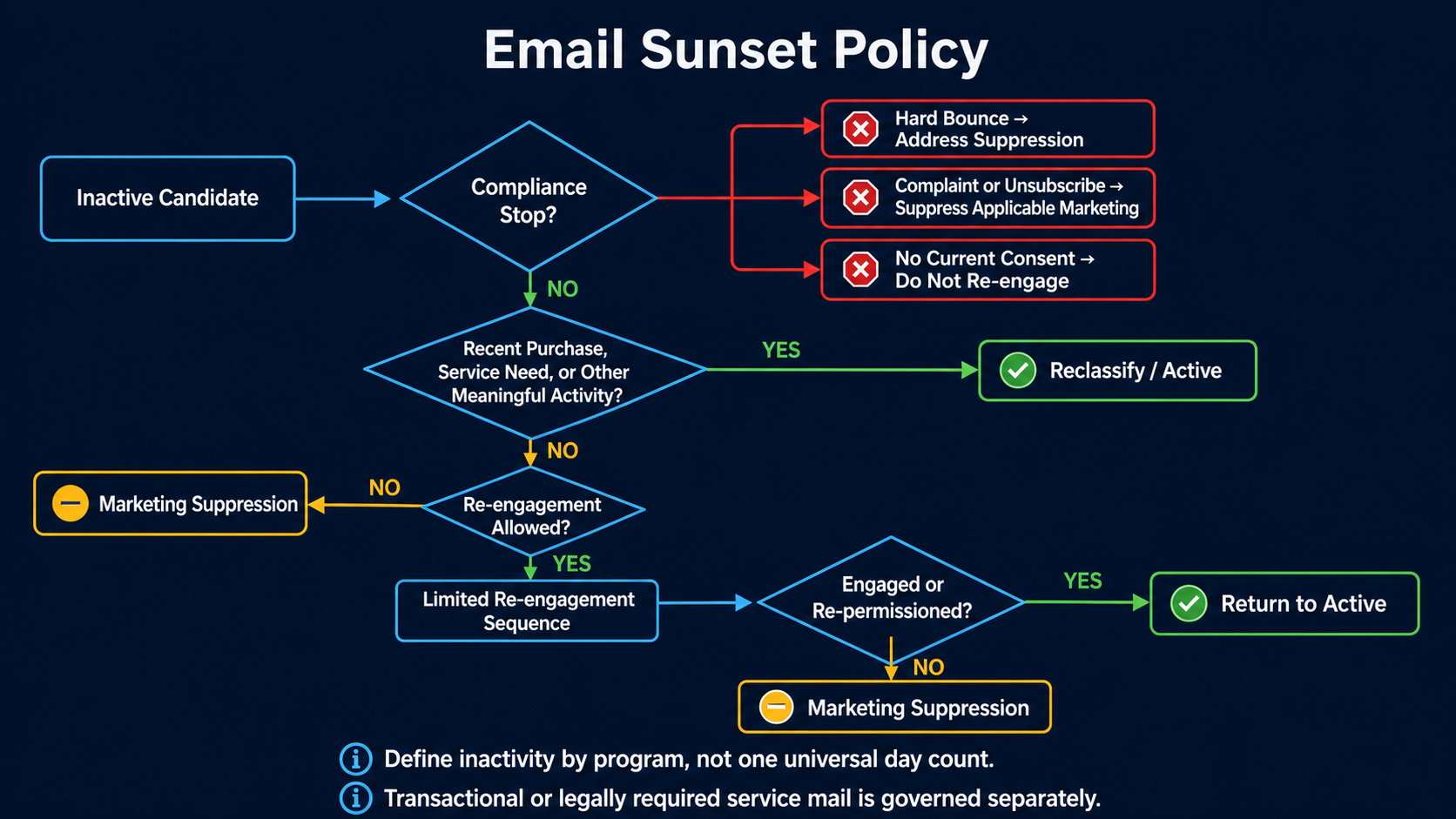
Suppression scope matters. A hard bounce normally makes the address unsafe for further attempts. An unsubscribe or complaint must stop the applicable marketing stream and may require broader suppression under policy or law. Transactional or legally required service mail is governed separately and should not be casually blocked by a marketing-inactivity rule.
Why opens and one universal day count are unsafe
Continuing to mail chronically inactive populations increases cost and exposes the sender to recycled-address, complaint and reputation risk while adding little value. But deleting everyone who did not open is also unsound because privacy proxying and image blocking make opens incomplete. Use clicks, replies, conversions, account activity and purchases where lawfully available.
Re-engagement is not permission repair for records that never had valid consent. The eligibility gate must confirm current permission and frequency rules before any sequence. When provenance is missing or consent was withdrawn, suppress rather than sending a campaign that asks the address to legitimize itself.
Policy owners should also decide whether suppression is temporary, indefinite, or reviewable only after a new affirmative action. An old click should not automatically revive a record years later. A fresh signup can create a new permission event when it meets the current notice and confirmation rules, while the earlier suppression remains preserved for audit. This makes state transitions explainable rather than dependent on whichever platform happens to send next.
Build a program-specific sunset policy
- Define inactivity by program. Document meaningful activity, observation window, cadence, customer cycle, exclusions and evidence sources for each program.
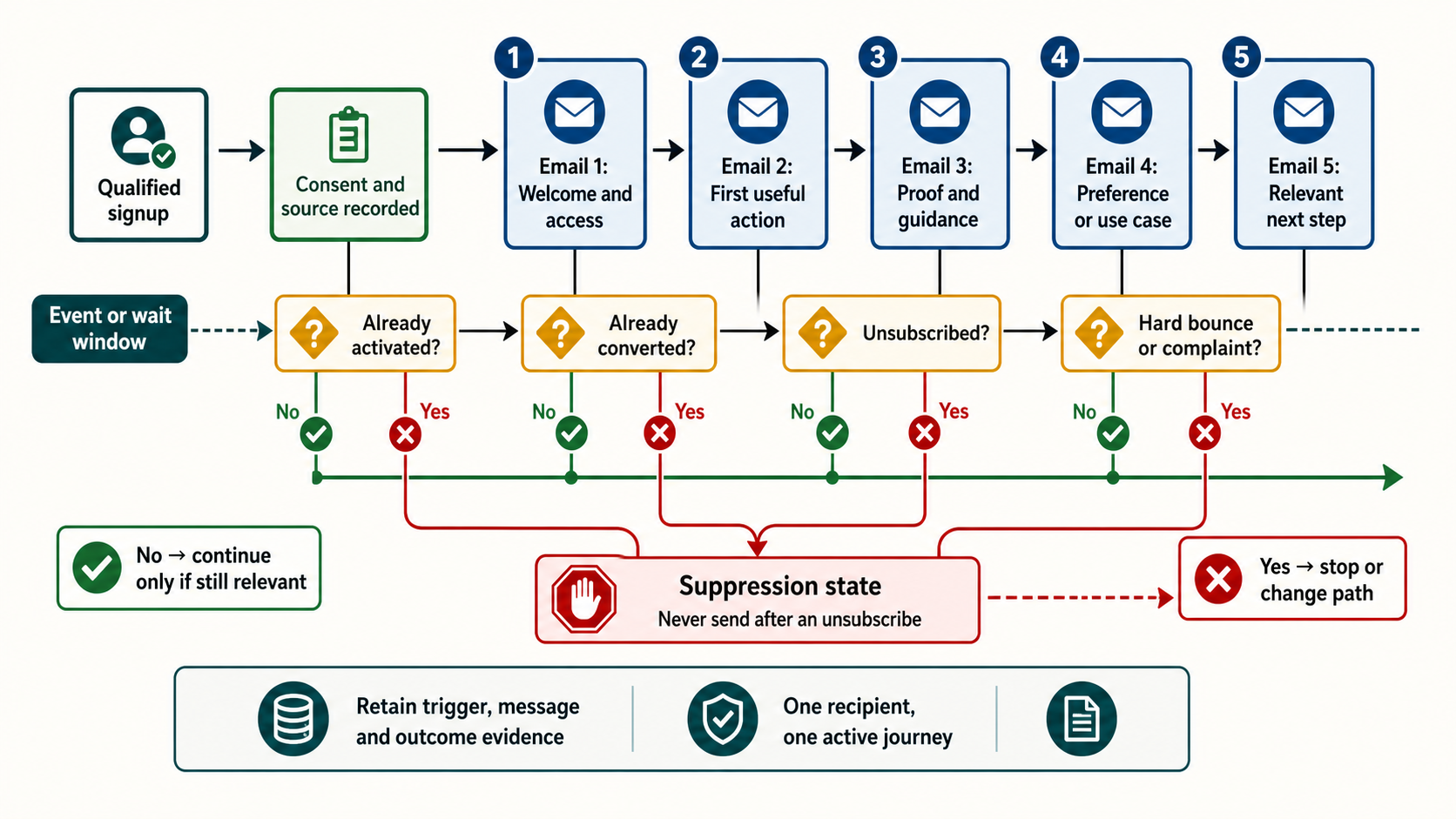
- Establish precedence. Apply hard-bounce, complaint, unsubscribe and consent rules before scoring inactivity or considering a re-engagement send.
- Use several signals. Combine trustworthy email actions with purchase, account, product or service activity; do not depend on opens alone.
- Create an inactive candidate state. Stop routine promotional cadence while evaluating recent transactions, obligations, channel activity and suppression history.
- Check re-engagement eligibility. Confirm valid consent, permitted purpose, frequency capacity and absence of a complaint, unsubscribe or permanent failure.
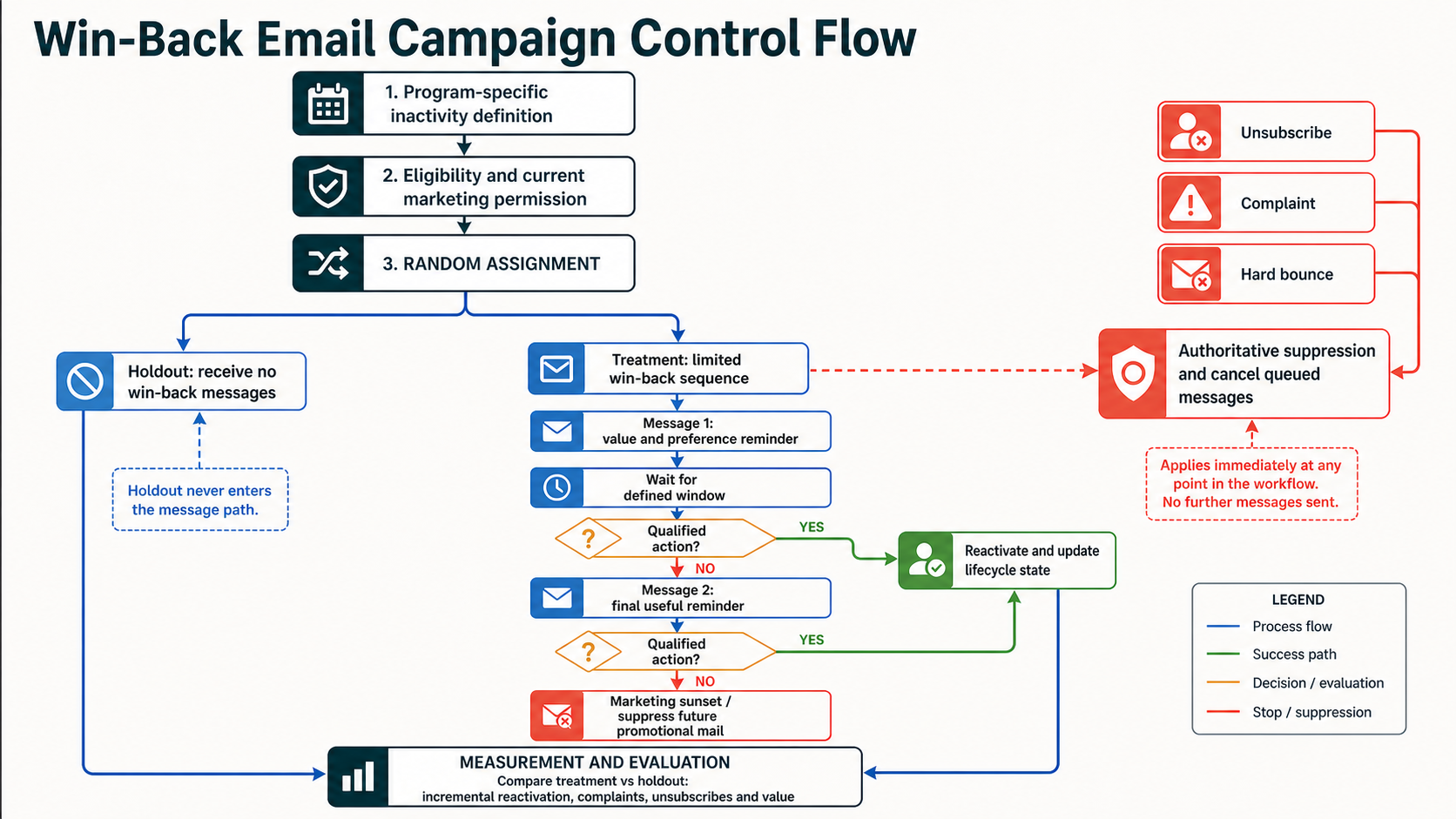
- Run a limited sequence. Use a small transparent sequence that restates value and offers preference control without manipulative urgency or escalating frequency.
- Resolve the state. Return demonstrably engaged or re-permissioned recipients to an appropriate stream; otherwise apply marketing suppression.
- Retain and review evidence. Store reason, source signals, policy version, transition time and scope, then test whether the rule protects reputation and customer value.
Apply suppression precedence before re-engagement
| Condition | State decision | Mail treatment |
|---|---|---|
| Hard bounce | Address suppression | Stop attempts to that address |
| Complaint or unsubscribe | Applicable marketing suppression | Honor immediately and retain service rules separately |
| Recent purchase or service obligation | Reclassify, not inactive | Send only appropriate expected communications |
| Valid consent but sustained inactivity | Re-engagement candidate | Use one bounded policy-controlled sequence |
| No response after re-engagement | Marketing suppression | Exclude from routine promotional selection |
Worked lifecycle: inactive marketing, active service account
A subscription service sends weekly education and monthly offers. A customer has not clicked or used the product for months, but has an active paid contract and still requires billing and security notices. The marketing policy marks the customer inactive for promotion but preserves required service communications.
Because the original marketing consent remains valid, the customer is eligible for one preference-focused re-engagement sequence. No meaningful response follows, so promotional selection is suppressed. The billing system keeps its separate legal and service rules. The state and reason travel with the customer record when the ESP changes.
Sunset-policy evidence to retain
- Policy: program, cadence, inactivity definition, evidence priority, consent requirement, re-engagement limit and policy version.
- Recipient state: current state, state time, reason, suppression scope, source and next permitted evaluation.
- Activity: clicks, replies, conversions, purchases, account or product use and known privacy limitations.
- Safety: hard bounces, complaints, unsubscribes, invalid addresses, unknown provenance and prior suppression.
- Outcome: re-engagement delivery, meaningful response, complaint, conversion, suppression and later lawful permission renewal.
Sunset and re-engagement mistakes that create risk
- Using opens as the only signal: proxying and image behavior make open events unreliable for individual-state decisions.
- Applying one day count everywhere: a weekly newsletter and annual renewal program have different natural cycles.
- Re-engaging without consent: inactivity policy cannot manufacture permission.
- Suppressing critical service mail accidentally: marketing and transactional eligibility need explicit separate rules.
- Losing suppressions during migration: scope, reason and timestamp must move with the recipient.
Email sunset-policy checklist
- Define inactivity separately for each program and lifecycle.
- Document consent, complaint, unsubscribe and bounce precedence.
- Use several meaningful activity signals, not opens alone.
- Separate marketing suppression from necessary service communication.
- Limit re-engagement eligibility, attempts and frequency.
- Make preferences and unsubscribe clear in the sequence.
- Persist state, scope, reason, time and policy version.
- Review outcomes and adjust the policy using controlled evidence.
Define recipient states before writing campaign rules
| State | Entry evidence | Allowed marketing action |
|---|---|---|
| Active | Current permission and meaningful activity within the program window | Normal policy-controlled cadence |
| Declining | Activity weakening but not beyond the inactivity definition | Reduce repetition and review relevance/frequency |
| Inactive candidate | No qualifying activity across the defined observation window | Stop routine promotion while exclusions are evaluated |
| Re-engagement eligible | Valid consent, no stronger suppression and permitted contact | One bounded transparent sequence |
| Marketing suppressed | No response, unsubscribe, complaint or policy decision | No marketing under the applicable scope |
| Address suppressed | Definitive permanent failure or unsafe address state | No attempts to that address |
States must be mutually understandable even when stored across a CRM, warehouse and ESP. Preserve the reason, scope, effective time and policy version, not only an active/inactive flag.
Apply legal, consent and delivery precedence first
A sunset score must never reactivate a recipient who is already excluded by a stronger rule. Evaluate precedence before inactivity.
- Permanent address failure: stop attempts to that address.
- Complaint: suppress the applicable marketing scope immediately.
- Unsubscribe or withdrawn consent: honor the requested scope and legal requirement.
- Program permission: confirm the purpose and current notice allow marketing.
- Service obligation: classify necessary transactional communication separately.
- Inactivity: only now evaluate active, declining, candidate and re-engagement states.
A purchase or account login can show an ongoing customer relationship, but it does not automatically override an email-marketing unsubscribe. Keep behavioral relevance and permission as separate controls.
Choose inactivity windows from cadence and customer cycle
| Program example | Evidence to study | Why one global window fails |
|---|---|---|
| Daily content | Clicks, visits, replies and frequency fatigue over many sends | Enough opportunities accumulate quickly |
| Monthly newsletter | Several complete issues and seasonal variation | A short window may cover only one or two messages |
| Quarterly purchase cycle | Orders, product use and lifecycle stage | Email-only activity misses natural buying cadence |
| Annual renewal | Contract state, renewal window and required notices | Long quiet periods may be normal |
These are design examples, not prescribed day counts. Back-test candidate rules on historical cohorts. Measure how many wanted customers would be removed, how complaints and bounces change, and whether conversion or margin is preserved.
Implement sunset selection with explainable logic
SELECT subscriber_id,
       marketing_permission,
       last_meaningful_email_action,
       last_purchase_or_product_action,
       complaint_at, unsubscribe_at, hard_bounce_at,
       current_state, state_reason
FROM subscriber_eligibility
WHERE program_id = :program
  AND marketing_permission = 1
  AND complaint_at IS NULL
  AND unsubscribe_at IS NULL
  AND hard_bounce_at IS NULL;
The query deliberately selects evidence before applying a program-specific window. A reviewed policy layer should calculate the new state and write an append-only transition record. Do not let an ESP segment become the only record of why a person was suppressed.
state_transition(
  subscriber_id, program_id, old_state, new_state,
  reason_code, evidence_cutoff, policy_version, changed_at
)
Design a bounded re-engagement sequence
| Message | Purpose | Required control |
|---|---|---|
| Value reminder | Explain what the subscriber receives and expected frequency | Clear identity, preferences and unsubscribe |
| Preference choice | Offer lower cadence or relevant topic selection | Do not preselect expanded consent |
| Final notice when appropriate | Explain routine marketing will stop without action | No manipulative urgency or repeated extension |
Define what counts as meaningful re-engagement before launch. Opens alone are weak because privacy systems can load pixels without human attention. Prefer a deliberate preference save, reply, authenticated product action, qualified click or purchase when appropriate to the program.
After the bounded sequence, resolve the state. Do not leave nonresponders in a permanent “one more message” loop.
Measure whether the sunset policy improves the program
Track eligible population, state transitions, re-engagement response, complaints, unsubscribes, hard bounces, conversion, margin and provider-specific delivery evidence. Compare against the prior policy or a controlled holdout where safe and lawful.
A policy that reduces volume but also removes valuable seasonal customers may be too aggressive. A policy that retains nearly everyone and shows no quality improvement may be too weak. Review by program and acquisition source, record the approved revision, and apply it prospectively rather than rewriting historical states.
Weight engagement signals by what they actually prove
| Signal | Useful interpretation | Caution |
|---|---|---|
| Human-qualified click | Intent on a specific message or destination | Security scanners and accidental clicks need filtering |
| Reply | Strong direct interaction | Not available for no-reply or automated workflows |
| Purchase/product use | Ongoing customer relationship | Does not override marketing consent or unsubscribe |
| Open pixel | An image request occurred | Proxying, prefetch and blocking weaken person-level meaning |
| Preference save | Explicit program or frequency choice | Verify identity and retain the notice/version |
Define signal priority and freshness in the policy. Do not let one machine-generated open reset inactivity indefinitely. Where clicks may be automated, use qualified destinations, session evidence or deliberate preference actions.
Preserve sunset and suppression state during platform changes
Before migrating, export the current state, reason, scope, effective timestamp, consent evidence, last qualifying activity and policy version. Reconcile row counts and reason counts after import. Test that a suppressed recipient cannot become active simply because the destination platform lacks the original field.
Run parallel eligibility comparisons for at least one normal selection cycle. Investigate every difference before enabling sends. Keep the prior export and transformation mapping under restricted retention so an incident can be traced without storing unnecessary recipient data indefinitely.
Represent sunset as an eligibility state, not a deletion job
recipient_marketing_state(
  recipient_key, program_scope, state, reason,
  effective_at_utc, source_event_id, policy_version
)

states: marketable, cooling, reactivation_eligible,
        sunset_suppressed, unsubscribe, complaint, hard_bounce
Complaint, unsubscribe and hard-bounce states take precedence over engagement logic. Sunset is a marketing eligibility decision for records that no longer show sufficient current relationship; it must not erase consent history or silently affect necessary service messages. Store scope because a person may leave one newsletter without ending every account communication.
Use append-only state events or equivalent audit history. A CRM import cannot reactivate a sunset or stronger suppression merely because its row says active. Define the only permitted transitions, who can approve them and which new permission event is required.
Use a hierarchy of human and business evidence
| Evidence | Strength for current relationship | Caution |
|---|---|---|
| Purchase, renewal, login or product use | Strong when relevant to program | Does not override unsubscribe |
| Qualified click or reply | Useful intentional action | Filter security scanners |
| Image open | Weak diagnostic | Privacy proxy and image blocking |
| Delivered/accepted | Transport evidence only | Does not show reading or desire |
| No recorded action | Possible inactivity | Tracking gaps and offline relationship |
Set thresholds by program cadence and relationship. A monthly publication and a daily promotion cannot use the same days-since-event rule. Validate the policy against complaints, hard bounces, conversion and incremental value rather than maximizing the size of the marketable file.
Measure the policy before suppressing a large population
SELECT provider, acquisition_source, consent_age_bucket,
       activity_bucket, COUNT(*) AS eligible,
       SUM(complaint) AS complaints,
       SUM(hard_bounce) AS hard_bounces,
       SUM(conversion) AS conversions
FROM recipient_period_evidence
GROUP BY provider, acquisition_source,
         consent_age_bucket, activity_bucket;
Use matured outcomes and stable definitions. Compare cohorts around proposed cutoffs and examine source quality. A sharp risk increase among old partner imports may justify a source-specific rule, while recent first-party customers without tracked clicks may remain valuable.
Run a randomized holdout where feasible to measure whether mailing the marginal cohort creates incremental value after complaints, unsubscribes and discounts. Do not infer value only from conversions among people who clicked.
Release, recover and audit a sunset policy safely
- Preview counts by program, provider, source, state and suppression reason.
- Test boundary dates, null events, duplicate identities and late-arriving data.
- Materialize an immutable decision snapshot with reason codes.
- Apply final complaint/unsubscribe/bounce checks immediately before send.
- Move the selected cohort to cooling or suppression under an approved version.
- Monitor population jumps, provider outcomes and override attempts.
- Require a new valid permission event for re-entry where policy allows.
Do not send a reactivation campaign to recipients who no longer have current marketing permission. For eligible dormant subscribers, cap frequency, state the relationship clearly and stop after the approved sequence. If a release incorrectly suppresses active recipients, roll back the policy version while preserving stronger suppressions and the erroneous decision record.
Calibrate inactivity thresholds from risk, value and cadence
Start with several candidate thresholds rather than selecting 90 or 180 days because another sender uses them. For each candidate, calculate eligible population, provider distribution, acquisition provenance, recent business activity, complaint rate, hard-bounce rate, unsubscribe rate and incremental outcome. Use matured windows and minimum sample sizes. The cutoff should reduce avoidable risk without suppressing an active relationship the email tracker cannot see.
| Cohort | Likely treatment | Reason |
|---|---|---|
| No human action, no purchase, old unknown source | Suppress or require fresh permission outside email | Weak provenance and relationship |
| No trackable open but recent authenticated product use | Remain eligible under controlled cadence | Stronger non-email relationship |
| Recent click classified as scanner | Do not extend activity automatically | No verified intent |
| Recent purchase after unsubscribe | Marketing remains suppressed | Transaction does not reverse opt-out |
| Dormant confirmed subscriber selected for reactivation | Bounded sequence with stop rule | Test current interest without indefinite mailing |
Run the policy in shadow mode first. Store what state each recipient would receive without changing sends, compare with operator-reviewed samples, and reconcile counts. Check seasonal customers whose legitimate interval exceeds ordinary cadence and business accounts where user identity changes.
A policy can use more than one clock: time since last qualified email action, last account activity, last transaction and last explicit preference. Define how nulls and conflicting timestamps resolve. Use UTC internally and a documented business timezone for calendar windows.
Review the model after major privacy, tracking, product or acquisition changes. If a click classifier changes, do not silently move millions of recipients between states. Version the evidence rule, assess population impact and release under the same controls as a campaign eligibility change.
Investigate a sudden jump in sunset suppressions
A daily sunset job moves 28% of a newsletter audience to suppression instead of the expected 1%. Pause the state write and preserve the candidate snapshot. Compare source freshness, timezone, activity classifier version, identity joins and exclusion precedence with the last successful run. Do not “fix” the count by lowering the inactivity threshold.
The root cause is a delayed product-activity feed interpreted as no activity. Operators restore the last valid evidence snapshot, rerun shadow decisions and reconcile every changed state. Complaints and unsubscribes that arrived during the incident remain suppressed; rollback must never weaken stronger states.
Add data freshness as an eligibility prerequisite. If a required source misses its service level, the policy returns unknown and alerts rather than suppressing or mailing recipients. Monitor daily transition counts by reason and source, plus attempts by imports to reverse state. Close the incident after a full successful run, recipient samples and downstream ESP reconciliation confirm the corrected policy version.
Review exceptions without creating a permanent bypass
Exceptions need scope, business reason, approver and expiry. A sales request or high customer value cannot override complaint or unsubscribe. Review active exceptions monthly and test whether they still have current relationship evidence. Report exception outcomes separately so risky mail does not hide inside the ordinary eligible population.
Give support teams a read-only explanation of the state and reason, not a button that silently reactivates marketing. Corrections should create a new auditable event under the approved transition rules.