Win-Back Email Campaigns: Eligibility, Sequence and Suppression
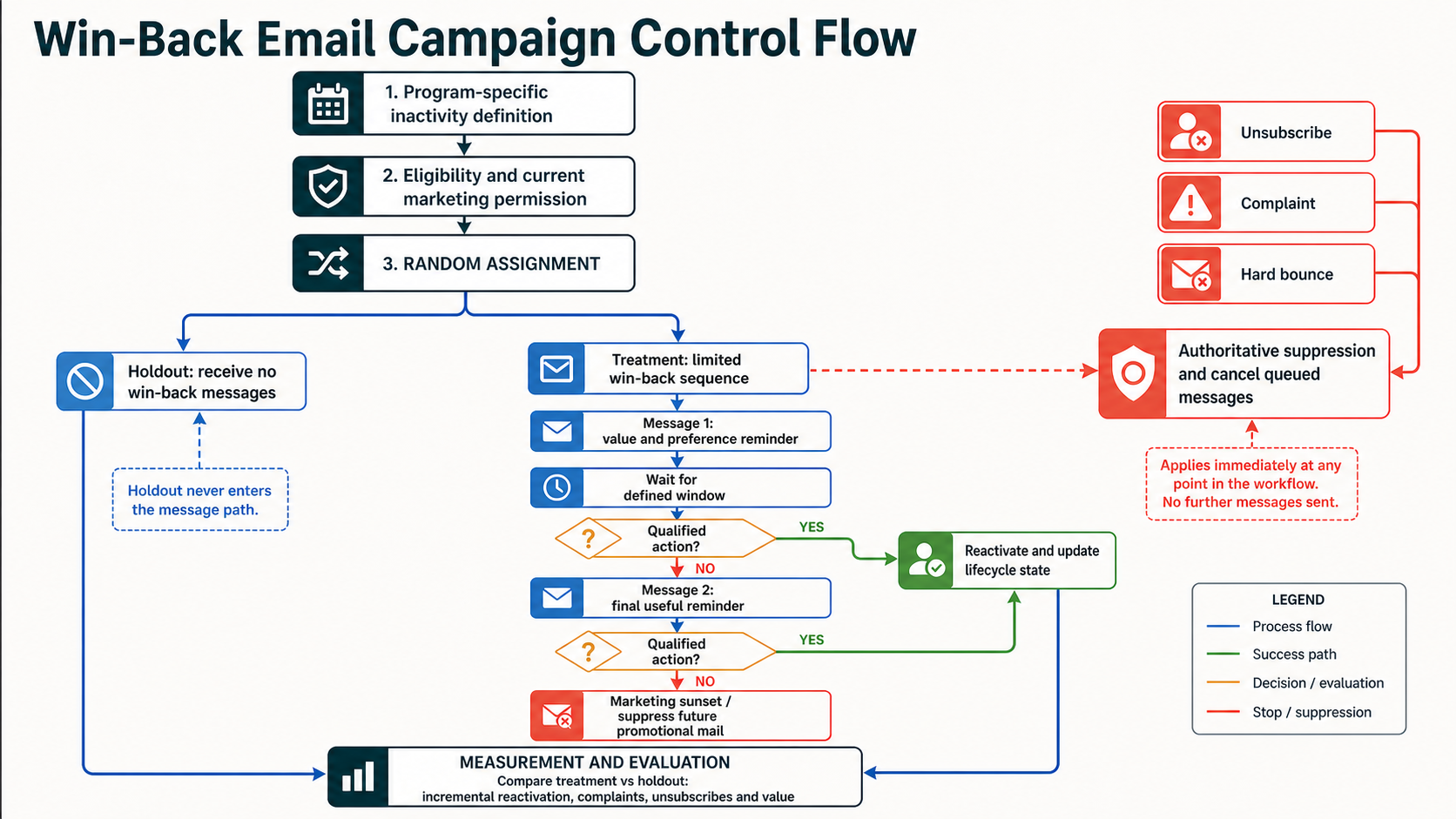
A win-back campaign is a limited experiment for a clearly defined inactive population, not permission to mail an old database indefinitely. The design begins with current consent, durable suppression and address safety, then defines inactivity from meaningful business behavior. A small sequence, frequency cap, control group and firm sunset rule protect recipients and make the result measurable.
Define inactivity for the business cycle
A grocery customer, annual subscriber and enterprise buyer have different expected intervals. Use product use, purchase, renewal, account login, qualified click or reply according to the relationship. Do not use lack of an open as the sole definition because image blocking and privacy fetching distort both open and non-open evidence.
Record the observation window, qualifying events, timezone and segment version. Distinguish never-activated contacts from formerly active customers; they need different messages and expected outcomes.
Apply strict eligibility precedence
- Remove hard bounces and definitively invalid addresses.
- Remove complaints and unsubscribes for the applicable scope.
- Confirm the consent purpose and legal basis remain valid.
- Exclude active service or support cases where promotion is inappropriate.
- Apply global frequency and recent-contact rules.
- Confirm the recipient meets the versioned inactivity definition.
A recent purchase may make a person active but does not reverse a marketing unsubscribe.
Keep the sequence short and purposeful
| Step | Purpose | Exit |
|---|---|---|
| Message 1 | Restate value and preference clearly | Qualified action, unsubscribe or complaint |
| Wait | Allow a full decision window | Purchase, login, reply or preference change |
| Message 2 | Final relevant reminder or transparent choice | Reactivate or sunset |
Do not resend daily to non-openers. Stop queued messages immediately after a stronger event.
Use an offer that does not train bad behavior
Discounts can create response but may teach customers to wait for inactivity rewards. Test education, saved preferences, product improvement, service help or a relevant benefit against a discount. State conditions, expiry and renewal terms honestly.
Do not use false urgency, misleading “account closing” claims or an unsubscribe disguised as a preference button. The visible sender and link domains should remain consistent with established identity.
Measure incremental return and durability
Assign a random holdout before the first message. Compare return, conversion, margin and subsequent retention, plus complaints and unsubscribes. A recipient who returned after receiving mail may have returned without it; the holdout estimates that baseline.
Keep the measurement window long enough to detect one-time discount purchases versus sustained reactivation. Report eligible, excluded, sent, held out and reactivated populations.
End the program decisively
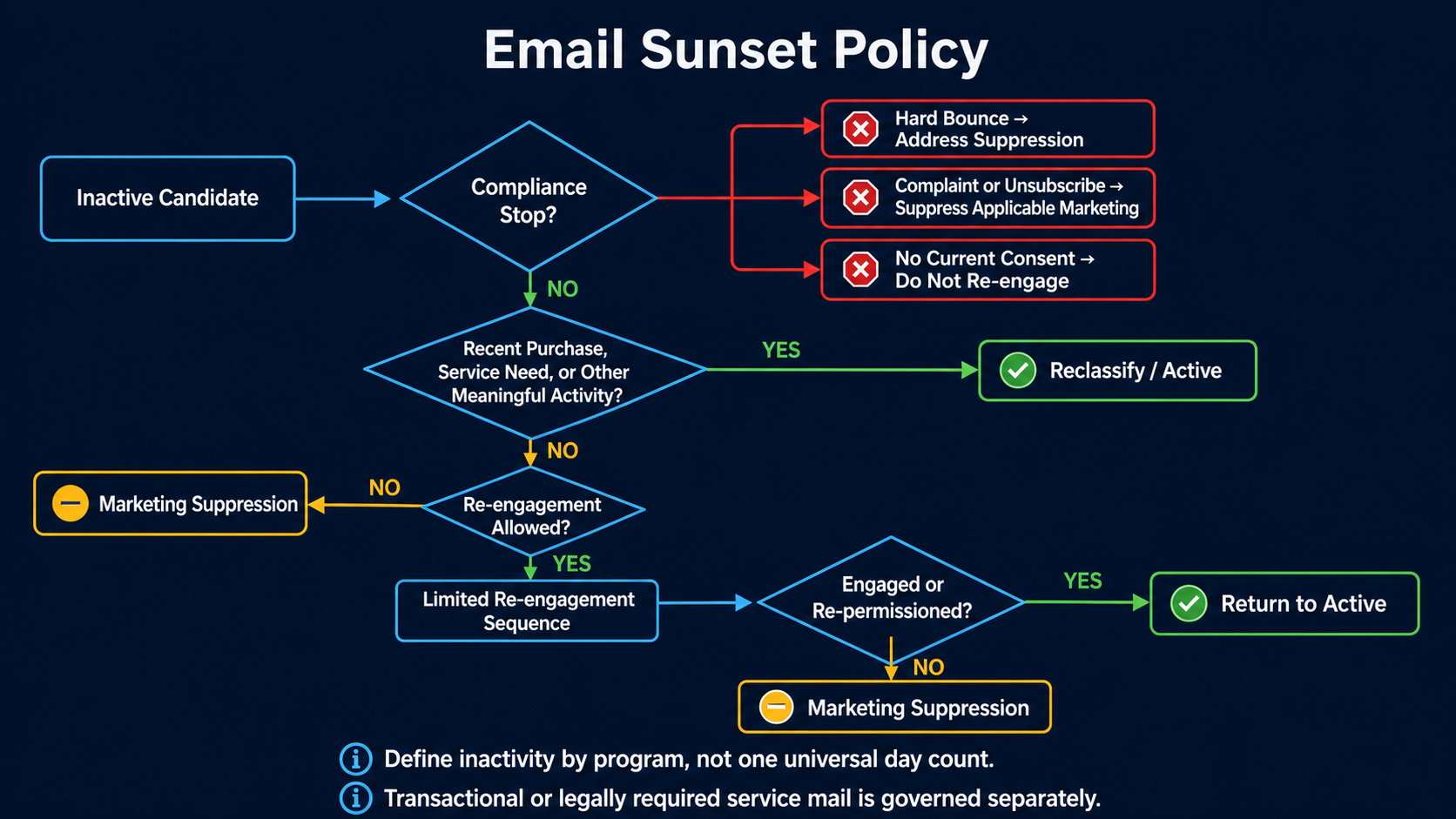
If no qualifying action occurs after the bounded sequence and wait, suppress routine marketing under the sunset policy. Retain only the minimum suppression evidence needed to prevent accidental reactivation. Do not recycle the same inactive population into a new win-back every month.
Define what safely reactivates a sunset address: a new explicit subscription or another permitted action with clear notice, never a purchased update or a machine open.
Define who can legally and operationally receive win-back mail
Win-back is marketing, not a permission reset. Begin with current program permission and exclude complaints, unsubscribes, hard bounces, legal restrictions, unknown provenance and anyone outside the program’s inactivity policy. A previous purchase does not automatically override an opt-out.
| Cohort | Treatment |
|---|---|
| Current permission, recently lapsed | Eligible for bounded test |
| Old unknown-provenance import | Quarantine/no campaign |
| Complaint/unsubscribe | Durable exclusion |
| Recent account/product activity | Not lapsed; correct state |
| Hard bounce | Do not retry marketing |
Define inactivity from relationship evidence, not opens alone
Use program cadence, last qualified click/reply, transaction, authenticated product activity, renewal and support relationship. Apple privacy fetching can create opens and image blocking can hide reads. There is no universal 90/180-day cutoff.
winback_candidate = current_permission
  AND lifecycle_state = lapsed
  AND no_recent_qualified_relationship
  AND acquisition_provenance_known
  AND NOT any_stronger_suppression
Run threshold candidates in shadow mode and inspect complaint/value history before selecting.
Segment by reason for lapse and relationship value
| Lapse pattern | Likely message job |
|---|---|
| Product friction/support issue | Resolve problem, not generic discount |
| Consumable replenishment window | Relevant reminder with timing |
| Seasonal customer | Respect natural interval |
| Content subscriber decline | Preference/value reminder |
| Price-sensitive churn | Test economics; avoid permanent subsidy |
Do not use predicted value to override permission. Keep source, age, prior complaints and frequency as safety dimensions.
Use a bounded sequence with an explicit stop rule
- Remind the person of the real relationship and current value.
- Offer help/preference when friction is plausible.
- Use an incentive only when economics and fairness support it.
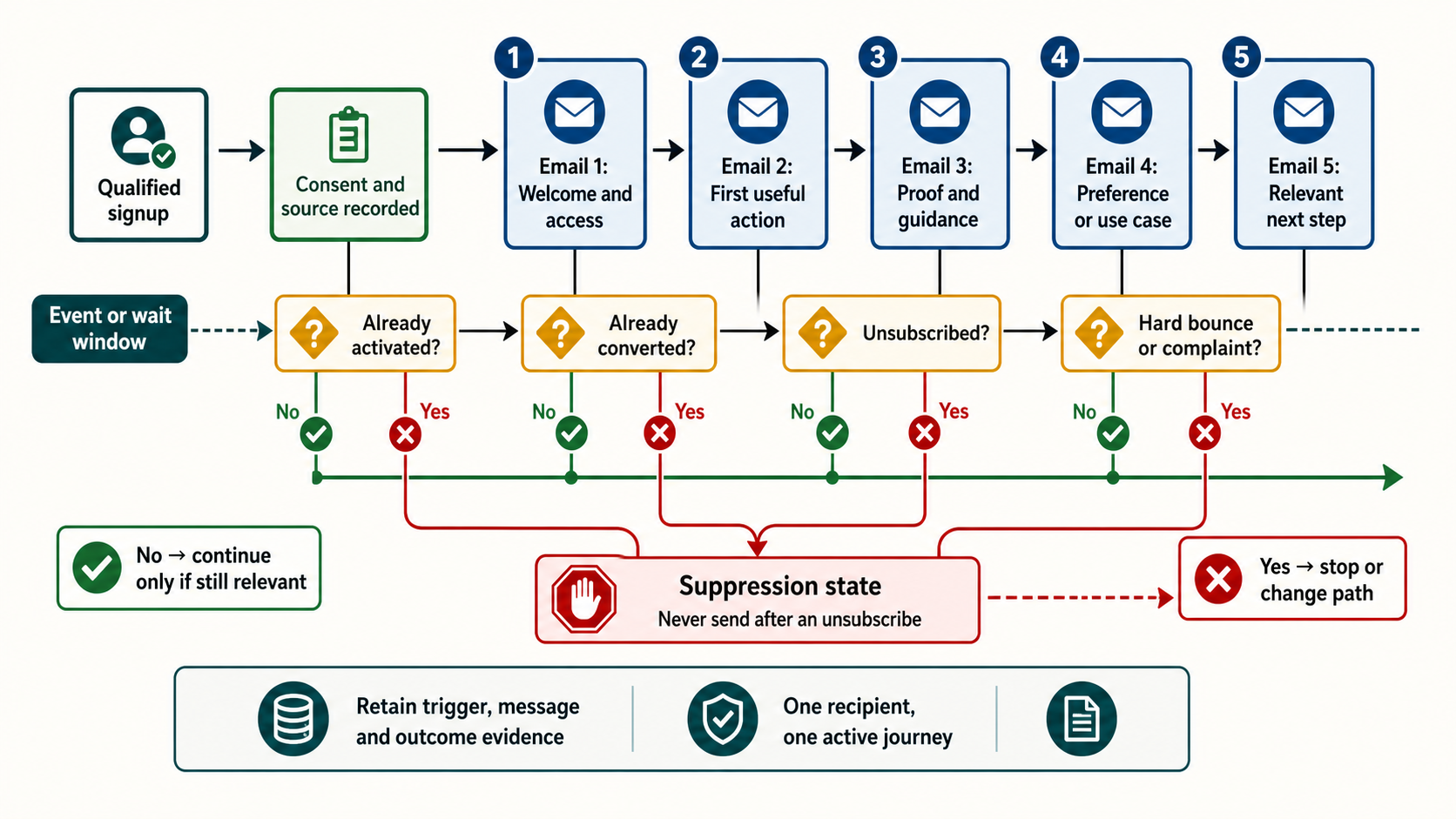
- Stop on qualified action, purchase, preference, unsubscribe, complaint or hard bounce.
- Sunset after the approved no-response sequence.
Apply global frequency caps with other journeys. Do not extend because of a privacy-likely open or scanner click. Cancel queued messages when lifecycle state changes.
Measure margin and long-term behavior, not redemption alone
incremental_margin = incremental_orders * contribution_margin
                     - incentive_cost
                     - campaign_cost
                     - incremental_support_or_risk_cost

track repeat purchase/retention after incentive maturity
A steep discount can win an order that would have happened anyway and train customers to wait. Compare holdout net margin, repeat behavior and unsubscribe/complaint. Separate attribution from causal lift.
Randomize eligible customers before treatment
Assign at person/account according to the decision and retain intention-to-treat. Keep holdout from equivalent win-back messages. If testing creative or offer, factorial designs can separate incentive from message when sample permits. Preselect primary outcome and maturity.
| Outcome | Why |
|---|---|
| Incremental reactivation | Did the program cause return? |
| Incremental net margin | Value after discount/cost |
| Repeat retention | Was return durable? |
| Complaint/unsubscribe | Recipient/reputation cost |
| Holdout contamination | Experiment validity |
Protect reputation when contacting a less active cohort
Begin with a bounded, recent, well-documented segment. Forecast recipients by receiving organization and send under provider-aware throttling. Monitor full SMTP replies, complaints, unknown users and blocklist/provider evidence. Do not send the entire dormant population to “see who responds.”
release gate:
  source and permission evidence current
  final suppression check healthy
  message/one-click validated
  provider-hour volume approved
  cohort stop switch tested
  complaint and queue alerts active
Moving poor data to another IP spreads damage.
Worked case: attributed revenue is large but incremental value is small
A win-back campaign sends 100,000 eligible accounts and reports $240,000 last-click revenue. A 10% persistent holdout converts at 5.0%; treatment converts at 5.2%. Absolute lift is 0.2 percentage points, much smaller than attribution implies.
incremental_purchases at treatment scale:
  90,000 * (0.052 - 0.050) = 180

if incremental contribution margin = $32:
  estimated incremental margin = $5,760
The team keeps the path-attribution report for journey diagnostics but uses experimental margin for budget decisions. It also checks uncertainty and repeat retention before scaling.
Respond when win-back complaints or bounces rise
- Stop the exact cohort/sequence.
- Preserve permission, source, age, selection and replies.
- Check suppression sync and lapse-data freshness.
- Compare provider/source/age complaint concentration.
- Correct state, audience, promise or frequency.
- Resume only a clean bounded cohort.
- Monitor delayed complaints and mature outcomes.
Do not send another “confirmation” to excluded data or shift the cohort to another ESP.
Win-back production checklist
- Require current permission and known provenance.
- Use multi-signal lapse definition.
- Exclude all stronger suppressions.
- Segment by lapse reason.
- Bound sequence and frequency.
- Cancel on state change.
- Randomize holdout before exposure.
- Measure incremental margin and retention.
- Monitor provider/source safety.
- Sunset nonresponders under policy.
Write win-back messages from the known relationship
Identify the actual product, subscription or value the customer used. Avoid pretending to know why they left. Give one clear next step, current terms and an easy preference/unsubscribe. If an account or service problem is known, lead with resolution rather than a generic coupon.
| Message element | Requirement |
|---|---|
| Relationship reminder | Accurate and recognizable |
| Value | Current, relevant and not deceptive urgency |
| Offer | Terms, expiry and eligibility clear |
| Call to action | One intended action, safe link domain |
| Exit | Visible and one-click where required |
Choose timing from natural lifecycle and data confidence
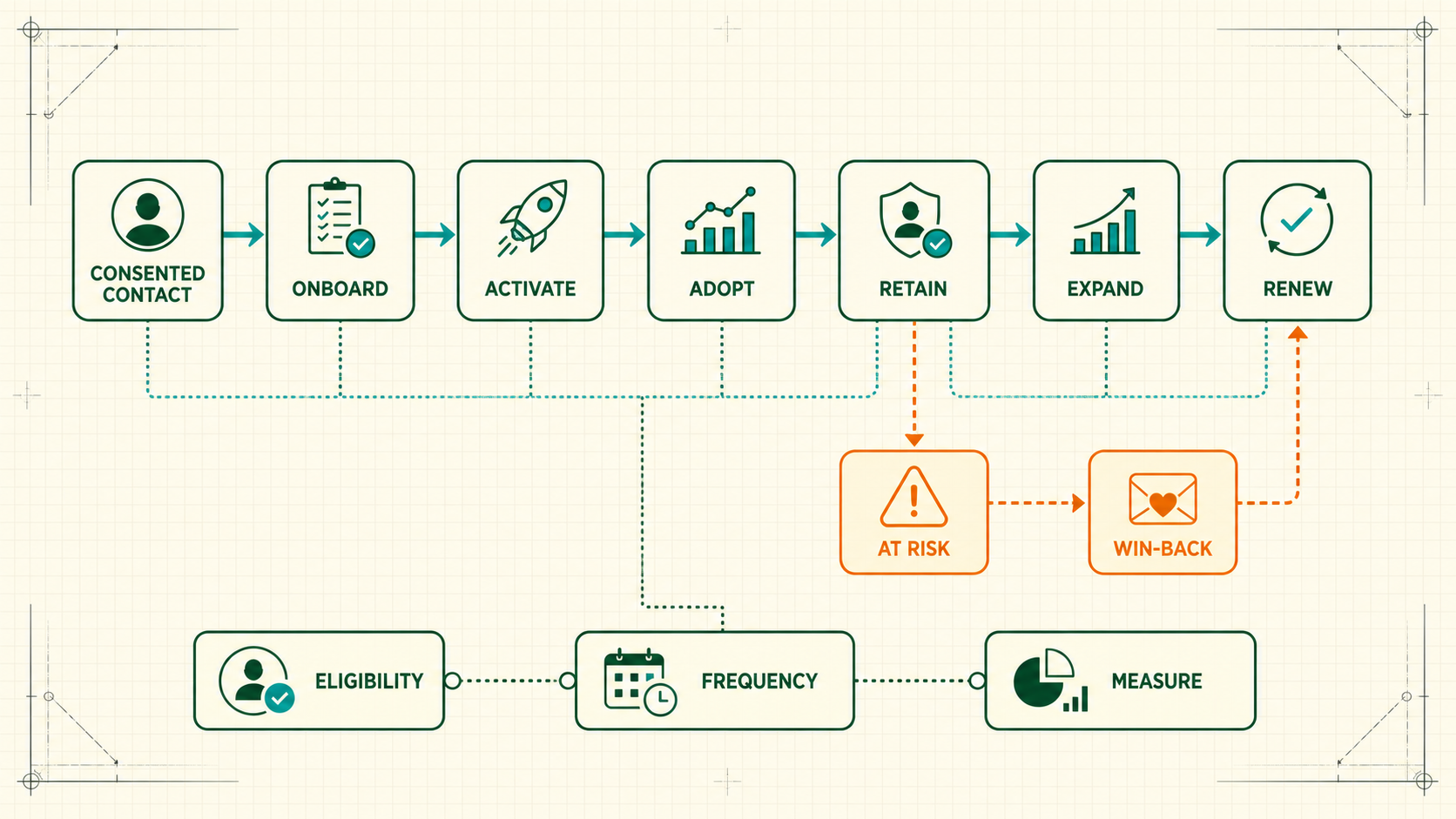
Estimate normal reorder, renewal or use intervals by customer/product cohort. A customer who buys annually is not lapsed at 90 days. Use event maturity, refunds and delayed offline activity. Keep UTC event time and business timezone.
eligible_after = expected_next_value_window + grace_period
expires_at = campaign_or_relationship_policy_end

if source_watermark stale OR new_activity arrives:
  cancel_or_hold scheduled winback
Run threshold alternatives in shadow mode and compare risk/value. Do not select the largest reachable audience.
Test incentive depth against incremental margin and fairness
| Variant | Question |
|---|---|
| No discount/value reminder | Will relationship recover without subsidy? |
| Service/help message | Was friction the cause? |
| Small incentive | Does added lift exceed cost? |
| Larger incentive | Does margin/retention justify it? |
| Holdout | What returns naturally? |
Prevent offer leakage and repeated discount cycling. Track repeat full-price behavior and customer support/fraud cost after redemption.
Prevent win-back from colliding with current customer journeys
At dispatch, check purchase, renewal, support case, active onboarding, account status, suppression and global frequency. A lapsed snapshot can become obsolete while the message waits. Win-back must lose priority to current service/renewal state.
cancel winback when:
  new_purchase OR renewal OR active_product_use
  OR complaint OR unsubscribe OR hard_bounce
  OR higher_priority_journey
  OR message_expired
Record cancellation reason and ESP acknowledgment. Do not count canceled messages as treatment delivered, but retain intention-to-treat for experiment analysis.
Do not use win-back to manufacture permission
If current marketing permission is absent or cannot be established, do not email merely to ask whether the person wants marketing. Where another authorized relationship/channel permits a fresh signup invitation, direct the person to a current transparent capture process. Requirements vary, so apply appropriate policy/legal review.
A fresh valid permission event should record notice, scope, time, source and confirmation. It does not erase historical complaint/security evidence. Unknown-provenance records remain excluded.
Validation and mailbox reachability cannot substitute for permission.
Analyze win-back safety by provider, source and inactivity age
Break attempted, accepted, deferral, complaint, hard bounce and outcome by receiving organization, acquisition source, age bucket and sequence step. Use counts and minimum samples. One blended complaint rate can hide an old partner cohort.
| Finding | Action |
|---|---|
| First-step complaints in one source | Stop source cohort and audit expectation |
| Unknown users rise with age | Tighten sunset/eligibility |
| Provider deferrals across cohorts | Check volume/rate/identity and reputation |
| Clicks without conversion | Inspect offer/site/scanner classification |
Store selection and outcome evidence
winback_assignment(
  experiment_id, subject_key, cohort_reason,
  inactivity_evidence, source, permission_version,
  variant, holdout, assigned_at_utc,
  final_dispatch_state, cancellation_reason
)
Preserve eligibility snapshot and suppressions without exposing recipient data broadly. Join matured orders/refunds with stable IDs. Keep attribution window/model separate from experimental assignment. Version click classifier and message/offer.
This record supports incident replay and explains why a person was contacted.
Operate win-back as a controlled lifecycle program
Name lifecycle, deliverability, analytics, finance, data and offer owners. Catalog active cohorts, rules, maximum sequence, offer, holdout, source exclusions, provider capacity and shutdown mechanism. Review before seasonal peaks and after CRM/ESP migrations.
Emergency expansion or discount changes expire and require post-review. Retire old journeys by canceling timers and checking every ESP/workflow copy. Archive policy and matured experiment outcome.
Release win-back volume by risk, provider and cohort
Dormant recipients are not equivalent to an engaged newsletter population. Forecast eligible counts by receiving organization, inactivity age, acquisition source and prior relationship quality. Start with the most recent, best-documented cohort and use a daily/hourly ceiling that the established sending identity can absorb.
| Release stage | Evidence required to continue |
|---|---|
| Internal and seeded checks | Content, links, authentication and cancellation verified |
| Small recent cohort | Expected SMTP acceptance, low complaints, correct outcomes |
| Provider-aware expansion | No material degradation by mailbox organization |
| Older/riskier cohort | Separate approval and positive incremental economics |
Throttle using actual SMTP response and queue behavior. Do not rotate domains or IPs to bypass provider controls.
Validate recognition, rendering and destination experience
A recipient should recognize the sender, prior relationship and reason for contact without exaggerated familiarity. Test From name/address, subject, preheader, plain-text part, dark mode, mobile layout, accessibility, image blocking, tracked and untracked links, preference center and one-click unsubscribe. Offer terms must agree between email and landing page.
Use a controlled redirect domain aligned with the brand and HTTPS. Check every destination for status, regional behavior, authentication requirements and expiry. A successful SMTP send followed by a broken login or unavailable product is a failed win-back experience.
Rendering platforms and seed accounts reveal technical defects; they do not prove population inbox placement or human interest. Preserve the final message and template version with the campaign record.
Separate email failure from site, product and offer failure
Build a funnel from assignment to eligible, attempted, accepted, qualified visit, account recognition, intended action, order, refund and repeat value. When clicks rise without recovery, inspect page latency, mobile errors, login/reset friction, inventory, geographic restrictions, coupon validation and analytics loss before blaming reputation.
assigned -> eligible -> attempted -> accepted -> qualified_visit\n-> authenticated_action -> settled_value -> retained_value\n\nreport counts, rates, maturity and unknowns at each boundaryUse stable identifiers with appropriate privacy controls. Never remove failed delivery or landing-page errors from the treatment denominator simply because the user could not convert.
Control incentive leakage, fraud and customer fairness
Single-use codes, account eligibility, redemption limits and expiry should be enforced server-side. Monitor code sharing, new-account creation, refund abuse, resellers and support exceptions. Do not embed sensitive account information in a URL. A leaked public discount can make attributed revenue look strong while destroying incremental margin.
Compare treatment groups with a no-incentive value reminder and a persistent holdout. Measure who would have returned naturally, whether discount depth changes repeat full-price behavior and whether loyal active customers are unfairly excluded from comparable value.
Finance, fraud, legal/policy and customer-support owners should approve material offers. Emergency deactivation must invalidate the offer without breaking preference or unsubscribe links.
Turn no response into a documented stop decision
After the bounded sequence, stop win-back mail for the defined program and move the record to its approved sunset state. A privacy-likely open, image fetch or scanner click does not prove renewed interest. A qualified reply, preference update, authenticated product activity or purchase may return the person to the appropriate current lifecycle state.
Sunset scope matters: ending promotional newsletters may not erase necessary service records, security communications or a separately requested publication. Store the program, reason, effective time, source policy version and permitted future paths. Never delete complaint or unsubscribe evidence merely to reduce database size.
Review whether dormant records still have a valid purpose and retention basis. Hashing or archiving must still support durable suppression where required.
Final win-back approval questions
- Can we prove current permission and acquisition provenance for every cohort?
- Does the inactivity definition match natural customer behavior?
- Are service disputes, current activity and stronger journeys excluded?
- Is the sequence bounded, globally capped and cancellable at dispatch?
- Are provider/source/age volumes visible before release?
- Do message, offer, landing page and preference paths work together?
- Is holdout assignment persistent and uncontaminated?
- Are margin, repeat retention, complaint and unsubscribe matured?
- Can operations stop one cohort immediately without moving traffic?
- Is the final no-response sunset state explicit?
If any answer depends on an assumed open or an unexplained imported list, the campaign is not ready.
Evaluate the program after return, refund and repeat behavior mature
The first conversion report is not the final result. Close each cohort only after the normal purchase, cancellation, return and repeat-use windows. Reconcile assigned treatment and holdout populations, then report natural return, incremental reactivation, contribution margin, incentive cost, refunds, support demand, complaints, unsubscribes and hard bounces. Keep results by inactivity age, original acquisition source, provider, lapse reason and offer.
Investigate whether the recovered customer performed the intended durable behavior. A discounted order followed by immediate churn can be less valuable than no campaign. Compare full-price repeat activity and time to the next lapse. If the program merely shifts an order forward, the long-term curve and holdout will expose the effect.
Read negative signals as product and expectation evidence. Complaints concentrated in a partner-import cohort point to provenance or recognition; complaints after the third reminder point to sequence pressure; clicks followed by login failure point to destination friction. Correct the relevant boundary instead of moving the traffic to a new IP.
Decide separately for each cohort: continue, adjust threshold, change message job, reduce sequence, remove incentive or sunset. Preserve the mature result, policy version and decision owner. Future win-back planning should start with these measured cohort outcomes rather than copying last year’s audience size and attributed revenue.
Close operational controls after the campaign matures
Compare actual volume with the approved provider-hour forecast and document every emergency hold. If recovery required a manual exclusion, add that condition to durable selection logic and regression fixtures. Confirm that nonresponders reached the intended sunset state and that no copied automation continues to contact them. Reconcile campaign assignment, CRM state, suppressions, ESP jobs and scheduled actions. Preserve final cohort outcomes and remove temporary credentials, offers and overrides. The program is not closed while an unexplained population or active timer remains.