Email List Hygiene: Validation, Suppression and Risk Controls
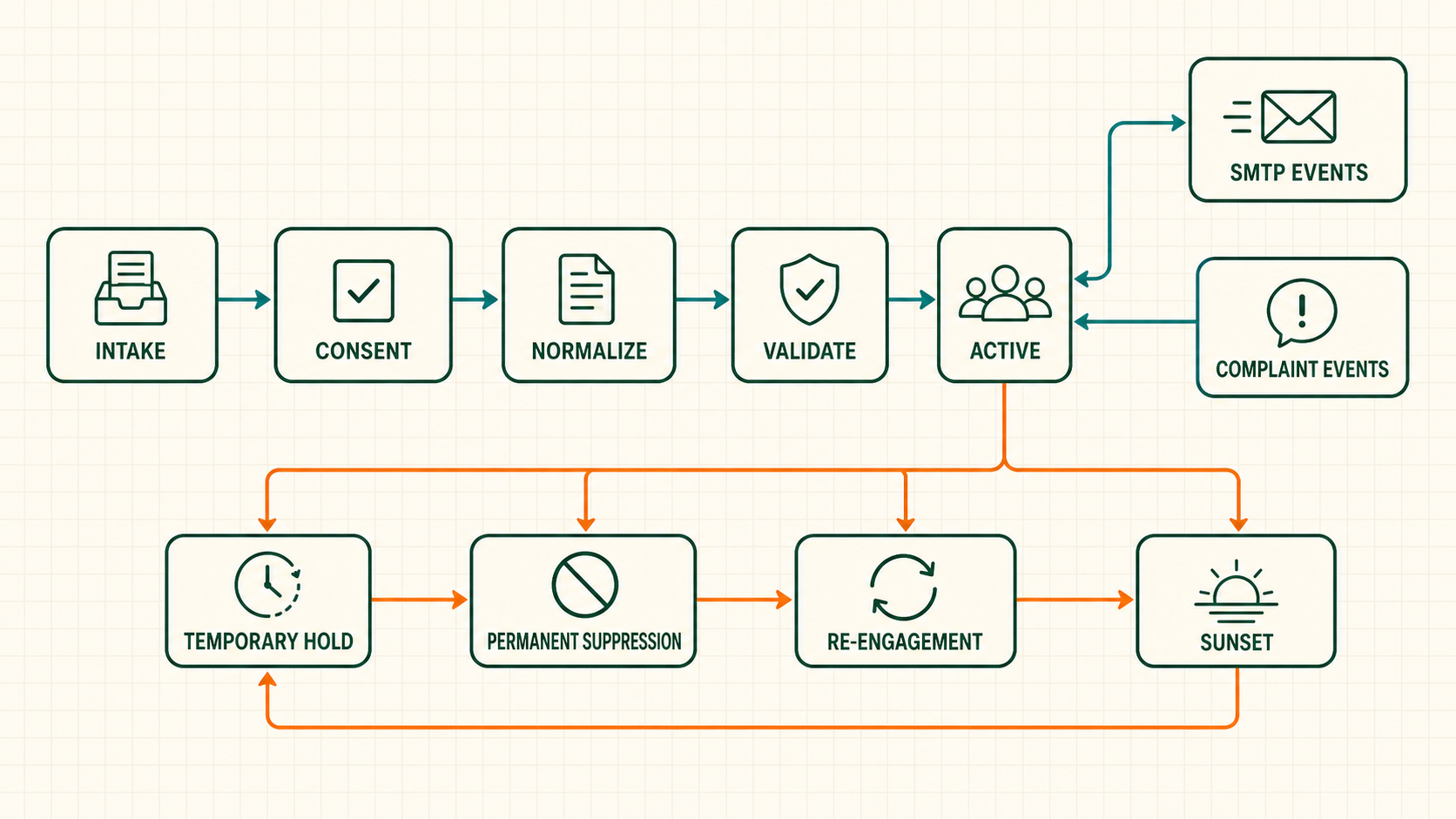
List hygiene is the controlled management of address state from collection through suppression. It is not periodic deletion of “inactive” rows and it is not permission to use purchased validation data as consent. A reliable system records why an address is eligible, handles SMTP outcomes correctly, makes complaints and unsubscribes durable, and separates temporary uncertainty from permanent suppression.
Define address and subscription states
| State | Entry | Allowed action |
|---|---|---|
| Pending confirmation | Submitted but not verified where confirmation is used | Only confirmation/service flow |
| Active | Valid permission and no stronger exclusion | Policy-controlled marketing |
| Temporary hold | Repeated temporary failures or uncertain risk | Pause and investigate |
| Marketing suppressed | Unsubscribe, complaint or policy sunset | No marketing in scope |
| Address suppressed | Definitive invalid recipient | No attempts to address |
Validate intake without confusing it with consent
Normalize whitespace and domain case, preserve the original value for audit, and apply cautious syntax/IDN handling. Confirmation can reduce typos and malicious submissions. Third-party validators can provide risk signals but cannot prove ownership, mailbox activity or permission.
Never send a “test” message to determine whether an unknown harvested address exists. Apply existing suppression before any welcome or import send.
Classify SMTP outcomes at recipient level
Permanent unknown-user responses generally suppress the address after confirming the receiver and response are definitive. Temporary mailbox, rate or system responses remain queued according to policy and should not become hard bounces from one event. Store full reply, enhanced code, provider, attempt count and terminal state.
Do not retry 5xx failures as if temporary. Do not double-count retries as new recipients. A domain-wide failure can indicate DNS or receiver trouble rather than every address becoming invalid.
Give complaints and unsubscribes precedence
A complaint should immediately suppress the applicable marketing scope and cancel queued marketing. Unsubscribe scope follows the user request and applicable law. Keep reason, source, timestamp and policy version. Do not overwrite it with a later “active” event or re-import.
Use a one-way hashed suppression exchange only when necessary and governed; a suppression list remains sensitive data and must not become a source for targeting.
Use a bounded sunset policy
Define meaningful activity from qualified clicks, replies, purchases, account use and lifecycle context. Privacy-prefetched opens are not reliable human activity, while no open is not proof of no reading. Reduce frequency before a short, transparent re-engagement sequence, then stop routine marketing when the policy window expires.
A purchase can affect relevance but does not reverse unsubscribe. Transactional messages must be separately classified and limited to their service purpose.
Reconcile hygiene across systems
- Compare CRM, warehouse, ESP and MTA suppression counts by reason.
- Test complaint and unsubscribe propagation end to end.
- Find active rows with stronger suppression events.
- Find queued messages created before a new suppression.
- Review temporary holds and stale unknown states.
- Verify deleted contacts are removed from derived audiences and exports.
Run recipient fixtures after integration changes and preserve only the minimum personal data required.
Replace periodic cleaning with durable recipient state
recipient_state(
  subject_key, address_canonical, program_scope,
  status, reason, effective_at_utc,
  source_event_id, policy_version
)

strong states:
  complaint, unsubscribe, hard_bounce,
  legal_suppression, sunset_suppression
Hygiene is continuous capture, bounce, complaint, unsubscribe, permission and inactivity control. A CSV scrub before a campaign cannot repair missing provenance or suppression precedence. Store reason and scope; never reduce every exclusion to inactive.
Classify bounces from complete delivery evidence
| Evidence | State/action |
|---|---|
| Permanent invalid recipient (for example 5.1.1) | Stop retry and durable invalid suppression |
| Temporary mailbox/resource response | Bounded retry; no immediate hard-bounce state |
| Policy/authentication rejection | Repair sender; do not label address invalid |
| Queue expiry after repeated temporary failures | Separate expired/undelivered state for policy review |
| Later DSN | Parse recipient Action/Status/Diagnostic-Code |
Provider text and enhanced codes vary. Keep raw response, parser version, remote MX, attempts and final result.
Make suppression precedence deterministic across systems
precedence example:
  legal/global prohibition
  complaint
  unsubscribe (scope-aware)
  permanent invalid/hard bounce
  program sunset
  marketable permission

incoming import cannot overwrite a stronger existing state
A valid fresh permission event may support a reviewed transition where applicable, but do not delete history. Reconcile CRM, ESP, warehouse and feedback-loop states. Hash/case changes and duplicate customer IDs do not create new recipients.
Use address validation only for narrow quality questions
| Result | Supports | Does not prove |
|---|---|---|
| Syntax valid | Plausible address format | Mailbox ownership or consent |
| Domain/MX exists | Domain receives mail at test time | Individual mailbox safety |
| Risky/unknown | Route for review under policy | Definite spam trap |
| Deliverable prediction | One capture-QA input | Permission, relevance or future activity |
Avoid recipient verification methods that create abusive SMTP load or violate provider terms. Do not buy “trap removal” lists.
Prevent bad states at acquisition time
Collect source, notice, timestamp, scope and confirmation; give typo feedback; protect forms from bots/list bombing; separate service identity from marketing choice. Never silently correct an address and mail the guessed destination. Partner/API inputs require the original evidence and rejection rights.
| Path | Test |
|---|---|
| Web form | Typo, duplicate, bot and confirmation |
| Checkout | Separate receipt need from marketing permission |
| Partner feed | Provenance fields and suppression precedence |
| Offline/event | Transcription and expectation |
| Migration | State/reason/time preservation |
Use an evidence-based sunset policy
There is no universal inactive-day threshold. Evaluate program cadence, last qualified human action, transaction/account relationship, acquisition source, complaint/bounce history and legal basis. Apple privacy fetches are weak evidence; image silence can also be false inactivity.
candidate_for_sunset =
  no_current_qualified_relationship
  AND inactivity_exceeds_program_policy
  AND no_service_need_for_marketing_state

complaint/unsubscribe remain excluded regardless
Run thresholds in shadow mode, review cohorts and use holdouts where appropriate. Do not send re-permission mail to people who lack current permission.
Handle duplicates without losing permission or frequency controls
Define canonicalization conservatively. Email local-part rules differ by provider; do not strip dots, tags or change identities globally based on one provider. Store original and delivery form. Merge customer records only with governed identity evidence.
| Conflict | Resolution |
|---|---|
| One address, several customer IDs | Apply strongest suppression and global cap |
| Address changed case only | Canonical comparison with original retained |
| Plus-tag variants | Do not assume same permission universally |
| Recycled business role | Reconfirm current relationship under policy |
Deduplication should prevent overmailing, not combine unrelated permissions.
Monitor quality by acquisition source and first exposure
- Unknown-provenance share.
- Confirmation completion.
- First-send hard bounce.
- Complaint and unsubscribe in first campaigns.
- Long-inactive eligibility.
- Suppression overwrite attempts.
- Volume/population drift by import batch.
Use counts and minimum samples. Quarantine a source when safety changes; do not wait for total-domain reputation to fall. Preserve incident cohort and transformations.
Worked case: a CRM migration reactivates every suppression
A migration maps any contact with a nonempty email to active. Unsubscribes, complaints, hard bounces and sunset reasons from the former ESP are overwritten. First campaign bounces and complaints spike.
The team stops the migrated cohort, preserves both state stores and rebuilds precedence. Complaint/unsubscribe/hard-bounce states win regardless of incoming active flags. Recent first-party eligible subscribers resume only after snapshot comparison. Unknown-provenance records remain quarantined.
Regression fixtures cover each suppression, duplicate identity, late event and repermission transition. Hygiene recovery comes from state correctness, not running addresses through a validator.
Run a recurring list-hygiene audit
- Reconcile permission and suppression counts across all senders.
- Sample state reasons/source evidence under controlled access.
- Review bounce parser unknowns and permanent/temporary mapping.
- Measure source and inactivity cohorts.
- Test imports cannot weaken existing state.
- Verify unsubscribe/complaint cancel queued sends.
- Retire orphaned integrations and exports.
- Record owner, policy version and corrective actions.
Do not report “clean list percentage” without defining states and unknown provenance. The useful result is explainable eligibility.
Turn complaints into suppression and source evidence
Enroll in provider feedback programs where eligible, authenticate and safely parse reports, map message/recipient identifiers, then suppress promptly for the applicable marketing scope. Restrict access because reports can include content and recipient data.
| Step | Evidence |
|---|---|
| Ingest | Transport, deduplication and parser result |
| Attribute | Message, campaign, source and acquisition age |
| Suppress | State event and acknowledgments from every platform |
| Correct | Cohort/source/frequency remediation |
Removing the individual complainant is mandatory but does not fix a high-complaint source.
Respond to spam-trap evidence by fixing the process
Do not attempt to identify or buy removal of individual traps. Analyze source, import batch, age, confirmation, activity and sending changes. Pristine-like evidence points toward unsafe collection; recycled risk points toward old data/sunset failures; terminology varies by operator.
incident cohort dimensions:
  source, batch, acquisition_age,
  confirmation_state, last_qualified_relationship,
  suppression_history, campaign, outbound_route
Pause the smallest causal cohort and preserve lineage. A quiet period without another signal is not proof of recovery.
Treat disposable and role addresses according to program risk
Disposable domains can be used for abuse or privacy, but domain lists change and false positives exist. Role addresses can be legitimate for business operations. Do not globally reject every role/disposable-looking address without defining the product and communication risk.
| Context | Possible control |
|---|---|
| Free trial abuse | Account/behavior limits beyond email |
| Security notification | Require stable verified contact |
| B2B role newsletter | Explicit current permission and ownership review |
| Marketing signup | Confirmation and source monitoring |
Keep list/vendor version and review decisions; validation is not consent.
Test hygiene states before every data migration
fixtures:
  active permission
  unsubscribe at program scope
  complaint at brand/global scope
  permanent invalid address
  temporary bounce history
  sunset suppression
  new valid repermission event
  duplicate customer identities

assert exact final state, reason, scope and timestamp
Compare pre/post counts by reason and sample transitions. Freeze unsafe exports during cutover. A migration rollback must preserve new complaints and unsubscribes received after the snapshot.
Separate operational suppression retention from unnecessary profile data
Organizations often need enough suppression information to avoid contacting an opted-out/invalid address again while deleting unrelated marketing profile data under policy. Use minimized identifiers, purpose-limited access and documented retention. Do not delete suppression evidence in a way that permits reimport and remailing.
Propagate deletion and consent changes to derived segments, model features, exports and vendors. Record acknowledgments. Legal requirements vary; obtain appropriate counsel rather than treating this technical guide as legal advice.
Automate state transitions with conservative failure behavior
Event consumers should be idempotent, ordered or precedence-aware, and observable. A late “active” event must not beat a newer complaint. If suppression service is unavailable, marketing dispatch should fail safe instead of assuming eligible.
| Automation failure | Control |
|---|---|
| Duplicate complaint | Idempotent event ID |
| Out-of-order import | Event time and precedence |
| Partial ESP sync | Per-destination acknowledgment/retry |
| Stale cache | Dispatch-time final check |
| Unknown parser result | Review queue, no unsafe activation |
Report hygiene outcomes without a vanity “clean score”
Show marketable, suppressed by reason, unknown provenance, confirmation state, first-send bounce, complaint, early unsubscribe, inactivity and overwrite attempts by source/cohort. Counts must reconcile from imported/captured through final dispatch.
eligible_count = permissioned
                 - complaint_scope
                 - unsubscribe_scope
                 - hard_bounce
                 - legal_policy
                 - sunset
                 - frequency_or_journey_exclusion
A lower marketable count can be a successful control. Pair hygiene with retained/incremental value and provider outcomes.
List-hygiene incident runbook
- Stop the smallest unsafe import/source/journey.
- Preserve state stores, lineage, parser and transformations.
- Compare first abnormal cohort with clean baseline.
- Restore strongest suppression precedence.
- Fix capture, parser, sync or sunset cause.
- Validate fixtures and reconcile every platform.
- Resume only current explainable eligibility.
- Monitor delayed complaints/bounces and recurrence.
Do not move the cohort to another ESP/IP or send a permission request where permission is absent.
Handle address changes and repermission as explicit events
When a user changes their account email, do not copy marketing permission blindly without policy and user expectation. Verify the new address, preserve the old address state and avoid sending confirmation to an unverified guessed value. A later signup can create a valid new permission event where applicable, but it does not erase prior complaint/security history.
| Transition | Required evidence |
|---|---|
| Account email change | Authenticated action and verification |
| Fresh marketing signup | Current notice, scope and confirmation |
| Old address hard bounce | Keep invalid state; do not redirect automatically |
| Complaint then new signup | Reviewed scope/legal policy and explicit event |
Govern validation, ESP and data vendors
Document the data sent, purpose, retention, security, subprocessors, output definitions and deletion/return. A vendor risk label should include version and reason; never let an opaque score suppress or activate recipients without policy.
Test vendor outages and stale results. Validation must not block complaint/unsubscribe ingestion or become permission evidence. Require export of suppression and event history before ESP exit. Reconcile record counts and reason codes during transition.
Do not upload customer lists to unapproved public checkers.
Review domain/type intelligence as changing reference data
address_risk_observation(
  address_hash, category, provider_or_rule,
  reference_version, observed_at_utc,
  policy_action, reviewer
)
Disposable-domain inventories and provider behavior change. Cache with expiry, handle DNS/network failure as unknown and measure false positives. Role detection is pattern-based and language/domain-specific. The final action depends on product and permission context, not category alone.
Keep the original address under protected operational storage where needed; broad dashboards should use minimized identifiers.
Release data rules like production code
- Version capture, parser, suppression and inactivity rules.
- Run positive, negative, null, duplicate and ordering fixtures.
- Shadow population impact and reconcile reasons.
- Verify final dispatch-time suppression.
- Test every ESP/vendor acknowledgment.
- Set rollback that preserves newer strong events.
- Monitor first cohorts by source/provider.
Stop on unexpected population growth, lower suppression, parser unknown spike or stale consent feed. Count reason transitions, not only final total.
List hygiene production checklist
- Store permission and suppression reason/scope/time.
- Classify complete bounce evidence.
- Process complaints/unsubscribes promptly everywhere.
- Prevent imports from weakening state.
- Use validation only for narrow QA.
- Apply evidence-based inactivity.
- Monitor source and first exposure.
- Preserve state through migrations.
- Fail safe when suppression data is unavailable.
- Audit explainable eligibility, not a vendor score.
Reconcile every stage from source record to delivered eligibility
captured_or_imported
  - invalid_or_unconfirmed_under_policy
  - complaint
  - unsubscribe
  - hard_bounce
  - legal_or_program_suppression
  - sunset
  - duplicate/arbitration/frequency exclusions
  = dispatch_eligible

dispatch_eligible
  - final_pre_send_changes
  - ESP_additional_suppression
  = attempted_recipients
Counts should reconcile by reason without double subtraction. Keep a precedence-aware primary reason plus all applicable states when analysis needs them. Investigate unexplained drops between export and ESP acceptance.
Test difficult state scenarios, not only ordinary unsubscribes
| Scenario | Expected behavior |
|---|---|
| Complaint after audience selection | Cancel queued send everywhere |
| Hard bounce then CRM active import | Hard-bounce state remains |
| Program unsubscribe, another brand permission | Respect exact scope and enterprise policy |
| Address changes during journey | Verify new address; do not copy blindly |
| Suppression service unavailable | Marketing dispatch fails safe |
| Parser receives unknown 5xx | Review, not automatic invalid/active guess |
Assign cross-system ownership
Deliverability owns bounce/complaint interpretation, lifecycle owns permission/cadence, data engineering owns event/state correctness, security owns abuse/credentials, and privacy/legal stakeholders define applicable retention/scope. One accountable owner approves the eligibility policy.
Review unknown provenance, parser unknowns, vendor changes, source incidents and migration plans. Keep exceptions scoped and expiring. No commercial deadline can authorize bypassing complaint or unsubscribe suppression.
Connect hygiene failures to receiver evidence
Unknown users, complaints, trap indications and long-inactive exposure can affect provider decisions differently. Correlate by receiving organization, source, cohort, campaign and route. Do not treat acceptance as proof of a clean audience or a public blocklist absence as safety.
| Signal | Data correction |
|---|---|
| First-send unknown users | Capture/source freshness |
| Complaint concentration | Expectation, targeting and source |
| Trap-risk after old reactivation | Sunset and provenance |
| Policy deferrals after import | Pause cohort and inspect all above |
Repair the source/state process before requesting provider recovery.
Worked case: policy rejections are mislabeled as hard bounces
An ESP mapping treats every 5xx as invalid recipient. A Gmail authentication-policy rejection suppresses thousands of valid subscribers as hard bounces. Operators preserve raw replies and discover the error family is route-level, not recipient validity.
They hold the affected route, repair authentication, version the parser and restore only recipients suppressed by the specific faulty mapping after confirming no stronger complaint/unsubscribe state exists. Historical invalid-recipient suppressions remain.
Regression fixtures cover 5.1.1, 5.7.x, temporary 4xx and DSNs. The incident shows why list hygiene depends on technically correct response classification.
Final review
Select controlled samples from every state and prove the reason, source event, scope and effective time. Confirm each sending platform rejects strong suppressions at dispatch. Reconcile unknown provenance, parser unknowns and failed syncs. No unexplained record may become marketable merely to meet campaign volume.
Record policy, parser and integration versions with reviewer and next audit date.
Quarantine data that cannot support an eligibility decision
Unknown provenance, missing scope, failed confirmation migration, contradictory timestamps or unreviewed vendor classifications should produce a quarantine state, not active or permanently invalid by guess. Quarantine excludes marketing while preserving the record for investigation under access and retention controls.
Define owners, resolution reasons and maximum review age. A campaign deadline cannot bulk-release quarantine. If evidence cannot be recovered, apply the documented conservative disposition and record it.
Record review date
Store the active permission/suppression policy, bounce parser, source catalog, integration versions, responsible owners and next state-reconciliation audit. Revalidate after every ESP, CRM, warehouse, feedback or acquisition migration.
Sign-off
Approve eligibility only when every strong suppression remains durable, source evidence is current, system counts reconcile and the final dispatch check has been tested. Keep unresolved records quarantined.
Archive
Archive reconciliation, fixtures, incident evidence and approvals under the defined retention policy. Restrict recipient-level access and retain enough version metadata to reproduce historical campaign eligibility accurately and safely.