Email Psychology: Ethical Motivation, Friction and Trust
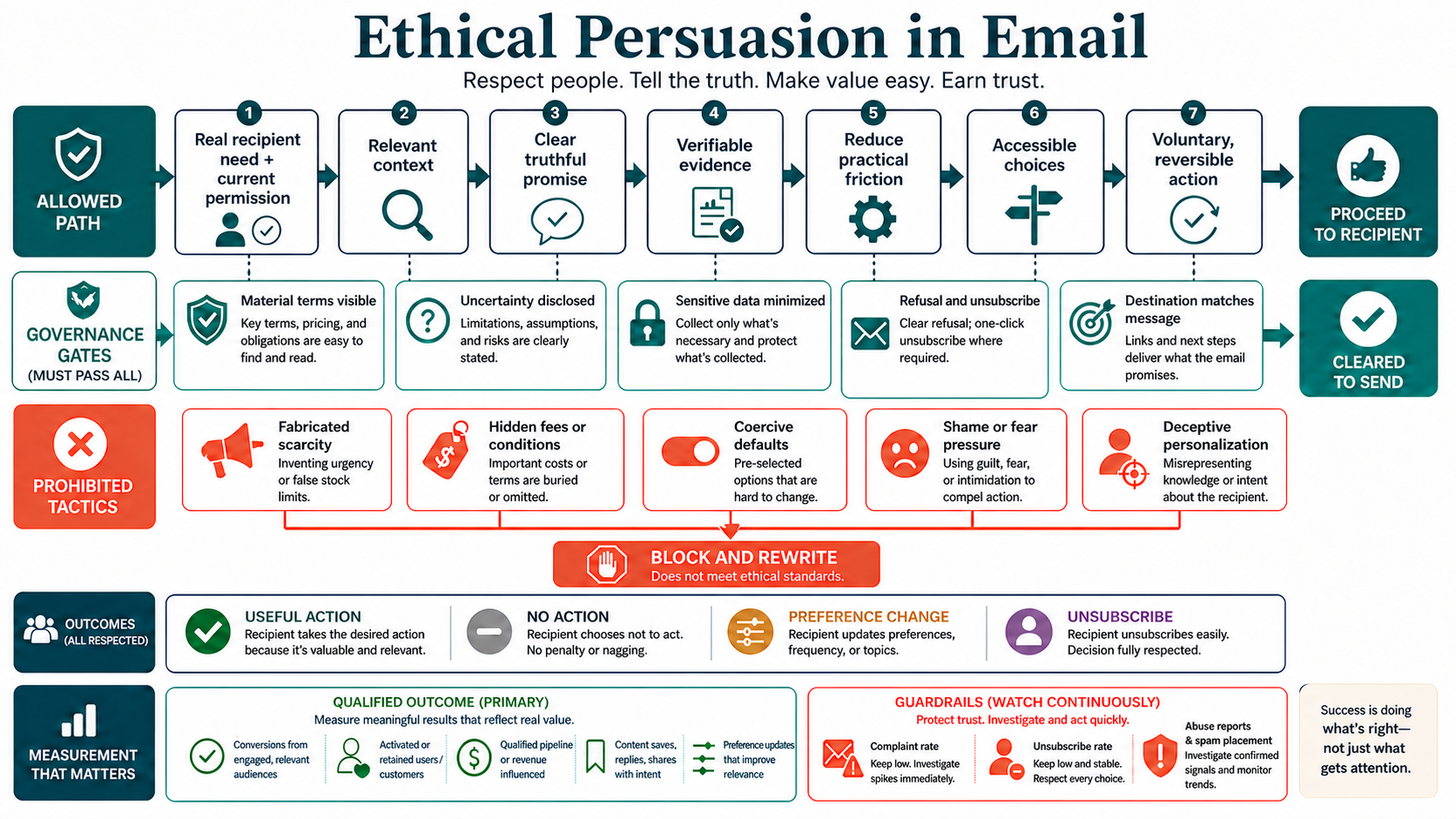
Email psychology should help a person recognize value, understand consequences and act voluntarily. It should not exploit confusion, hide material information or create pressure with fake scarcity. Motivation matters, but so do ability, trust, timing, uncertainty and the option to decline. Ethical persuasion makes the decision easier to understand while preserving the recipient’s autonomy and the sender’s long-term credibility.
Use a complete behavior model instead of trigger lists
| Dimension | Question | Email response |
|---|---|---|
| Motivation | Does this outcome matter now? | Connect to a real need |
| Ability | Can the person complete the action? | Reduce steps and explain prerequisites |
| Trust | Are sender, claim and destination credible? | Provide accurate identity and evidence |
| Friction | What blocks a decision? | Resolve product, price or process uncertainty |
| Autonomy | Can the person decline freely? | Clear choice, preferences and unsubscribe |
An emotional reaction is not automatically an informed decision or durable value.
Write the recipient benefit before the conversion goal
State what the person can understand, accomplish or avoid after reading, then state the business outcome. If the only benefit is helping the sender hit a quota, the message lacks a defensible job. A useful email can help someone decide no, postpone or choose a smaller option.
Map benefits to current lifecycle and evidence. Do not use a vulnerability, support issue or private behavior as a pressure point. Long-term value depends on fit and expectation, not merely the speed of the first action.
Connect motivation to a real current need
Desire can express a positive outcome, while risk information can explain a consequence. Neither requires fantasy or fear. Describe the current condition, plausible outcome, required effort and uncertainty. Avoid implying that all readers share the same ambition or problem.
Motivation also changes over time. A customer handling an incident needs resolution, not aspiration. A research subscriber may need education, not a deadline. Use state and declared preference to choose the job, then let the recipient control the decision.
Remove genuine friction instead of adding pressure
If the next action is difficult, clarify prerequisites, time, price, data requirements, cancellation, accessibility and support. Reduce unnecessary form fields and preserve entered data securely. A reminder cannot compensate for a slow page, broken authentication, unavailable product or unclear contract.
| Friction | Ethical response |
|---|---|
| Unclear fit | Eligibility and no-fit conditions |
| Setup complexity | Steps, owner and realistic effort |
| Price uncertainty | Total cost and material terms |
| Risk concern | Controls, limitations and support |
| Decision delay | Preference or follow-up choice |
Treat trust as evidence plus consistent behavior
Recognizable sender identity, accurate authentication, a functioning reply path, clear links and consistent expectations provide a base. Claims need appropriate proof. Terms should remain the same from email through checkout, and a stated deadline should behave as stated.
Trust accumulates across service, support, marketing and unsubscribe experiences. A high-performing message cannot repair a deceptive cancellation flow. Measure complaints, support contacts, refunds and repeat behavior to see where claimed value and actual experience diverge.
Use curiosity to reveal value, not conceal terms
A curiosity gap can point to an unanswered mechanism, comparison or lesson. It becomes manipulative when it hides price, renewal, eligibility, risk or the basic identity of the offer. The payoff must match the setup and arrive without forcing an unrelated click.
Measure what happens after attention. Privacy opens and scanner clicks can create false confidence, while disappointment appears later as complaints, unsubscribes and lower future response.
Ground urgency and scarcity in verifiable constraints
urgency_claim(
  constraint_type, source_of_truth, affected_population,
  effective_start, real_expiry, timezone,
  behavior_after_expiry, owner, evidence_version
)
A countdown that resets, an unsubstantiated only-three-left message, or a deadline that does not change the offer is not a harmless copy technique. If the source cannot support the claim at send and click time, omit it. Explain the actual consequence without magnifying fear.
Present risk without exploiting fear
Loss framing can be appropriate for real account expiry, security risk, safety action or contract consequence. State probability or uncertainty when known, define who is affected and provide a proportionate response. Do not convert a minor opportunity cost into catastrophe.
Separate service warnings from promotional pressure. A security or health-related alert should prioritize safe action and support, not add an upsell. Review vulnerable audiences and high-stakes contexts with appropriate subject-matter and policy owners.
Make social proof relevant and representative
Testimonials, customer counts and case studies need permission, accurate context and material conditions. A result from a large enterprise may not support the same expectation for a small buyer. Disclose incentives or atypical selection where appropriate. Do not fabricate named users, reviews or performance numbers.
| Proof | Review |
|---|---|
| Testimonial | Permission, exact claim and current relationship |
| Case result | Baseline, method, period and constraints |
| Popularity | Definition, timestamp and population |
| Expert authority | Relevant qualification and independence |
Use reciprocity without creating hidden obligation
A promised guide, trial or consultation should deliver the stated value without implying that the recipient now owes a purchase. If data capture, renewal or payment is required, disclose it before the action. A free resource should not silently enroll someone in unrelated programs.
Follow-up may ask whether the material helped and offer a relevant next step. It should also make preferences and unsubscribe easy. Measure qualified use and fit, not only form completion after a gated asset.
Respect the scope of earlier choices
A previous signup, small purchase or survey answer can guide relevant communication, but it does not authorize an unlimited escalation. Commitment and consistency effects become coercive when the sender portrays a past action as a duty to continue. Let the person update preferences, stop or choose a smaller path.
Record consent and program scope independently from lifecycle behavior. A customer who bought once may be relevant for service communication while remaining unsubscribed from marketing.
Do not use defaults to manufacture agreement
Preselected boxes, bundled permission and confusing opt-out wording can create apparent conversion without informed choice. Use clear labels, balanced options and a visible explanation of frequency and sender. Do not make rejection visually or procedurally harder than acceptance.
Preference centers should confirm what changed and apply it consistently. A save button that quietly adds new lists, or a cancellation path that introduces repeated retention screens, undermines autonomy and creates complaint risk.
Use personal relevance without surveillance theater
Declared preferences and current relationship context can improve relevance. A name token alone does not create trust, and inaccurate inferred details can feel invasive. Minimize data, state why it is used, respect preference changes and avoid sensitive inferences without appropriate purpose and review.
Never imply that a person performed an action unless the event is reliable and belongs to that identity. Security scanners, shared accounts and forwarded messages complicate click evidence. Provide a safe fallback instead of exposing a missing or incorrect field.
Write clear choices and material terms
Prefer concrete verbs, specific outcomes and complete conditions. Avoid double negatives, disguised advertising, fake reply language and jargon that prevents comparison. State total price, renewal, expiry, eligibility and cancellation where material to the decision. The CTA should describe what happens next.
Clarity does not eliminate emotion; it gives emotion an honest object. A customer can feel relief because a process is simpler or confidence because evidence is visible. There is no need to manufacture anxiety around a vague loss.
Include cognitive and visual accessibility in persuasion
Readable hierarchy, sufficient contrast, descriptive links, plain language and meaningful text alternatives help people understand the decision. Do not encode urgency only in color, hide conditions in small images or use animation that distracts. Ensure destinations work with keyboard, zoom and assistive technology.
Give enough time to review high-impact choices and allow correction of errors. An inaccessible checkout can falsely appear as low motivation. Test comprehension and task completion, not only visual preference.
Use generative tools as draft support, not claim authority
AI can propose variants, summarize objections and help organize language, but it can also invent evidence, overstate personalization, reproduce manipulative patterns and flatten audience differences. Give it approved facts and constraints, then require human claim, privacy, accessibility and brand review.
Store prompt or instruction version when it materially affects production copy. Do not send personal customer data to an unapproved model. Performance prediction from past opens inherits privacy and selection bias, so validate variants through controlled experiments.
Optimize durable voluntary outcomes
Define the desired behavior, recipient benefit, business outcome and harm guardrails. Randomize at the decision unit and use a holdout where practical. Compare qualified action, net value, cancellation or refund, complaint, unsubscribe, support burden and repeat behavior after maturity.
ethical treatment passes only when:
  claims and material terms are accurate
  action is voluntary and appropriately reversible
  incremental value exceeds full costs
  recipient-harm guardrails remain acceptable
  no vulnerable cohort is hidden by blended totals
A short-term conversion increase does not justify a design that creates regret or avoidable cancellation friction.
Worked case: urgency increases orders and refunds
A retailer tests a 24-hour countdown in cart recovery. Orders rise during the first day, but the offer remains available afterward and the timer resets when reopened. Refunds, support complaints and future unsubscribes rise. Last-click revenue calls the campaign successful, while a holdout shows little incremental margin.
The team removes the false timer, documents the real promotion end in the account timezone and adds a neutral no-discount variant. The truthful deadline produces fewer immediate orders but higher settled margin and lower support burden. Customers who needed more time can choose a preference instead of being told a fictional opportunity disappeared.
The decision uses mature net value and recipient harm, not the fastest conversion curve.
Run an ethical persuasion review
- State the recipient benefit and possible no-action choice.
- List every explicit and implied claim.
- Verify proof, scope, conditions and uncertainty.
- Validate urgency and scarcity against a source of truth.
- Check permission, preference and unsubscribe behavior.
- Inspect personalization and sensitive inference.
- Test comprehension and accessibility.
- Review post-click terms, cancellation and support.
- Define experiment outcome and harm guardrails.
- Assign an owner with authority to stop the treatment.
A reviewer should be able to explain the decision without relying on the emotional wording.
Maintain a persuasion claim register
Record recurring claims, evidence owner, population, conditions, approval, expiry and message locations. Link testimonials and case studies to their permissions and current context. Expire performance numbers when products, prices or measurement definitions change.
Catalog high-pressure patterns and prohibited practices for the organization. Review them after complaints, regulatory changes and product redesign. Keep a decision ledger for experiments so a short-term winner does not circulate without mature refund, cancellation and retention evidence.
Ethical email psychology checklist
- The message serves a current recipient need.
- Motivation is grounded in plausible value or risk.
- Ability and friction are addressed honestly.
- Identity, evidence and destination support trust.
- Curiosity resolves without hiding material facts.
- Urgency and scarcity are real and auditable.
- Social proof is permitted and representative.
- Personalization is accurate, minimal and appropriate.
- Choices, accessibility and unsubscribe preserve autonomy.
- Measurement includes incremental value and long-term harm.
Ethical persuasion is not weak persuasion. It removes the uncertainty that prevents a suitable person from making a confident choice.
Apply stricter controls in vulnerable and high-stakes contexts
Health, finance, employment, housing, education, security and crisis situations can make recipients unusually sensitive to pressure or misunderstanding. Define which claims, personalization, urgency and experiments require specialist review or are prohibited. Necessary safety information should be direct, accurate and separate from promotion.
Do not infer vulnerability from private behavior and then exploit it. Avoid shame, threats, exaggerated consequences and countdowns around decisions that deserve reflection. Provide support, accessible alternatives and enough time where practical. Segment review should look for harm hidden by an acceptable aggregate conversion rate.
Record the recipient benefit, material risk, choice path and escalation owner. If the team cannot articulate a fair no-action option, the treatment should not ship.
Design balanced choices and reversible steps
Present options with comparable language and visual weight. State what happens after each choice, including subscription, renewal, data use and cancellation. Do not use a bright accept button beside a concealed or confusing decline link. Avoid preselection that changes the person’s current state without an informed action.
| Decision | Fair design | Manipulative design |
|---|---|---|
| Subscribe | Clear program and cadence | Bundled hidden lists |
| Trial | Price and conversion date visible | Surprise renewal |
| Preference | Granular change and unsubscribe | Save adds programs |
| Offer | Current total and conditions | Hidden fees |
| Decline | Simple respected choice | Repeated pressure screens |
Judge persuasion by cancellation and recovery experience
The email promise extends beyond conversion. A customer should be able to correct an error, get support, return where permitted and cancel according to the actual agreement. If sign-up is easy but cancellation is obstructed, the campaign’s apparent conversion overstates durable value and creates complaint, chargeback and reputation risk.
Track time to cancel, failed cancellation, support contacts, refunds and repeat disputes by treatment. Preserve the variant that introduced the customer so downstream harm can be attributed appropriately. Do not route dissatisfied customers through additional offers before honoring the requested action.
Use post-conversion surveys cautiously and do not condition help on a positive rating. Operational owners must fix the product path, not ask copywriters to soften accurate customer frustration.
Review psychological framing across cultures and languages
Authority, humor, urgency, individual aspiration and social proof do not carry identical meaning across cultures. Give local reviewers the intended behavior, evidence and material conditions, not only translated copy. Check whether an idiom, status claim or fear frame creates unintended shame or exclusion.
Localize dates, currency, regulatory notices and support routes. Avoid using cultural stereotypes as personalization. A social count from one market may not be relevant proof in another. Treat each localization as a controlled content version and measure recipient safety separately.
Machine translation and generative rewriting can intensify claims or drop qualifications. Require bilingual claim review and compare source and destination meaning before release.
Run a mature-treatment ethics audit
Start with assigned population and reconcile exposure across email, product and sales channels. Review every explicit and implied claim, source evidence, default, deadline, incentive, personalization input and choice path. Sample recipients from conversions, cancellations, complaints, support contacts and no-action outcomes.
Compare incremental net value with refunds, chargebacks, support burden, unsubscribe, complaint and long-term retention. Inspect vulnerable or small cohorts with privacy-safe minimums. A treatment can pass legal review and still fail the organization’s trust standard or produce poor customer value.
Close findings with owned product, data, lifecycle and content changes. Expire exceptions and update prohibited-pattern guidance. The audit should change the running system, not merely archive screenshots.
Connect treatment versions to post-conversion outcomes
Store the exact choice architecture, claims, price, incentive, deadline, audience and assignment with the resulting order or account. Mature analysis must see cancellation, return, refund, chargeback, support, complaint and repeat value. Without treatment lineage, downstream harm is assigned to the product generally while the high-pressure copy keeps winning short-term reports.
Use appropriate access and minimize personal data. Aggregate by treatment and relevant cohort, preserving small-group privacy. A classifier or attribution update creates a new report version rather than silently rewriting the evidence.
Give support and cancellation teams a structured way to flag misleading expectations. Their reasons should enter the ethics review without exposing unnecessary ticket text.
Final ethical persuasion signoff
The accountable owner should be able to state the recipient benefit, supported claims, real constraints, no-action choice, correction or cancellation path and people who may face elevated harm. Evidence owners approve numbers, testimonials, scarcity and deadlines. Accessibility and local reviewers approve comprehension, not only style.
Attach the experiment, mature-value window, safety thresholds and stop mechanism. Confirm that permission, preference and unsubscribe operate before and after conversion. Reject the treatment if the business case depends on hidden terms, forced defaults, difficult cancellation or an unsupported inference.
Signoff expires when the product, price, evidence, audience or choice path changes. Reapproval must inspect the actual end-to-end experience rather than the email screenshot alone.
Give ethical exceptions an owner and expiry
Time pressure can create requests to bypass claim, accessibility or experiment review. Record the exact exception, affected population, reason, compensating control, approver and expiry. No exception may override complaint or unsubscribe suppression, invent evidence or conceal material terms. Review actual outcomes immediately after the bounded release and remove the override. Repeated exceptions indicate a product or operating-design problem that requires permanent correction.
Primary references
- FTC dark patterns report
- Gmail email sender guidelines
- W3C writing for accessibility
- WCAG 2.2
- Apple Mail Privacy Protection