GDPR for Email Data Processing: Lawful Basis, Transparency, Tracking, Retention and Rights
The GDPR became applicable on May 25, 2018 and governs personal-data processing across an email program, including collection, segmentation, delivery evidence, tracking, suppression, support and processor use. It does not provide one universal rule that permits marketing email. Direct electronic marketing must also satisfy the ePrivacy Directive and the applicable national law. This guide is an operational framework, not legal advice.
What changed on May 25, 2018
Regulation (EU) 2016/679 became applicable across the European Union. It established directly applicable principles, lawful-basis requirements, transparency duties, data-subject rights, processor controls, security obligations and accountability. Email addresses, recipient identifiers, behavioral events and inferred interests can be personal data when they relate to an identified or identifiable person.
The GDPR did not begin EU rules for unsolicited marketing email. Article 13 of Directive 2002/58/EC already governed direct marketing by electronic mail and is implemented through national law. An email program therefore needs both a personal-data analysis and a communications-marketing analysis.
Separate the GDPR layer from the marketing-send layer
The first question is whether the organization may send the communication under the applicable ePrivacy and national rules. The second question is whether every related processing operation has a GDPR lawful basis and meets the principles. A positive answer to one does not automatically answer the other.
Article 13 generally addresses prior consent for direct marketing email and includes a customer exception for a sender’s own similar products or services when all stated conditions are met, including clear free objection at collection and in every message. Member State implementation and recipient categories require jurisdiction-specific review.
Create a purpose map before choosing a lawful basis
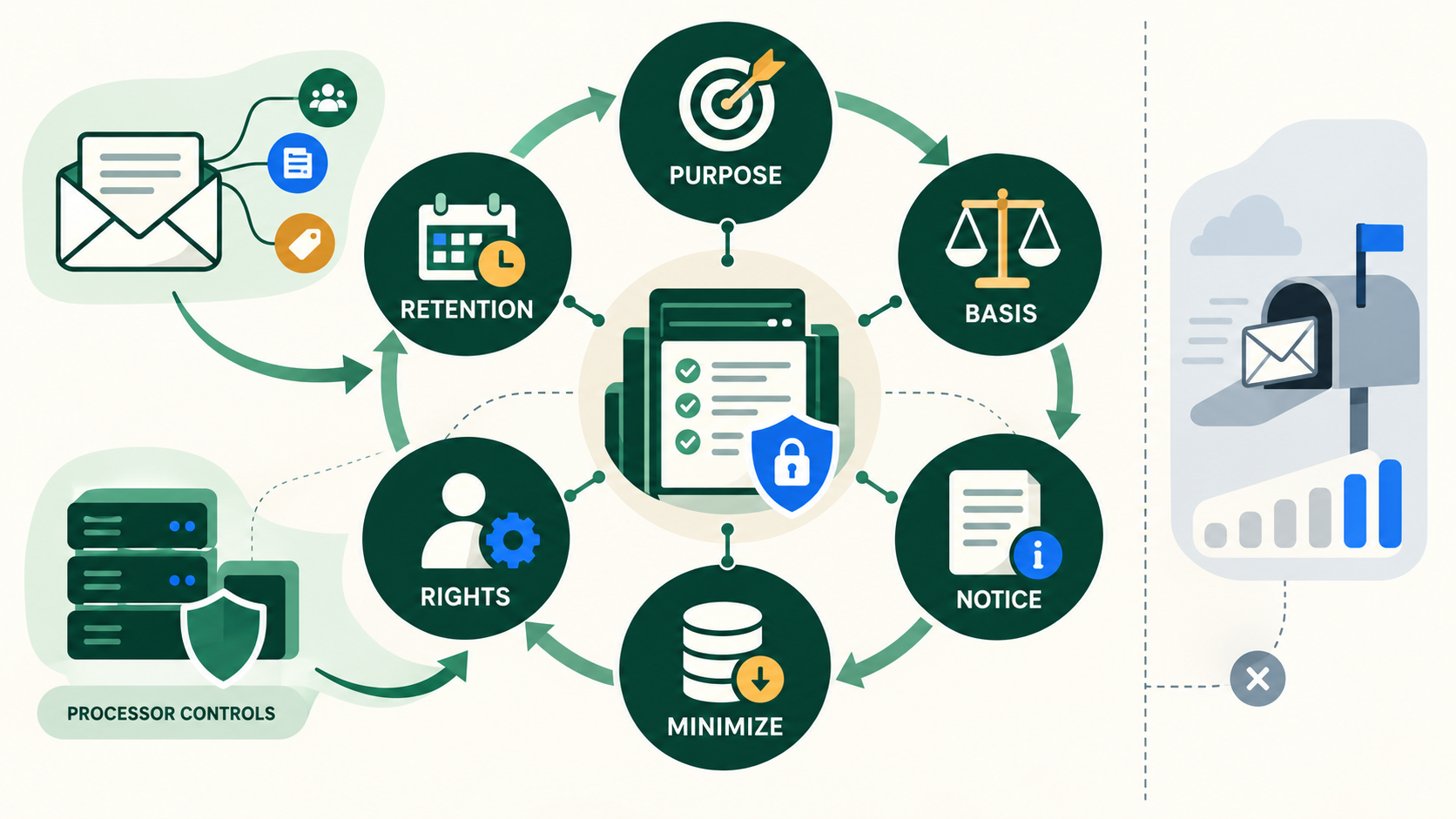
Do not assign one lawful basis to the entire “email system.” Distribution, account notices, security logs, bounce handling, open tracking, click tracking, profiling, suppression and legal claims are different purposes. Article 5 requires specified purposes, data minimization, accuracy, storage limitation, security and accountability.
For every purpose, list the exact fields, source, recipients, processor, retention, transfer, expected effect and rights path. Only then select and document the legal analysis. Changing purpose later requires a compatibility and transparency review and may require a new basis or consent.
Lawful-basis examples without blanket conclusions
| Processing purpose | Possible legal analysis | Evidence required | Common mistake |
|---|---|---|---|
| Send a requested operational message | Contract, requested pre-contract steps, legal obligation or another basis may apply depending on necessity and facts. | Purpose, triggering event, recipient relationship, required content and necessity assessment. | Calling promotional content “transactional” because it uses an operational template. |
| Send direct marketing email | Apply the relevant ePrivacy and national marketing rules first, then document the GDPR basis and transparency for related personal-data processing. | Jurisdiction, recipient class, consent or applicable customer exception, collection notice and objection state. | Assuming GDPR legitimate interests alone creates permission to send marketing email. |
| Maintain suppression data | A narrowly scoped record may be necessary to honour objections and prevent renewed marketing. | Address or controlled token, scope, source, effective time, systems notified and documented retention rationale. | Deleting the unsubscribe evidence and later importing the person as marketable. |
| Measure delivery and security | Legitimate interests or another basis may be considered when processing is necessary, proportionate and properly disclosed. | Defined purpose, data fields, necessity test, balancing, access controls and retention. | Treating every open, device and link event as technically necessary for deliverability. |
| Personalize or profile engagement | Requires a separate analysis of purpose, lawful basis, transparency, reasonable expectations and ePrivacy rules where applicable. | Inputs, inference logic, effects, recipients, opt-out or withdrawal controls and DPIA screening. | Reusing delivery events for behavioral targeting without a compatible-purpose assessment. |
| Defend abuse or legal claims | Legitimate interests or legal obligation may support proportionate evidence retention. | Threat or claim purpose, restricted fields, access log, review date and legal hold. | Keeping complete campaign and tracking histories indefinitely “just in case.” |
Consent is a controlled event, not a database flag
GDPR consent must be freely given, specific, informed and unambiguous through a statement or clear affirmative action. The controller must be able to demonstrate consent. When consent is presented with other matters, the request must be distinguishable, intelligible and accessible in clear language. Withdrawal must be as easy as giving consent.
Store the exact notice and form version, purposes, controller identity, affirmative action, timestamp, source, address, age-related control where relevant and withdrawal state. A prechecked box, inactivity or a purchased list entry does not produce the required affirmative evidence. Consent to one brand or purpose should not be expanded silently to affiliates, profiling or unrelated offers.
Legitimate interests requires a documented three-part test
Article 6(1)(f) is not a shortcut used whenever consent is inconvenient. The EDPB describes three cumulative conditions: a lawful, precise and present legitimate interest; necessity of the processing for that interest; and a balance showing that the person’s interests, rights and freedoms do not override it.
Document alternatives that use less data, reasonable expectations, source and nature of data, scale, impact, safeguards and objection handling before processing begins. Direct marketing can be an interest considered in the analysis, but the separate ePrivacy sending rule and the absolute GDPR right to object to direct marketing still apply.
Contract necessity is narrower than business usefulness
Article 6(1)(b) applies where processing is objectively necessary to perform a contract with the person or take requested pre-contract steps. A receipt, security alert or requested service message can have a different analysis from recommendations, cross-sells and behavioral profiling. Bundling promotional content into an operational message does not make the promotion necessary for contract performance.
Tracking pixels and redirect links are separate processing
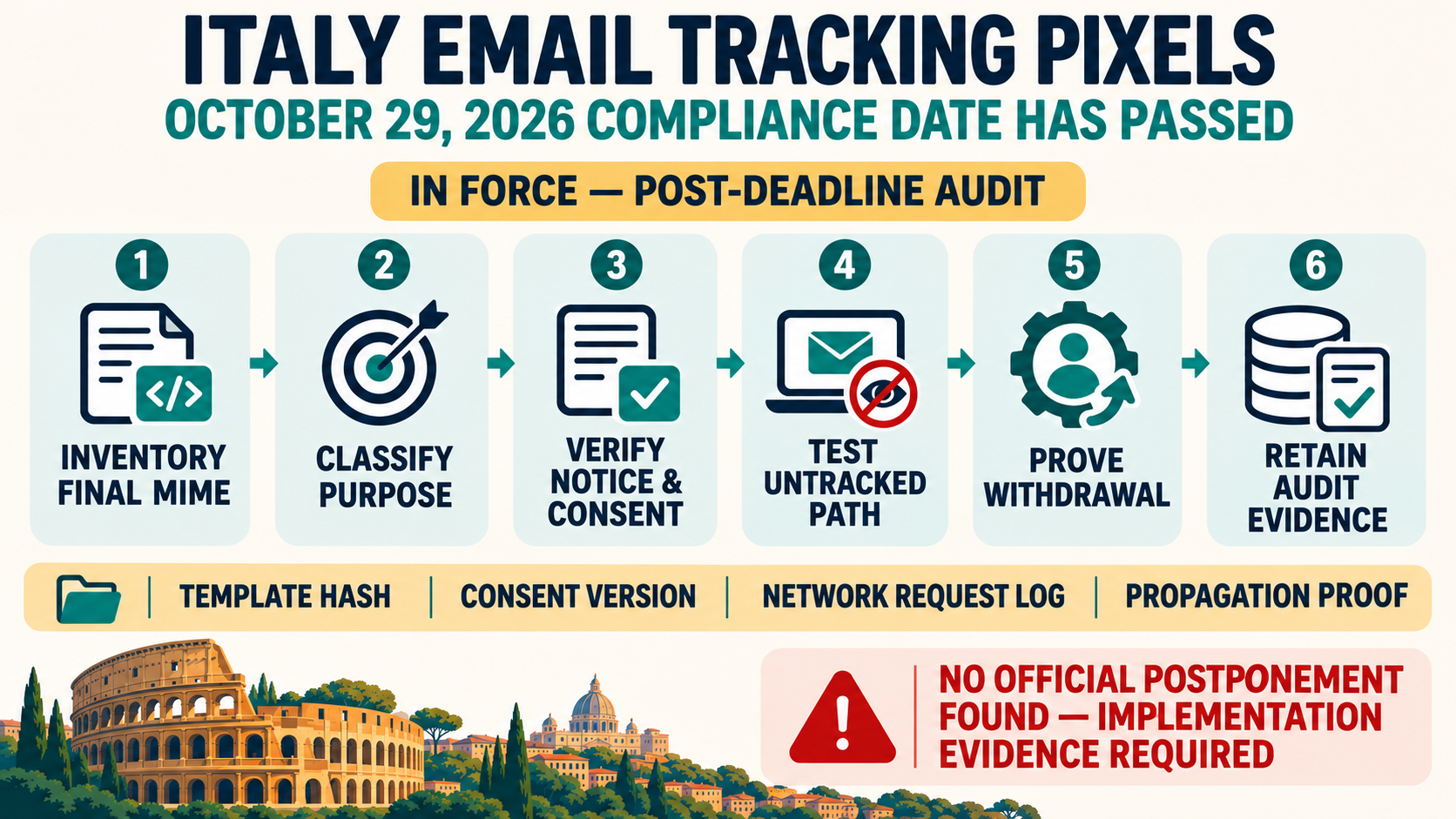
An email can be permitted for sending while individual open or click tracking still lacks an appropriate control. A pixel request can disclose or derive a token, time, IP address, user agent, campaign, device behavior and inferred engagement. Redirect links can associate browsing with a recipient. Inventory the actual fields and inferences rather than describing the system only as analytics.
Depending on the technology and jurisdiction, ePrivacy rules concerning terminal equipment and national regulator guidance may apply in addition to GDPR. Necessary delivery evidence should be separated from optional behavioral measurement. Mailbox-provider image proxying, caching and privacy features also make opens unreliable as proof that a human read a message.
Tracking assessment example
Resource: https://track.example/pixel/<recipient-token>.gif
Collected: request time, token, IP address, user agent, message/campaign ID
Declared purpose: measure individual opens
Separate questions:
- Is the email send permitted under the applicable marketing rule?
- What GDPR lawful basis covers each collected field and inference?
- Does ePrivacy or national law require consent for terminal access/tracking?
- Is individual tracking necessary, or will aggregate delivery evidence suffice?
- What notice, withdrawal, retention and processor controls apply?
Transparency must describe the real email data flow
Articles 12 through 14 require concise, transparent and accessible information, with required details depending on whether data came from the person or another source. The notice should identify the controller, purposes, bases, legitimate interests where used, recipients or categories, transfer information, retention criteria, rights, complaint route and relevant automated decision information.
A generic statement that “we may use data to improve services” does not explain recipient-level engagement tracking, list enrichment or sharing with an ESP. Link the collection surface and email footer to the relevant notice version, but do not hide essential consent information behind a link when it must be presented with the request.
An unsubscribe is both a delivery control and a rights signal
Article 21 gives a person the right to object at any time to personal-data processing for direct marketing, including related profiling. Once the person objects, personal data must no longer be processed for those purposes. The right must be explicitly brought to attention clearly and separately no later than the first communication.
Propagate the objection across ESPs, CRM, CDP, automation, audience exports and queued campaigns. Retain only the minimum suppression evidence needed to prevent re-entry, with a documented basis and access restrictions. Erasing every trace of an objection can undermine compliance if the address is later reimported.
Build retention by data class and purpose
| Data class | Example fields | Retention decision | Deletion or restriction control |
|---|---|---|---|
| Subscription evidence | Notice version, affirmative action, timestamp, source and purposes. | Retain while relied on and for a documented period needed to demonstrate compliance. | Restrict access; delete or anonymize when no continuing purpose or defence need remains. |
| Suppression record | Address/token, channel, brand, scope, objection time and source. | Keep the minimum needed to prevent prohibited future processing, with documented review. | Do not reactivate through list imports; separate it from campaign analytics. |
| Delivery telemetry | Message ID, provider response, bounce class, timestamp and route. | Use a short operational period tied to troubleshooting and aggregate reporting needs. | Remove local parts or replace them with controlled identifiers where exact identity is unnecessary. |
| Open and click events | Time, URL, IP, device, campaign and recipient identifier. | Set purpose-specific periods only after lawful-basis and ePrivacy analysis. | Disable collection when no valid control applies; aggregate or delete raw events promptly. |
| Message content and headers | Subject, body, recipient, authentication and routing headers. | Keep only samples or incidents needed for support, security or legal purpose. | Redact unrelated addresses and content; restrict forensic access. |
| Processor exports and backups | ESP export, CRM replica, logs and backup snapshots. | Include replicas and backups in the schedule and restoration process. | Ensure deleted or suppressed states are not silently reversed after restoration. |
“Keep forever” is not a retention period, and “delete inactive contacts after two years” is not enough if raw tracking remains elsewhere. Define start event, period or criteria, deletion method, backup behavior, legal holds, owner and evidence of execution for each data class.
Example processing-activity record
{
  "activity": "EU newsletter distribution",
  "controller": "Example EU Ltd",
  "purposes": ["send requested newsletter", "measure aggregate delivery"],
  "data_subjects": ["subscribers"],
  "data_categories": ["email address", "consent evidence", "delivery events"],
  "marketing_rule": "national implementation of ePrivacy Article 13",
  "lawful_basis_by_purpose": {
    "distribution": "consent",
    "security_logging": "legitimate_interests_assessment_LIA-2026-04"
  },
  "recipients": ["contracted ESP", "authorized support team"],
  "international_transfer": "documented separately",
  "retention_schedule": "EMAIL-EU-v4",
  "security_controls": ["RBAC", "MFA", "encryption", "audit logging"],
  "rights_route": "[email protected]",
  "owner": "Privacy Operations",
  "last_reviewed": "2026-10-28"
}
Article 30 records have specific applicability and content requirements. This compact example is an engineering handoff, not a substitute for the controller or processor record required by law.
Pre-send privacy and marketing gate
INPUT: recipient, message purpose, brand, jurisdiction, tracking profile

1. Classify the final message as operational, direct marketing or mixed purpose.
2. Resolve the applicable ePrivacy and national electronic-marketing rule.
3. Resolve the GDPR lawful basis for each personal-data processing purpose.
4. Verify consent, customer exception or other sending condition with evidence.
5. Check objection, withdrawal, suppression and legal restrictions globally.
6. Confirm the final message matches the disclosed purpose and sender identity.
7. Apply the approved tracking profile; default to no behavioral tracking.
8. Write the decision rule, evidence IDs, notice version and processor route.
9. Recheck suppression immediately before queue release.
10. Block the send when evidence is missing, expired, contradictory or out of scope.
The gate should fail closed for direct marketing where jurisdiction, sending condition or evidence is unresolved. Manual overrides need a named approver, legal rationale, affected population, expiry and immutable audit record.
Control ESPs and other processors under Article 28
Determine controller, joint-controller and processor roles from actual decisions, not contract labels alone. A processor contract must cover required subject matter and controls. Maintain approved subprocessors, locations, security commitments, deletion/return terms, assistance with rights and breaches, and audit information.
Test processor behavior. Verify suppression propagation, export scope, administrator access, tracking defaults, log retention, account closure and backup deletion. A controller remains accountable for selecting and governing processors.
Document international transfers separately
Sending recipient data to an ESP or support system outside the EEA can invoke Chapter V. Record destination countries, importer, transfer mechanism, supplementary measures and reassessment process. A data-processing agreement alone is not necessarily a transfer mechanism.
Purchased, enriched and partner lists need source-level evidence
A contract stating that a list is “GDPR compliant” is not evidence that each address can be used for the proposed message. Record the original source, collection notice, controller identities, purposes, lawful basis, ePrivacy sending condition, collection date, recipient category, objections and onward-disclosure terms. Compare the original scope with the planned brand, content and tracking.
Article 14 transparency can apply when personal data did not come directly from the person, subject to its conditions and exceptions. Complete due diligence before import, quarantine unresolved records and preserve suppression matches. Hash matching against suppression data can reduce exposure, but the matching design must still prevent prohibited reactivation reliably.
Apply security appropriate to the email risk
Article 32 calls for measures appropriate to risk. Email systems commonly need role-based access, MFA, encryption, key management, audit logs, export restrictions, secret rotation, environment separation, incident detection, tested restoration and vendor controls. Protect suppression and consent evidence from unauthorized changes as well as disclosure.
Do not put full recipient addresses, tokens or message content in broadly accessible analytics. Use controlled identifiers, short log retention and redaction. Test whether unsubscribe tokens can be guessed, replayed to expose data or used to alter another person’s preferences.
Operate rights across every email system
request received
  -> authenticate proportionately
  -> identify request and jurisdiction
  -> search CRM, ESP, CDP, suppression, logs and processors
  -> preserve restriction or objection immediately where required
  -> assess exceptions and third-party rights
  -> export, rectify, erase, restrict or explain
  -> notify processors and recipients where applicable
  -> record outcome, response date and retained minimum evidence

Never require the person to receive another marketing email to exercise a right.
Rights are not absolute in every circumstance, and identity verification must be proportionate. The system should locate source, purposes, processors, event history, inferred segments and suppression state without requiring the person to understand the internal architecture.
Screen tracking and profiling for DPIA requirements
Article 35 requires a DPIA where processing is likely to result in high risk. Screen large-scale profiling, sensitive inferences, vulnerable people, systematic monitoring, data combination and novel tracking against regulator criteria. Complete the assessment before processing, document mitigations and review when risk or technology changes.
Connect email incidents to breach response
Wrong-recipient sends, exposed exports, compromised ESP accounts, leaked tracking tokens and unauthorized list access may be personal-data breaches. Preserve facts, contain access, assess risk, document the decision and meet applicable notification duties. Deliverability logs should provide evidence without expanding the breach through excessive content retention.
Failures an audit should detect
- One lawful basis assigned to every email activity.
- Legitimate interests treated as permission to send all marketing.
- ePrivacy and national marketing rules omitted.
- Consent record lacks notice, purposes or affirmative action.
- Operational messages contain undisclosed promotion.
- Tracking pixels enabled by default without separate assessment.
- Open events treated as proof a person read the email.
- Objections propagate to one ESP but not other systems or queues.
- Suppression evidence is deleted and the person is reimported.
- Raw engagement data has no retention schedule.
- Processor and subprocessor locations are unknown.
- Rights searches omit logs, segments, backups or vendors.
Operational acceptance checklist
- Map every email purpose, field, source, recipient and processor.
- Resolve applicable ePrivacy and national sending rules.
- Document a GDPR lawful basis for each processing purpose.
- Keep consent and legitimate-interest evidence reproducible.
- Separate required delivery evidence from behavioral tracking.
- Render accurate collection and email notices.
- Apply objection and withdrawal before queue release.
- Maintain purpose-specific retention and deletion jobs.
- Control processors, subprocessors and international transfers.
- Operate access, erasure, restriction and objection workflows.
- Screen high-risk profiling and tracking for DPIA.
- Test incident and breach-response evidence.
Legal boundary and current status
GDPR remains applicable law, while ePrivacy Directive requirements operate through Member State implementation and later interpretation. The correct result can vary by country, recipient type, relationship, message purpose and tracking technology. Obtain qualified legal review before deploying direct marketing or behavioral tracking.
This article was reviewed on October 28, 2026. It explains controls and evidence but does not assign a lawful basis or marketing permission to a specific organization.
Primary law and official guidance
- Regulation (EU) 2016/679 (GDPR): Official regulation covering principles, lawful bases, consent, transparency, rights, accountability, processors, security and transfers.
- Directive 2002/58/EC, Article 13: Official ePrivacy rules for unsolicited direct marketing by electronic mail and the customer exception.
- EDPB Guidelines 05/2020 on consent: Official guidance on valid consent and withdrawal.
- EDPB Guidelines 1/2024 on legitimate interests: Official EDPB analysis of Article 6(1)(f), including interest, necessity and balancing.
- EDPB endorsed transparency guidance: Official collection of endorsed GDPR transparency guidance.