Gmail Internationalized Email Addresses: SMTPUTF8, Unicode and Safe Validation
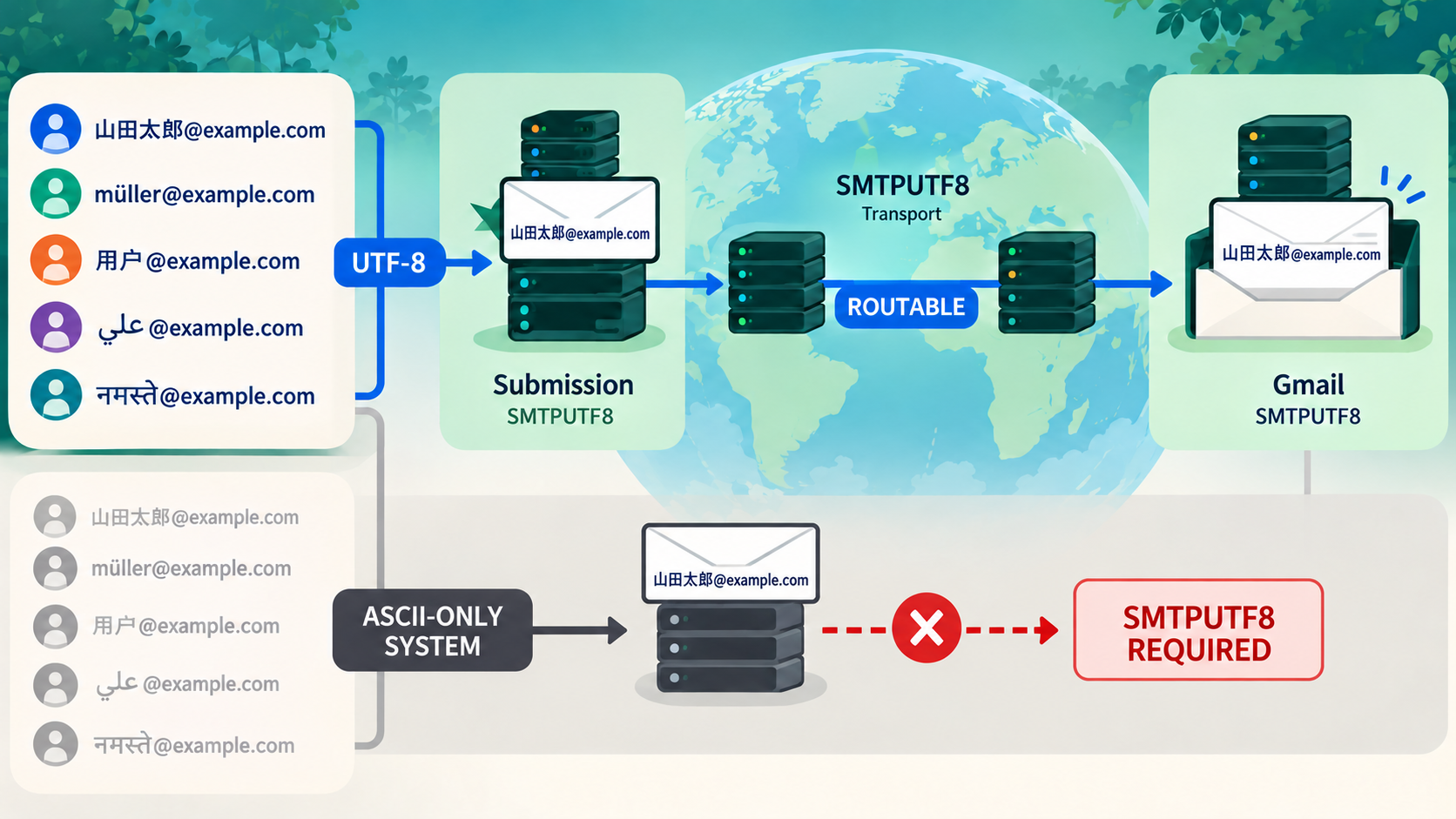
On August 5, 2014, Gmail announced that Gmail users could send mail to and receive mail from addresses containing accented Latin or non-Latin characters. The announcement was an interoperability step for internationalized addresses. It did not announce that people could create Gmail accounts with non-ASCII local parts. Correct implementation requires the EAI standards family, SMTPUTF8 transport, IDNA-aware domain processing and evidence that does not confuse syntax with mailbox existence.
What Gmail changed in August 2014
Google stated that Gmail, and shortly afterward Calendar, would recognize addresses containing accented or non-Latin characters. Gmail users could exchange messages with people whose addresses used those characters. Google separately described internationalized Gmail account creation as a future goal. A historical timeline must keep those two capabilities separate.
The enabling standards were published by the IETF in February 2012. RFC 6530 defines the framework, RFC 6531 defines the SMTPUTF8 extension, RFC 6532 permits UTF-8 in internationalized message headers and RFC 6533 extends delivery-status and disposition-notification formats. Gmail adoption did not redefine address syntax; it implemented support within this standards architecture.
An email address contains different technical domains
An address should not be processed as one undifferentiated string. The local part appears before the final address separator, while the domain appears after it. A display name can surround the mailbox in a message header but is not part of the SMTP envelope mailbox. Each component has different syntax, normalization and transport rules.
The domain can use internationalized domain-name processing and has a DNS-compatible A-label form. The local part is controlled by the receiving system and does not have a general Punycode transformation. Replacing a Unicode local part with transliteration, escaped text or Punycode creates a different string and can direct mail to a different mailbox or no mailbox at all.
Classify the address form before validating it
| Address form | Example | Required handling | What must not be inferred |
|---|---|---|---|
| ASCII local part and ASCII domain | [email protected] | Base SMTP and message syntax can represent the address. Continue with ordinary DNS and transport checks. | Valid syntax and an MX record do not prove that the mailbox exists. |
| ASCII local part and internationalized domain | user@例え.テスト | Process the domain with an IDNA library and retain both the Unicode U-label and DNS A-label forms. | Do not apply Punycode to the local part or display a transformed domain without preserving the submitted form. |
| Unicode local part and ASCII domain | δοκιμή@example.com | Preserve the UTF-8 local part exactly and require SMTPUTF8 across the relevant SMTP path. | An ASCII-only validator rejection does not prove that the address is invalid. |
| Unicode local part and internationalized domain | 用户@例子.广告 | Use SMTPUTF8 for the mailbox and standards-based IDNA processing for the domain. | There is no safe generic algorithm that converts the mailbox into an equivalent ASCII address. |
| Unicode display name with ASCII mailbox | José Ramón | Treat the display name separately from the mailbox. MIME encoded words or UTF-8 header rules may apply according to the message format. | A non-ASCII display name does not make the mailbox an internationalized address. |
SMTPUTF8 is a negotiated transport capability
RFC 6531 defines the EHLO keyword SMTPUTF8. A server advertising it declares support for the extension on that SMTP connection and must also advertise 8BITMIME. The client can then add the valueless SMTPUTF8 parameter to MAIL FROM when the envelope, internationalized headers or embedded message structure requires that support.
If the next-hop server does not advertise SMTPUTF8, an SMTPUTF8-aware client must not transmit an internationalized address or an RFC 6532 internationalized message. The correct result is a bounded inability to use that route, an alternate route known to support the extension, or a sender-supplied ASCII alternate address. Silent character deletion is not a standards-compliant downgrade.
Observed SMTP capability example
S: 220 mx.example ESMTP
C: EHLO sender.example
S: 250-mx.example
S: 250-8BITMIME
S: 250 SMTPUTF8
C: MAIL FROM:<[email protected]> SMTPUTF8 BODY=8BITMIME
S: 250 2.1.0 Sender accepted
C: RCPT TO:<用户@例子.广告>
S: 250 2.1.5 Recipient accepted

Evidence: this server advertised SMTPUTF8 for this connection.
It is not proof that every alternate MX or later relay supports SMTPUTF8.
Support must exist across the relevant path
An initial MX advertising SMTPUTF8 is useful evidence, but an email path can include submission, outbound relay, recipient MX, forwarding service, mailing-list software, filtering gateway, delivery agent, mailbox store and client. A component that serializes addresses into an ASCII-only field can corrupt an address even when SMTP delivery succeeds elsewhere.
Test every published MX and failover route that can receive production traffic. For outbound systems, test the relays selected by routing policy. For forwarding and mailing lists, test messages where the envelope sender, recipient, visible From, Reply-To and returned error report contain internationalized addresses. Preserve the exact hop and reply that produced a failure.
UTF-8 headers and UTF-8 bodies are different capabilities
MIME has long allowed non-ASCII message bodies and encoded words in selected header values. That does not by itself allow a non-ASCII mailbox local part. RFC 6532 extends message-header syntax so UTF-8 can appear directly in addresses and many field bodies when transported through an SMTPUTF8-capable path. Header field names remain ASCII.
A message with an ASCII envelope can still require SMTPUTF8 because an internationalized address or UTF-8 header appears in the message or a nested message. Parsers must inspect the complete MIME structure, including attached messages and delivery reports, instead of deciding only from RCPT TO.
Use IDNA for the domain, never as a local-part converter
Internationalized domain labels have a user-facing Unicode form called a U-label and a DNS-compatible ASCII form called an A-label. Use a maintained IDNA library to validate and convert domain labels. DNS queries use the resulting DNS form, while interfaces should retain the original form and can display a safe Unicode representation with its ASCII form when security review is needed.
Do not implement IDNA by lowercasing the entire address or passing the whole address to a Punycode function. Split the mailbox safely first. Conversion errors, disallowed code points, label-length failures and bidirectional-text failures should be reported explicitly, not collapsed into “invalid email.”
Unicode normalization is not mailbox equivalence
RFC 6532 recommends NFC and warns against compatibility normalization that can lose spelling information. That recommendation does not authorize an application to rewrite stored mailbox identifiers and assume the rewritten value is equivalent. Visually identical Unicode can have different code-point sequences, and only the receiving system controls local-part interpretation.
Keep the submitted address as the source of truth. A normalized comparison key may support duplicate review, but it must not replace the delivery address without an explicit provider rule and tested business policy. Never merge consent, suppression or account ownership solely because two addresses render similarly.
Confusable characters and display safety
Unicode expands legitimate identity expression and also creates opportunities for look-alike characters, mixed-script deception and misleading bidirectional display. Security controls should flag unusual script combinations, invisible controls and display inconsistencies without declaring all non-Latin addresses suspicious.
Administrative interfaces should expose the exact address, escaped code points when needed, the domain A-label and a safe rendered form. Logs must resist control-character injection. Confirmation flows, account recovery and payment changes should bind authorization to verified user action rather than visual similarity.
Replace a single regex with layered validation
An ASCII-era regular expression often rejects valid internationalized addresses or accepts malformed Unicode. A safer validator first verifies input encoding and structural boundaries, then applies the selected email syntax profile, IDNA domain rules, DNS routing checks and optional authorized SMTP evidence as separate stages.
The result should say what was actually tested: syntax accepted, domain route observed, SMTPUTF8 advertised by selected MX, recipient response observed or user verification completed. Do not invent a deliverability percentage from unrelated checks.
Evidence levels and allowed conclusions
| Evidence layer | Observed fact | Conclusion allowed | Conclusion not allowed |
|---|---|---|---|
| Input and syntax | The submitted UTF-8 sequence is well formed and the address structure is accepted by the selected standards profile. | The application can preserve and process the submitted form. | The mailbox exists or will accept mail. |
| Domain processing | IDNA conversion succeeds and DNS returns current routing evidence. | The domain has a syntactically usable DNS form and an observed mail route. | Every route supports SMTPUTF8. |
| SMTP capability | The selected server advertises SMTPUTF8 after EHLO. | That server declares support for RFC 6531 transport on this connection. | Every backup MX, relay, forwarder or downstream system supports it. |
| SMTP transaction | A controlled authorized transaction produces a specific reply for the submitted recipient. | The tested server gave that response at that time. | Inbox placement, human ownership or future acceptance. |
| Confirmed user action | The user completed a verification flow through the submitted address. | The user controlled the delivery path at verification time. | Permanent mailbox validity or consent for unrelated purposes. |
Store original, transport and evidence forms separately
The database needs Unicode-capable columns, APIs and queues from ingestion through suppression. Byte truncation, an ASCII-only index or an intermediate CSV export can damage an address. Test maximum lengths in bytes as well as characters because UTF-8 code points occupy multiple octets.
Separate the exact original address, parsed local part, domain U-label, domain A-label, classification and observed evidence. Protect the local part as personal data and avoid placing it in broad telemetry. Suppression lookup must use a stable strategy that does not discard meaningful characters.
Example evidence record
{
  "address_original": "用户@例子.广告",
  "local_part_utf8": "用户",
  "domain_ulabel": "例子.广告",
  "domain_alabel": "xn--fsqu00a.xn--4rr70v",
  "address_class": "smtputf8",
  "unicode_normalization_observed": "NFC",
  "syntax_profile": "RFC6530-family",
  "dns_checked_at": "2026-10-28T11:00:00Z",
  "smtp_capability": "observed",
  "smtp_capability_host": "mx.example",
  "smtp_capability_checked_at": "2026-10-28T11:00:03Z",
  "mailbox_existence": "not_proven"
}
Web forms, APIs and imports
Every collection surface must accept UTF-8 consistently. Browser input, JSON APIs, CRM fields, message queues, export files, template variables and webhook signatures should be tested with real examples from multiple scripts. An HTML email input control does not guarantee EAI support in the backend.
Show a specific error when the organization does not support SMTPUTF8 rather than claiming the address is invalid. If an ASCII alternate address is required, ask the user to provide it. Never generate one through transliteration. Retain the address used for consent and confirmation so later sends do not silently switch identity.
Migration from an ASCII-only email platform
Begin with an inventory of every component that parses, stores, compares or transmits an address. This includes signup forms, identity providers, CRM schemas, customer-data platforms, list imports, consent ledgers, suppression services, ESP APIs, SMTP relays, bounce processors, support consoles, data warehouses and backup exports. A front-end change alone creates a partial implementation that can accept an address and later corrupt or strand it.
Run migration in evidence stages. First make storage and internal APIs byte-safe without enabling delivery. Next add classification and IDNA domain handling. Then validate outbound SMTPUTF8 support on controlled routes and instrument failures by hop. Finally enable selected internationalized addresses with a rollback path that preserves their original suppression and consent state.
Do not rewrite historical ASCII addresses during this migration. Do not merge an internationalized address with a transliterated address unless the user has verified both and the account model intentionally links them. Keep feature flags by sending system and route, because one ESP or relay may support SMTPUTF8 while another does not.
Production monitoring without exposing mailbox data
Monitor counts by address class, IDNA conversion outcome, MX provider, SMTPUTF8 capability, selected route and enhanced status family. Use restricted identifiers or keyed hashes for broad telemetry, and keep exact local parts only where support, suppression or security workflows require them.
Alert when a previously capable MX stops advertising SMTPUTF8, when a backup MX differs from the primary, when Unicode addresses fail at a specific queue boundary, or when DSN parsing loses the original recipient. Capability drift is operational evidence; it is not permission to transform the mailbox silently.
Operational decision flow
1. Preserve the exact submitted address and UTF-8 bytes.
2. Split local part and domain with an address-aware parser.
3. Validate UTF-8 and reject control characters or malformed sequences.
4. Classify the local part as ASCII or non-ASCII.
5. Process only the domain through a current IDNA library.
6. Resolve current MX routing; apply Null MX behavior where present.
7. If any envelope address or required header needs UTF-8, require SMTPUTF8.
8. Observe EHLO capability on the selected authorized route.
9. If SMTPUTF8 is absent, do not invent an ASCII local-part replacement.
10. Return a bounded result: syntax, route, capability, transaction or user proof.
Bounce and DSN processing
RFC 6533 extends delivery-status notifications so internationalized recipient information can be represented. A bounce processor that assumes every Original-Recipient, Final-Recipient or diagnostic value is ASCII may lose the exact failed address or split a report incorrectly.
Store the SMTP reply code, enhanced status code, reporting MTA, failed stage and original UTF-8 address. RFC 6531 defines responses for cases where an internationalized address cannot be accepted because required support is absent, including enhanced status code X.6.7 where supported. Do not classify every such failure as an unknown mailbox.
Authentication and alignment still use their own rules
SMTPUTF8 support does not replace SPF, DKIM or DMARC. Authentication systems evaluate their defined identities and domain rules. Header parsers must preserve internationalized addresses while extracting the correct domain evidence, and should not invent alignment by transliterating a local part.
DKIM signs bytes after canonicalization; unplanned gateway rewriting of internationalized headers can break signatures. Test the complete route and retain Authentication-Results from the trusted receiving boundary. A valid DKIM signature does not prove that an address supports SMTPUTF8, and SMTPUTF8 capability does not prove authentication.
Acceptance tests before production support
- ASCII local part with ASCII domain remains unchanged.
- ASCII local part with Unicode domain produces a valid A-label and preserves the U-label.
- Unicode local part with ASCII domain remains byte-accurate through storage and queues.
- Unicode local part and domain survive form, API, database, template and SMTP assembly.
- Malformed UTF-8 and disallowed domain code points fail with specific reasons.
- SMTPUTF8 is required only when the envelope or message actually needs it.
- A route lacking SMTPUTF8 is not sent a prohibited internationalized transaction.
- All MX priorities and authorized relay paths are tested independently.
- HTML, text, Reply-To, forwarding, list expansion and attached messages preserve addresses.
- DSN and bounce parsers preserve internationalized recipient evidence.
- Suppression and deduplication do not merge visually similar but distinct addresses.
- Security views expose safe Unicode and DNS-compatible forms.
Historical conclusion and current boundary
The verified August 5, 2014 event is Gmail interoperability with internationalized addresses for sending and receiving. It should not be rewritten as a claim that Gmail launched non-ASCII Gmail usernames that day. Provider account-creation policy, SMTP transport support and standards-valid address syntax are separate facts.
As reviewed on October 28, 2026, RFC 6530, RFC 6531, RFC 6532 and RFC 6533 remain the primary standards set used by this guide. A production decision still requires current route evidence because support can differ by provider, MX, relay, forwarding path and application component.
Primary and contemporaneous references
- Google: A first step toward more global email: Contemporaneous August 5, 2014 Gmail announcement and its explicit sending, receiving and future-account-creation scope.
- RFC 6530: Internationalized Email framework: Framework and terminology for internationalized addresses and the SMTPUTF8 standards family.
- RFC 6531: SMTPUTF8 extension: SMTP capability advertisement, MAIL parameter, envelope extension and failure behavior.
- RFC 6532: Internationalized email headers: Direct UTF-8 header syntax, normalization guidance and message/global format.
- RFC 6533: Internationalized delivery status: Internationalized delivery-status and disposition-notification extensions.
- RFC 5890: IDNA definitions: U-label and A-label terminology used for internationalized domain names.