Gmail Sender Guideline Enforcement: November 2025 Technical Guide
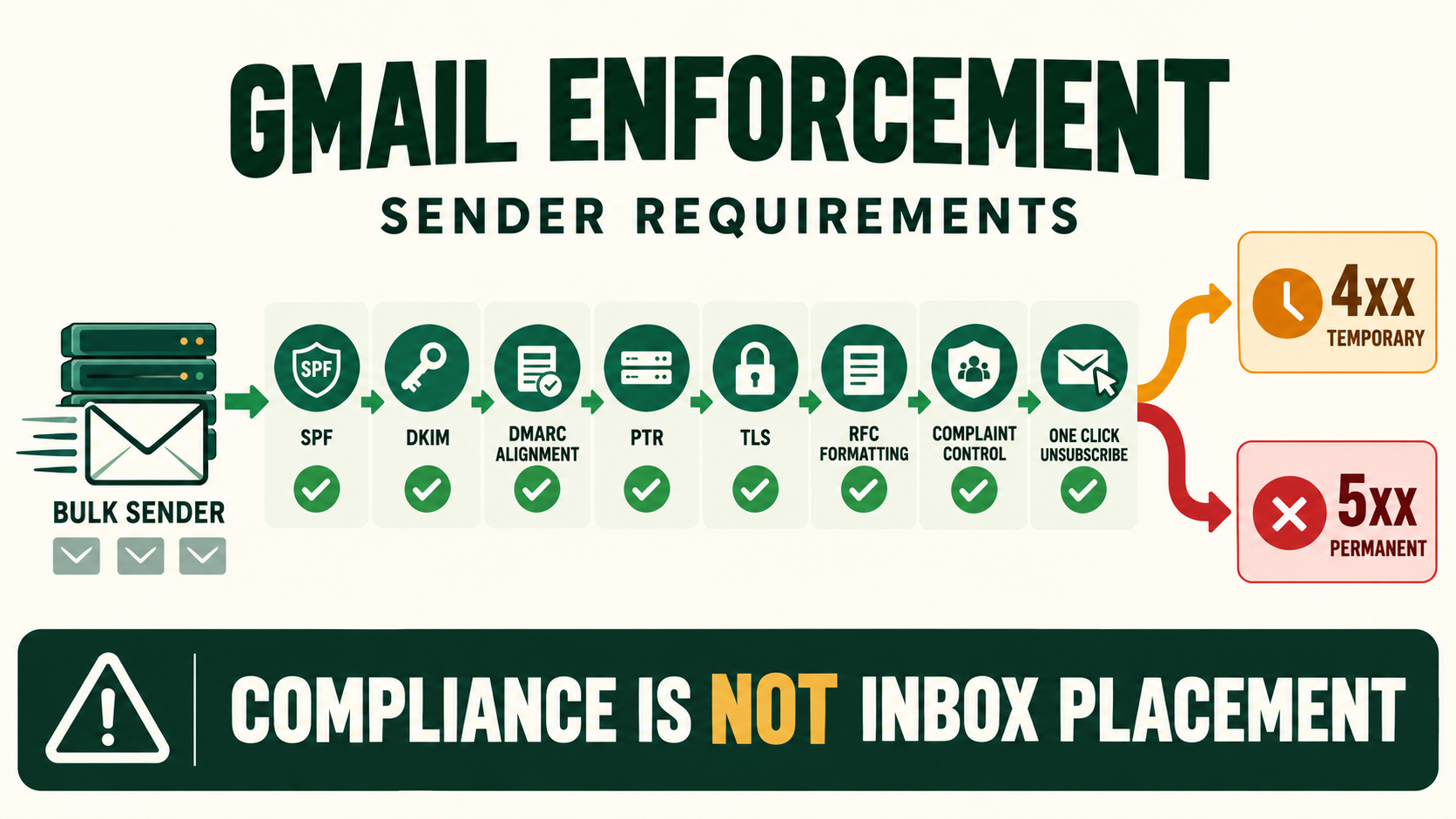
In November 2025, Gmail began ramping up enforcement of sender requirements that had already taken effect in February 2024. The change was enforcement intensity, not a replacement specification. Non-compliant traffic can be placed in spam, temporarily deferred with a 4xx response, permanently rejected with a 5xx response, or made ineligible for Gmail delivery mitigation. The result must be diagnosed from the exact message, SMTP reply, DNS state and Google telemetry rather than from a generic compliance score.
What changed in November 2025?
| Date or phase | What Google documented | Correct interpretation | Evidence |
|---|---|---|---|
| October 2023 announcement | Google announced stronger requirements for high-volume senders. | This was advance notice, not proof that every defect was rejected immediately. | Google product announcement and sender guidance. |
| February 2024 requirements | Covered senders were required to meet authentication, infrastructure, format, complaint and unsubscribe controls. | This is the requirement baseline. November 2025 did not replace it with a new standard. | Current Gmail Email Sender Guidelines. |
| November 2025 ramp-up | Gmail began ramping up enforcement against non-compliant traffic, including temporary and permanent rejections. | Enforcement is gradual, progressive and message-specific. A sender may see mixed delivery, spam placement, 4xx and 5xx results. | Gmail Sender Guidelines FAQ and raw SMTP replies. |
| Current operation | New sending domains can face an accelerated enforcement progression. | A new domain is not a safe bypass. Controlled ramp-up and complete compliance are needed before volume. | Postmaster Tools, SMTP logs and dated domain inventory. |
Google describes the rollout as gradual and progressive. That wording matters. Two messages from the same program can receive different treatment because the recipient, identity, infrastructure, traffic history, message type and rollout state differ. A successful seed message cannot certify the complete program, and one rejection cannot establish that every message is blocked.
The defensible event statement is narrow: Gmail moved further from warning-led adoption toward active disruption for non-compliant traffic. The exact disruption is established by Gmail SMTP evidence and Postmaster Tools, not by the calendar date alone.
Who Gmail classifies as a bulk sender
| Question | Google-defined scope | Operational consequence |
|---|---|---|
| Which recipients count? | Personal Gmail accounts. | The sender requirements do not apply to mail addressed to Google Workspace accounts, although other Google policies still apply. |
| Which senders are covered? | Every sender has baseline requirements. A bulk sender sends close to 5,000 or more messages to personal Gmail accounts in 24 hours. | Do not limit the inventory to marketing systems. Count every source using the same primary domain. |
| How are subdomains counted? | Messages from the same primary domain are aggregated. | 2,500 from example.com plus 2,500 from news.example.com can make example.com a bulk sender. |
| Does status expire? | No. Google says a sender classified as bulk remains permanently classified as bulk. | Reducing volume later does not remove the requirements. |
| Do Google Workspace senders qualify? | Yes, when they send to personal Gmail accounts. | The platform used by the sender does not create an exemption. |
| What is a new domain? | A domain that has not sent more than 5,000 messages per day to personal Gmail accounts since January 1, 2024. | Google states that enforcement progression for new domains is accelerated. |
Google uses the primary domain as the aggregation boundary. Splitting traffic among marketing.example.com, alerts.example.com and receipts.example.com does not necessarily split the bulk-sender count. This also means that an ungoverned business unit or SaaS platform can move the shared primary domain into permanent bulk status.
Build a complete primary-domain traffic inventory
Inventory marketing platforms, transactional applications, CRM automation, support systems, billing services, monitoring tools, recruitment platforms, user-generated mail and direct employee campaigns. For each source, record visible From, MAIL FROM, DKIM d=, selector, egress IP, HELO, daily personal-Gmail volume, owner and unsubscribe system.
Do not count only messages shown in one campaign dashboard. Google observes accepted and attempted traffic at its boundary, while one vendor sees only its own stream. Your internal count should aggregate all sources and preserve UTC windows so a 24-hour threshold is not hidden by local-midnight reports.
All-sender and bulk-sender controls
| Control | All senders to personal Gmail | Bulk sender requirement | Failure evidence |
|---|---|---|---|
| Authentication | SPF or DKIM. | SPF and DKIM. | Authentication-Results plus 4.7.27, 5.7.27, 4.7.30 or 5.7.30. |
| DMARC | Recommended where not otherwise required. | Publish DMARC with at least p=none. | DNS evidence, Postmaster compliance status and 4.7.31. |
| Alignment | Avoid impersonating Gmail From addresses. | For direct mail, RFC5322.From organizational domain aligns with passing SPF or DKIM organizational domain. | Authentication-Results and 4.7.32. |
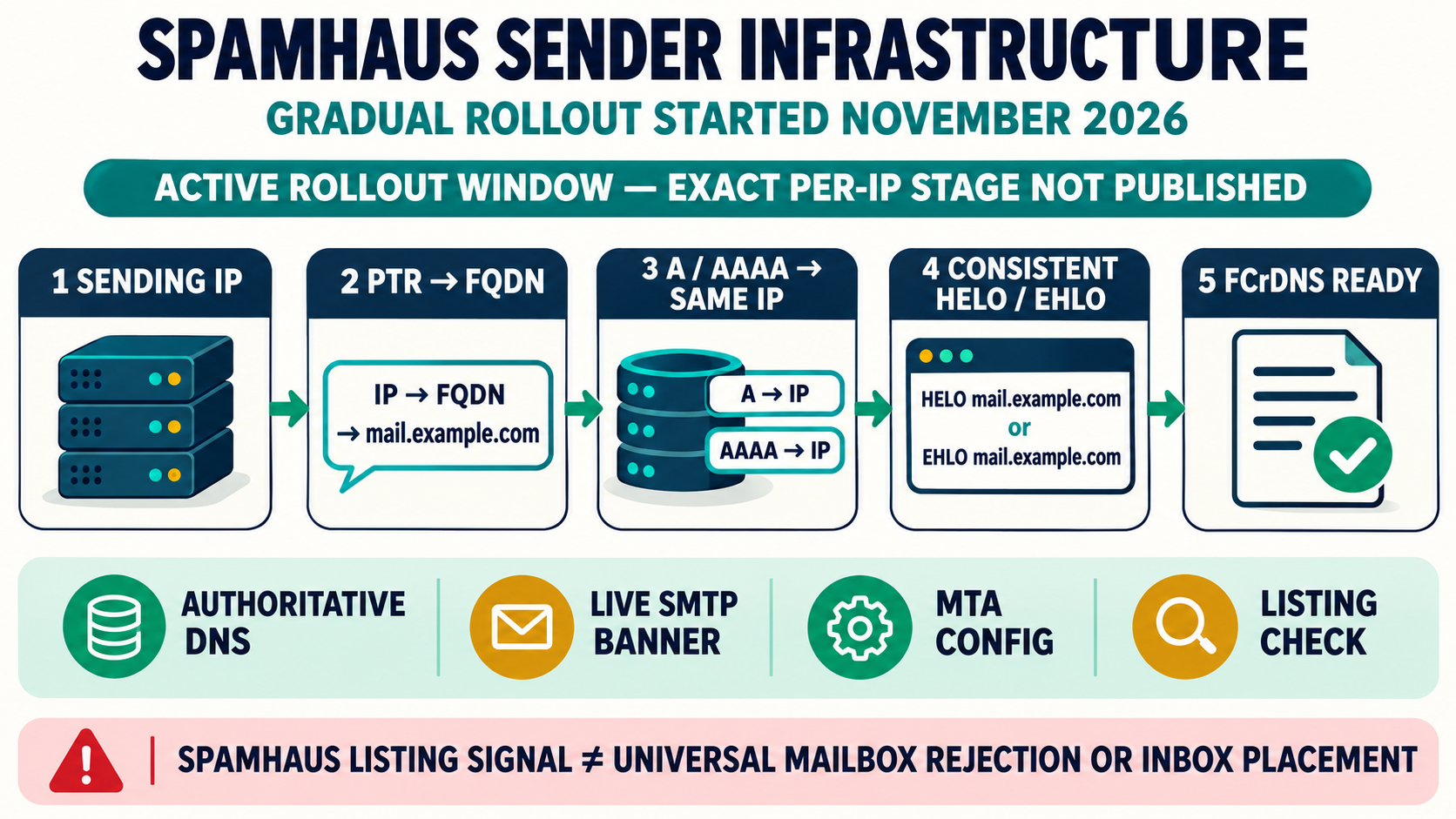
| DNS identity | Valid forward and reverse DNS for sending IPs. | Same requirement. | PTR and forward-confirmation evidence plus 4.7.23 or 5.7.25. |
| Transport | Use TLS. | Same requirement. | Sending MTA TLS log plus 4.7.29 or 5.7.29. |
| Message format | Follow RFC 5322. | Same requirement. | Raw EML, parser defects and Gmail SMTP response. |
| Complaint rate | Avoid unwanted mail. | Keep user-reported spam below 0.1% and prevent it from reaching 0.3% or higher. | Postmaster Tools spam-rate evidence, with volume and reporting limitations recorded. |
| One-click unsubscribe | Good practice when applicable. | Required for marketing and promotional messages. | Raw List-Unsubscribe fields, DKIM coverage, endpoint logs and Postmaster compliance status. |
For bulk traffic, SPF and DKIM are both required. This is different from the alignment decision: for direct messages to personal Gmail, only one passing mechanism needs an organizational domain aligned with the RFC5322.From domain. Running both mechanisms does not mean both must align, although aligning both reduces dependence on one path.
Understand the identities before changing DNS
| Identity | Where it appears | What passes | How it relates to DMARC |
|---|---|---|---|
| RFC5321.MailFrom | SMTP MAIL FROM, commonly surfaced as Return-Path after delivery. | SPF evaluates the connecting IP against this domain. | A passing SPF domain can align with RFC5322.From. |
| HELO or EHLO | SMTP session greeting. | SPF can evaluate it, especially when MAIL FROM is empty. | It is not normally the visible author identity and does not by itself satisfy From alignment. |
| DKIM d= | DKIM-Signature header. | The receiver verifies the signature with the selector key under d=. | A passing d= domain can align with RFC5322.From. |
| RFC5322.From | Visible From header. | It is not independently an SPF or DKIM pass. | It is the author domain against which DMARC alignment is evaluated. |
| DMARC policy domain | DNS under _dmarc. | A syntactically valid discoverable record supplies policy. | For Gmail bulk senders, the minimum published policy is p=none. |
A common failure is publishing SPF on example.com while the provider uses bounce.vendor.example as MAIL FROM, or signing with d=vendor.example while the visible From is example.com. The mechanisms may pass for the provider identity but fail DMARC alignment with the visible author. Inspect Authentication-Results from a real received message before choosing the repair.
SPF implementation and evidence
SPF evaluates the connecting IP against the SMTP identity. Authorize every legitimate egress path in the record actually used as MAIL FROM, keep one SPF record per name, stay within the RFC 7208 limit of ten DNS-query-causing terms, and end with a policy appropriate to the completed inventory. An include does not authorize a vendor by brand name; it authorizes whatever address set that included domain publishes at evaluation time.
A delivered header with spf=pass proves only that Gmail reported a pass for that sample and identity. It does not prove that another pool, fallback IP, empty reverse path or subdomain passes. Preserve the smtp.mailfrom property and source IP with the result.
DKIM implementation and evidence
Use DKIM with a controlled signing domain, a maintained selector, SHA-256 and a suitable key. Publish the exact public key under <selector>._domainkey.<d-domain>. Verify that gateways do not modify signed headers or body content after signing. A DKIM-Signature header proves that a signature was attached, not that Gmail validated it.
Retain Gmail Authentication-Results showing dkim=pass, header.d and header.s. For one-click unsubscribe, the valid DKIM signature must also cover List-Unsubscribe and List-Unsubscribe-Post in its h= list.
DMARC policy and alignment
Gmail requires bulk senders to publish DMARC with at least p=none. That minimum enables discovery and alignment evaluation but does not request quarantine or rejection of failing mail. A stronger policy should follow an inventory and report review; it is not a substitute for making legitimate SPF and DKIM identities align.
For direct mail to personal Gmail accounts, the organizational domain in From must align with the passing SPF organizational domain or passing DKIM organizational domain. Google states that both SPF and DKIM are required for bulk senders, while one aligned pass satisfies this alignment requirement. Forwarded and mailing-list paths need separate interpretation because intermediary changes can break authentication.
DNS publication example
; SPF at the envelope sender domain. Keep one SPF record.
bounce.example.com. 3600 IN TXT "v=spf1 ip4:192.0.2.25 include:esp.example -all"

; DKIM public key for selector g2025 and signing domain example.com.
g2025._domainkey.example.com. 3600 IN TXT "v=DKIM1; k=rsa; p=BASE64PUBLICKEY"

; Gmail bulk-sender minimum is a valid DMARC record with at least p=none.
_dmarc.example.com. 3600 IN TXT "v=DMARC1; p=none; rua=mailto:[email protected]"

; Forward-confirmed reverse DNS for the exact outbound IP.
25.2.0.192.in-addr.arpa. 3600 IN PTR outbound1.example.com.
outbound1.example.com. 3600 IN A 192.0.2.25
These values are teaching placeholders. Do not copy the IP, include domain, public key or reporting mailbox. Query the authoritative data after publication and again through independent public resolvers. Preserve TTL, response code and UTC retrieval time.
PTR and forward-confirmed reverse DNS
Every connecting IP needs a PTR hostname, and that hostname must resolve forward to the same IP. The hostname should also be a sensible SMTP identity under the operator’s control. A PTR that points to outbound1.example.com while outbound1.example.com resolves somewhere else is not forward-confirmed.
Cloudflare proxying does not apply to SMTP address identity in this test. Query the actual public sending IP. Shared providers own the PTR and forward record, so the customer should obtain evidence from the provider and still verify the public answers.
TLS on the outbound SMTP hop
Gmail’s TLS requirement concerns the SMTP connection into Gmail. An HTTPS certificate on the sender website, tracking domain or API does not prove that the mail hop used TLS. Inspect the MTA log for STARTTLS negotiation, Gmail MX, protocol, cipher and final response.
When Gmail returns 4.7.29 or 5.7.29, trace the route that generated that exact transaction. A fallback relay, legacy appliance or alternate IP pool can be the only path missing TLS while ordinary test mail succeeds.
RFC 5322 message-format controls
Validate the final transmitted message, not the template before MIME construction. Check one From field, valid Date and Message-ID, legal line endings, bounded line length, correct header folding, valid MIME boundaries, transfer encoding and syntactically valid addresses. DKIM signing must occur after final deterministic construction.
Malformed messages can be altered, rejected or interpreted differently by relays. Keep the raw source and queue identifier for a rejected sample. A screenshot of rendered content cannot expose transport-format defects.
How Gmail currently applies the controls
| Observed issue | Google-documented current effect | What the operator should conclude |
|---|---|---|
| From and authenticated identity do not align | Temporary or permanent failure codes, or spam foldering. | Inspect one failed message. Do not assume that a DNS record alone proves alignment. |
| Both SPF and DKIM are not present and passing as required | Temporary or permanent failure codes, or spam foldering. | Bulk mail needs both mechanisms; one aligned pass satisfies the direct-mail alignment requirement. |
| Forward and reverse DNS are invalid | Temporary or permanent failure codes, or spam foldering. | Test every actual connecting IP and its announced hostname. |
| TLS is absent | Temporary or permanent failure codes, or spam foldering. | Inspect the outbound connection selected for Gmail, not a browser certificate. |
| RFC 5322 format is invalid | Temporary or permanent failure codes, or spam foldering. | Preserve the exact transmitted EML after all relays and signing steps. |
| Spam rate exceeds 0.3% | Delivery support or mitigation is unavailable. | 0.3% is a danger boundary, not a target. Google advises staying below 0.1%. |
| DMARC is missing | Delivery support or mitigation is unavailable. | Publish at least p=none, then verify the record from public resolvers. |
| Applicable one-click unsubscribe is missing or requests are not honored within 48 hours | Delivery support or mitigation is unavailable. | Test header syntax, DKIM coverage, POST processing and final suppression separately. |
Google’s table does not say that missing one-click unsubscribe automatically causes rejection. Its FAQ explicitly says those messages are not automatically rejected or marked spam for that reason, but unwanted mail is more likely to be reported and non-compliant bulk senders are not eligible for mitigation. Report each effect exactly as documented.
Gmail SMTP codes and remediation
| Gmail code | Meaning in Google guidance | Queue action | Primary repair |
|---|---|---|---|
| 4.7.23 | PTR is missing or forward DNS does not match the sending IP; temporarily rate limited. | Defer and retry with controlled backoff. | Repair PTR and matching forward A or AAAA for the exact sending IP. |
| 5.7.25 | PTR is missing or forward DNS does not reference the sending IP; blocked. | Do not retry unchanged as a transient event. | Repair FCrDNS, then test with a new controlled message. |
| 4.7.27 / 5.7.27 | SPF did not pass for the message. | 4xx: queue with backoff. 5xx: suppress that delivery attempt and repair. | Authorize the real egress IP in the evaluated MAIL FROM domain and control DNS lookup count. |
| 4.7.29 / 5.7.29 | The message was not sent over TLS. | 4xx: retry only through a TLS-capable route. 5xx: repair before a new send. | Enable STARTTLS on the actual outbound Gmail connection and inspect the negotiated session. |
| 4.7.30 / 5.7.30 | DKIM did not pass for the message. | Treat the exact signed message as evidence. | Check selector DNS, canonicalization, signing identity and post-signature modification. |
| 4.7.31 | The sending domain lacks DMARC or the record does not specify policy. | Defer and correct DNS before continued volume. | Publish one valid record beginning v=DMARC1 with at least p=none. |
| 4.7.32 | RFC5322.From is not aligned with authenticated SPF or DKIM organizational domain. | Defer, then repair identity selection. | Align passing MAIL FROM or DKIM d= with the visible From domain. |
Store the complete response text, not only the numeric code. A provider dashboard can collapse multiple Gmail reasons into a generic deferral. Preserve recipient domain, remote MX, UTC time, queue ID, connecting IP, MAIL FROM, From, DKIM identity and retry result.
How to handle a 4xx temporary failure
Keep the recipient in the queue, slow the affected stream, use exponential backoff and respect the queue lifetime. Do not create a new message or change Message-ID for every retry. Repeated aggressive connections can turn a recoverable throttling event into more pressure.
Repair deterministic defects such as missing DMARC, failed DKIM or FCrDNS before resuming normal volume. Then use a controlled canary. A later 250 response proves acceptance of that canary only.
How to handle a 5xx permanent failure
Stop retrying that unchanged recipient transaction. Classify the exact enhanced status, notify the responsible identity or infrastructure owner, repair the cause and send a new controlled message only when appropriate. Do not suppress a valid subscriber permanently merely because one infrastructure policy failure occurred, but do prevent automated retry loops.
Separate recipient-invalid responses from sender-policy rejections. They have different suppression and remediation paths. The Gmail code and text establish which class was returned.
Spam rate is an operating limit, not a score to chase
Google recommends keeping the user-reported spam rate below 0.1% and preventing it from ever reaching 0.3% or higher. The 0.3% value is not a safe target. Rates above 0.1% can already harm delivery, while 0.3% or higher has a greater negative effect and blocks mitigation eligibility.
Use consistent numerator, denominator and UTC date. Postmaster Tools can omit or delay data when volume is insufficient. Missing data is unknown, not zero. Segment acquisition source, message type, campaign, From domain, DKIM domain and sending IP so one aggregate does not hide a harmful stream.
One-click unsubscribe applies to promotional mail
Google requires one-click unsubscribe for marketing and promotional messages, not for transactional messages such as password resets and reservation confirmations. A message containing both service information and promotion should not be relabelled transactional merely to avoid the control. Recipient expectation and actual content matter.
The message body still needs a clear visible unsubscribe link. A body link alone does not satisfy Gmail’s RFC 8058 one-click requirement, and a mailto URI alone does not satisfy it. The header needs an HTTPS URI and the separate List-Unsubscribe-Post field.
Correct RFC 8058 headers and DKIM coverage
From: Example Updates <[email protected]>
Return-Path: <[email protected]>
DKIM-Signature: v=1; a=rsa-sha256; d=example.com; s=g2025;
 h=from:to:subject:date:message-id:list-unsubscribe:list-unsubscribe-post;
 bh=BODYHASH; b=SIGNATURE
List-Unsubscribe: <https://u.example.com/o/opaque-recipient-and-list-token>
List-Unsubscribe-Post: List-Unsubscribe=One-Click

Expected identity result for this example:
SPF passes for bounce.example.com and aligns relaxed with example.com.
DKIM passes for d=example.com and aligns exactly with From example.com.
DMARC passes because at least one authenticated identifier aligns.
The URI must identify both recipient and list automatically. Use an opaque, hard-to-forge token rather than exposing a raw email address. Do not require login, confirmation page, cookies or manual selection for the receiver-generated one-click POST.
How the one-click HTTPS POST works
POST /o/opaque-recipient-and-list-token HTTP/1.1
Host: u.example.com
Content-Type: application/x-www-form-urlencoded
Content-Length: 26

List-Unsubscribe=One-Click

Required service behavior:
1. Validate the opaque, hard-to-forge token.
2. Identify the recipient and the list without cookies or login.
3. Suppress future mail for that list.
4. Return a successful response without an HTTPS redirect.
5. Replicate suppression to every queue and sending vendor.
RFC 8058 says the sender must not return an HTTPS redirect because redirected POST behavior is unreliable. Test GET behavior for the human-facing flow separately from POST behavior. Record accepted token, list, event time, suppression completion and downstream propagation without retaining unnecessary personal data in logs.
What the 48-hour window means
Google recommends fulfilling unsubscribe requests within 48 hours and lists failure to honor them within 48 hours as a condition that makes delivery support or mitigation unavailable. The safest system suppresses immediately at ingestion, then confirms propagation to every active vendor and queued campaign.
Do not enable two independent unsubscribe owners without a reconciliation design. If an ESP and a marketing platform both manage suppression, duplicate links and divergent global or list-level states can result.
Use Postmaster Tools without overclaiming
Postmaster Tools can show compliance and aggregate Gmail observations for traffic Google can associate with the verified domain. It does not replace raw logs, and not every dashboard reports at low volume. A green compliance state is useful receiver evidence but not a promise of Inbox placement or future acceptance.
Verify every active authentication domain needed by the selected dashboard. Record screenshot or export time, reporting window and unavailable fields. Compare changes with sender-side volume so an apparent rate change is not caused by a denominator shift.
Evidence required for a defensible finding
| Evidence item | What it can prove | What it cannot prove |
|---|---|---|
| Raw Gmail SMTP reply | The receiving Gmail server returned a specific status for a specific delivery attempt. | That every Gmail recipient or future attempt receives the same decision. |
| Complete delivered EML | Final headers, Authentication-Results, Received path, list headers and transmitted body for that sample. | The sender-side response for rejected messages that never produced an EML. |
| Authoritative DNS snapshot | Published SPF, DKIM, DMARC, PTR and forward data at a recorded time. | Which cached answer Gmail used earlier. |
| Sending MTA log | Connecting IP, route, TLS negotiation, queue ID, recipient response and retry history. | Inbox placement after SMTP acceptance. |
| Postmaster Tools | Google-reported compliance and aggregate traffic signals for eligible observed traffic. | A recipient-level verdict or a complete picture when traffic is too small to report. |
| Unsubscribe endpoint log plus suppression state | A one-click POST was accepted and the address was removed from the relevant list. | That every queued campaign and every vendor honored the updated state. |
NitWings should not report “Gmail compliant” from DNS alone. A complete conclusion needs publication evidence, one or more received samples, rejected-message SMTP evidence where available, active endpoint tests, sender inventory and provider telemetry. Unknown evidence remains unknown.
Controlled verification commands
# Public DNS evidence. Replace names and IP with the actual sending identity.
dig +short TXT bounce.example.com
dig +short TXT g2025._domainkey.example.com
dig +short TXT _dmarc.example.com
dig +short -x 192.0.2.25
dig +short A outbound1.example.com

# Test SMTP STARTTLS capability on Gmail MX. This does not send a message.
openssl s_client -starttls smtp -connect gmail-smtp-in.l.google.com:25 \
  -servername gmail-smtp-in.l.google.com -brief

# Test the RFC 8058 endpoint using the same POST body a receiver can send.
curl -i -X POST -H 'Content-Type: application/x-www-form-urlencoded' \
  --data 'List-Unsubscribe=One-Click' \
  'https://u.example.com/o/controlled-test-token'
Run network tests only from authorized infrastructure. A successful manual STARTTLS handshake proves that the tested Gmail MX offered TLS to that client at that time. It does not prove that the production sender selected the same route or negotiated TLS.
Remediation runbook
- Freeze unrelated domain, IP, content and cadence changes.
- Preserve the exact Gmail SMTP response and one complete delivered control EML.
- Inventory every source under the primary domain and identify permanent bulk status.
- Map From, MAIL FROM, DKIM d=, selector, IP, PTR, HELO and message type.
- Repair SPF and DKIM independently, then verify at least one aligned pass.
- Publish and verify one DMARC record with at least p=none.
- Repair FCrDNS and TLS on every egress path.
- Validate final RFC 5322 and MIME construction.
- Implement RFC 8058 for promotional streams and test suppression propagation.
- Reduce volume, send a controlled canary and observe the complete retry window.
- Monitor Postmaster compliance and user-reported spam without treating missing data as zero.
- Document pass, fail and unavailable evidence separately.
New domains need an accelerated readiness plan
Google defines a new domain by historical personal-Gmail volume and states that its enforcement progression can be accelerated. A domain rotation strategy therefore does not erase sender obligations and can discard useful history. Prepare authentication, PTR, TLS, DMARC, message format, consent and unsubscribe before meaningful volume.
Increase volume gradually based on wanted-recipient response, not an arbitrary warming calendar. Stop when complaints, deferrals or unknown acquisition evidence rise. A technically authenticated domain can still send unwanted mail.
Common incorrect conclusions
- “We send fewer than 5,000 from each subdomain” ignores primary-domain aggregation.
- “We reduced volume, so bulk status expired” conflicts with Google’s permanent classification statement.
- “SPF and DKIM pass, so DMARC passes” ignores RFC5322.From alignment.
- “p=none means no DMARC” is false; p=none is Gmail’s minimum bulk-sender policy.
- “Our website has HTTPS, so mail uses TLS” confuses web TLS with SMTP STARTTLS.
- “The footer has unsubscribe” does not prove RFC 8058 one-click headers or successful POST processing.
- “0.3% is acceptable” misreads a high-risk boundary as a target.
- “No Postmaster data means zero complaints” converts unavailable evidence into a pass.
- “One Gmail seed reached Inbox” does not certify other recipients, pools or future traffic.
Acceptance tests before normal volume
- All sources under the primary domain are owned and counted.
- Every egress IP has matching PTR and forward DNS.
- Production connections to Gmail negotiate TLS.
- SPF passes for the observed MAIL FROM identity.
- DKIM passes after the final relay and signs with the expected d= and selector.
- At least one passing identity aligns with RFC5322.From.
- One valid DMARC record is visible publicly with at least p=none.
- The final transmitted message parses as RFC 5322 and MIME.
- Promotional mail contains visible unsubscribe plus RFC 8058 fields.
- The DKIM h= list covers both list-unsubscribe fields.
- The one-click POST succeeds without login, cookies or redirect.
- Suppression reaches every active queue well inside 48 hours.
- 4xx retries use controlled backoff and 5xx results do not loop.
- Postmaster data and unavailable states are retained with dates.
Operational conclusion
The November 2025 event is best understood as an enforcement ramp for an existing sender standard. The useful question is not whether Gmail “turned on” one universal block. It is which requirement failed for which message, which identity and which SMTP transaction, and whether the sender can prove the repair across every source under the primary domain.
As reviewed on November 9, 2026, Google still describes enforcement as gradual and progressive. This guide therefore avoids a universal rejection claim and uses Google’s current scope, SMTP codes, compliance effects and primary evidence boundaries.
Primary and contemporaneous references
- Gmail Email Sender Guidelines FAQ: Google scope, permanent bulk classification, progressive enforcement, current effects, SMTP codes and unsubscribe FAQ.
- Gmail Email Sender Guidelines: Google requirements for all senders and senders of close to 5,000 or more messages per day.
- Gmail SMTP errors and codes: Google reference for temporary and permanent Gmail SMTP responses.
- Gmail introduces new requirements for bulk senders: Google’s October 2023 announcement of the February 2024 sender requirements.
- RFC 8058: Signaling One-Click Functionality for List Email Headers: Standards requirements for HTTPS POST, header syntax, DKIM coverage and endpoint behavior.
- RFC 7208: Sender Policy Framework: SPF identity, evaluation and DNS lookup limits.
- RFC 6376: DomainKeys Identified Mail: DKIM signing and verification semantics.
- RFC 9989: DMARC: Current DMARC authentication, alignment and policy-discovery specification.