Permission-Based Email Marketing: Consent and Evidence
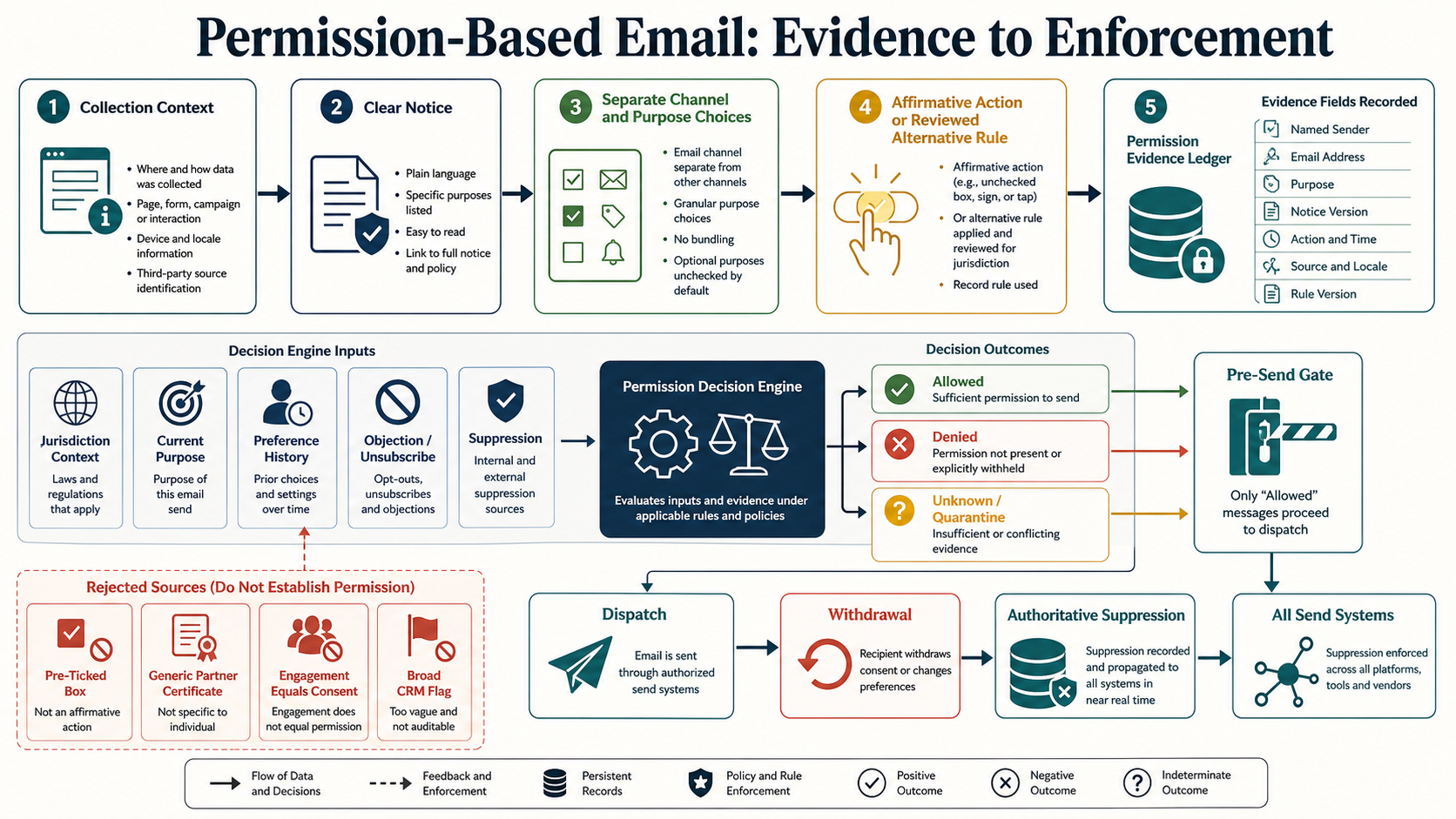
Permission-based email is not a checkbox stored forever. It is a demonstrable relationship between a person, address, named sender, communication purpose, collection experience and effective time. Requirements differ by jurisdiction and context, so teams need reviewed rules rather than one global slogan. The system must prove why a message was allowed, enforce scope, honor withdrawal everywhere and preserve enough evidence to answer a complaint without retaining unnecessary personal data.
Define the operating decision before choosing tactics
Decide whether this sender may deliver this purpose to this address now under the applicable rule, evidence, preference and suppression state.
For Permission-Based Email Marketing, write the eligible population, excluded population, decision owner, effective time, expiry and expected recipient benefit before selecting software or creative. This prevents a dashboard metric from becoming the goal and gives reviewers a concrete standard for rejecting unsafe or irrelevant execution.
Separate adjacent problems that need different controls
| In scope | Separate decision | Why separation matters |
|---|---|---|
| Consent | Lawful basis | Consent is one possible basis |
| Permission | Engagement | An open does not grant permission |
| Service | Marketing | A transaction does not authorize promotion |
| Preference | Suppression | Choice and hard stop differ |
| Collection | Proof | A flag lacks context |
Within Permission-Based Email Marketing, a clean boundary keeps one favorable signal from overriding a harder requirement. Permission, suppression, identity, product state, provider acceptance and business outcome remain distinct even when one platform displays them together.
Choose the correct identity and decision unit
The primary Permission-Based Email Marketing decision unit is an address joined to sender, channel, purpose, jurisdictional rule, evidence version and effective time. Define when person, address, account, household, device, order, campaign and receiving-provider state may be joined. Record the join source, confidence, effective time and collision behavior. A shared mailbox, forwarded message or security scanner must not silently become evidence about one individual.
Minimize downstream data for Permission-Based Email Marketing. Rendering and dispatch systems usually need the selected treatment and reason code, not an unrestricted behavior history. When identity is uncertain, choose a neutral fallback or hold the action instead of forcing a match.
Build an effective-dated evidence contract
| Evidence | Operational use | Freshness or caution |
|---|---|---|
| Collection artifact | Show wording and choices | Version and locale |
| Affirmative event | Record action and time | No pre-ticked inference |
| Rule determination | Explain jurisdiction | Owner and effective date |
| Preference history | Show withdrawal | Append-only |
| Send decision | Reproduce eligibility | All versions |
Every Permission-Based Email Marketing input needs an owner, timestamp, completeness watermark and null behavior. Keep occurrence time separate from ingestion time. A late source should produce an explicit unknown state; treating missing data as a negative signal creates confident but wrong decisions.
Represent the workflow as cancellable states
collection -> clear notice + choices
action or reviewed alternative -> evidence
evidence + rule + purpose -> eligibility
preference + suppression -> dispatch gate
withdrawal -> authoritative suppression
change or doubt -> review or stop
Each Permission-Based Email Marketing transition needs an entry reason, earliest action, useful-until time, cancellation events and terminal state. Re-evaluate current permission, suppression and business state immediately before dispatch. A queue is not authorization to send after the original condition disappears.
Apply hard gates before optimization rules
| Gate | Pass condition | Failure response |
|---|---|---|
| Sender scope | Named organization covered | Do not send |
| Purpose scope | Message matches expectation | Seek permission |
| Rule basis | Reviewed rule passes | Hold |
| Withdrawal | No applicable objection | Suppress |
| Evidence | Decision can be demonstrated | Quarantine |
Hard gates for Permission-Based Email Marketing should be deterministic and observable. A model score, predicted revenue or creative winner cannot override a complaint, applicable unsubscribe, invalid destination, expired event or material data uncertainty. Reserve capacity only after eligibility passes, then release the reservation when the action is canceled.
Implement the system in bounded stages
- Inventory forms, imports, partners, applications and purposes.
- Version notice, sender, channel, source and action.
- Create a rule service returning allowed, denied or unknown.
- Enforce authoritative suppression across every tool.
- Sample decisions and review legal changes with qualified counsel.
Promote the same versioned Permission-Based Email Marketing rules, templates and schemas through test and production. Shadow evaluation before activation reveals population changes without contacting recipients. Start with a bounded cohort whose expected count and provider distribution have been reviewed.
Test data quality at the decision boundary
For Permission-Based Email Marketing, reconcile source records to eligible, excluded, unknown, selected, canceled, attempted, accepted and completed states. Test duplicates, late arrivals, deletion, identity merges, timezone boundaries and one-to-many joins. Sample decisions immediately above and below every threshold.
The team should reproduce why one an address joined to sender, channel, purpose, jurisdictional rule, evidence version and effective time received or did not receive a treatment using the versions and watermarks available at that time. A current dashboard is not sufficient historical evidence for Permission-Based Email Marketing.
Use positive, negative and adversarial fixtures
- Pre-ticked box creates no affirmative record.
- Withdrawal reaches copied workflows.
- Unnamed partner permission stays blocked.
- Service mail excludes unpermitted promotion.
- Rule changes identify affected evidence.
Fixtures for Permission-Based Email Marketing must assert both the selected output and the reason. Run them after changes to data mapping, templates, model versions, providers, links and destination pages. Include accessibility and plain-text behavior, not only a screenshot of the preferred desktop client.
Publish metrics with numerator, denominator and maturity
| Measure | Definition | Decision supported |
|---|---|---|
| Provable permission | Eligible records with complete proof | Quality |
| Quarantined source | Records blocked for uncertainty | Containment |
| Withdrawal latency | Time to all send systems | Control |
| Complaints by source | Provider rate by evidence cohort | Expectation |
| Refresh outcome | Retained, narrowed or withdrawn | Relationship |
Report Permission-Based Email Marketing counts beside rates and expose data latency. Opens are not a reliable universal person-level outcome because images can be blocked or privacy-prefetched. Qualify automated clicks and allow enough time for conversion, cancellation, refund or repeat behavior before declaring business value.
Separate attribution from incrementality
For Permission-Based Email Marketing, last-click and platform-attributed outcomes answer which recorded touch received credit; they do not prove that the treatment caused the outcome. Use randomized treatment and holdout where ethical and practical, keep assignment stable, and prevent equivalent exposure through another journey. If randomization is unavailable, document the comparison design and its remaining bias.
topic = Permission-Based Email Marketing
incremental outcome = treatment outcome rate - holdout outcome rate
incremental value = mature net value in treatment - mature net value in holdout
guardrails = complaints + unsubscribes + support harm + provider failures
Operate by receiving provider and sending stream
For Permission-Based Email Marketing, forecast attempted volume by receiving organization, hour, identity and message category. Monitor complete SMTP replies, queue age, deferrals, hard failures, complaint signals and authentication results without blending transactional and promotional streams. A healthy global acceptance rate can hide one damaged provider cohort.
Do not rotate domains or IP addresses to escape a Permission-Based Email Marketing permission, targeting or content problem. Reduce the affected population, preserve evidence and correct the cause. Volume increases require stable provider evidence, not a calendar percentage.
Minimize personal data and protect decision artifacts
Collect only data needed for the declared Permission-Based Email Marketing purpose, limit access, define retention and prevent live personal data from entering prompts, tickets, screenshots or test fixtures. Sensitive attributes and inferred vulnerability require stricter review. URLs, tracking parameters and template comments must not expose internal segments or private facts.
Protect Permission-Based Email Marketing webhooks and feedback events with authentication, replay controls and idempotency. A forged conversion, complaint or preference event can select the wrong content or suppress the wrong person. Log decisions without logging secrets.
Make the complete experience understandable and operable
For Permission-Based Email Marketing, use semantic structure, readable hierarchy, sufficient contrast, descriptive links, meaningful image alternatives and a useful plain-text MIME alternative. Keep material conditions and the primary action available without images. Test zoom, image blocking, dark mode, keyboard access to destinations and representative assistive technology.
The Permission-Based Email Marketing accessibility review includes the landing page, preference center, form, checkout and cancellation path. A visually attractive message is not successful when the next step cannot be completed.
Diagnose recurring failure patterns
| Failure | Likely cause | First safe action |
|---|---|---|
| Opt-in flag lacks artifact | Evidence incomplete | Quarantine |
| One ESP suppresses only itself | Fragmentation | Stop and propagate |
| Partner asserts consent | Sender not named | Reject source |
| Receipt contains offer | Purpose mixing | Remove module |
| Inactivity treated as consent | Concept confusion | Reapply rules |
During a Permission-Based Email Marketing failure, pause the narrowest unsafe cohort or rule. Preserve assignments, source watermarks, selected versions, provider acknowledgements and destination behavior before changing the system. Correct one boundary at a time so recovery evidence remains interpretable.
Scenario: UK soft opt-in
The team documents sale context, similar-product scope, initial opt-out and message-level opt-out before relying on the UK rule; it does not call soft opt-in consent or export it globally.
Scenario: US commercial newsletter
The program follows CAN-SPAM header, address and opt-out requirements while maintaining a stricter source and expectation policy than the legal minimum.
Scenario: purchased partner file
A generic supplier certificate lacks collection wording, named sender, purpose and action, so records remain blocked despite the contract.
Contain and recover from a bad release
- Pause the affected rule, cohort, template or route while preserving necessary service communication.
- Capture source watermarks, assignments, artifact versions, queued actions and downstream acknowledgements.
- Apply current complaints, unsubscribes, hard bounces and terminal business events before replay.
- Correct the causal boundary and run the full fixture suite in shadow mode.
- Cancel obsolete work instead of emptying the backlog through stale sends.
- Resume a bounded cohort under provider, complaint and business guardrails.
- Close only after delayed outcomes mature and counts reconcile.
The postmortem for Permission-Based Email Marketing must identify the failed assumption, actual blast radius, customer correction, durable control and owner.
Keep a versioned catalog and decision ledger
Catalog the Permission-Based Email Marketing audience, purpose, permission scope, inputs, precedence, content or rule versions, maximum exposure, experiment, owner, stop condition and retirement date. Detect copied workflows that no longer inherit the approved suppression and frequency policy.
Record each material Permission-Based Email Marketing decision with hypothesis, evidence window, guardrails, uncertainty and resulting action. Expire claims, offers, models and exceptions. Retirement includes disabling triggers, canceling timers and confirming no regional or provider copy remains active.
Create an approval record that can survive an incident
The accountable Permission-Based Email Marketing owner signs the intended recipient benefit, eligibility logic, data versions, message and destination, provider forecast, experiment, safety exclusions, monitoring window and rollback trigger. Data, legal or policy, accessibility, deliverability and business owners approve their boundaries rather than giving a generic campaign approval.
The Permission-Based Email Marketing approval expires when a material audience, claim, source, provider, template, offer or destination changes. Emergency exceptions need a named owner, narrow scope, compensating control and expiry.
Permission-Based Email Marketing release data contract
The release package must make the leading evidence relationship explicit: Collection artifact; Show wording and choices; Version and locale. Store the source snapshot, completeness watermark, decision timestamp, rule version, selected reason, exclusion reasons and downstream acknowledgement. Reconcile expected and actual counts before expanding exposure.
Document the owner for every field and what Permission-Based Email Marketing does when the source is missing, late, duplicated or contradictory. The contract should be small enough to review and strong enough to reproduce a customer question months later without querying today current profile.
Permission-Based Email Marketing uncertainty and review cadence
The primary measurement relationship is Provable permission; Eligible records with complete proof; Quality. Publish uncertainty, data latency and maturity beside it. During launch, review provider and safety evidence at a cadence fast enough to stop harm; after stabilization, move to scheduled drift and cohort reviews without losing alert ownership.
For Permission-Based Email Marketing, compare observed distribution with the approved population and inspect boundary samples. A stable average does not excuse unexplained unknowns, one provider divergence or a small cohort with serious negative outcomes.
Permission-Based Email Marketing capacity and economics
The first implementation priorities are Inventory forms, imports, partners, applications and purposes.; Version notice, sender, channel, source and action.. Estimate data, engineering, creative, review, provider, support and incident cost before scaling. Capacity includes human review and customer support, not only messages per hour.
Measure marginal mature Permission-Based Email Marketing value after variable cost and recipient harm. A treatment that increases attributed activity but overloads support, creates refunds or requires constant manual correction is not operationally successful. Record which constraint binds the next release.
Permission-Based Email Marketing retirement and evidence closure
The leading failure pattern is Opt-in flag lacks artifact; Evidence incomplete; Quarantine. Retirement should stop new selection, cancel obsolete actions, remove copied and regional triggers, disable dependent offers or models, and preserve the final artifact plus aggregate decision evidence. Apply retention and deletion policy to raw personal data.
Confirm that providers, CRM, warehouse, sales automation and preference systems no longer activate the treatment. Close the catalog entry with reason, effective time, owner and any replacement. A hidden orphaned workflow means Permission-Based Email Marketing is still operational.
Permission-Based Email Marketing completion checklist
- Sources are inventoried.
- Rules are jurisdiction reviewed.
- Choices are specific.
- Evidence includes wording and action.
- Unknown fails closed.
- Service stays separate.
- Partners prove provenance.
- Withdrawal propagates.
- Suppression prevents re-import.
- Changes are auditable.
The Permission-Based Email Marketing implementation is ready only when the team can explain eligibility, treatment, evidence, cancellation and outcome for a real example without relying on a mutable dashboard or undocumented operator knowledge.
Separate legal minimum from operating policy
CAN-SPAM regulates commercial messages in the United States without a general prior-opt-in rule. UK PECR normally requires consent for unsolicited electronic mail to individual subscribers, subject to defined conditions such as soft opt-in. Other jurisdictions differ.
Record the reviewed rule, recipient context and effective date. This is an operating framework, not legal advice.
Store evidence that explains the choice
Keep the address, named organization, channel, purpose, exact notice and choice version, context, action, time, source, locale and withdrawal history. Protect identifiers and retain only what is justified.
Append preference transitions instead of overwriting history.
Audit partner collection
Require the actual collection experience, named parties, purpose, channel, transfer rights and suppression process. Generic partner language may not establish specificity or expectation.
Isolate sources so one failure can be stopped precisely.
Make withdrawal easy and authoritative
Honor one-click requirements where applicable and never turn direct unsubscribe into login, survey or negotiation. Maintain preference choices only as optional alternatives.
Retain minimum suppression data needed to prevent re-import.
Refresh expectation carefully
There is no universal permission-expiry period. Consider original wording, cadence, relationship, sender and purpose changes, law and recipient expectation.
A reconfirmation request may itself be marketing and needs a valid basis.
Reproduce a real send decision
Retrieve collection evidence, rule version, purpose, preference changes, suppression result and dispatched artifact. Do not depend on today mutable CRM fields.
Restrict access because evidence contains personal data.
Make permission decisions explicit and testable
A rule should accept recipient context, sender, address, channel, purpose, jurisdiction inputs, relationship evidence, consent or alternative basis, current preferences, objections and message classification. It returns allowed, denied or unknown with a rule version and reasons. Unknown must not be silently converted into allowed because a campaign has a deadline.
Legal owners approve rule meaning; engineering owners prove enforcement. Historical decisions retain the rule and evidence versions used at that time.
Treat every import as a security boundary
Before an import becomes eligible, validate schema, source authorization, collection artifact, sender and purpose scope, timestamps, suppression screening, duplicates, address normalization and expected counts. Load uncertain records into quarantine, not the active audience. Preserve a source identifier so complaints and anomalies can stop one population precisely.
Exports need the same controls. A spreadsheet copied to another platform must not escape withdrawal, retention or regional restrictions.
Re-evaluate permission when purpose changes
A person who requested product updates did not necessarily request partner offers, profiling-driven recommendations, sales outreach or another brand newsletter. Map every message to a controlled purpose and compare it with the collection artifact before eligibility. Material changes need a reviewed compatibility assessment or a new choice, not a renamed campaign field.
Record purpose lineage when programs consolidate. The migration must preserve narrower choices and objections; it cannot translate several specific states into one broad marketing flag simply because the new CRM has fewer columns.
Permission-Based Email Marketing verification packet
Before approving Permission-Based Email Marketing, assemble one dated packet containing the generated message or decision, source data watermark, identity and permission result, rule and content versions, destination proof, provider-route sample, expected counts, test outcomes, named approvals, monitoring window and rollback trigger. The leading evidence contract is: Collection artifact | Show wording and choices | Version and locale. The first hard gate is: Sender scope | Named organization covered | Do not send. Reviewers should be able to reject the release from this packet without opening a mutable campaign dashboard.
After launch, append selected, excluded, canceled, attempted and accepted counts plus the mature measurement relationship: Provable permission | Eligible records with complete proof | Quality. Sample decisions at each boundary and investigate the leading failure condition: Opt-in flag lacks artifact | Evidence incomplete | Quarantine. Close the packet only after delayed outcomes mature, discrepancies reconcile, temporary exceptions expire and the owner records whether to retain, revise, pause or retire the implementation.