RFC 7672 SMTP DANE: DNSSEC, TLSA Validation and Downgrade-Resistant Transport
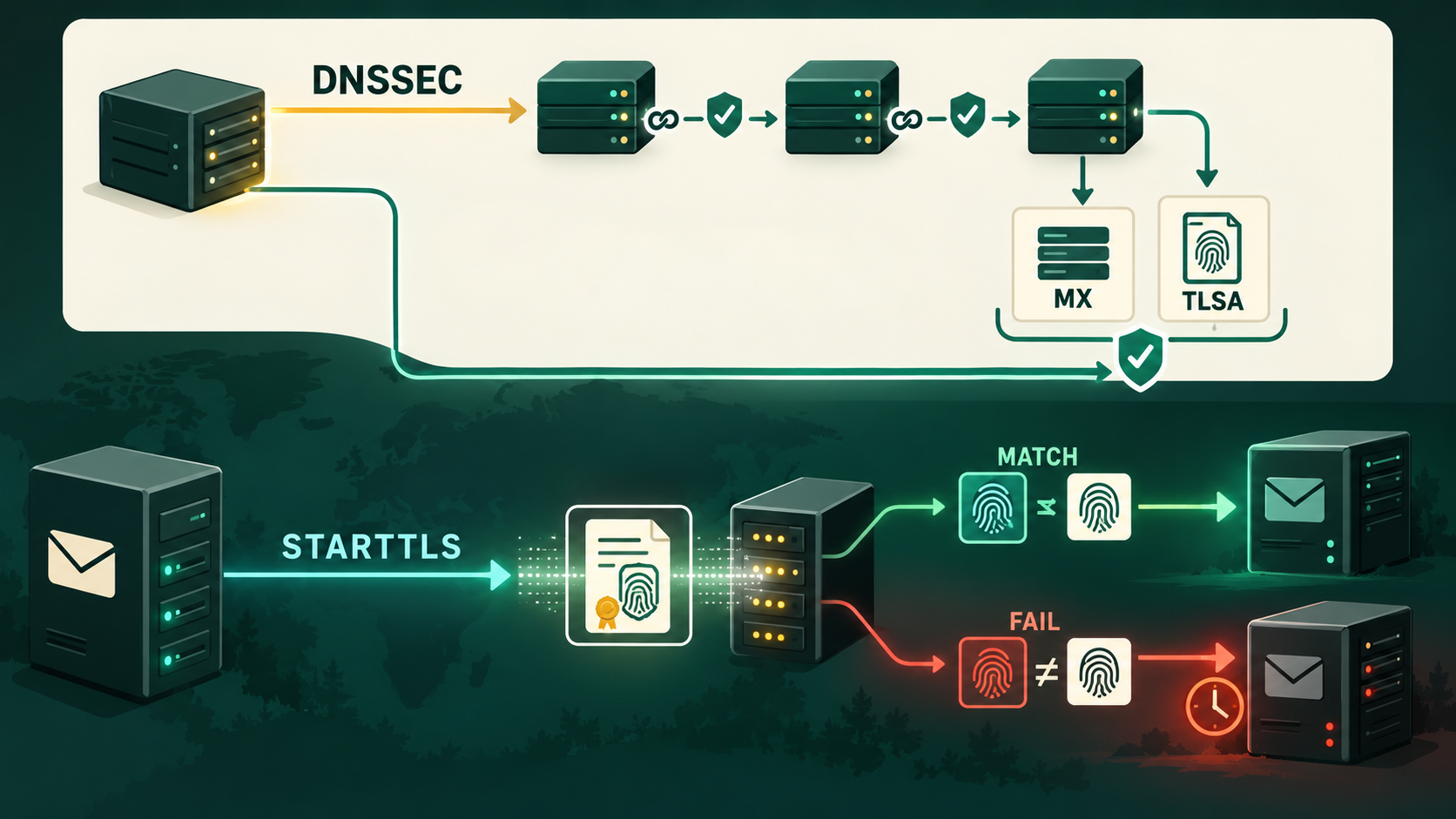
RFC 7672, published in October 2015, defines downgrade-resistant SMTP transport security using DNSSEC-authenticated MX discovery and TLSA certificate associations. When a destination publishes usable DANE policy, a conforming sender authenticates the receiving TLS service and does not silently fall back to cleartext after a policy or certificate failure. DANE protects an SMTP hop; it does not provide end-to-end message encryption.
Why ordinary opportunistic SMTP TLS is vulnerable
Traditional SMTP discovers a destination indirectly through MX records and negotiates STARTTLS over an initially cleartext connection. Without authenticated policy, an active attacker can forge MX answers, suppress the STARTTLS advertisement or interfere with the handshake. A delivery system designed to prefer delivery may then send in clear text.
Public web PKI validation alone does not solve MX redirection. The recipient address contains the destination domain, but mail may be handled by a third-party MX hostname. The sender needs authenticated DNS evidence that binds the recipient domain to that MX before it can rely on the MX hostname or its TLS credentials.
What RFC 7672 standardized
RFC 7672 combines DNSSEC validation, SMTP MX routing, TLSA records and STARTTLS. DNSSEC authenticates the routing and policy data. The TLSA RRset identifies acceptable certificate or public-key material for the SMTP service. The sending MTA verifies that the server reached through the authenticated route satisfies at least one usable association.
The model is opportunistic by destination: mail to a domain with usable authenticated DANE policy receives authenticated encrypted transport. Mail to a destination without such policy can continue using ordinary opportunistic TLS, unless stricter local policy applies. Once authenticated policy is discovered, however, transport failure cannot be converted into an unauthenticated delivery.
DANE is hop-by-hop transport authentication
DANE secures the SMTP connection from one MTA to its next hop. A later relay, forwarder or mailbox system is a separate hop with its own policy. The message can also exist unencrypted in queues, backups and mailbox storage. Claims should therefore say “authenticated TLS to the observed next hop,” not “the email is end-to-end encrypted.”
SPF, DKIM and DMARC authenticate different identities and do not replace transport security. MTA-STS is another recipient transport policy mechanism with a different discovery and trust model. A domain can deploy DANE and MTA-STS together, but monitoring must identify which policy governed each delivery.
Start with DNSSEC-validated MX discovery
The sending MTA resolves the recipient domain’s MX RRset through a security-aware resolver and classifies the result. A secure answer has a valid chain of DNSSEC authentication. An insecure answer proves that the relevant zone is unsigned through authenticated denial. Bogus means signatures or the chain failed validation. A timeout or incomplete response is not the same as authenticated absence.
If the MX RRset is secure, each MX hostname enters the TLSA lookup process. If it is insecure, opportunistic DANE does not apply because an attacker could have selected the MX hostname. Logs should retain the original, unexpanded MX hostname and must not describe TLS to an insecurely discovered host as secure delivery to the intended domain.
How to implement SMTP DANE and TLSA
There are two separate implementations. A receiving domain publishes DNSSEC-authenticated MX and TLSA data and presents the matching certificate on SMTP port 25. A sending MTA performs DNSSEC validation, discovers TLSA policy and enforces it during delivery. Publishing TLSA protects mail only from DANE-capable senders; enabling sender-side DANE protects outbound mail only when the destination publishes usable policy.
Do not start by adding a TLSA record. First establish ownership, DNSSEC, certificate stability, monitoring and a rollback plan. A securely published wrong association causes conforming senders to defer delivery, which is safer than downgrade but still an outage.
Purchased SSL certificate, self-signed certificate and DANE are not the same thing
A certificate supplies a public key and identity assertions for TLS. DANE supplies an authenticated method for a sending MTA to determine which certificate or public key is acceptable for the MX service. Buying a certificate does not automatically enable DANE, and publishing TLSA does not install or enable TLS on Postfix.
| Component | What it establishes | Who can use it | What it does not establish |
|---|---|---|---|
| CA-issued SMTP certificate | A public CA signed the certificate and normal PKIX clients can validate its chain and names. | SMTP clients that perform CA and hostname validation, plus ordinary STARTTLS clients that only encrypt. | It does not authenticate the MX lookup or stop an attacker from suppressing STARTTLS. |
| Self-signed SMTP certificate | The server possesses the private key corresponding to the presented certificate. | Ordinary opportunistic TLS clients may encrypt without authenticating it; explicitly configured clients may pin it. | It is not publicly trusted merely because it is self-signed. |
| DNSSEC plus TLSA 3 1 1 | Authenticated DNS binds the MX service to the published leaf public-key digest. | DANE-capable sending MTAs with a DNSSEC-validating resolver. | It does not make the certificate browser-trusted or protect non-DANE senders from downgrade. |
| CA-issued certificate plus TLSA | Both PKIX compatibility and DNSSEC-authenticated DANE association are available. | DANE-aware senders and clients using normal CA validation. | It remains hop-by-hop SMTP transport protection, not end-to-end message encryption. |
A self-signed leaf certificate can be authenticated by a DANE-capable sender when a DNSSEC-validated 3 1 1 TLSA record matches its public key. The sender trusts the DNSSEC-authenticated association, not the self-signature. A sender that does not implement DANE will not gain public CA trust from that TLSA record. Browsers also do not trust an SMTP certificate because an SMTP TLSA record exists.
For broad interoperability, keep a valid CA-issued certificate and publish a matching TLSA association. DANE-capable senders receive downgrade-resistant authentication; non-DANE senders can continue normal STARTTLS behavior and, where implemented, normal CA validation.
Do not confuse Postfix receiving and sending settings
| Postfix role | Parameter prefix | Purpose | Minimum practical configuration |
|---|---|---|---|
| Receiving mail on port 25 | smtpd_ | Advertise STARTTLS and present the certificate/private key that remote senders will evaluate. | smtpd_tls_cert_file, smtpd_tls_key_file and smtpd_tls_security_level=may. |
| Sending mail to remote MX hosts | smtp_ | Discover remote policy and apply opportunistic DANE when the destination publishes authenticated usable TLSA. | smtp_dns_support_level=dnssec, smtp_host_lookup=dns and smtp_tls_security_level=dane. |
| DNS validation dependency | System resolver | Provide trustworthy secure, insecure and bogus DNSSEC states to the Postfix SMTP client. | A local validating recursive resolver on loopback is recommended by Postfix. |
| DNS publication | Authoritative DNS | Publish signed MX and TLSA records for the receiving service. | Valid DNSSEC delegation plus _25._tcp. TLSA coverage for every receiving MX. |
The final “d” matters: smtpd_tls_security_level controls the Postfix SMTP server that receives connections. smtp_tls_security_level controls the Postfix SMTP client that sends mail. Configuring only the receiving side does not make outbound Postfix validate DANE, and configuring only the sending side does not publish TLSA or make inbound STARTTLS available.
Complete implementation flow
- Install the certificate and private key on every receiving Postfix MX.
- Configure
smtpd_*settings and verify STARTTLS on port 25. - Ensure the MX hostname is not hidden behind an unsupported web proxy.
- Enable and externally validate DNSSEC, including the parent DS delegation.
- Generate a
3 1 1SPKI SHA-256 digest from the live SMTP leaf certificate. - Publish
_25._tcp.<mx-host> TLSA 3 1 1 <digest>for every MX key. - Validate the signed TLSA RRset and compare it with every live endpoint.
- Configure a local DNSSEC-validating resolver for the sending MTA.
- Enable the Postfix
smtp_*DANE settings for outbound delivery. - Test matching policy, no policy, DNSSEC failure, TLSA mismatch and key rollover before production acceptance.
The receiving side can be deployed without enabling outbound DANE, and outbound DANE can be enabled even if the organization does not publish TLSA for its own MX. Deploying both gives protection in both directions when the remote party also supports and publishes the necessary evidence.
Worked naming example for NitWings
# Worked naming example. Run only after DNSSEC validates correctly.
# Recipient domain: nitwings.com
# MX hostname: mail.nitwings.com
# SMTP service: TCP port 25
# TLSA owner: _25._tcp.mail.nitwings.com

dig +short MX nitwings.com
delv nitwings.com MX

# Calculate the SPKI SHA-256 digest from the live SMTP leaf certificate.
openssl s_client -starttls smtp \
  -connect mail.nitwings.com:25 \
  -servername mail.nitwings.com \
  -showcerts </dev/null 2>/dev/null \
  | openssl x509 -pubkey -noout \
  | openssl pkey -pubin -outform DER \
  | openssl dgst -sha256 -binary \
  | xxd -p -c 256

# Publish the generated digest, not a sample value:
_25._tcp.mail.nitwings.com. 300 IN TLSA 3 1 1 <GENERATED-DIGEST>

# Validate after publication:
delv _25._tcp.mail.nitwings.com TLSA
This example establishes the correct record location and calculation sequence; it does not claim that the record is already deployed. Publication should occur only after the MX answer validates through DNSSEC and every live mail endpoint has been checked.
Step 1: satisfy the prerequisites
- The recipient domain has explicit MX records or a correctly understood implicit-MX case.
- The recipient zone and every DNS zone needed to authenticate MX routing have a valid DNSSEC chain.
- The parent zone publishes the correct DS record for each signed child delegation.
- Every MX endpoint offers STARTTLS on TCP port 25.
- The operator controls or coordinates the certificate and public key presented by every MX node.
- The DNS platform supports TLSA records and DNSSEC-safe changes.
- Monitoring can test IPv4, IPv6, primary, backup and disaster-recovery endpoints.
Enabling DNSSEC at a DNS provider without completing the DS delegation at the registrar does not create a validated chain. Conversely, publishing a stale or incorrect DS can make the domain bogus. Verify DNSKEY, DS and signatures from an external validating resolver before publishing DANE policy.
Step 2: inventory every receiving endpoint
List the exact MX hostnames and preferences returned for the recipient domain. Resolve every hostname to all current IPv4 and IPv6 addresses. Connect to each address using the MX hostname as SNI and record the leaf certificate, chain and public-key fingerprint. Repeat through every load-balancer region and backup route.
If multiple nodes intentionally use different keys, publish one TLSA association for every active key in the same RRset. If an unowned backup MX or hosted provider does not support coordinated TLSA, do not pretend the domain has complete DANE coverage. Remove the route, obtain provider support or document the resulting policy boundary before release.
Step 3: generate a 3 1 1 TLSA association
The recommended 3 1 1 record hashes the DER-encoded SubjectPublicKeyInfo from the SMTP server’s leaf certificate with SHA-256. The output is 32 bytes, represented by 64 hexadecimal characters. Hash the certificate actually presented on port 25, not the HTTPS certificate from the same hostname and not a copied textual public-key block.
The following commands require OpenSSL and xxd. Run them from a controlled system, inspect the certificate first, and independently reproduce the digest before publication.
# Replace these examples with the actual recipient domain and MX host.
dig +short MX example.net
dig +short A mx1.example.net
dig +short AAAA mx1.example.net

# Retrieve the leaf certificate currently presented on SMTP port 25.
openssl s_client -starttls smtp \
  -connect mx1.example.net:25 \
  -servername mx1.example.net \
  -showcerts </dev/null 2>/dev/null \
  | openssl x509 -outform PEM > mx1-leaf.pem

# Inspect before hashing. Confirm subject, issuer, dates, SAN and public key.
openssl x509 -in mx1-leaf.pem -noout \
  -subject -issuer -dates -ext subjectAltName

# Generate TLSA 3 1 1 association data:
# usage 3 = DANE-EE, selector 1 = SPKI, match 1 = SHA-256.
openssl x509 -in mx1-leaf.pem -pubkey -noout \
  | openssl pkey -pubin -outform DER \
  | openssl dgst -sha256 -binary \
  | xxd -p -c 256

# Publish the returned lowercase or uppercase hexadecimal digest as:
_25._tcp.mx1.example.net. 3600 IN TLSA 3 1 1 <64-HEX-CHARACTERS>
If the SMTP service uses a certificate file already available on the server, begin at the inspection and SPKI commands with that leaf certificate. Do not hash a bundle file as one object. The pipeline extracts only the leaf public key before creating the DER SPKI digest.
Example generated record
Illustrative command output (do not copy this digest):
9f86d081884c7d659a2feaa0c55ad015a3bf4f1b2b0b822cd15d6c15b0f00a08

BIND-style zone record:
_25._tcp.mx1.example.net. 3600 IN TLSA 3 1 1 (
  9f86d081884c7d659a2feaa0c55ad015
  a3bf4f1b2b0b822cd15d6c15b0f00a08 )

Typical hosted-DNS form when editing the example.net zone:
Type: TLSA
Name/Host: _25._tcp.mx1
TTL: 3600
Usage: 3
Selector: 1
Matching type: 1
Certificate association data: <digest generated from your live MX key>
The digest above is only a formatting example. A valid record must contain the digest calculated from the public key actually served by your MX. A copied example will create an authenticated mismatch and defer mail from conforming DANE senders.
Step 4: publish the TLSA record in the MX hostname’s zone
Create DNS type TLSA at _25._tcp.<mx-hostname>. In a zone editor for example.net, the host field may be entered as _25._tcp.mx1; in a zone file, use the fully qualified owner name or understand the active $ORIGIN. The RDATA is 3 1 1 followed by the 64-character digest.
The TLSA record belongs to the DNS zone authoritative for the MX hostname. If customer.example routes to mx.provider.example, the provider controls the natural TLSA owner below provider.example. Publishing _25._tcp.customer.example does not authenticate the provider MX unless that name is the actual TLSA base domain selected by the RFC 7672 discovery algorithm.
Choose a TTL that supports stable operation and planned rollover. A very short TTL does not repair a bad deployment automatically, and a long TTL extends the overlap required during key changes. Ensure the TLSA RRset itself receives valid RRSIG coverage and that negative answers are also authenticated.
Step 5: validate DNS and the live certificate before release
Use a validating tool such as delv to prove the DNSSEC chain. dig +dnssec requests signatures but does not by itself prove that the local path validated them. Then retrieve the live SMTP certificate, recalculate its SPKI digest and compare it byte-for-byte with every published association.
# Validate the DNSSEC chain and MX answer. "fully validated" is expected.
delv example.net MX

# Validate the TLSA RRset at the MX hostname.
delv _25._tcp.mx1.example.net TLSA

# Inspect records and signatures. +dnssec requests DNSSEC data;
# use a validating resolver or delv to establish validation, not dig alone.
dig +dnssec MX example.net
dig +dnssec TLSA _25._tcp.mx1.example.net

# Recalculate the digest from the live server and compare it with DNS.
openssl s_client -starttls smtp \
  -connect mx1.example.net:25 \
  -servername mx1.example.net \
  -showcerts </dev/null 2>/dev/null \
  | openssl x509 -pubkey -noout \
  | openssl pkey -pubin -outform DER \
  | openssl dgst -sha256 -binary \
  | xxd -p -c 256
Run the checks from outside the authoritative DNS and mail networks to detect split-horizon, stale secondary and firewall behavior. Confirm that a deliberately incorrect digest fails in a controlled test environment. Never publish the deliberately incorrect value in production.
Step 6: release receiving-side DANE safely
Publish the correct association while the matching certificate is already active on every endpoint. Wait for authoritative and recursive propagation, then verify multiple independent resolvers and sender networks. Watch inbound deferrals, TLS handshake errors and certificate mismatch reports.
The receiving MTA does not need to parse TLSA to be authenticated by remote DANE senders. It must reliably provide STARTTLS and the matching certificate. DNSSEC and TLSA publication are nevertheless part of the receiving service’s production configuration and must share change control with certificate deployment.
Receiving Postfix STARTTLS example
# Receiving-side Postfix example for SMTP STARTTLS on port 25.
# Use paths for the certificate and private key deployed on this MX.
smtpd_tls_cert_file = /etc/letsencrypt/live/mx1.example.net/fullchain.pem
smtpd_tls_key_file = /etc/letsencrypt/live/mx1.example.net/privkey.pem
smtpd_tls_security_level = may
smtpd_tls_received_header = yes

# DANE senders authenticate this service from DNSSEC and TLSA.
# Non-DANE senders can still use ordinary opportunistic STARTTLS.
After reloading Postfix, connect to every MX address with openssl s_client -starttls smtp and confirm the same intended leaf public key is presented. The may setting advertises opportunistic STARTTLS to ordinary senders; authenticated DANE enforcement is performed by DANE-capable remote senders based on the TLSA record.
Step 7: enable sender-side DANE enforcement
A sending MTA needs a DNSSEC-aware resolver path and DANE-capable SMTP client. For Postfix builds that support DANE, the core settings are shown below. Confirm the exact requirements against the installed Postfix version, distribution patches and resolver architecture before applying them.
# Sender-side Postfix example. Confirm support in the installed Postfix build.
# The configured resolver path must provide trustworthy DNSSEC validation.
smtp_dns_support_level = dnssec
smtp_tls_security_level = dane
smtp_tls_loglevel = 1

# Apply with the normal change-control process, then validate configuration.
# postconf -n
# postfix check
# systemctl reload postfix
Test first with controlled destinations representing secure matching policy, secure absence, bogus DNSSEC, TLSA mismatch, missing STARTTLS and multiple MX priorities. Verify that matching DANE delivery succeeds, authenticated policy failures defer, and destinations without DANE continue under the intended fallback policy. A configuration reload without behavioral tests is not acceptance.
Step 8: automate certificate-to-TLSA consistency checks
At least daily, retrieve every published TLSA RRset through a validating resolver and every live certificate from all MX addresses. Recalculate all supported associations and compare. Alert before a certificate or key deployment, not only after senders begin deferring. Store the observed RRset, signatures, certificate fingerprints and endpoint address with each result.
Integrate certificate automation with DNS change control. If automated renewal reuses the key, a 3 1 1 SPKI association can remain stable; if it generates a new key, the future association must be prepublished and allowed to propagate before activation. Do not assume ACME renewal always preserves private keys.
Construct the SMTP TLSA owner name correctly
For SMTP delivery on TCP port 25, the TLSA query is made below the MX hostname using _25._tcp. A recipient domain such as example.net can route to mx1.example.net; its TLSA owner is therefore _25._tcp.mx1.example.net, not _25._tcp.example.net unless the domain itself is the actual next-hop host.
Publish policy for every MX that can receive traffic, including backup hosts and every operational provider target. Missing policy on a lower-priority host can create an unintended non-DANE route when that host is selected under the standard algorithm.
Illustrative DNS layout
example.net.                 3600 IN MX 10 mx1.example.net.
example.net.                 3600 IN MX 20 mx2.example.net.

_25._tcp.mx1.example.net.    3600 IN TLSA 3 1 1 (
  8A1C...SHA256-OF-SUBJECT-PUBLIC-KEY-INFO...91F0 )
_25._tcp.mx2.example.net.    3600 IN TLSA 3 1 1 (
  2B77...SHA256-OF-SUBJECT-PUBLIC-KEY-INFO...A504 )

Required evidence:
- MX RRset validates as DNSSEC secure.
- Each reachable MX hostname has its own secure TLSA answer.
- The TLSA owner name uses port 25 and TCP.
Read all four TLSA record components
| TLSA field | Value | Meaning for SMTP DANE | Operational consequence |
|---|---|---|---|
| Certificate usage | 3: DANE-EE | Match the end-entity certificate or its public key directly through DNSSEC-authenticated association data. | RFC 7672 recommends DANE-EE with SPKI and SHA-256 in most SMTP deployments. PKIX name and chain validation do not replace the TLSA match. |
| Certificate usage | 2: DANE-TA | Use a matching certificate or public key as the trust anchor for the presented chain. | Useful when multiple services share an issuing authority, but chain construction and rollover need careful testing. |
| Selector | 0: Cert | Select the complete DER certificate. | A certificate renewal changes the selected object even when the public key is reused. |
| Selector | 1: SPKI | Select the DER SubjectPublicKeyInfo structure. | A renewed certificate using the same key can continue matching the record. |
| Matching type | 0: Exact | Publish the complete selected certificate material. | Large DNS data and rollover complexity make this less common. |
| Matching type | 1: SHA-256 | Publish the SHA-256 digest of the selected material. | Mandatory-to-support digest and the normal choice for interoperable records. |
| Matching type | 2: SHA-512 | Publish the SHA-512 digest of the selected material. | Can be used according to algorithm-agility rules, but should not be the only record unless client support is known. |
The TLSA RDATA begins with certificate usage, selector and matching type, followed by association data. A displayed green DNS record is not enough: the analyzer must understand the parameter combination, support its algorithms, calculate the selected certificate material correctly and verify DNSSEC provenance.
Why 3 1 1 is the normal SMTP recommendation
RFC 7672 recommends DANE-EE(3) SPKI(1) SHA2-256(1) for most SMTP deployments. It binds the authenticated TLSA record to the leaf certificate’s public-key information. A certificate can be renewed with the same key without changing the association, while a new key requires a controlled DNS rollover.
With DANE-EE, the TLSA association supplies the authenticated binding. Certificate names do not have to match the MX reference identifier, and the ordinary certificate expiration check is not used in the same manner described for PKIX authentication. This is not permission to ignore operational hygiene: expired-looking certificates can confuse non-DANE clients and monitoring, so operators should still maintain coherent certificates.
When DANE-TA can be appropriate
DANE-TA usage 2 authenticates through a TLSA-designated trust anchor. It can reduce record duplication where a controlled authority issues certificates for multiple services. The server must present enough chain material for clients to construct a valid path to the matching trust anchor according to DANE rules.
Trust-anchor deployments are more sensitive to chain variants and issuer rotation. Test with independent DANE validators and multiple sending implementations. Do not assume that a browser-valid chain contains the exact material a DANE-TA client needs.
Map DNS and TLS states to explicit delivery behavior
| Observed state | DANE interpretation | Delivery behavior | Evidence to retain |
|---|---|---|---|
| MX and TLSA are DNSSEC secure; usable TLSA matches | Authenticated DANE policy is present and validated. | Use STARTTLS, verify the association and deliver through the authenticated channel. | Validated chain, MX host, TLSA RRset, DNSSEC status, certificate material, TLS version and cipher. |
| MX is secure; TLSA securely proves no record | DANE is not applicable to that host. | Proceed according to pre-DANE opportunistic TLS or stricter local policy. | Secure denial evidence, resolver response and selected fallback policy. |
| MX is secure; TLSA lookup is bogus or indeterminate because of an error | A policy lookup failure must not be treated as authenticated absence. | Treat that SMTP server as unreachable and retry rather than silently downgrade. | DNSSEC validation failure, resolver error, TTLs and queue decision. |
| MX answer is insecure | No authenticated MX binding exists for opportunistic DANE. | DANE does not apply; pre-DANE opportunistic TLS or local policy governs. | Unexpanded MX hostname, DNS state and explicit non-DANE classification. |
| Usable TLSA exists; STARTTLS absent, handshake fails or no association matches | Published authenticated policy cannot be satisfied. | Do not deliver in clear text; defer or fail according to queue and local policy. | SMTP transcript, certificate chain, calculated associations and mismatch reason. |
| TLSA parameters are unsupported or malformed | Those associations are unusable; other usable records in the RRset still matter. | Evaluate all usable associations before determining whether DANE applies or fails. | Raw RRset, unsupported values, supported algorithm set and final classification. |
Authenticated absence and lookup failure are different
A secure denial of existence for TLSA says that no TLSA record is published at the queried owner name. That permits non-DANE handling. A SERVFAIL, timeout, truncated unresolved response, bogus signature or validation failure does not establish absence. Treating those conditions as “no policy” enables downgrade during an attack or outage.
Queue diagnostics should preserve resolver status, validation state, queried owner, response code, TTL and retry history. Operators need to distinguish a recipient DNSSEC incident from a TLS certificate mismatch or local resolver failure.
STARTTLS and association validation
After a usable secure TLSA association is found, the receiving server must offer STARTTLS and complete a TLS handshake that can be authenticated against at least one usable record. A missing STARTTLS capability, handshake error or association mismatch means authenticated delivery is unavailable. The sender must not continue in clear text.
Evaluate every usable association in the RRset. Unknown parameter values make that individual association unusable; they do not invalidate supported records beside it. Apply digest algorithm agility so a weaker published digest does not override a stronger supported association.
SNI and certificate presentation
RFC 7672 requires the SMTP client to send TLS SNI containing the TLSA base domain so a server can select the intended certificate chain. A server whose default chain already matches can operate without relying on SNI, but shared infrastructure should be tested both for correct SNI routing and for the actual chain returned to DANE-aware clients.
Probe each IPv4 and IPv6 address behind every MX. A load balancer node presenting an old key can cause intermittent deferrals even when most connections pass. Evidence must identify the destination address, SNI name, certificate chain and calculated matching result.
Rotate keys with overlapping authenticated associations
Key rotation is a DNS and server deployment transaction. RFC 7672 requires publishing associations for the current and future key before the new key is used. Wait for prior DNS caches and signatures to expire, then deploy the new key, verify every server and retain overlap until rollback is no longer needed.
Safe rollover sequence
T0  Publish TLSA records for the current key and the future key.
T1  Wait until caches containing the previous RRset and signatures expire.
T2  Deploy the certificate and private key matching the future association.
T3  Verify every MX address and failover node presents a matching chain.
T4  Keep both associations during the observation and rollback window.
T5  Remove the retired association only after cache and rollback safety permits.

Never deploy the new key before authenticated DNS can validate it.
Never remove the old association while any active server still presents it.
TTL alone is not the only timing input. Account for negative caching, DNSSEC signature lifetimes, secondary propagation, provider control-plane delay and long-lived SMTP queues. An emergency compromised-key replacement needs a documented procedure that removes the association and key consistently.
Multi-MX and hosted-mail boundaries
Each MX hostname is independently evaluated. A domain is not “DANE enabled” merely because its primary MX has a valid record. Backup MX, disaster-recovery targets and temporary migration records can receive real traffic and need consistent policy or an explicitly understood fallback boundary.
When a hosted provider owns the MX hostname, DNSSEC and TLSA control may belong to the provider rather than the customer domain. The customer still controls its MX publication. Contracts and change procedures should identify who signs each zone, publishes TLSA, rotates keys, monitors failure and communicates incidents.
The validating resolver is part of the security boundary
DANE requires trustworthy DNSSEC validation evidence. Merely sending DNS over an encrypted channel to a resolver that does not validate signatures is insufficient. A local validating resolver or a correctly authenticated security-aware resolver path must communicate secure, insecure, bogus and indeterminate states without collapsing them.
Monitor trust-anchor updates, clock accuracy, UDP and TCP reachability, response-size handling and resolver redundancy. Test deliberately broken DNSSEC names so monitoring proves that bogus data is rejected rather than accepted as insecure.
Sender-side decision workflow
INPUT: recipient domain, current DNSSEC-validating resolver evidence

1. Resolve MX and classify the answer as secure, insecure, bogus or indeterminate.
2. Preserve original MX hostnames and preference order.
3. For each eligible MX, query _25._tcp.<mx-host> TLSA with DNSSEC validation.
4. Separate usable associations from unknown, malformed or weak associations.
5. If authenticated usable policy exists, require STARTTLS and a valid match.
6. Try eligible MX hosts according to SMTP and RFC 7672 rules.
7. On DNS errors, STARTTLS stripping, handshake failure or mismatch, defer safely.
8. Fall back to pre-DANE opportunistic TLS only when authenticated policy is absent.
9. Log the DNS state, TLSA data, certificate evidence and final queue decision.
Evidence and monitoring that operations need
For each DANE attempt, record the recipient domain, unexpanded MX hostname, preference, destination IP, DNSSEC state, TLSA owner and RRset, usable associations, STARTTLS advertisement, negotiated protocol and cipher, certificate chain fingerprints, calculated match and final queue action. Retain enough data to reproduce a mismatch without retaining message content unnecessarily.
Aggregate by destination and failure layer. Alert on DNSSEC bogus responses, sudden TLSA disappearance, association mismatch, STARTTLS loss, one failing address behind an MX, rollover overlap ending too early and queues approaching expiry. Report deferral separately from permanent failure and delivered mail.
Deployment failures to detect
- TLSA published without a DNSSEC-valid chain.
- Record placed under the recipient domain instead of the MX hostname.
- Only the primary MX is covered.
- IPv6 nodes present a different certificate from IPv4 nodes.
- A new key is deployed before its TLSA record reaches caches.
- The old association is removed while a server still uses the old key.
- SPKI and full-certificate selectors are confused.
- Hex digest contains the wrong selected object or algorithm.
- DNS SERVFAIL is treated as authenticated absence.
- STARTTLS failure falls back to cleartext despite usable policy.
- Browser PKI success is treated as proof of a TLSA match.
- Monitoring calls hop-by-hop TLS end-to-end encryption.
Production acceptance checklist
- Validate the DNSSEC chain from the current trust anchor.
- Confirm secure MX answers and preserve original MX names.
- Query the correct
_25._tcpowner for every MX. - Validate parameter support and every calculated association.
- Probe every IPv4, IPv6, load-balancer and failover endpoint.
- Verify STARTTLS cannot be stripped into successful delivery.
- Test mismatch, bogus DNS, timeout and secure-absence behavior.
- Exercise a complete two-key rollover before production.
- Confirm retry and queue-expiry behavior during an outage.
- Separate DANE evidence from MTA-STS and ordinary TLS evidence.
- Document provider and customer ownership boundaries.
- Retain reproducible evidence for each failed layer.
Current standards status and interpretation
RFC 7672 remains a Standards Track specification for SMTP DANE. Its core dependency is not simply the existence of TLSA records; it is authenticated discovery and correct failure behavior. A scanner that fetches records without validating DNSSEC cannot conclude that downgrade-resistant DANE is active.
This guide was reviewed on October 28, 2026. Current implementations should also follow RFC 7671 usage and algorithm-agility guidance and the current IANA DANE parameter registries. Local mandatory-TLS policy can be stricter than opportunistic DANE and should be documented separately.
Primary standards and registries
- RFC 7672: SMTP Security via Opportunistic DANE TLS: Normative SMTP discovery, TLSA use, downgrade resistance, key management and failure behavior.
- RFC 6698: DANE TLSA protocol: TLSA resource-record format, certificate usages, selectors and matching types.
- RFC 7671: DANE operational guidance: Usage guidance and digest algorithm agility referenced by SMTP DANE.
- RFC 4033: DNSSEC introduction and requirements: DNSSEC validation model and resolver terminology.
- IANA DANE parameters: Current TLSA certificate usage, selector and matching-type registries.