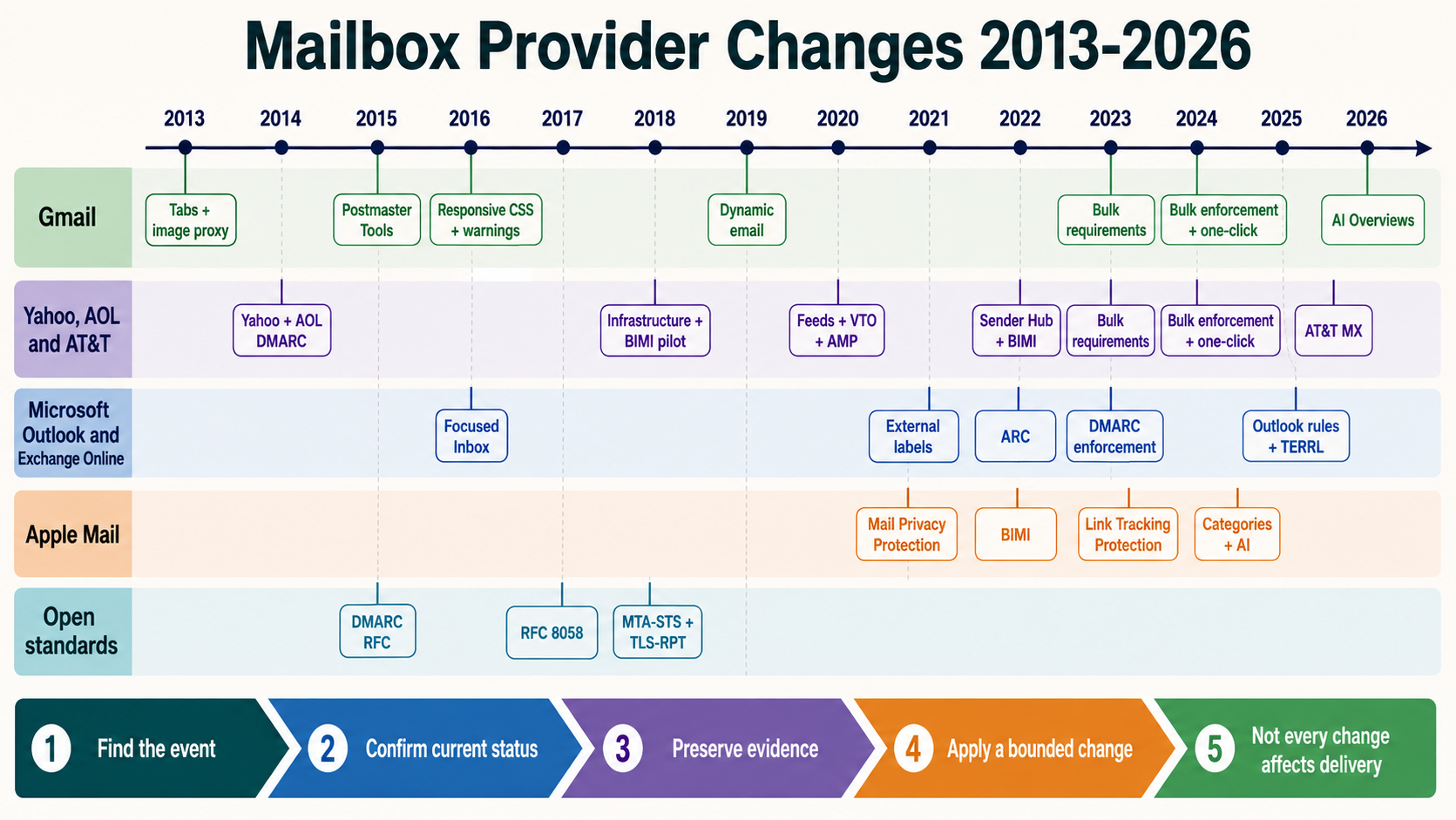
RFC 8058 One-Click Unsubscribe in 2017: The Standard Behind Modern Requirements
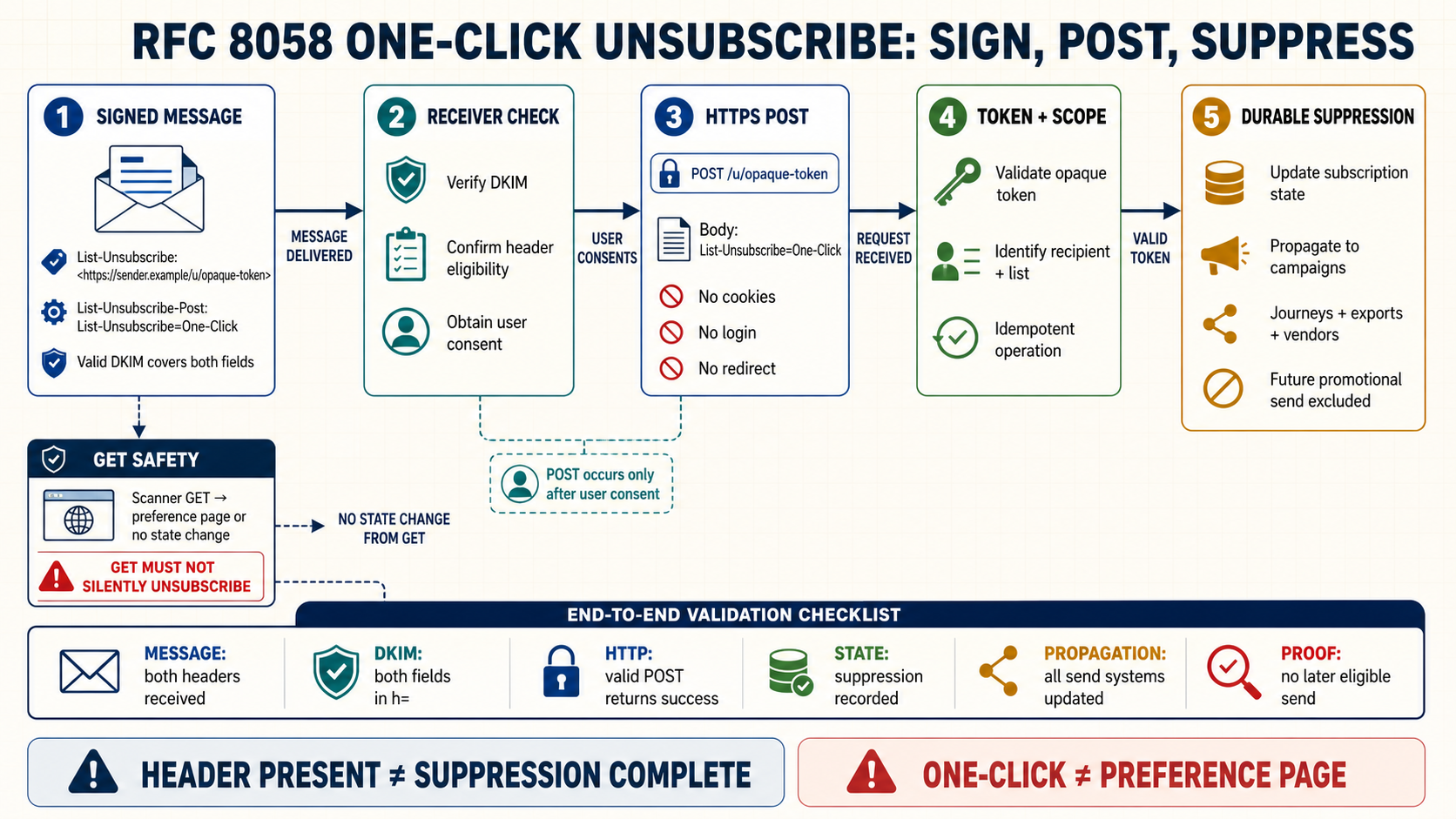
In January 2017, the IETF published RFC 8058, “Signaling One-Click Functionality for List Email Headers.” The standard solved a specific problem: receivers needed a safe way to distinguish an intentional unsubscribe operation from an automated GET performed by security software. It defined an HTTPS POST signaled by two message headers and protected by a valid DKIM signature covering those headers. The standard did not remove the visible unsubscribe link from the email body, did not authorize receivers to unsubscribe without user consent and did not turn a preference center into one-click processing.
The dated mailbox-provider change
| Event field | Verified value | Why it matters |
|---|---|---|
| Historical event date | January 2017 | This is the provider-change date, not the NitWings publication date. |
| Mailbox provider | Industry/IETF | The affected provider estate determines which recipient cohorts require separate evidence. |
| Change area | Unsubscribe | This identifies whether the change altered authentication, filtering, visibility, measurement or sender operations. |
| Current status | active-standard-and-current-bulk-sender-requirement | Historical instructions are interpreted against the feature or standard that exists now. |
RFC 2369 had standardized List-Unsubscribe and related list headers in 1998. A List-Unsubscribe field could include a mailto address or an HTTP URL. An HTTPS URL often led to a webpage where the recipient confirmed an address or changed preferences. That worked for a human, but it did not provide a safe machine-triggered operation.
Security scanners and anti-abuse systems commonly fetch URLs to assess them. If a simple GET URL immediately removed a subscriber, an automated fetch could create an accidental unsubscribe. Senders added confirmation pages to avoid that risk, but the extra step meant receivers could not offer a reliable one-action control.
RFC 8058 separated the manual GET experience from a receiver-initiated POST. The message signals that the HTTPS URI accepts a one-click action. A receiver performs the POST only with user consent, using a fixed body. The token in the URI identifies the recipient and list without relying on cookies, a login session or additional questions.
The standard became more important years later when Gmail and Yahoo incorporated one-click unsubscribe into bulk-sender expectations and requirements. That later enforcement should not be backdated to 2017. January 2017 created the interoperable mechanism; provider mandates and interface eligibility evolved afterward.
How the system worked before the change
Before RFC 8058, a sender could publish `List-Unsubscribe` with a mailto URI, an HTTP or HTTPS URI, or both. A receiving client might expose an unsubscribe affordance, but URL behavior was ambiguous. Was a fetch only checking reputation, presenting a confirmation page or performing the removal?
A GET endpoint that immediately suppressed an address was vulnerable to automated traversal. A confirmation page avoided that outcome but required the recipient to load the page and submit another action. This was not a standard receiver-to-sender one-click protocol.
Unsubscribe systems also depended too heavily on web state. Some endpoints required a login, cookies or the recipient to type an email address. These flows failed when the recipient used a different browser, forwarded the message or did not remember which alias received it.
Operationally, a successful webpage response did not prove suppression. The front end could acknowledge the request while a delayed export continued to feed other campaign systems. List-level and global suppression semantics were often unclear, leading recipients to receive another message and choose “report spam.”
What changed on the provider side
RFC 8058 requires one `List-Unsubscribe` header containing an HTTPS URI and one `List-Unsubscribe-Post` header whose value is `List-Unsubscribe=One-Click`. The HTTPS URI can coexist with other List-Unsubscribe methods, such as mailto. The URI carries enough information to identify the recipient and list.
The message must have a valid DKIM signature that covers both `List-Unsubscribe` and `List-Unsubscribe-Post`. They must appear in the signature’s `h=` list. The receiver should not offer the one-click operation without the required valid signature because unauthenticated headers could direct requests to an unrelated or malicious endpoint.
With user consent, the receiver sends an HTTPS POST to the URI. The request body contains the fixed key and value. The POST must not depend on cookies, HTTP authorization or prior browser context. The RFC prohibits an HTTPS redirect for this POST because redirected POST behavior has historically been unreliable.
The URI should contain an opaque or hard-to-forge component. The handler should validate it, map it to the correct recipient and list, make the operation idempotent and record durable suppression. A 2xx HTTP response is only the protocol acknowledgement; the sender still needs to prove that future eligible sends stop.
Message path before and after
Before
Message contains List-Unsubscribe URL
    |
    +----> Security scanner performs GET
    |          |
    |          +----> immediate removal creates accidental unsubscribe risk
    |
    +----> Recipient performs GET
               |
               v
         Confirmation or preference page
               |
               v
         Additional human action required
After
Signed message
    |
    +----> List-Unsubscribe: <https://sender.example/u/opaque-token>
    +----> List-Unsubscribe-Post: List-Unsubscribe=One-Click
    +----> valid DKIM covers both fields
    |
    v
Receiver verifies eligibility and obtains user consent
    |
    v
HTTPS POST with fixed request body
    |
    v
Sender validates token ----> idempotent list suppression
    |
    v
Propagation to every campaign system and audit evidence
Who and what the change affected
| Traffic or stakeholder | What changed | Required interpretation |
|---|---|---|
| Subscription-message senders | They gained a standard machine-actionable opt-out. | Implement the exact two-header and signed-POST design. |
| Mailbox providers | They could expose a safe unsubscribe control with user consent. | Verify DKIM and do not POST through passive scanning. |
| ESP platforms | They needed per-recipient secure tokens and suppression propagation. | Treat endpoint availability as production mail infrastructure. |
| Security scanners | Ordinary GET inspection no longer needed to trigger removal. | Do not simulate a consented RFC 8058 POST. |
| Recipients | They could leave a list without a login or confirmation journey. | The operation applies to the list identified by the message. |
| Compliance teams | A technical standard became part of provider expectations. | Keep legal obligations and provider rules separately documented. |
Effect on delivery, placement and recipient visibility
Easy unsubscribe reduces the pressure to use the spam button when a recipient no longer wants a subscription. That can protect complaint rates and sender reputation, but the mechanism is not a reputation reset. A program that sends without permission or ignores frequency expectations can still be filtered after implementing perfect headers.
Current Gmail requirements apply one-click unsubscribe to marketing and subscribed messages from senders above the applicable bulk threshold. Gmail also requires a clearly visible body link and expects requests to be honored within 48 hours. Google states that the RFC 8058 header implementation, not a body mailto or preference-page link alone, meets its one-click requirement.
Current Yahoo guidance requires bulk senders to support easy unsubscribe, recommends RFC 8058 POST, calls for a visible body link and requires requests to be honored within two days. Yahoo may support other header methods, but provider acceptance of a method should not be confused with the exact RFC 8058 POST design.
Missing or malformed headers can affect support eligibility, provider UI and sending compliance even when SMTP acceptance continues. The reverse is also true: a displayed provider unsubscribe control does not prove that the backend suppressed the address. Monitor the complete path from header creation to future send exclusion.
Do not add one-click unsubscribe indiscriminately to security alerts, password resets or receipts. Current provider documentation distinguishes promotional or subscription traffic from transactional traffic. Message taxonomy, consent and applicable law determine which streams need opt-out and which must continue for account operation.
Effect on measurement and diagnosis
Measure RFC 8058 at three boundaries. The message boundary proves that both headers exist once, contain the intended URI and are included in the `h=` tag of a valid DKIM signature. Verification must use the received message because an intermediate service can alter or remove fields.
The HTTP boundary records timestamp, token validation, request method, content type, fixed body, response and processing result. Logs should minimize personal data and prevent tokens from becoming reusable tracking identifiers. Rate controls must stop abuse without blocking legitimate provider traffic.
The suppression boundary proves the list state changed. Record the subscription identifier, scope, source, effective time and propagation acknowledgements. Test that duplicates are idempotent and that an already-suppressed recipient receives a safe success response rather than an error that invites retries.
The campaign boundary verifies that no later promotional selection includes the address after the required processing window. Examine queued campaigns, journey engines, batch exports, regional databases and vendors. A central table is insufficient if a precomputed audience file remains sendable.
Provider UI display is observational evidence, not the only validation. Gmail and Yahoo apply their own eligibility and reputation checks before showing an interface affordance. The sender should validate the protocol even when a controlled message does not display a blue link or top-of-message button.
Advantages for email marketers
| Potential advantage | When the advantage is real | Evidence to verify |
|---|---|---|
| Fewer accidental GET removals | Only the consented POST performs one-click suppression. | GET test leaves state unchanged; POST changes it once. |
| Lower recipient friction | The token identifies the list without login or questions. | Provider action reaches durable suppression. |
| Reduced complaint pressure | Wantedness and frequency are already responsibly managed. | Complaint and unsubscribe trends by stream. |
| Interoperable provider controls | Headers and DKIM follow the RFC exactly. | Received-message verification across providers. |
| Auditable suppression | The endpoint and downstream systems retain bounded evidence. | Request-to-exclusion trace with timestamps. |
Disadvantages and operational risks
| Cost or risk | How it appears | Control |
|---|---|---|
| Automated GET unsubscribes users | The manual link performs removal on fetch. | Keep GET informational or confirmatory; use POST for one-click. |
| Unsigned headers are trusted | An attacker directs receiver POSTs elsewhere. | Require valid DKIM covering both fields. |
| Redirect breaks POST semantics | Endpoint sends 301 or 302 to another handler. | Serve the final HTTPS endpoint directly. |
| Token exposes recipient data | Address or list details appear in URLs and logs. | Use opaque, scoped, hard-to-forge tokens. |
| Suppression is local only | Another platform sends again after acknowledgement. | Propagate and reconcile every sending system. |
| Preference page is called one-click | The user must choose and submit again. | Keep it as the visible body option, not RFC 8058 replacement. |
What email teams needed to do at the time
- Add both protocol headers. Publish one HTTPS URI and the exact List-Unsubscribe-Post value.
- Cover them with DKIM. Include both field names in the valid signature’s header list.
- Create opaque recipient-list tokens. Make them scoped, hard to forge and safe to log.
- Build a direct POST endpoint. Do not require cookies, authorization, a login or redirect.
- Separate GET and POST behavior. A scanner GET must not silently perform the one-click action.
- Make suppression idempotent. Duplicate provider requests should return safe success.
- Propagate the decision. Exclude the subscription from every future campaign source.
- Retain a body unsubscribe link. Offer understandable preferences and accessibility for the recipient.
What email teams should do now
- Apply current Gmail and Yahoo requirements. Identify bulk, promotional and subscription streams accurately.
- Honor requests within provider timelines. Design for immediate suppression and verify within 48 hours or two days.
- Inspect received DKIM. Ensure intermediaries and vendors do not remove coverage of either header.
- Run safe endpoint probes. Confirm GET does not suppress and valid POST does.
- Reject malformed or forged tokens safely. Avoid account enumeration and sensitive error detail.
- Monitor availability as production infrastructure. Alert on latency, TLS, status codes and processing backlog.
- Reconcile every audience store. Include journeys, scheduled exports, partner platforms and recovery queues.
- Keep list scope precise. One-click should remove the subscription associated with the message, not invent an undisclosed global choice.
- Preserve a visible body link. Let recipients review preferences even when provider one-click exists.
- Measure complaints after implementation. Protocol compliance supports wantedness but does not replace it.
Worked deliverability scenario
An ESP adds a `List-Unsubscribe` HTTPS URL and sees Gmail expose an unsubscribe control for some campaigns. The handler redirects to a preference center and requires the recipient to confirm. Operations call the project RFC 8058 complete.
A received-message audit finds no `List-Unsubscribe-Post` header, and DKIM does not cover List-Unsubscribe. A direct POST receives a 302 redirect. The preference center records browser confirmations but no provider POST events. The implementation is a useful manual unsubscribe path, not compliant one-click.
The ESP issues per-subscription opaque tokens, adds both headers, signs them and creates a direct idempotent endpoint. A GET displays the preference page without changing state. A valid POST records suppression immediately and publishes an event consumed by the campaign engine, journey platform and export service.
Tests verify duplicate POSTs, expired campaign queues and regional replication. Future promotional selections exclude the address, while required transactional notices remain governed by a separate stream policy. Complaints decline, but the team continues permission and frequency work rather than crediting the protocol for all improvement.
Evidence and diagnostics
- Received headers: exact List-Unsubscribe and List-Unsubscribe-Post fields, count and folding.
- DKIM coverage: valid signature, signing domain, selector and both fields in `h=`.
- URI security: HTTPS, opaque scoped token, no recipient data leakage and no redirect.
- POST request: method, fixed body, supported content type, timestamp and provider consent path.
- Handler result: validation, idempotent state change, response code, latency and error class.
- Suppression record: list scope, effective time, source and audit identifier.
- Propagation: campaign engine, journeys, exports, vendors, queues and regional stores.
- Future-send check: controlled selection after processing deadline.
- Provider evidence: current requirement, interface eligibility and complaint trend.
Failure modes and incorrect conclusions
- Using only a body link. It does not create the RFC 8058 header operation.
- Using only mailto. Current Gmail one-click requirements call for the HTTPS POST method.
- Performing suppression on GET. Security scanners can trigger unintended state changes.
- Omitting DKIM header coverage. The receiver cannot safely trust the operation.
- Redirecting the POST. The RFC prohibits it because behavior is unreliable.
- Returning success before durable state. A later promotional send proves the path failed.
- Equating one-click with global opt-out. The token represents the list associated with the message.
- Adding unsubscribe to every transaction. Stream taxonomy and applicable obligations still matter.
Current status and superseding changes
RFC 8058 remains the active standards reference for one-click unsubscribe. Its central technical requirements are unchanged: the two headers, an HTTPS URI, valid DKIM coverage, a user-consented receiver POST, a fixed body, no contextual cookies or authorization and no redirect.
Gmail currently requires qualifying bulk marketing and subscription messages to support one-click unsubscribe and to include a visible body link. Google’s documentation points directly to RFC 8058 and states that a body link, mailto or preference page alone does not satisfy its one-click requirement.
Yahoo currently requires bulk senders to support easy unsubscribe, recommends the RFC 8058 POST method, expects a visible body link and requires honoring requests within two days. Yahoo’s interface display also depends on its own reputation and eligibility checks.
The durable operational lesson is that the header is only the front door. Correct implementation includes authentication, endpoint security, durable suppression, cross-system propagation, campaign exclusion and evidence that the recipient does not receive another eligible subscription message.
Operator checklist
- Use January 2017 as the RFC publication date because the RFC Editor gives month precision.
- Publish exactly one List-Unsubscribe field with an HTTPS URI for one-click.
- Publish List-Unsubscribe-Post with List-Unsubscribe=One-Click.
- Use valid DKIM that covers both fields.
- Keep GET behavior separate from the consented POST operation.
- Use an opaque, scoped and hard-to-forge token.
- Do not redirect the POST or require web-session context.
- Make processing idempotent and suppression durable.
- Propagate suppression to all queues, journeys, exports and vendors.
- Meet current Gmail and Yahoo timing and body-link expectations.
- Verify future campaign exclusion and continue monitoring complaints.
Primary and contemporaneous references
- RFC Editor: RFC 8058: Complete Standards Track specification and protocol requirements.
- RFC Editor: RFC 8058 information: Publication date, authorship and status.
- Google: Email sender guidelines: Current Gmail bulk-sender and one-click requirements.
- Google: Sender guidelines FAQ: Scope, enforcement and processing expectations.
- Yahoo Sender Hub: Best practices: Current Yahoo requirements and timing.
- Yahoo Sender Hub: Subscription Hub: Current Yahoo RFC 8058 example and user experience.