RFC 8689 REQUIRETLS: Message-Level Authenticated TLS and Failure Handling
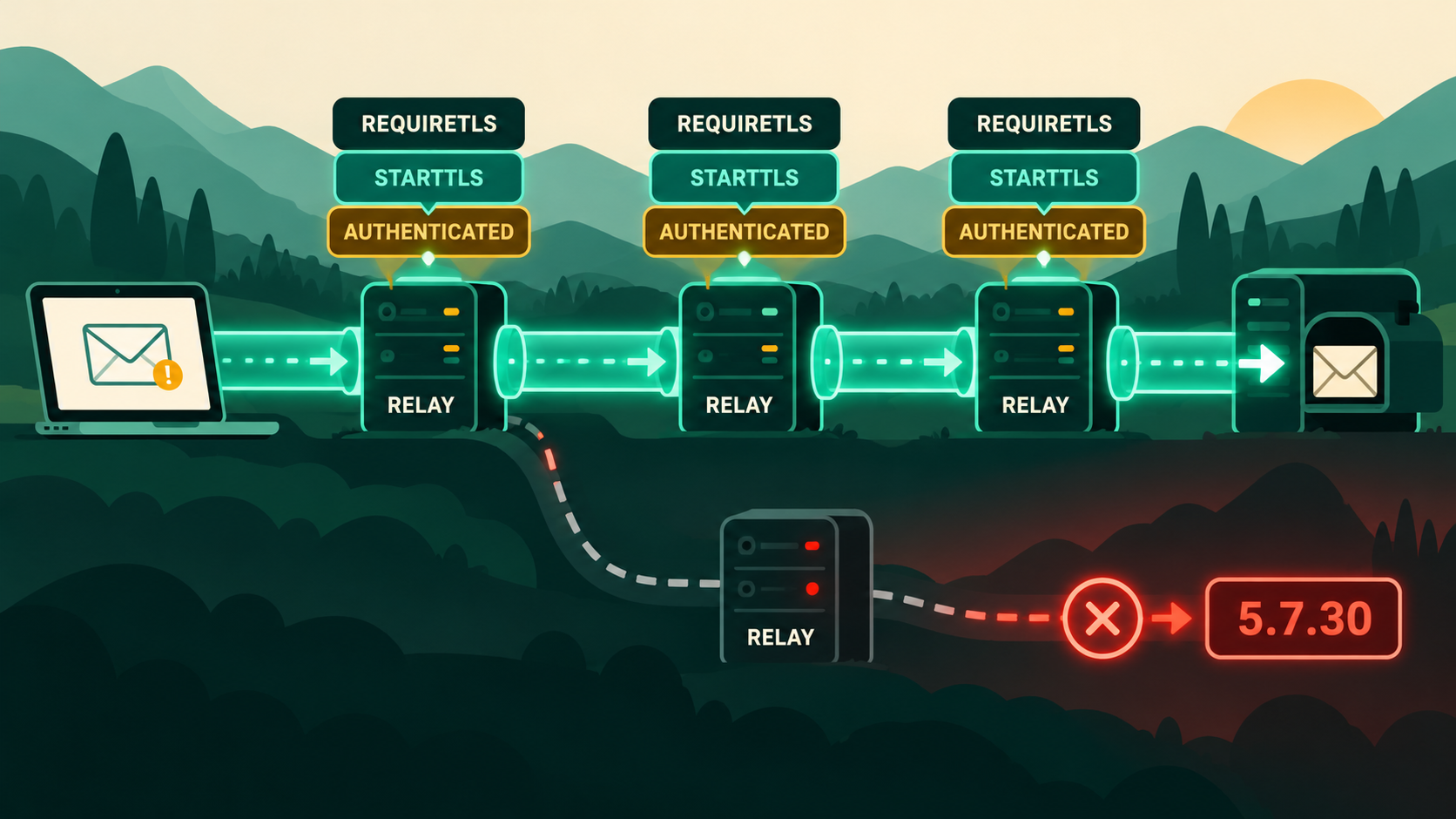
RFC 8689, published on the Standards Track in November 2019, defines a per-message SMTP REQUIRETLS option. It lets an originator request authenticated TLS across supporting relay hops and requires non-delivery instead of silent cleartext fallback when that protected path cannot be maintained.
What is REQUIRETLS?
REQUIRETLS is an SMTP service extension and a parameter on the MAIL FROM command. A receiving server advertises REQUIRETLS in its EHLO response. A sending server selects the protected behavior for one message by transmitting MAIL FROM:<address> REQUIRETLS inside an already authenticated TLS session.
It is not a new SMTP command, not a DNS record and not a message-body encryption method. It is a message-level transport instruction that participating MTAs must retain while relaying the message.
Why is REQUIRETLS needed?
Traditional SMTP STARTTLS is usually opportunistic. If STARTTLS is missing, stripped by an attacker, or fails, an MTA can prioritize delivery and send without encryption. Some clients also negotiate TLS without verifying that the certificate belongs to the intended receiving server.
Recipient policies such as MTA-STS and DANE strengthen transport for mail going to a domain, but they do not let an originator distinguish one highly sensitive message from an ordinary message. REQUIRETLS adds that per-message choice.
REQUIRETLS is not end-to-end encryption
SMTP TLS protects each network connection between participating systems. Every MTA on the delivery path receives message plaintext and can inspect or modify it. If intermediaries must not read the content, use end-to-end content encryption such as S/MIME or OpenPGP in addition to transport controls.
REQUIRETLS, STARTTLS, MTA-STS, DANE and S/MIME are different
| Mechanism | Who expresses policy | Scope | Required behavior | Important boundary |
|---|---|---|---|---|
| Opportunistic STARTTLS | Each SMTP client and server | One SMTP connection | Use TLS when available; ordinary policy may still permit cleartext fallback. | STARTTLS availability alone does not authenticate the MX or prevent downgrade. |
| REQUIRETLS SMTP option | Message originator through supporting MTAs | One message across supporting relay hops | Use authenticated TLS and pass REQUIRETLS onward, or do not transmit the protected message. | Every participating hop must advertise and honor REQUIRETLS. |
| MTA-STS | Recipient domain | Mail sent to that recipient domain | Validate permitted MX hosts and Web PKI certificates according to the published policy. | Domain policy, not a per-message sender request. |
| SMTP DANE | Recipient domain through DNSSEC and TLSA | Mail sent to TLSA-covered MX hosts | Authenticate TLS using DNSSEC-validated routing and TLSA evidence. | Requires a validated DNSSEC chain and correct TLSA coverage. |
| TLS-Required: No | Message originator | One message | Try STARTTLS, but do not fail solely because recipient-side MTA-STS or DANE policy cannot be satisfied. | This lowers transport requirements. It is not another spelling of REQUIRETLS. |
| OpenPGP or S/MIME | Message participants | Message content | Encrypt content so selected intermediaries cannot read it. | End-to-end content protection, unlike hop-by-hop SMTP TLS. |
RFC 8689 defines two opposite controls
The positive control is the SMTP REQUIRETLS parameter. It requires authenticated TLS and onward REQUIRETLS support. The second control is the message header TLS-Required: No. That header asks a supporting client not to fail delivery merely because recipient-side MTA-STS or DANE policy cannot be satisfied.
There is no TLS-Required: Yes header in RFC 8689. Requiring TLS is expressed at SMTP submission or relay time with the MAIL FROM parameter. A parser that treats the header and SMTP option as equivalent reverses the protocol’s meaning.
How protected delivery works
1. Determine whether this specific message requires protected transport.
2. Resolve the recipient route and retain all eligible MX candidates.
3. Authenticate MX identity with DNSSEC or MTA-STS as RFC 8689 requires.
4. Connect, issue EHLO and confirm STARTTLS is offered.
5. Negotiate TLS and authenticate the receiving server certificate.
6. Issue EHLO again inside TLS and require REQUIRETLS advertisement.
7. Send MAIL FROM with the REQUIRETLS parameter.
8. The receiver tags the queued message as REQUIRETLS-protected.
9. Every supporting relay repeats authenticated TLS and REQUIRETLS checks.
10. If no compliant route exists, do not downgrade; create a protected DSN.
EHLO must be checked twice
The client first uses EHLO to discover STARTTLS. After STARTTLS succeeds, SMTP state resets and the client issues EHLO again inside TLS. Only the post-TLS response proves that the authenticated peer advertises REQUIRETLS for the protected session.
Seeing REQUIRETLS before STARTTLS is not sufficient. An active attacker could manipulate the plaintext greeting. The protected advertisement, certificate authentication and MX identity validation work together.
Complete SMTP session example
S: 220 mx.receiver.example ESMTP
C: EHLO sender.example
S: 250-STARTTLS
S: 250 SIZE 52428800
C: STARTTLS
S: 220 Ready to start TLS

# TLS negotiation and certificate verification succeed.
# SMTP state resets, so the client sends EHLO again inside TLS.

C: EHLO sender.example
S: 250-REQUIRETLS
S: 250 SIZE 52428800
C: MAIL FROM:<[email protected]> REQUIRETLS
S: 250 2.1.0 Sender accepted
C: RCPT TO:<[email protected]>
S: 250 2.1.5 Recipient accepted
C: DATA
S: 354 End data with <CRLF>.<CRLF>
Requirements before sending MAIL FROM REQUIRETLS
| Check before MAIL FROM REQUIRETLS | Pass evidence | Failure action |
|---|---|---|
| TLS is active | Negotiated TLS session with acceptable protocol and cipher. | Do not transmit this message on the cleartext session. |
| MX identity is protected | DNSSEC-validated MX lookup, or MX hostname validated under MTA-STS. | Try another eligible MX; otherwise fail delivery. |
| Server certificate is authenticated | Valid trusted certificate chain and hostname match, or successful DANE validation. | Do not accept an unverified certificate for this message. |
| Post-TLS EHLO advertises REQUIRETLS | 250-REQUIRETLS appears after STARTTLS and the new EHLO. | Use another eligible MX or return 5.7.30. |
| Onward relay can preserve the requirement | Receiving MTA accepted MAIL FROM with REQUIRETLS and tags the queued message. | Receiving MTA must not silently downgrade onward delivery. |
MX routing must be authenticated
If normal MX lookup selects the server, RFC 8689 requires the recipient MX answer to be DNSSEC validated or the selected MX hostname to be validated under MTA-STS. A valid certificate for an attacker-selected hostname is not enough, because spoofed MX routing could redirect the connection.
The receiving certificate must validate
The sender authenticates the service using a trusted PKIX chain and hostname match or DANE as applicable. Opportunistic behavior that ignores an expired certificate, unknown issuer or hostname mismatch cannot be used for a REQUIRETLS message.
Every supporting relay must preserve the requirement
When a server accepts the REQUIRETLS MAIL FROM parameter, it tags the queued message internally. On onward relay it must establish a compliant protected path and include REQUIRETLS again. How the queue flag is stored is implementation-specific, but silent loss of the flag violates the intended behavior.
Aliases and redistribution
If a receiving system aliases or redistributes a protected message to multiple addresses, every resulting instance must retain the same REQUIRETLS treatment. This can make some destinations undeliverable, which is preferable to silently weakening the originator’s stated requirement.
What happens when REQUIRETLS is unavailable?
C: EHLO sender.example
S: 250-STARTTLS
S: 250 SIZE 52428800
C: STARTTLS
S: 220 Ready to start TLS

# TLS succeeds, but the post-TLS EHLO has no REQUIRETLS capability.

C: EHLO sender.example
S: 250 SIZE 52428800
C: QUIT

# Try every eligible MX. If none supports the protected path:
Status: 5.7.30
Diagnostic-Code: smtp; REQUIRETLS support required
The sender tries the remaining eligible MX hosts. If none provides authenticated TLS and post-TLS REQUIRETLS support, it does not transmit the protected message. RFC 8689 recommends 5.7.30 REQUIRETLS support required when the extension is unavailable and 5.7.10 Encryption needed when TLS cannot be established.
Outcome and evidence matrix
| Observed condition | Expected outcome | Suggested evidence |
|---|---|---|
| All checks pass | Transmit using MAIL FROM: REQUIRETLS. | TLS details, MX validation source, post-TLS EHLO and accepted MAIL response. |
| Peer lacks REQUIRETLS after TLS | Try remaining MX hosts; if none qualify, generate non-delivery. | 5.7.30 REQUIRETLS support required. |
| TLS or certificate authentication fails | Try remaining eligible MX hosts; never send protected message in cleartext. | 5.7.10 Encryption needed plus the precise TLS failure. |
| TLS-Required: No and STARTTLS fails | Delivery may continue if the receiver accepts cleartext and local policy permits it. | Header value, attempted STARTTLS and recipient response. |
| Empty reverse path for REQUIRETLS bounce | Special DSN handling applies; avoid a bounce loop and protect retained metadata. | Empty MAIL FROM, RET=HDRS behavior and onward result. |
What TLS-Required: No actually means
TLS-Required: No is for a message that should still be attempted when recipient transport policy is broken. One use is notifying a postmaster that its certificate has expired. The sender should still attempt STARTTLS, but it need not fail solely because MTA-STS or DANE validation fails.
From: TLS Monitor <[email protected]>
To: Postmaster <[email protected]>
Subject: Your receiving TLS certificate cannot be validated
TLS-Required: No
Date: Fri, 30 Oct 2026 12:00:00 +0530
Message-ID: <[email protected]>

This diagnostic message may be delivered even when recipient-side
MTA-STS or DANE policy is currently misconfigured. STARTTLS should
still be attempted when available.
Only one TLS-Required header is allowed. If the SMTP REQUIRETLS parameter was supplied, it takes precedence and the header is ignored for behavior. The header can cross MTAs that do not implement REQUIRETLS, so its handling is not guaranteed at every hop.
Message submission and user interfaces
An MUA or submission agent can expose a “require protected transport” choice or apply rules based on message classification. To request protection, it must negotiate STARTTLS and submit with the REQUIRETLS MAIL FROM parameter. Merely inserting a custom header does not request required TLS.
Operators should restrict this choice to supported submission paths and make delivery failure explicit. A sensitive-message checkbox that the submission server ignores creates false assurance.
Non-delivery messages require special handling
A DSN can contain original headers and sensitive routing information. A DSN produced for a REQUIRETLS message must normally be protected with REQUIRETLS too. The sender therefore needs a return path capable of receiving REQUIRETLS mail or the failure notification can be lost.
RFC 8689 treats protected bounces as if RET=HDRS was requested, even if RET=FULL was supplied. This limits disclosure of original content. Empty reverse paths require loop-safe handling and must not generate another bounce.
Mailing lists, forwarders and reoriginators
A mediator may create a new message rather than relay the original SMTP transaction. Mailing lists, Sieve processing, vacation responders and notification systems should propagate the incoming requirement to the new message where feasible. User-side forwarding can lose SMTP envelope metadata, so sensitive-message designs should test every actual forwarding path.
Downgrade attacks REQUIRETLS addresses
An on-path attacker can strip STARTTLS from a plaintext EHLO response, terminate TLS with a false identity, or redirect MX routing. REQUIRETLS refuses delivery unless TLS, route identity, certificate identity and the protected REQUIRETLS advertisement all satisfy the protocol.
Threats REQUIRETLS does not solve
- A participating relay can read message plaintext.
- A malicious relay can lie about support or strip internal state.
- REQUIRETLS does not authenticate the visible From address.
- It does not provide spam, malware or phishing classification.
- It does not guarantee recipient reading or inbox placement.
- It does not create universal support across the Internet.
Implementation is an MTA capability, not an Nginx or certificate setting
Installing a web certificate, enabling SMTP STARTTLS or publishing MTA-STS does not automatically implement REQUIRETLS. The sending and receiving MTA software must advertise the extension, accept the MAIL FROM parameter, store per-message queue state, enforce authenticated TLS on onward relay and generate correct DSNs.
Before publishing an implementation guide for Postfix, Exim or another MTA, verify that the deployed version supports RFC 8689 end to end. Do not invent a configuration directive or imply support from generic TLS settings.
Postfix version requirement
Native SMTP client and server REQUIRETLS support was added in Postfix 3.11. An older Postfix can support ordinary STARTTLS, DANE or external MTA-STS policy integration without understanding the REQUIRETLS MAIL FROM parameter. Do not copy the following settings into an older build and assume protection.
# Native REQUIRETLS support requires Postfix 3.11 or later.
postconf mail_version

# Confirm that this build knows the REQUIRETLS parameters.
postconf -d requiretls_enable
postconf -d smtp_requiretls_policy
postconf -d lmtp_requiretls_policy
postconf -d requiretls_esmtp_header
postconf -d requiretls_redact_dsn
postconf -d smtp_log_tls_feature_status

# Display active overrides before changing anything.
postconf -n | grep -E '^(requiretls|smtp.*requiretls|lmtp.*requiretls|smtp_tls_)'
If postconf reports an unknown parameter, stop and upgrade through the operating system’s supported packaging path or a controlled Postfix build. Confirm the exact binary used by the active service, not only a package repository version.
Postfix receive-only compatibility profile
This profile lets a Postfix 3.11 perimeter MTA advertise and receive REQUIRETLS while relaxing enforcement toward internal stores, filters and onward systems that may not support it. This is useful for a personal or controlled domain, but it does not preserve strict RFC 8689 protection through a non-compliant onward path.
# /etc/postfix/main.cf
# Compatibility profile: receive REQUIRETLS messages, but do not enforce
# REQUIRETLS toward internal stores, filters, or onward destinations.
requiretls_enable = yes
smtp_tls_security_level = may
smtp_requiretls_policy = opportunistic
lmtp_requiretls_policy = opportunistic
requiretls_esmtp_header = no
requiretls_redact_dsn = yes
smtp_log_tls_feature_status = yes
requiretls_enable=yes is the global feature switch and is the Postfix 3.11 default. The opportunistic client policies intentionally prevent internal LMTP or SMTP destinations from becoming unavailable. Because this profile disables the internal propagation header, it should not be described as strict onward enforcement.
Postfix strict external-delivery profile
The following profile follows the official Postfix pattern: internal symbolic names and IP destinations are opportunistic, while unmatched external destinations use enforce. With enforce, a REQUIRETLS message needs secure route discovery, a matching authenticated certificate, STARTTLS and remote REQUIRETLS advertisement.
# /etc/postfix/main.cf, Postfix 3.11+
requiretls_enable = yes
smtp_tls_security_level = may
requiretls_esmtp_header = yes
requiretls_redact_dsn = yes
smtp_log_tls_feature_status = yes

# This policy keeps REQUIRETLS optional for internal destinations and
# enforces the complete RFC 8689 path for external destinations.
smtp_requiretls_policy =
    inline:{
        { ${domain_to_ascii{$mydomain}} = opportunistic }
        { .${domain_to_ascii{$mydomain}} = opportunistic }
        { localhost = opportunistic } }
    cidr:{
        { 0.0.0.0/0 opportunistic }
        { ::/0 opportunistic } }
    enforce

lmtp_requiretls_policy = opportunistic

# REQUIRED FOR SCALABLE STRICT EXTERNAL ENFORCEMENT:
# Configure a maintained DANE and/or MTA-STS policy source that returns
# certificate-name matching and authenticated-route policy.
# smtp_tls_policy_maps = socketmap:unix:/path/to/verified-policy-service
The smtp_tls_policy_maps line is deliberately not supplied as a fake universal path. Strict Internet delivery needs a real DANE and/or MTA-STS policy source. Postfix supports DANE policy levels, while MTA-STS commonly requires a maintained policy plugin. Verify the policy service, cache, failure behavior and certificate-name output before enabling enforce.
Meaning of Postfix REQUIRETLS policy levels
enforce: require STARTTLS, authenticated route and certificate match, and remote REQUIRETLS support. Return the message if no suitable server exists.opportunistic+starttls: require STARTTLS, but permit delivery when the peer lacks REQUIRETLS or certificate matching policy. This is not full RFC 8689 enforcement.opportunistic: STARTTLS and REQUIRETLS are optional. Useful for internal compatibility or measurement, not a protected-delivery promise.disable: ignore the REQUIRETLS request. Use only as a documented emergency workaround.
Postfix content filters and Require-TLS-ESMTP
SMTP proxy and after-queue content filters may remove the original SMTP envelope context. With requiretls_esmtp_header=yes, Postfix can carry its internal request through supported filter designs using the Postfix-specific Require-TLS-ESMTP: yes header. This is not the RFC 8689 TLS-Required: No header and must not be exposed as a user-authored substitute.
Enable this propagation header only when the filter architecture requires it and removes or consumes it correctly on reinjection. If no such content filter is present, the official guidance permits disabling it. Test that the queue flag survives filter failure, retry and reinjection.
Request REQUIRETLS for a locally submitted message
Postfix provides the sendmail-compatible option -Orequiretls=yes. Applications using SMTP submission should instead negotiate TLS and submit the actual REQUIRETLS MAIL FROM parameter to a Postfix 3.11 server. Adding TLS-Required: Yes is invalid and adding Require-TLS-ESMTP: yes without the matching trusted Postfix configuration is not a portable request.
# Validate configuration before reload.
postfix check
postconf requiretls_enable smtp_requiretls_policy \
  lmtp_requiretls_policy requiretls_esmtp_header \
  requiretls_redact_dsn smtp_log_tls_feature_status
postfix reload

# Submit one message through the Postfix sendmail compatibility interface.
/usr/sbin/sendmail -Orequiretls=yes [email protected] <<'MESSAGE'
From: [email protected]
To: [email protected]
Subject: Postfix REQUIRETLS controlled test
Date: Fri, 30 Oct 2026 12:00:00 +0530

This message must retain the Postfix REQUIRETLS queue attribute.
MESSAGE

# Review delivery evidence. Use the log path used by your distribution.
grep -i requiretls /var/log/maillog
journalctl -u postfix --since '-15 minutes' --no-pager | grep -i requiretls
Interpret Postfix REQUIRETLS log evidence
With smtp_log_tls_feature_status=yes, successful strict delivery records tls=level/requiretls. Policy failures can include !requiretls:nocertmatch, !requiretls:nostarttls, !requiretls:noencryption or !requiretls:none. A question-mark state means the decision was incomplete because the connection or policy evaluation failed early.
Do not count every string containing “requiretls” as success. Separate successful requests, relaxed delivery, absent capability, certificate mismatch, no STARTTLS and policy errors. Correlate the queue ID with the final delivered, deferred or bounced status.
Postfix DSN redaction
The default requiretls_redact_dsn=yes removes the REQUIRETLS label from an undeliverable return and returns headers rather than the full original message. This reduces content leakage and improves the chance that the notification can travel over a return path that lacks REQUIRETLS. Changing this default requires a documented confidentiality and failure-notification design.
Protected and ordinary messages need distinct queue state
A server can receive ordinary and REQUIRETLS messages in the same process and may connect to the same destination for both. The queue must retain the policy per envelope or per delivery request. A destination’s temporary inability to satisfy REQUIRETLS must not block unrelated ordinary mail, and successful ordinary delivery must not be treated as evidence that the protected message was transmitted securely.
Queue inspection should expose the protection flag without exposing message content. Retry logic must keep the flag through deferral, failover, process restart and queue migration. If software cannot prove that preservation, it should not advertise REQUIRETLS.
Split recipients when policy or route outcomes differ
One submission can contain recipients at multiple domains. Each domain has its own MX route, MTA-STS or DANE evidence, TLS service and REQUIRETLS capability. The sender must evaluate each delivery path independently. A pass for one recipient domain does not authorize sending the same protected message to another domain whose route fails.
For aliases or distribution lists, document whether the system creates separate queue envelopes, reoriginates a new message or performs local delivery. That distinction determines where REQUIRETLS state must be copied and where a new SMTP decision begins.
Log enough evidence to explain a protected delivery decision
A useful log records message or queue identifier, recipient domain, selected MX, MX preference, IP address, DNSSEC state, MTA-STS policy identifier when used, DANE result when used, TLS version, cipher, certificate identity, post-TLS REQUIRETLS advertisement, MAIL parameter, SMTP response and final disposition.
Do not log private keys, authentication credentials or unnecessary message content. Keep the evidence long enough to investigate a delivery or downgrade failure, and ensure timestamps from DNS, policy cache, TLS and SMTP events can be correlated.
Use a controlled rollout before offering REQUIRETLS to users
Start with test domains and controlled relays that support every required step. Exercise missing STARTTLS, invalid certificates, changed MX answers, absent post-TLS REQUIRETLS, alternate MX selection, queue restart, DSN return and forwarding. Confirm that each negative case fails closed for the protected message.
Next, enable policy for a small class of messages whose recipients have documented support. Publish user guidance that protected transport can cause non-delivery. Monitor 5.7.30 and 5.7.10 separately, because extension absence and TLS authentication failure require different remediation.
Production acceptance tests
- EHLO before STARTTLS advertises STARTTLS.
- EHLO after STARTTLS advertises REQUIRETLS.
- MAIL FROM REQUIRETLS is accepted and queue state is retained.
- A compliant next hop receives REQUIRETLS again.
- A peer without REQUIRETLS is skipped without message downgrade.
- All unsuitable MX hosts produce a bounded DSN.
- Certificate expiry, hostname mismatch and unknown issuer fail protected delivery.
- DNSSEC or MTA-STS routing validation is evidenced.
- TLS-Required: No is not treated as required TLS.
- Protected DSNs contain headers rather than full content.
- Alias and mailing-list expansion preserve policy as designed.
What a REQUIRETLS analyzer should report
- Whether STARTTLS and REQUIRETLS were advertised before and after TLS.
- TLS version, cipher, certificate chain and hostname validation.
- How MX identity was authenticated: DNSSEC, MTA-STS or DANE.
- Whether MAIL FROM carried REQUIRETLS.
- Whether queue and onward relay evidence preserved the flag.
- Any TLS-Required header and whether SMTP precedence applied.
- Every attempted MX and exact stopping reason.
- 5.7.30 or 5.7.10 DSN evidence.
- A clear warning that transport TLS is not end-to-end encryption.
Current status and deployment boundary
RFC 8689 is a Standards Track RFC. Standards status does not mean every mailbox provider or MTA implements the extension. Deployment claims must be based on post-TLS EHLO evidence and actual relay testing, not on STARTTLS support alone.
This guide was reviewed on October 30, 2026. Product support and provider behavior can change, so version-specific implementation guidance must be verified against maintained vendor documentation.
Primary standards
- RFC 8689: SMTP Require TLS Option: Normative REQUIRETLS option, TLS-Required header, relay, failure and security behavior.
- RFC 3207: SMTP STARTTLS: STARTTLS negotiation and post-TLS SMTP state.
- RFC 8461: MTA-STS: Recipient-domain MX and PKIX policy used by REQUIRETLS routing validation.
- RFC 7672: SMTP DANE: DNSSEC and TLSA authentication path accepted by REQUIRETLS.
- IANA Mail Parameters: Registered REQUIRETLS SMTP extension and status-code parameters.
- Postfix REQUIRETLS Support: Official Postfix 3.11 configuration, policy levels, content filters, submission, logging and DSN behavior.