PSD DMARC: RFC 9091 History and RFC 9989 DNS Tree Walk
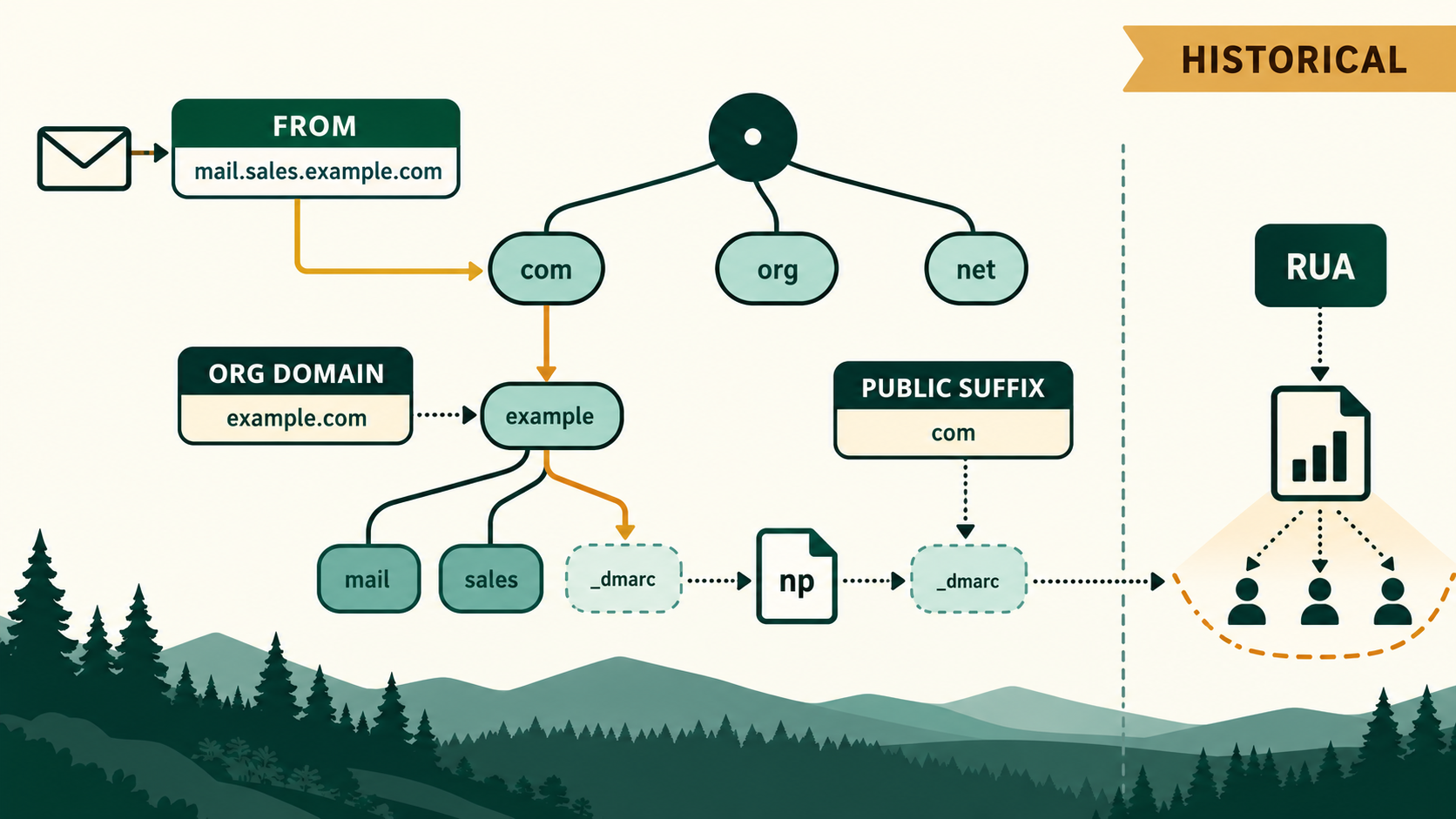
RFC 9091 was a 2021 experiment that extended DMARC policy discovery to selected Public Suffix Domains so a suffix operator could protect otherwise uncovered organizational names and non-existent cousin domains. It introduced the np policy tag and a registry-gated PSD lookup. RFC 9989 replaced that experiment in May 2026 with a bounded DNS Tree Walk, retained np, added psd=y|n|u, and made the old PSD registry unnecessary.
What problem was RFC 9091 trying to solve?
Original DMARC used a Public Suffix List to distinguish a registrable Organizational Domain from its public parent. An organization such as example.org could publish policy for itself and its own subdomains, but the operator of org could not normally publish one DMARC policy that applied to every uncovered registrant beneath it.
This mattered for controlled suffixes and namespaces requiring DMARC. An attacker could use an unregistered cousin name beneath the suffix, such as t4x.gov.example, and the ordinary Organizational Domain lookup might find no organizational policy. Defensive registration of every possible cousin name does not scale.
PSD DMARC is not permission for every TLD to control registrants
RFC 9091 did not say that any public suffix record should automatically govern all organizations beneath it. The experiment defined eligible participating PSDs and special feedback constraints. It focused on branded suffixes controlled by one organization and multi-organization suffixes that required registrants to use DMARC.
An ordinary multi-tenant suffix without that governance presents a serious boundary problem. A suffix policy or report destination could affect independent organizations. That is why the 2021 mechanism depended on an external registry and why feedback privacy received explicit treatment.
The namespace terms must be understood first
| Term | RFC 9091 meaning | Example | Operational importance |
|---|---|---|---|
| Public Suffix Domain (PSD) | A domain below which independent Organizational Domains can be registered. | org, co.uk, bank.example | Ordinary organizational policy should not automatically cross this boundary. |
| Organizational Domain | The registrable domain determined with the receiver's Public Suffix List under the RFC 7489 model. | example.org beneath org | It is the normal fallback policy and relaxed-alignment boundary. |
| Longest PSD | The Organizational Domain with one label removed, naming its immediate PSD parent. | org for example.org | RFC 9091 queried it only after ordinary author and Organizational Domain discovery failed. |
| Public Suffix Operator (PSO) | The organization managing operations within a PSD. | The operator of bank.example | Only the PSO can publish PSD-level policy for that namespace. |
| PSO-controlled name | A name managed by the PSO and unavailable as an Organizational Domain registration. | A reserved infrastructure name under a PSD | It must not be treated as an independent registrant merely because of label depth. |
| Non-existent domain | Under RFC 9091, a domain with NXDOMAIN or NODATA responses for A, AAAA and MX. | t4x.gov.example with no address or mail data | The original experiment allowed a distinct np policy for these names. |
RFC 9091 policy discovery algorithm
RFC 9091 policy discovery extension

1. Extract RFC5322.From Author Domain.
2. Query _dmarc.<Author Domain> under RFC 7489 rules.
3. If no record, determine the Organizational Domain with a Public Suffix List.
4. Query _dmarc.<Organizational Domain>.
5. If still empty, find the longest PSD above that Organizational Domain.
6. Check whether that PSD is acceptable in the PSD DMARC registry.
7. If eligible, query _dmarc.<longest PSD>.
8. Apply PSD policy only when the Organizational Domain did not publish policy.
9. Restrict PSD feedback according to RFC 9091 privacy rules.
The PSD query occurred only after the exact Author Domain and Organizational Domain policy searches failed. A PSD record could not override an Organizational Domain that published its own policy. It also was not a way for a PSD to supply report addresses when an organization chose not to request reports in its own record.
Why the old PSD registry existed
The receiver needed to know whether the longest PSD was suitable for the experiment. RFC 9091 described a registry and a Public Suffix List formatted extension. Participation required documented policy showing either that the PSO required Domain Owners to use DMARC or that all Domain Owners belonged to one organization with the PSO.
The registry was not a DNS authentication mechanism and did not prove that a record was safe merely because it appeared at a suffix. It was governance input used by the experimental receiver algorithm. RFC 9989 later reported that the experiment was not implemented as written and removed the need for that registry.
What the np tag means
np requests policy for non-existent subdomains of the applicable Organizational Domain or PSD. It does not apply to the queried domain itself, and it is not the policy for an existing subdomain. Its values use the same policy vocabulary as p: none, quarantine or reject.
Under the 2021 definition, when np was absent, the receiver used sp if present, otherwise p. RFC 9989 retains that fallback. What changed is the current definition of non-existence and the method used to discover the policy boundary.
Which policy tag applies?
| Author-domain condition | Record selected | Policy tag used | Fallback |
|---|---|---|---|
| Record found at the exact Author Domain | Exact Author Domain record | p | No higher-level policy replaces it. |
| Existing subdomain with policy inherited from Organizational Domain or PSD | Discovered parent record | sp when valid | p when sp is absent. |
| Non-existent subdomain with policy inherited from Organizational Domain or PSD | Discovered parent record | np when valid | sp when present, otherwise p. |
| Organizational Domain publishes its own DMARC record | Organizational Domain record | p, sp or np according to scope | PSD policy is not used for that organization. |
| No applicable valid DMARC record discovered | None | None | DMARC does not apply; absence is not a DMARC pass. |
Historical and current record examples
; Historical RFC 9091-style PSD experiment record.
; Eligibility came from the separate PSD DMARC registry.
_dmarc.bank.example. 3600 IN TXT \
  "v=DMARC1; p=reject; sp=reject; np=reject; rua=mailto:[email protected]"

; Current RFC 9989 PSD declaration.
; A Public Suffix Operator publishing policy must identify it with psd=y.
_dmarc.bank.example. 3600 IN TXT \
  "v=DMARC1; p=reject; sp=reject; np=reject; psd=y; rua=mailto:[email protected]"

; Organizational Domain below that PSD publishes its own policy.
; psd=n explicitly marks this as an Organizational Domain boundary.
_dmarc.goodbank.bank.example. 3600 IN TXT \
  "v=DMARC1; p=reject; sp=reject; np=reject; psd=n; rua=mailto:[email protected]"
These are teaching examples, not records to copy without namespace authority, report-destination authorization and staged evidence. A normal domain owner must not publish psd=y. A PSO using current RFC 9989 policy must include it.
Why PSD reporting creates a privacy concern
A PSD report destination can be outside the independent Organizational Domain whose traffic produced the evidence. Aggregate reports can reveal source IPs, authentication identifiers, traffic counts and domain use. Failure reports can expose message-specific headers or content and therefore present a greater risk.
RFC 9091 limited PSD feedback to aggregate reports. For multi-organization PSDs that did not require registrants to use DMARC, feedback was limited to non-existent domains. The experiment allowed broader aggregate feedback only where the registry established the relevant governance condition.
External report authorization still matters
A rua URI does not compel a receiver to send a report. Current aggregate reporting follows RFC 9990, including destination authorization, size and transport controls. Report consumers must parse untrusted compressed XML safely, prevent entity expansion and archive bombs, authenticate intake, minimize retained data and deduplicate report identifiers.
Do not use PSD policy as a shortcut to collect reports for an Organizational Domain that published its own DMARC record without reporting addresses. RFC 9091 and RFC 9989 both preserve the higher-priority organizational record.
PSD scope increases DNS security impact
A poisoned or wrongly delegated record at a high namespace level can affect many author domains. RFC 9091 explicitly noted that PSD DMARC amplifies DNS cache-poisoning and external-reporting risks. Operators should protect authoritative DNS, control changes, monitor record history and use DNSSEC where the namespace policy supports it.
DNSSEC validation proves authenticated DNS data or authenticated denial for the observed chain. It does not prove that a published DMARC policy is operationally appropriate, that every receiver validates DNSSEC or that a report destination has good privacy governance.
Why RFC 9989 obsoleted RFC 9091
The IETF concluded that the RFC 9091 experiment was not implemented as written. RFC 9989 redefined policy discovery around DNS itself instead of a receiver-selected Public Suffix List plus a separate PSD registry. The new Tree Walk discovers valid policy records at controlled points in the namespace and uses the psd tag to identify boundaries.
This is more than a document-number update. A receiver using RFC 7489 and a PSL can select a different Organizational Domain or policy from a receiver using RFC 9989. Migration testing must compare the complete query and selection trace, not merely verify that one TXT record exists.
RFC 9091 versus RFC 9989
| Area | RFC 9091 and RFC 7489 model | RFC 9989 model | Migration consequence |
|---|---|---|---|
| Status | RFC 9091 was Experimental. | RFC 9989 is Standards Track and obsoletes RFC 7489 and RFC 9091. | Describe 9091 historically; implement current behavior from 9989. |
| Boundary discovery | Receiver-specific Public Suffix List. | Bounded DNS Tree Walk. | A PSL-based and tree-walk receiver can select different policy or Organizational Domains. |
| PSD eligibility | Separate PSD DMARC registry identified acceptable participating suffixes. | A PSD record identifies itself with psd=y. | Do not make a new implementation depend on the old experiment registry. |
| Organizational boundary marker | No psd tag. | psd=n can explicitly identify a non-PSD Organizational Domain boundary. | Record parsers and builders need y, n and default u handling. |
| Non-existent policy | np introduced with a broader A, AAAA and MX non-existence test. | np retained; non-existence follows NXDOMAIN semantics. | Do not carry the RFC 9091 NODATA test blindly into RFC 9989 processing. |
| Reporting | PSD feedback had special aggregate-only and registry-based privacy controls. | Core feedback points to RFC 9990; failure reporting is in RFC 9991. | Implement reporting from the current reporting RFCs and preserve privacy boundaries. |
| Query bound | Ordinary PSL discovery plus an additional eligible-PSD query. | Tree Walk is bounded to no more than eight relevant queries. | Test long author domains and exact author-domain lookup separately. |
How the RFC 9989 DNS Tree Walk works
RFC 9989 bounded DNS Tree Walk

1. Always query _dmarc.<Author Domain> first.
2. If no valid policy is found, start at the appropriate parent.
3. For very deep names, shorten the starting point so the walk remains bounded.
4. At each target, retain only one valid current-version DMARC record.
5. Stop when a retained record contains psd=n or psd=y.
6. Otherwise remove the left-most label and continue upward.
7. Perform no more than the bounded eight-query sequence.
8. Select policy in order: Author Domain, Organizational Domain, PSD.
9. Use p, sp or np according to exact, existing-subdomain or non-existent scope.
The receiver always queries the exact Author Domain first. For a name with eight or fewer labels, the subsequent walk begins at the immediate parent. For a deeper name, the algorithm shortens the start so a malicious author cannot force an unbounded number of DNS queries. An exact policy needed for a very deep Author Domain must therefore be published at that exact author name, because that first query is always made.
At one query target, records not beginning with the current DMARC version are discarded. If multiple candidate DMARC policy records remain, they are discarded for that target. A single valid record carrying psd=n or psd=y stops the walk.
The current psd tag has three states
psd=ydeclares that the publishing domain is a Public Suffix Domain. A PSO publishing current policy must use this value.psd=ndeclares that the publisher is not a PSD and is the Organizational Domain for itself and its subdomains.psd=u, the default when omitted, leaves the status unspecified and lets the Tree Walk selection rules continue.
The tag participates in policy discovery and Organizational Domain determination. It is not a general branding marker, a statement that DMARC passed or a replacement for SPF and DKIM alignment.
PSD discovery and identifier alignment are related but separate
DMARC passes when at least one authenticated identifier aligns with the RFC 5322 From Author Domain according to the selected strict or relaxed mode. Under RFC 9989, Tree Walks may be needed for the Author Domain, a passing SPF domain and each passing DKIM signing domain to establish their Organizational Domains for relaxed alignment.
Finding a PSD record does not make unrelated registrants align. If bank.example is marked psd=y, the Organizational Domain for giant.bank.example is the label immediately below that PSD, not the PSD shared with another registrant. The boundary prevents mega.bank.example from aligning merely because both names share the suffix.
Tag status for builders and analyzers
| Tag | RFC 9091 status | RFC 9989 status | Meaning |
|---|---|---|---|
| p | Required policy tag inherited from RFC 7489. | Required in a valid current policy record. | Policy for the queried policy domain itself. |
| sp | Existing-subdomain policy, with np-aware fallback. | Policy for existing subdomains when inherited. | Overrides p for applicable existing subdomains. |
| np | Introduced by RFC 9091. | Retained by RFC 9989. | Policy for non-existent subdomains when inherited. |
| psd | Not defined. | Added by RFC 9989 with y, n or default u. | Marks a PSD or an explicit Organizational Domain boundary. |
| rua | Aggregate destinations subject to PSD privacy constraints. | Aggregate reporting is specified by RFC 9990. | Requests aggregate reports; it does not guarantee reports. |
| ruf and fo | Failure-report controls inherited from RFC 7489, but PSD feedback was restricted. | Failure reporting is specified separately by RFC 9991. | Never assume a receiver emits message-specific reports. |
| pct, rf and ri | Part of the older DMARC ecosystem. | Historic in the RFC 9989 family. | A current builder must label rather than promote them as current core controls. |
Do not mix the two non-existence definitions
RFC 9091 defined a non-existent domain using NXDOMAIN or NODATA responses across A, AAAA and MX. RFC 9989 aligns non-existence with NXDOMAIN semantics: an NXDOMAIN response means that the name and possible descendants do not exist. A current implementation must follow the current definition rather than requiring the older three-type NODATA test.
Cache state, negative TTL, DNSSEC denial, resolver policy and transient errors affect the evidence. A timeout or SERVFAIL is not NXDOMAIN. A receiver may choose fail-open or temporary-rejection behavior for transient policy-query errors, but it must not rewrite them as confirmed non-existence.
Manual DNS evidence collection
# Query the exact Author Domain policy.
dig +dnssec TXT _dmarc.mail.goodbank.bank.example

# Query the Organizational Domain candidate.
dig +dnssec TXT _dmarc.goodbank.bank.example

# Query the PSD candidate. Do not assume it is applicable merely because it exists.
dig +dnssec TXT _dmarc.bank.example

# Check domain existence separately with the resolver result code.
dig +dnssec A nonexistent.goodbank.bank.example
dig +dnssec AAAA nonexistent.goodbank.bank.example
dig +dnssec MX nonexistent.goodbank.bank.example

# Preserve status, authority section, AD bit where applicable, resolver,
# UTC retrieval time and the exact queried name for every result.
Manual dig output helps inspect individual facts but does not reproduce a complete DMARC implementation automatically. A standards test harness must implement record filtering, duplicate handling, query bounds, stop conditions, policy precedence, existence classification and alignment discovery.
Parser and resolver requirements
- Preserve the exact Author Domain and every queried DNS name.
- Distinguish NXDOMAIN, NODATA, SERVFAIL, timeout and validated denial.
- Reject ambiguous multiple DMARC policy records at one target.
- Enforce the bounded Tree Walk query sequence.
- Implement
psd=y,psd=nand defaultu. - Apply exact, existing-subdomain and non-existent policies separately.
- Keep policy discovery separate from SPF and DKIM identifier alignment.
- Label RFC 9091 registry mode as historical if retained for comparison.
- Parse RFC 9990 aggregate reports with version-aware extension handling.
- Never turn missing evidence into a pass.
Expect mixed receiver implementations
Publication of RFC 9989 does not cause every mailbox provider, security gateway and open-source library to update simultaneously. Some receivers can still use RFC 7489 PSL logic, some may implement parts of RFC 9091, and others may use RFC 9989 Tree Walk behavior. The same domain hierarchy can therefore produce different policy discovery during transition.
Strict alignment and explicit DMARC records at every active Author Domain reduce ambiguity, but they also increase DNS and change-management responsibility. Test representative receivers and record the observed Authentication-Results rather than assuming implementation from provider name alone.
Evidence and allowed conclusions
| Evidence | What it proves | What it does not prove |
|---|---|---|
| Authoritative TXT response at _dmarc name | The queried server returned a candidate policy record at that time. | That every receiver discovers or applies the same record. |
| DNS Tree Walk trace | The implementation queried specific names and stopped for a stated reason. | That a PSL-based receiver will choose the same boundary. |
| Received Authentication-Results | That receiver reported a DMARC result for the observed message. | The complete internal discovery algorithm unless additional trace exists. |
| RFC 9990 aggregate report | The reporter counted evaluated traffic and supplied stated policy metadata. | Individual-message content, Inbox placement or complete provider coverage. |
| NXDOMAIN evidence | The resolver reported that name and its descendants do not exist under DNS semantics. | Permanent future non-existence or identical observations from stale resolvers. |
| Published psd=y | The publisher declares the record as PSD policy under RFC 9989. | Universal receiver support, correct registry governance or automatic rejection. |
Acceptance tests for a current implementation
- Exact Author Domain policy is selected before any parent policy.
- An Organizational Domain record prevents PSD policy from replacing it.
- An eligible current PSD record includes and honors
psd=y. psd=nstops the boundary at the declared Organizational Domain.- Missing
psdbehaves as defaultu. - Existing subdomains use
spand non-existent subdomains usenpwhen present. - Missing
npfalls back tosp, thenp. - SERVFAIL and timeout never become NXDOMAIN.
- Multiple policy records at one name are not merged.
- A deep Author Domain cannot trigger more than the bounded query sequence.
- Relaxed SPF and DKIM alignment use independently discovered Organizational Domains.
- Aggregate reports identify discovery method where supplied by RFC 9990 extensions.
- Historical RFC 9091 tests remain separate from current RFC 9989 conformance tests.
Migration checklist from RFC 9091 logic
- Inventory every place that consumes a Public Suffix List for DMARC.
- Identify any dependency on the historical PSD DMARC registry.
- Add a versioned RFC 9989 Tree Walk implementation with trace output.
- Add
psdparsing and boundary tests. - Update non-existence classification to current NXDOMAIN semantics.
- Retain
npwith correctspandpfallback. - Move aggregate-report behavior to RFC 9990 and failure-report behavior to RFC 9991.
- Run old and new discovery side by side on controlled domain trees.
- Review every changed policy-domain or alignment result manually.
- Deploy by receiver cohort with metrics and rollback.
Historical conclusion and current boundary
RFC 9091 remains important because it introduced PSD DMARC concepts and the np tag, documented suffix-level abuse cases and forced the ecosystem to address reporting privacy. It is no longer the current protocol specification.
As reviewed on November 9, 2026, RFC 9989 is the current DMARC core specification, RFC 9990 defines aggregate reporting and RFC 9991 defines failure reporting. New policy builders, analyzers and receivers should implement that family while clearly identifying older PSL and registry behavior in historical evidence.
Primary standards references
- RFC 9091: PSD DMARC experiment: The 2021 Experimental RFC defining registry-gated PSD discovery, np and PSD feedback constraints.
- RFC 9989: Current DMARC core protocol: The 2026 Standards Track RFC that obsoletes RFC 7489 and RFC 9091 and defines DNS Tree Walk and psd.
- RFC 9990: DMARC aggregate reporting: Current aggregate XML reporting specification, including discovery-method extensibility.
- RFC 9991: DMARC failure reporting: Current failure-reporting specification and privacy controls.