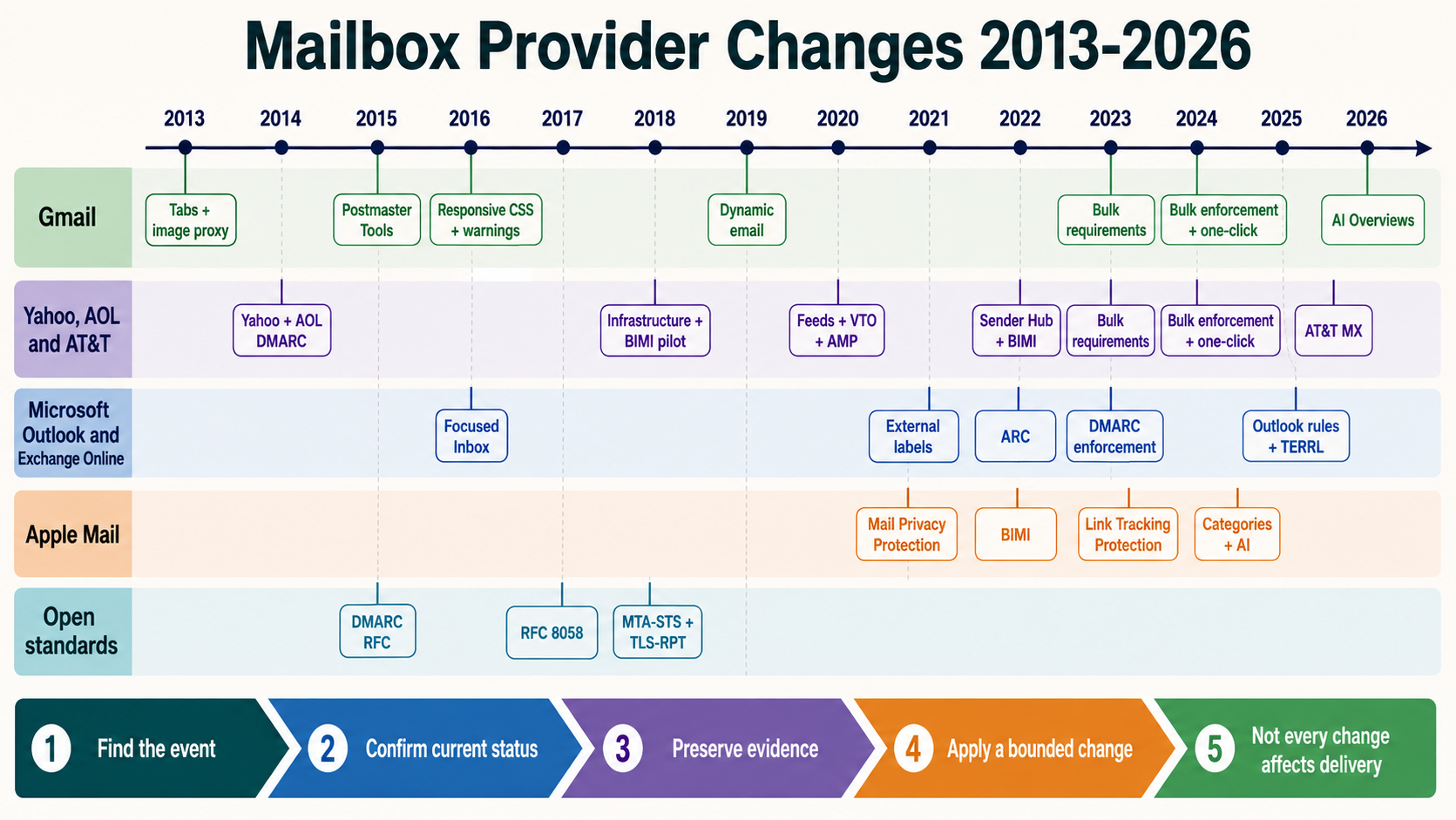
Yahoo and AOL Unified on OATH Mail Infrastructure in 2018
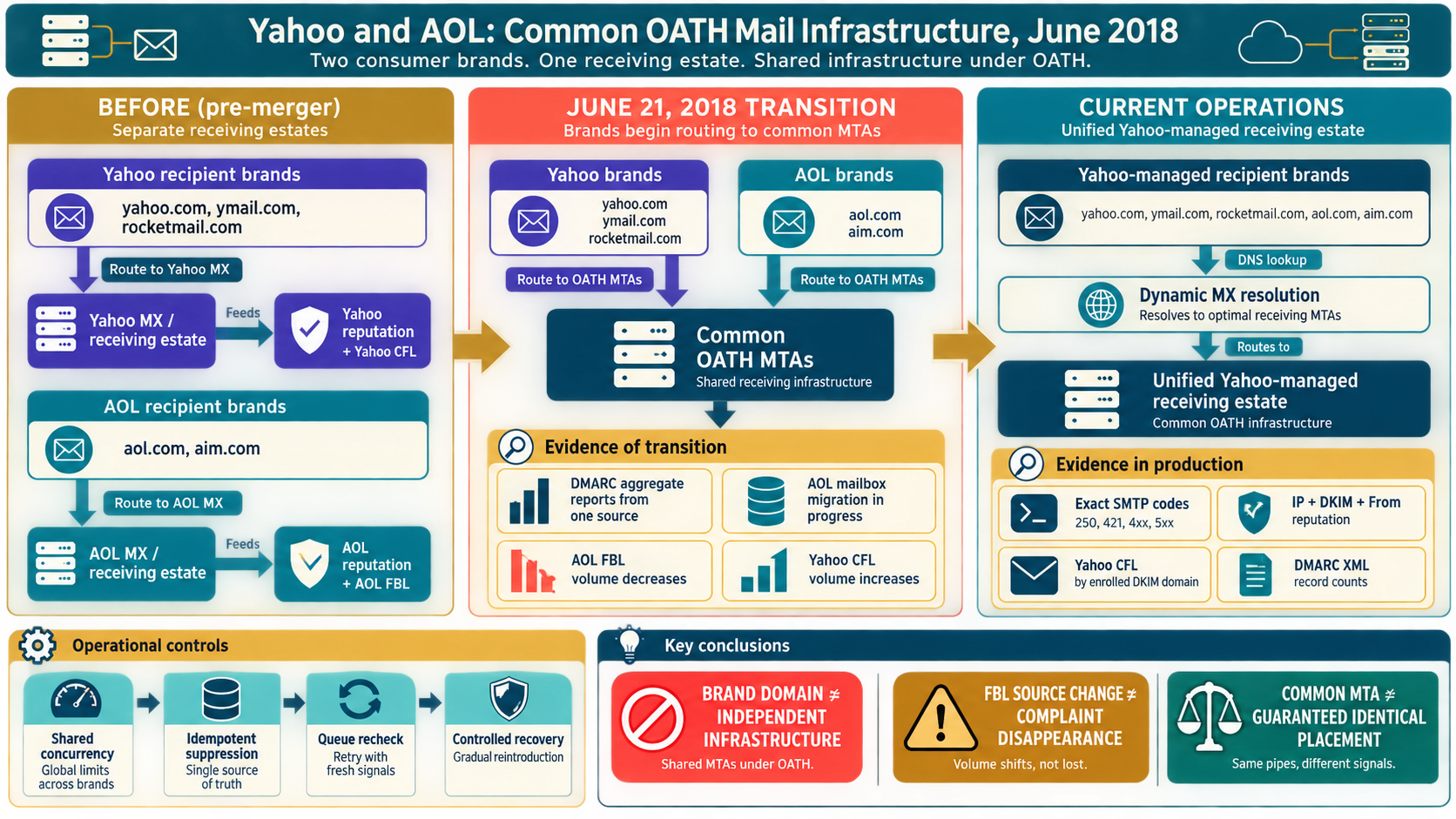
On June 21, 2018, the provider published a mail-migration update confirming that all OATH mail brands were being handled by common OATH mail transfer agents. DMARC aggregate reports were arriving from one source, AOL mailbox migration had begun, and complaint feedback was shifting from the AOL feedback loop toward the Yahoo Complaint Feedback Loop. For senders, the visible consumer brands no longer described independent delivery infrastructure. Traffic allocation, reputation analysis, reporting ingestion and complaint suppression had to follow the provider’s actual mail estate rather than the address printed after the @ sign.
The dated mailbox-provider change
| Event field | Verified value | Why it matters |
|---|---|---|
| Historical event date | June 21, 2018 | This is the provider-change date, not the NitWings publication date. |
| Mailbox provider | Yahoo Mail ecosystem | The affected provider estate determines which recipient cohorts require separate evidence. |
| Change area | Infrastructure/reputation | This identifies whether the change altered authentication, filtering, visibility, measurement or sender operations. |
| Current status | unification-complete-current-yahoo-managed-infrastructure | Historical instructions are interpreted against the feature or standard that exists now. |
Yahoo and AOL entered the OATH portfolio after Verizon combined its media properties. Their consumer domains remained recognizable, but the mail platform was being consolidated in stages. This produced a dangerous analytical interval: mailbox branding, MX routing, DMARC reporting and complaint feedback did not all change at the same moment.
Earlier transition notices explained that DMARC report origin followed MX movement, while complaint feedback followed mailbox migration. The June update marked a stronger infrastructure state. Common OATH MTAs handled the brands and DMARC reports had consolidated, but AOL mailbox migration was still progressing. AOL feedback volume was expected to decline as Yahoo CFL volume increased.
A sender looking only at recipient domain could therefore create false before-and-after conclusions. An AOL address might traverse common provider infrastructure while its complaint evidence was moving between systems. A drop in one feed did not prove that recipients had stopped complaining.
The provider declared the migration complete in April 2019. Current Yahoo Sender Hub guidance now covers Yahoo-managed brands and provides the operational reference for authentication, complaint feedback, SMTP error interpretation and sender practices.
How the system worked before the change
Before consolidation, operational teams commonly separated Yahoo and AOL into independent provider dashboards, connection pools, retry policies and reputation narratives. Separate MX patterns and feedback programs made that split appear technically justified.
DMARC aggregate XML could arrive from distinct reporting organizations. Complaint reports could be enrolled and processed through different paths. Analysts used feed volume as a rough proxy for mailbox-provider behavior, often without normalizing for traffic, coverage or migration stage.
MTA configurations sometimes encoded recipient-domain rules directly. Every AOL-labelled domain was sent through one route and every Yahoo-labelled domain through another. Such rules become brittle when multiple brands terminate on common infrastructure or when MX targets change during a staged migration.
Reputation was also over-segmented. Teams expected a good result at one consumer brand to be independent of problems at another, despite shared IPs, DKIM domains, campaigns and increasingly shared receiver systems. This delayed recognition of portfolio-wide complaint or traffic-shape failures.
What changed on the provider side
The June 21 update established three concrete facts. First, common OATH MTAs handled all OATH mail brands. Second, DMARC aggregate reporting came from a consolidated source. Third, AOL mailbox migration was underway, so AOL feedback-loop traffic would fall while Yahoo CFL traffic rose.
This did not mean every mailbox moved on June 21 or every brand produced identical placement. User cohorts, account age, product surfaces and internal models could still differ. Common infrastructure changes the correct unit of diagnosis; it does not prove uniform recipient outcomes.
Complaint operations required DKIM-domain discipline. Yahoo CFL attribution is domain based, so senders needed valid DKIM signing and correct enrollment to retain visibility as AOL-era complaint volume declined. Suppression had to accept both feeds during overlap and remain idempotent if duplicate evidence arrived.
Connection management also needed consolidation. Concurrent sessions and messages per connection should be governed at the shared receiver-estate level, using current MX resolution and exact SMTP responses. Multiplying limits independently for Yahoo and AOL domains could unintentionally create excess pressure against the same backend.
Message path before and after
Before
Yahoo recipients -> Yahoo MX and receiving estate -> Yahoo reputation and reporting
AOL recipients   -> AOL MX and receiving estate   -> AOL reputation and FBL
Sender operations split queues, dashboards and complaint feeds by visible domain
After
Yahoo, AOL and related recipient brands
    |
    v
Current MX resolution and common OATH MTAs
    |
    +----> shared infrastructure and reputation evidence
    +----> consolidated DMARC aggregate-report source
    +----> mailbox migration shifts AOL FBL toward Yahoo CFL
    |
    v
Sender correlates exact SMTP codes, DKIM domain, campaign and complaint suppression
Who and what the change affected
| Traffic or stakeholder | What changed | Required interpretation |
|---|---|---|
| Yahoo and AOL recipients | Their branded addresses increasingly reached common receiving infrastructure. | Group by verified MX and receiver evidence, while retaining recipient-brand dimensions. |
| Sending MTAs | Separate domain rules could target the same backend. | Coordinate concurrency, connection reuse and retry pressure across the estate. |
| DMARC processors | Aggregate reports consolidated to one source. | Deduplicate, sum record counts and preserve policy-domain identity. |
| Complaint teams | AOL feed volume declined as Yahoo CFL volume rose. | Run overlap ingestion and verify DKIM-domain enrollment. |
| Reputation analysts | Brand-level independence became an unsafe assumption. | Use shared IP, DKIM, campaign and receiver dimensions. |
| ESP customers | Shared platform signatures could affect service ownership. | Document who enrolls, receives and acts on complaints. |
Effect on delivery, placement and recipient visibility
Common MTAs mean that traffic labelled for different consumer brands can compete for the same receiver resources and contribute to related reputation evidence. A sender that opens an aggressive connection pool for each visible domain can exceed the intended aggregate pressure even though every local pool appears within its own limit.
The safe control is adaptive. Resolve MX at send time, group hosts by verified receiving organization, begin with conservative concurrency, reuse connections efficiently, and respond to exact temporary failures. Do not hard-code a historic host list or treat all 4xx replies as identical. A mailbox unavailable response, policy throttle and resource limit require different investigation.
Reputation should be analyzed at several layers: sending IP, DKIM signing domain, RFC5322.From domain, campaign, acquisition source and recipient cohort. Infrastructure consolidation makes cross-brand comparison more valuable, but it does not remove cohort differences. Compare like-for-like traffic before claiming that Yahoo and AOL placement is identical.
Complaint visibility is a deliverability control, not merely reporting. If AOL reports decline during migration and Yahoo CFL is not enrolled or parsed, the sender can continue mailing recipients who complained. That creates repeat unwanted mail and can damage reputation across the common estate.
DMARC consolidation is likewise not a placement score. Aggregate reports describe authentication disposition and observed sources. They do not report inbox versus spam. Use them to find unauthorized or broken streams, then combine the evidence with SMTP logs, complaints, controlled placement tests and recipient outcomes.
Effect on measurement and diagnosis
Mark June 21, 2018 as an infrastructure milestone, not as a single universal mailbox cutover. Preserve migration-stage annotations in historical reporting. A time series that silently joins separate AOL and Yahoo feeds can create artificial jumps or declines.
For DMARC, count the messages in XML records rather than the number of report files. Consolidation can reduce file count while covered volume remains stable. Retain report-org, report ID, date range, policy domain, source IP, disposition and authentication alignment so deduplication remains auditable.
For complaints, use a stable denominator such as eligible delivered promotional messages for the same provider estate and interval. Raw ARF count is distorted by volume, enrollment, redaction and feed availability. Record the source program and first-seen time, but normalize every complaint into one suppression event model.
Map receiver evidence from the actual delivery attempt: resolved MX, connected host, remote IP, timestamp, SMTP reply and queue decision. Recipient domain alone cannot prove which backend handled a message. Keep DNS evidence time bounded because migrations and failover alter routing.
Retain both the combined estate view and brand cohorts. The combined view exposes shared infrastructure pressure; the cohort view reveals differences in users, products or placement. A mature dashboard can move between IP, DKIM domain, campaign, provider estate and consumer brand without claiming that any single dimension is the complete reputation boundary.
Advantages for email marketers
| Potential advantage | When the advantage is real | Evidence to verify |
|---|---|---|
| Simpler receiver routing | Queues follow current shared MX ownership. | Lower redundant connection pressure and stable throughput. |
| Consolidated authentication evidence | DMARC records are normalized by message count. | Complete aligned and failing-source inventory. |
| Unified complaint handling | Yahoo CFL covers enrolled DKIM domains across managed brands. | No eligible sends after a complaint. |
| Cross-brand diagnosis | Shared traffic dimensions are retained. | Faster detection of portfolio-wide incidents. |
| Consistent sender controls | One provider playbook governs retries and recovery. | Fewer contradictory domain-specific rules. |
Disadvantages and operational risks
| Cost or risk | How it appears | Control |
|---|---|---|
| Visible domain is treated as infrastructure | Separate pools overload common MTAs. | Group by current MX and receiver organization. |
| AOL FBL decline is called improvement | Complaint coverage silently disappears. | Reconcile declining AOL and rising Yahoo feeds. |
| Common MTA is called identical placement | Cohort and product differences are hidden. | Retain brand and recipient-level comparisons. |
| DMARC file count is used as volume | Consolidation changes packaging. | Sum record counts and deduplicate report IDs. |
| Static MX rules survive migration | Mail follows stale routing assumptions. | Resolve DNS and maintain time-bounded evidence. |
| Duplicate feedback causes repeated work | Both transition feeds report one event. | Use idempotent suppression keys and audit logs. |
What email teams needed to do at the time
- Inventory affected brands. Map recipient domains to current MX targets and provider ownership.
- Coordinate connection pools. Limit aggregate pressure against common OATH MTAs.
- Ingest both complaint paths. Keep AOL and Yahoo feeds active during transition.
- Enroll DKIM domains in Yahoo CFL. Verify ownership and feedback destinations.
- Consolidate DMARC safely. Deduplicate by report organization and report identifier.
- Annotate the migration interval. Prevent false historical trend conclusions.
- Preserve brand cohorts. Shared infrastructure does not erase recipient differences.
- Test suppression propagation. Confirm complaints prevent the next eligible send.
What email teams should do now
- Use Yahoo Sender Hub. Follow current guidance for Yahoo-managed consumer brands.
- Resolve MX dynamically. Do not rely on 2018 infrastructure names or copied IP lists.
- Apply shared receiver limits. Govern concurrency and retry amplification across brands.
- Sign consistently with DKIM. Keep domain ownership and customer responsibility explicit.
- Maintain Yahoo CFL enrollment. Monitor feed health and suppression acknowledgements.
- Parse exact SMTP codes. Separate policy, reputation, recipient and resource failures.
- Measure multi-layer reputation. Correlate IP, DKIM, From, campaign and acquisition source.
- Retain raw reports. Preserve DMARC XML and authenticated complaint evidence for audit.
- Use controlled recovery. Reduce pressure, correct the cause, then ramp with guardrails.
- Keep transactional purpose clear. Do not let promotional complaints contaminate essential-message policy.
Worked deliverability scenario
An ESP operates one Yahoo queue and one AOL queue, each configured for the same concurrency. After the common-MTA transition, both queues connect to related receiver infrastructure. Temporary policy deferrals rise, while the AOL complaint feed falls sharply. The dashboard initially calls the decline a reputation improvement.
Delivery logs show that both recipient groups resolve into the common estate and peak at the same time. The Yahoo CFL parser also rejects one platform DKIM domain because enrollment was incomplete. Complaints did not disappear; part of the evidence path disappeared.
The ESP groups current MX hosts under one receiver policy, lowers combined concurrency, adds jittered retries and preserves exact enhanced status codes. It verifies every signing domain, restores Yahoo CFL ingestion, and sends complaint events through an idempotent central suppression service. Queued campaigns recheck suppression immediately before delivery.
Deferrals fall without a broad volume shutdown. Complaint reporting resumes under the Yahoo path, and historical dashboards mark the migration boundary. Analysts retain Yahoo and AOL recipient cohorts but interpret them inside one receiving-estate view. The repair comes from correcting routing, feedback and measurement, not from rotating IPs or assuming one brand is isolated.
Evidence and diagnostics
- DNS path: recipient domain, resolver, MX answer, TTL and observation time.
- Connection path: local IP, remote host and IP, TLS, concurrency and messages per connection.
- SMTP evidence: complete reply, enhanced status code, attempt count, delay and queue action.
- Identity: envelope domain, From domain, DKIM domain and selector, DMARC alignment.
- DMARC evidence: report organization, report ID, record count, source and disposition.
- Complaint evidence: AOL or Yahoo source, enrollment, DKIM attribution and ARF validation.
- Suppression: recipient key, stream scope, effective time and downstream acknowledgement.
- Cohort: brand, campaign, acquisition source, engagement and traffic class.
Failure modes and incorrect conclusions
- Treating June 21 as full mailbox completion. Migration was underway and completed later.
- Multiplying limits by consumer brand. Separate queues can hit the same receiving estate.
- Interpreting fewer AOL complaints as better behavior. Feedback was moving to Yahoo CFL.
- Calling DMARC a placement report. It measures authentication observations and disposition.
- Discarding recipient-brand dimensions. Shared MTAs do not guarantee identical user outcomes.
- Using a static provider map. DNS and infrastructure continue to change.
- Suppressing only inside one campaign tool. Other streams can mail the complainant again.
Current status and superseding changes
The provider announced completion of the Yahoo and AOL infrastructure migration on April 10, 2019. Current operations are documented through Yahoo Sender Hub, including best practices, complaint feedback and SMTP error guidance for Yahoo-managed brands.
Yahoo’s current complaint loop uses DKIM-domain enrollment. Senders and ESPs must decide whether a platform signature or customer-specific signature owns enrollment and suppression responsibility. The operational proof is not successful registration but authenticated feedback arriving and preventing later marketing sends.
Current bulk-sender expectations also require strong authentication, low complaint rates, easy unsubscribe and responsible traffic management. These controls operate across the same identities used to diagnose the consolidated estate.
The durable lesson extends beyond this merger. Consumer brand, MX operator, filtering platform, feedback provider and reporting organization can change on different dates. Build systems from observed infrastructure and signed identity, keep historical transitions explicit, and never convert missing telemetry into evidence of success.
Operator checklist
- Record June 21, 2018 as the common-MTA migration update, not final completion.
- Record April 10, 2019 separately as the provider-declared completion.
- Resolve and retain time-bounded MX evidence for delivery attempts.
- Coordinate Yahoo and AOL connection pressure at receiver-estate level.
- Keep DKIM domains enrolled in the current Yahoo complaint loop.
- Reconcile AOL feed decline with Yahoo CFL growth during historical analysis.
- Sum DMARC record counts and preserve raw XML.
- Separate authentication reporting, complaint feedback and inbox placement.
- Use idempotent central suppression with queue rechecks.
- Retain both combined-estate and recipient-brand cohort views.
Primary and contemporaneous references
- Yahoo Postmaster archive: Mail Migration Update: Primary June 21, 2018 provider update.
- Yahoo Postmaster: It’s Done: Provider record of April 2019 completion.
- Yahoo Sender Hub: Best practices: Current sender and infrastructure guidance.
- Yahoo Sender Hub: Complaint Feedback Loop: Current DKIM-domain complaint program.
- Yahoo Sender Hub: SMTP error codes: Current diagnostic reply guidance.