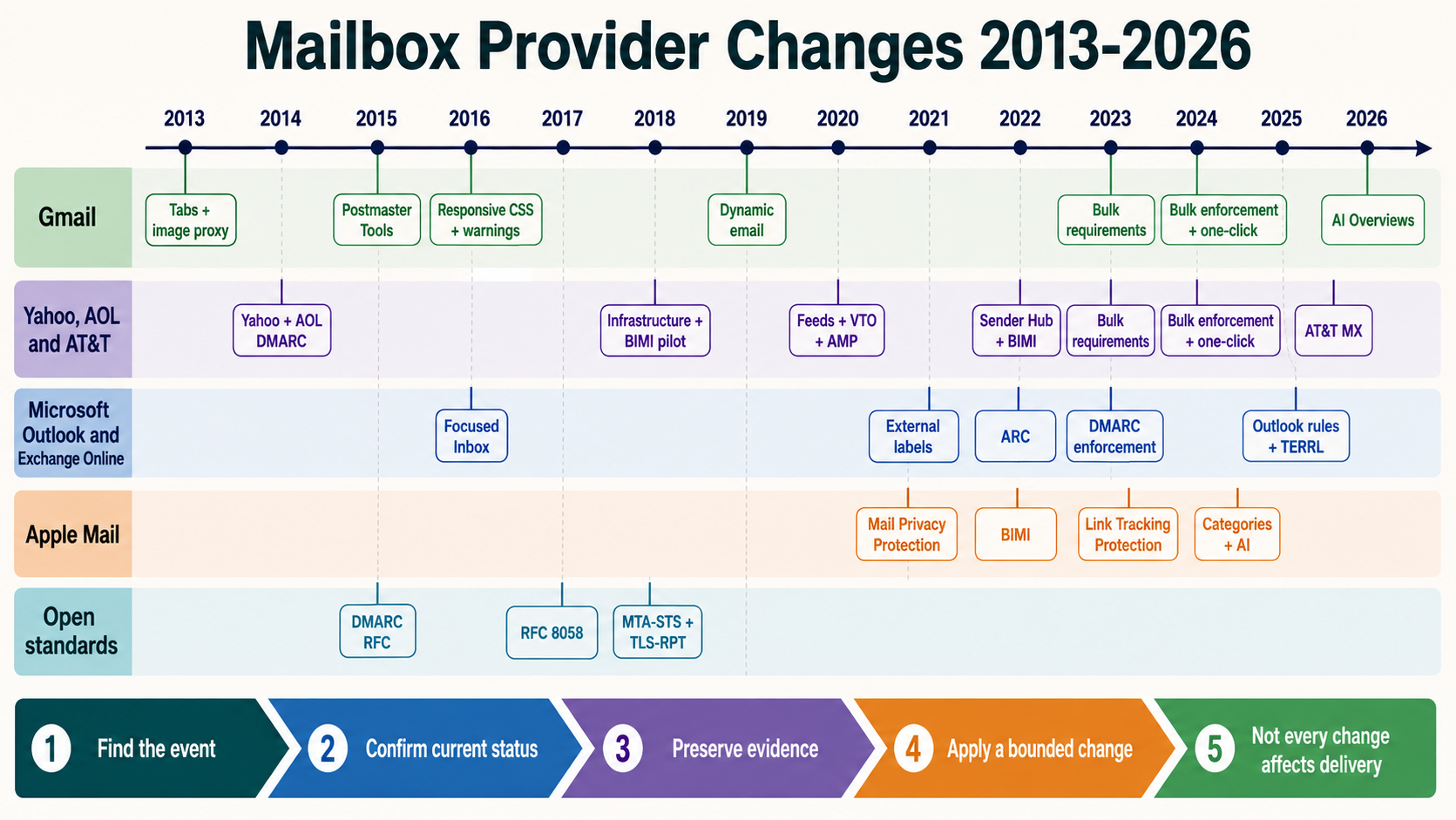
Yahoo Expanded DMARC Reject Policies in 2016: International Domain Impact
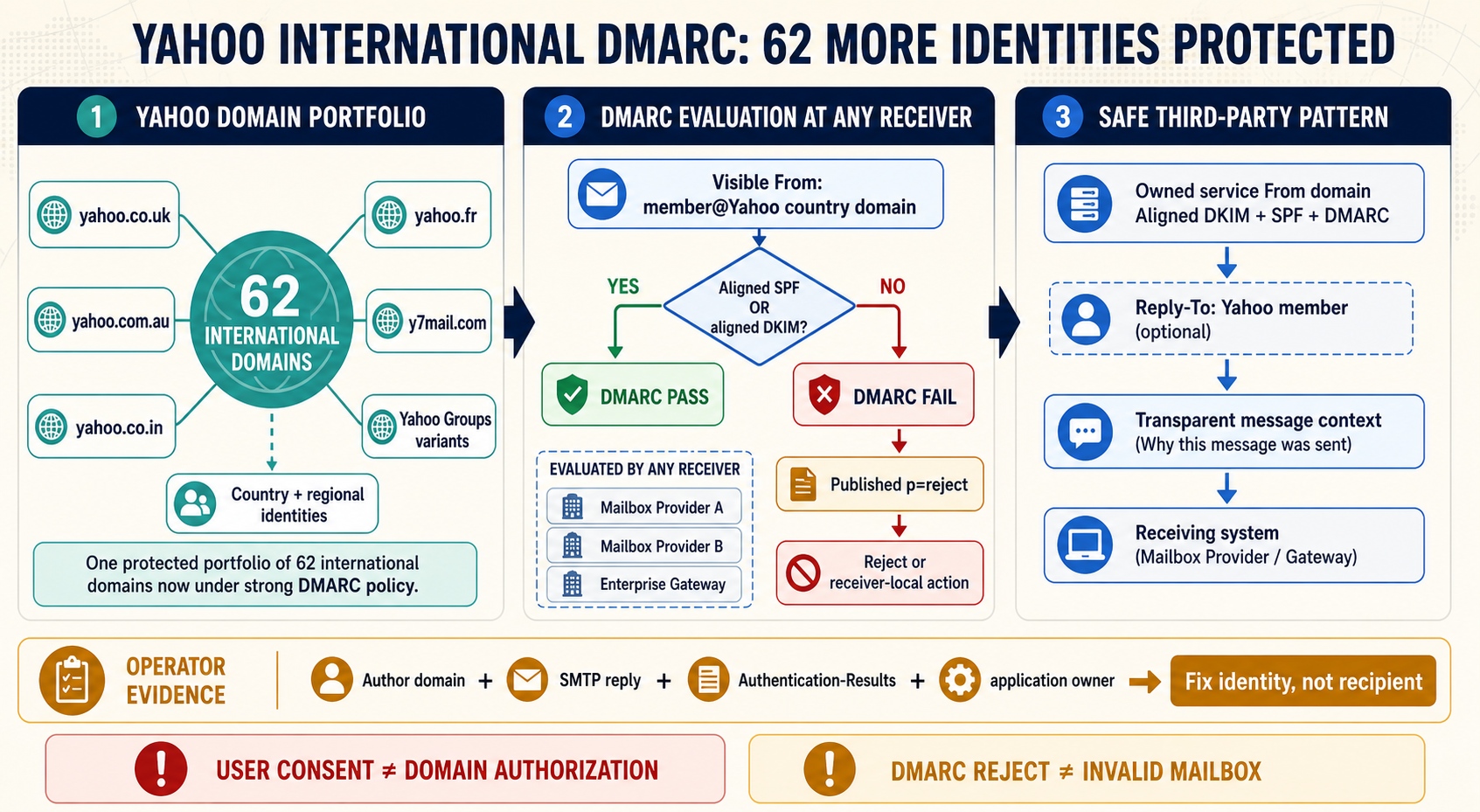
On March 28, 2016, Yahoo extended strong DMARC policies to 62 international domains, including country-specific Yahoo addresses, Y7mail, Yahoo Groups variants and Yahoo Xtra. The move expanded the identity boundary established for yahoo.com in 2014. Third-party mail that used one of the newly protected consumer domains in its visible From field could fail DMARC and be rejected even when the recipient address, sending IP and ESP authentication were otherwise valid.
The dated mailbox-provider change
| Event field | Verified value | Why it matters |
|---|---|---|
| Historical event date | March 28, 2016 | This is the provider-change date, not the NitWings publication date. |
| Mailbox provider | Yahoo Mail ecosystem | The affected provider estate determines which recipient cohorts require separate evidence. |
| Change area | Authentication/DMARC | This identifies whether the change altered authentication, filtering, visibility, measurement or sender operations. |
| Current status | active-and-expanded-across-yahoo-portfolio | Historical instructions are interpreted against the feature or standard that exists now. |
Yahoo’s original strict policy protected yahoo.com from direct spoofing, but Yahoo operated a much wider domain portfolio. Users in different countries held addresses under domains such as yahoo.co.uk, yahoo.de, yahoo.fr, yahoo.com.au and yahoo.co.in. Attackers and legitimate applications could still borrow those identities if the portfolio did not apply comparable policy.
DMARC.org documented the March 28 expansion and published the complete 62-domain list. Yahoo described it as a continuation of the 2014 program and indicated that other owned domains would follow. The event was therefore a portfolio-governance milestone, not a new authentication protocol.
For international marketers, the operational risk was easy to miss. A global form, invitation product, CRM or list manager might have corrected `@yahoo.com` From use after 2014 while leaving country variants untouched. The 2016 expansion turned those forgotten addresses into policy failures.
The policy applied wherever a participating receiver evaluated a protected Yahoo author domain, not only when mail was sent to a Yahoo recipient. A message claiming `[email protected]` could be rejected by another provider. Incident analysis therefore needed author-domain cohorting as well as recipient-domain cohorting.
How the system worked before the change
Before the expansion, Yahoo’s primary consumer domain already requested reject, but many international variants did not have the same strong published disposition. Third-party systems often treated consumer addresses as interchangeable user identifiers and copied them into RFC5322.From.
An ESP could pass SPF for its own bounce domain and DKIM for its own or the customer’s domain. Those passes did not align with the visible Yahoo country domain. Without a strict policy on that country domain, receivers could still apply local filtering and sometimes deliver the message.
Mailing lists and forwarding created a second problem. Authentic Yahoo country-domain mail might begin with a valid aligned DKIM signature, but forwarding changed the SPF path and list modification could invalidate the signature. A stricter policy made the loss of both aligned paths consequential.
Portfolio inventory was frequently incomplete. Teams searched only for `@yahoo.com`, overlooked regional address formats and did not connect dormant product features with current mail. The event exposed why a literal one-domain search is not a domain-governance program.
What changed on the provider side
Yahoo published strong DMARC policies for 62 additional domains. The protected set included country-code and regional Yahoo domains, Y7mail, several Yahoo Groups names and Yahoo Xtra. A receiver evaluating From against one of those policy domains could request rejection when neither aligned SPF nor aligned DKIM passed.
The change protected users against straightforward impersonation across the international portfolio. A phisher could no longer rely on a less-protected Yahoo country domain to imitate a member while sending from unrelated infrastructure at receivers that honored the policy.
The same mechanism affected authorized but unverifiable use. An application user could genuinely own `[email protected]`, but ownership of the mailbox did not grant the application permission to sign as yahoo.fr or alter Yahoo’s SPF. User consent and domain authorization are different controls.
Remediation required a service-owned visible From domain with aligned authentication. The initiating Yahoo address could be placed in Reply-To when replies truly belonged with that person, or shown transparently in the body. Lists needed deliberate From rewriting or signature-preserving behavior, plus tested Reply-To, Sender and List-ID semantics.
Message path before and after
Before
Application receives a Yahoo country-domain address
        |
        v
Third-party ESP sends with that address in visible From
        |
        +----> SPF passes for ESP bounce domain
        +----> DKIM passes for unrelated signing domain
        |
        v
No aligned Yahoo identity
        |
        v
Receiver-specific handling without portfolio-wide reject request
After
Message claims one of 62 protected Yahoo domains
        |
        v
Receiver evaluates SPF and DKIM alignment
        |
        +----> Aligned Yahoo authentication ----> DMARC pass
        |
        +----> No aligned identifier ----------> DMARC fail
                                                   |
                                                   v
                                        Published p=reject request
                                                   |
                                                   v
                                      Reject or receiver-local action
Who and what the change affected
| Traffic or stakeholder | What changed | Required interpretation |
|---|---|---|
| Yahoo country-domain members | Their addresses gained stronger anti-spoofing policy coverage. | Authentic Yahoo-originated mail needs surviving aligned evidence. |
| Global ESP customers | Regional consumer addresses could no longer serve as campaign From identities. | Use an owned authenticated organizational domain. |
| Invitation and share features | User ownership no longer implied domain authorization. | Represent the service as sender and preserve the user transparently. |
| Mailing lists | Redistribution could fail when Yahoo DKIM broke and SPF path changed. | Test From rewriting, DKIM preservation, ARC evidence and reply behavior. |
| Deliverability analytics | Failures could occur at any receiver based on author domain. | Segment by visible From domain, recipient provider, route and application. |
| Domain-governance teams | A portfolio policy closed regional gaps. | Inventory exact domains and do not reduce consumer identity to yahoo.com alone. |
Effect on delivery, placement and recipient visibility
The immediate symptom was a rise in permanent policy failures for messages claiming newly protected domains. The affected recipient could be valid, so treating the response as an unknown-user bounce would suppress good addresses and leave the faulty application unchanged.
IP warmup, traffic throttling and keyword changes could not repair alignment. An ESP signature from another domain remained valid for that domain but did not authorize a Yahoo country domain. The visible author identity had to change or an aligned Yahoo signature had to survive an authentic indirect path.
International routing complicated diagnosis. A global program could see failures concentrated in language or country cohorts because those users supplied regional Yahoo addresses. Recipient-provider reports might show failures across Gmail, Microsoft, enterprise gateways and Yahoo itself. Author-domain distribution explained the pattern better than campaign content.
Lists faced user-experience tradeoffs. Rewriting From to a list domain could restore DMARC eligibility but change recognition, replies and threading. An operationally complete fix tested client behavior and preserved the contributor in appropriate headers or body context.
Current Yahoo infrastructure is consolidated, but the protected identities remain distinct domains. Sender operations now use Yahoo Sender Hub for requirements and support. Identity-policy analysis still needs exact domain evidence, current DNS and received headers.
Effect on measurement and diagnosis
Build an author-domain inventory from actual message headers and application data. Normalize case and organizational-domain handling, but retain the exact visible domain because country variants identify the affected product and user population.
Classify SMTP outcomes by enhanced status, remote receiver and message identity. A DMARC policy rejection is not an invalid mailbox. Store a separate identity-policy category so remediation targets the route or application instead of the recipient.
Authentication dashboards that show only pass or fail are insufficient. Record the SPF-authenticated domain, every DKIM `d=` domain and alignment with From. A message can have two valid authentication passes and still fail DMARC when both domains are unrelated to the author.
Aggregate DMARC reports belong to the protected domain owner, so a third-party application using Yahoo identity cannot expect Yahoo’s reports. It must use its own rejection logs, headers and controlled tests. After moving to an owned From domain, the application can receive reports for that domain.
Measure remediation through acceptance, alignment, replies, complaints and application outcomes. A fall in policy rejects confirms the identity repair, while reply failures or recognition complaints can reveal a poor presentation design.
Advantages for email marketers
| Potential advantage | When the advantage is real | Evidence to verify |
|---|---|---|
| Portfolio-wide spoofing reduction | Receivers honor strong policies for the added domains. | Decline in unauthorized use of protected Yahoo identities. |
| Consistent international identity boundary | Regional domains receive comparable protection. | Current policy inventory and aligned Yahoo-originated samples. |
| Better application sender design | Services move from borrowed consumer From to owned domains. | Aligned service identity and transparent Reply-To behavior. |
| More accurate bounce classification | Policy replies are retained and normalized. | Identity failures separated from invalid recipients. |
| Stronger domain-governance practice | Teams inventory portfolios instead of one marquee domain. | Owned domain registry, policy state and accountable owner. |
Disadvantages and operational risks
| Cost or risk | How it appears | Control |
|---|---|---|
| Regional application outage | A country-domain From address starts receiving 5xx failures. | Migrate to an owned authenticated From identity. |
| Valid recipients are suppressed | Policy failure is normalized as hard bounce or unknown user. | Use an identity-policy category and keep recipient validity separate. |
| Mailing-list breakage | Redistribution loses both SPF and DKIM alignment. | Preserve signatures or use list-aware From handling and ARC evidence. |
| Literal yahoo.com search misses variants | Regional consumer identities remain in production. | Search the verified portfolio and enumerate all external consumer domains. |
| Reply behavior breaks after rewriting | Recipient replies reach the service or list unexpectedly. | Test Reply-To, Sender, List-ID and client threading. |
| DMARC pass is called inbox success | Aligned mail is still filtered for reputation or complaints. | Continue provider, consent, content and placement monitoring. |
What email teams needed to do at the time
- Load the complete 62-domain list. Search production data, templates, forms and list traffic for every protected identity.
- Stop consumer-domain From borrowing. Change third-party mail to a domain the service controls.
- Configure aligned authentication. Use customer or service DKIM and an appropriate aligned envelope path.
- Preserve human context. Put the Yahoo member in Reply-To or body context only when transparent and functionally correct.
- Update list behavior. Test From rewriting, DKIM survival, reply targets and threading.
- Reclassify bounces. Separate policy and authentication failures from invalid recipients.
- Analyze author domains across receivers. Do not restrict investigation to Yahoo destination domains.
- Monitor rollout results. Compare acceptance, complaints, replies and application conversion by region.
What email teams should do now
- Maintain an external-consumer-domain policy. Prevent any consumer mailbox domain from becoming automated From by default.
- Use owned purpose-specific identities. Give marketing, transactional and user-generated mail controlled From domains.
- Verify SPF, DKIM and DMARC alignment. Check real delivered headers for every production route.
- Use current Yahoo Sender Hub. Follow current requirements, SMTP diagnostics and support ownership for the Yahoo ecosystem.
- Query live DNS. Record current policy and timestamp instead of depending solely on the 2016 domain list.
- Preserve indirect-mail evidence. Maintain DKIM and ARC where appropriate without assuming receiver override.
- Test international client behavior. Validate display, Reply-To, character handling, threading and accessibility.
- Keep error taxonomy precise. A 5xx policy failure should not automatically invalidate the recipient.
- Protect permission and abuse controls. Correct authentication does not make user-generated invitations unlimited or wanted.
- Review portfolios after acquisitions. New brands and domains need policy, ownership and approved-source inventory.
Worked deliverability scenario
A travel platform allows customers to share itineraries. It places each customer’s email address in From and sends through an ESP. After March 28, failures rise mainly for customers in the United Kingdom, Australia and India. The ESP’s IP reputation and DKIM pass rate appear healthy.
Operators group failures by visible From domain rather than recipient provider. The affected messages claim yahoo.co.uk, yahoo.com.au and yahoo.co.in. ESP DKIM passes for the platform domain, but it does not align with those Yahoo domains. The receiver diagnostics identify DMARC policy rejection.
The platform changes From to `[email protected]`, signs with aligned DKIM and uses the verified customer address in Reply-To because direct replies are part of the feature. The body clearly identifies the customer, and rate limits plus complaint suppression protect the channel.
Policy rejects decline across all receivers. The team retains the regional analysis because client display and reply behavior still vary. It does not rotate IPs or suppress valid recipients, since the defect was authorization of the visible domain.
Evidence and diagnostics
- Visible author: exact RFC5322.From domain and whether it appears in the protected portfolio.
- SPF evidence: source IP, MailFrom domain, result and alignment.
- DKIM evidence: all signing domains, selectors, results and Yahoo-domain alignment.
- DMARC evidence: policy domain, pass or fail, disposition and Authentication-Results.
- SMTP evidence: receiver, reply code, enhanced status, diagnostic, queue ID and timestamp.
- Application ownership: feature, vendor, region, business owner and intended reply path.
- Indirect path: list or forwarder transformations, surviving signatures and ARC chain.
- Recipient handling: suppression category, retry behavior and confirmation that mailbox validity is separate.
- Current DNS: timestamped `_dmarc` response for the exact Yahoo domain under investigation.
Failure modes and incorrect conclusions
- Searching only for yahoo.com. The 2016 event covered 62 additional regional and service domains.
- Calling a valid ESP DKIM signature aligned. Its `d=` domain must relate correctly to visible From.
- Suppressing the recipient after policy rejection. The mailbox can be valid while the message identity is unauthorized.
- Rotating IPs to solve alignment. A new route cannot grant authority over a Yahoo-owned domain.
- Rewriting From without testing replies. Transport repair can break the human conversation.
- Assuming consolidation removed regional identities. Yahoo infrastructure ownership and protected From domains are different concerns.
- Treating authentication as inbox certification. Reputation, complaints and recipient signals still apply.
Current status and superseding changes
Yahoo’s portfolio-level anti-spoofing program remains relevant. Current Sender Hub documentation states that Yahoo publishes reject policies to protect Yahoo identities and warns that those policies can interfere with identity use authorized by a user but not verifiable through aligned authentication.
The operational interface has changed. Yahoo and AOL mailbox operations, requirements, feedback and support now reside in the Yahoo Sender Hub ecosystem. The exact protected-domain policy must still be checked in current DNS during an incident.
Current Yahoo requirements call for authentication from all senders and stronger SPF, DKIM and DMARC controls for bulk senders. Yahoo also recommends ARC for forwarding services. These inbound requirements are separate from Yahoo’s outbound-domain reject policies, though both depend on accurate identity evidence.
The lasting rule is portfolio awareness. A sender must not borrow consumer From identities, and a domain owner must govern every regional, reserved, acquired and disused domain. Strong policy protects the identity only when legitimate sources are understood and indirect paths are engineered deliberately.
Operator checklist
- Record March 28, 2016 as the verified change date.
- Use March 25, 2016 as this series publication date.
- Inventory all 62 protected domains across applications and lists.
- Segment failures by visible author domain as well as recipient provider.
- Replace consumer-domain From use with an owned authenticated domain.
- Verify SPF and DKIM alignment in received headers.
- Classify DMARC policy rejection separately from invalid recipients.
- Test list rewriting, forwarding, ARC and reply behavior.
- Query current DNS for the exact domain during incidents.
- Use current Yahoo Sender Hub requirements and diagnostics.
- Measure acceptance, replies, complaints and outcomes after remediation.
Primary and contemporaneous references
- DMARC.org: Yahoo protects 62 additional domains: Contemporaneous event record and complete domain list.
- Yahoo Sender Hub: DMARC FAQ: Current Yahoo policy explanation and identity-use warning.
- Yahoo Sender Hub: Sender best practices: Current authentication and forwarding guidance.
- Yahoo Sender Hub: SMTP error codes: Current authentication and policy error handling.
- RFC Editor: RFC 9989: Current core DMARC specification.
- RFC Editor: RFC 8617: ARC protocol for intermediary evidence.