Yahoo Mail Image Proxy in 2018: Measurement and Dynamic-Content Effects
On March 20, 2018, Yahoo/Oath announced Secure Images for Yahoo and AOL consumer mail. Images embedded in email would be fetched through provider-controlled proxy servers across desktop and mobile applications. The provider expected images to display more consistently and stated that many open-tracking cases would continue, but warned senders not to depend on recipient-IP geolocation for dynamic content. The change placed a privacy and security boundary between the recipient device and the sender’s image host.
The dated mailbox-provider change
| Event field | Verified value | Why it matters |
|---|---|---|
| Historical event date | March 20, 2018 | This is the provider-change date, not the NitWings publication date. |
| Mailbox provider | Yahoo Mail ecosystem | The affected provider estate determines which recipient cohorts require separate evidence. |
| Change area | Measurement/privacy | This identifies whether the change altered authentication, filtering, visibility, measurement or sender operations. |
| Current status | active-across-yahoo-managed-mail-with-published-proxy-identification | Historical instructions are interpreted against the feature or standard that exists now. |
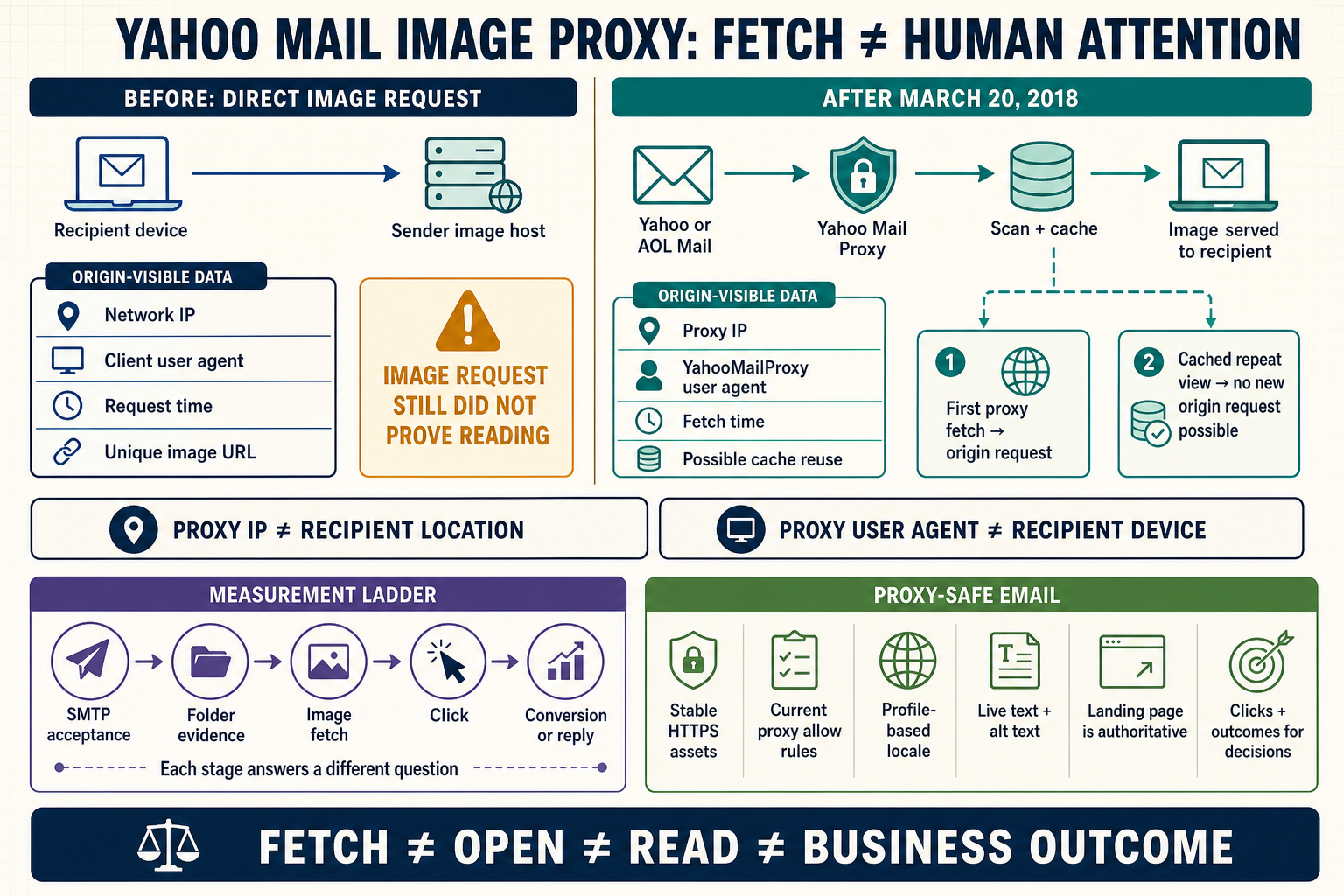
Email images are remote web resources. Before proxying, an allowed image request could travel from the recipient’s device or client network directly to the sender’s host. Origin logs might expose an IP address, user agent, request time and URL token. Senders used this event as an open proxy, device signal and dynamic-content trigger.
That model never proved human attention. Security scanners could request images, clients could block them, corporate gateways could rewrite paths, and text-only reading generated no image request. A tracking pixel measured a resource request, not comprehension or intent.
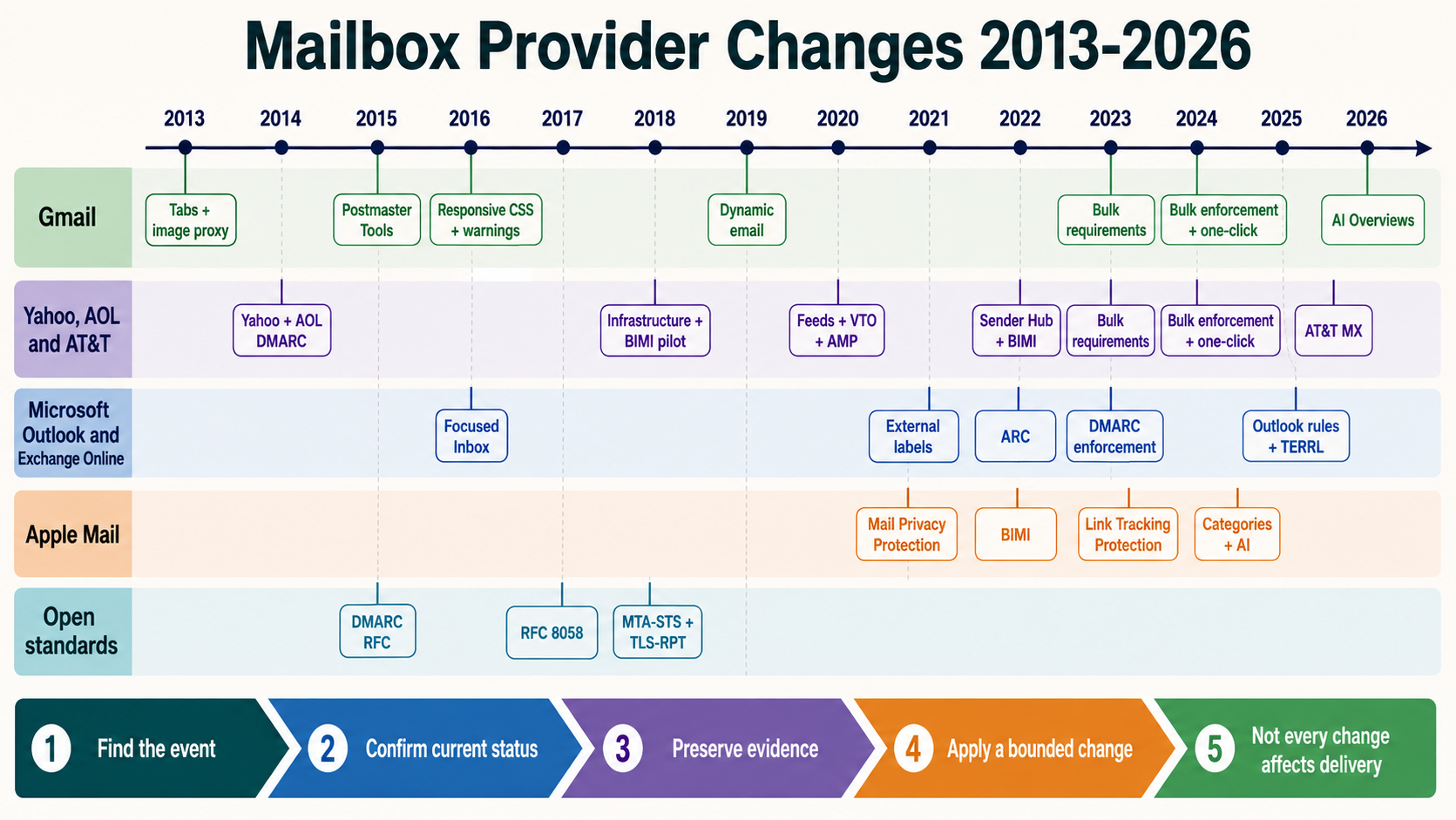
Gmail had introduced image proxying in 2013. Yahoo’s 2018 rollout extended a related privacy and security architecture to Yahoo and AOL consumers. Yahoo stated that all consumer desktop and mobile products would benefit and that the implementation was still being tested and adjusted.
The sender-facing impact depended on cache strategy and request behavior. The provider could fetch on demand, reuse a cached object, present its own IP and user agent, and protect the device from contacting the origin. A single campaign could therefore show origin requests that no longer mapped one-to-one to recipient devices.
How the system worked before the change
A direct image path connected the mail client to the sender’s CDN when images were enabled. A unique URL could identify the subscription or message, while the source IP was often mapped to approximate location. The user agent was used to infer client or device.
Dynamic-image vendors changed content at request time. A weather panel, countdown, nearest store or localized offer could depend on request IP and time. That design assumed the request originated from the person’s current network and occurred for every view.
Repeated requests were sometimes treated as repeated opens. Browser caches, mail-client caches and corporate proxies already weakened this assumption, but analysts still built engagement scores from counts without identifying fetch infrastructure.
Blocking remote images reduced tracking but could leave an email visually incomplete. Yahoo positioned secure proxying as a way to improve security and show messages as intended without exposing the same direct connection to the sender’s server.
What changed on the provider side
The Yahoo Mail applications began retrieving embedded images through Yahoo-controlled proxy servers. The sender’s image host observed a Yahoo proxy request rather than a direct device request. Current documentation identifies these requests with a `YahooMailProxy` user agent and publishes proxy network ranges.
Proxying separates origin evidence from recipient identity. The IP belongs to proxy infrastructure and should not be treated as the recipient’s home, company or current location. The user agent describes the fetch service, not necessarily the device rendering the message.
Caching can reduce repeated origin requests. A recipient can view an image served from cache without producing a new event at the sender’s host, while prefetch or security processing can create a request without meaningful reading. The exact behavior can evolve and should be measured rather than assumed from the announcement.
Personalization still works when the content is determined before send or encoded by a secure recipient-specific token. It becomes unsafe when the final content depends on proxy IP location, inferred device or a belief that every view creates a new origin fetch.
Message path before and after
Before
Recipient opens message with images enabled
    |
    v
Recipient device requests sender image URL
    |
    +----> origin sees network IP
    +----> origin sees client user agent
    +----> origin records request time
    +----> dynamic server chooses response
    |
    v
Image rendered in message
After
Recipient opens message
    |
    v
Yahoo or AOL Mail requests or reuses image
    |
    +----> Yahoo Mail Proxy fetches sender URL
    |          +----> origin sees proxy IP + YahooMailProxy
    |          +----> image scanned and cached
    |
    +----> cached image may avoid another origin request
    |
    v
Image rendered to recipient
    |
    +----> click, conversion or reply measured separately
Who and what the change affected
| Traffic or stakeholder | What changed | Required interpretation |
|---|---|---|
| Yahoo and AOL recipients | Their devices no longer needed to contact every sender image host directly. | Proxying improves separation but is not message encryption. |
| Tracking platforms | IP, user-agent and repeat-fetch precision changed. | Classify Yahoo proxy events and stop device-level claims. |
| Dynamic-content vendors | Request-IP geolocation became unreliable. | Use profile, declared locale or landing-page context. |
| CDNs and origin firewalls | Requests arrived from Yahoo networks and user agents. | Do not block verified current proxy traffic. |
| Deliverability analysts | Open data became more infrastructure-dependent. | Use clicks, replies, conversions and complaints. |
| Privacy teams | Direct recipient network exposure was reduced. | Review tokens, retention and profiling beyond IP. |
Effect on delivery, placement and recipient visibility
Image proxying does not decide SMTP acceptance or junk placement. A message can be rejected before images matter, delivered to spam with proxied images, or reach the inbox without a recorded origin request. Treat image behavior as rendering and measurement, not delivery proof.
Blocking Yahoo proxy ranges can create broken creative for many recipients. The current Sender Hub publishes proxy identification and advises senders not to rate-limit or block the service. Firewall changes should be based on the current provider list, not ranges copied from a historical article.
Open-rate movement after rollout could be a measurement discontinuity rather than a true behavior change. Compare Yahoo and AOL cohorts around the event, examine unique and total events, and preserve click and conversion trends. Do not retarget or suppress recipients solely because cached rendering changes the pixel.
Dynamic content needs graceful fallback. A nearest-store module based on proxy IP can show the proxy location. A countdown served from cache can become stale. Critical terms, prices, deadlines and security information belong in live text or a reliable landing page, not only a remotely chosen image.
Accessibility remains independent. Proxying may make images appear automatically, but alt text, semantic order, contrast and usable calls to action are still required. Images-off and assistive-technology tests remain part of acceptance.
Effect on measurement and diagnosis
Tag origin requests as Yahoo proxy based on the current documented user agent and validated network evidence. Do not permanently trust a user-agent string alone because it can be forged. Maintain a dated provider-range feed and record classification confidence.
Separate image requests into message-level unique fetch, repeat origin fetch, suspected scanner or proxy fetch and unknown. State that a unique fetch is not a unique attentive human. If a token identifies a recipient, protect it from exposure and limit retention.
Use a measurement ladder. SMTP logs measure acceptance. Seed and recipient evidence measure folder or rendering. Image requests measure resource retrieval. Clicks measure link activation. Conversions, replies and task completion measure stronger outcomes. Each layer has its own denominator.
Run controlled rendering tests across Yahoo web, iOS and Android, plus other major clients. Test first view, repeat view, forwarded message, cache-busting changes, images-off behavior and expired content. Do not use production recipient profiles merely to observe a pixel.
When comparing eras, mark March 2018 as an instrumentation change. Historical and current open rates may not be directly comparable. Preserve the analytics definition, vendor changes and privacy mechanisms in every trend report.
Advantages for email marketers
| Potential advantage | When the advantage is real | Evidence to verify |
|---|---|---|
| Reduced direct network exposure | Images are fetched through Yahoo infrastructure. | Origin sees documented proxy rather than device IP. |
| Safer consistent image display | The proxy fetches and serves valid content reliably. | Rendering tests across Yahoo surfaces. |
| Lower origin bandwidth through caching | Reusable assets are cached correctly. | Origin requests and CDN bytes by asset. |
| Better measurement discipline | Teams stop equating pixels with people. | Multi-signal reporting definitions. |
| More durable personalization | Content uses consented profile data and landing pages. | Correct locale and offer in controlled tests. |
Disadvantages and operational risks
| Cost or risk | How it appears | Control |
|---|---|---|
| Proxy IP is treated as recipient location | Many users appear in a data-center geography. | Ignore proxy IP for recipient localization. |
| Proxy user agent is treated as device | Client reports collapse into one fetch agent. | Use declared or on-site device context. |
| Cache suppresses repeat events | Multiple views produce one origin request. | Do not interpret total fetches as total reads. |
| Firewall blocks images | Yahoo recipients see broken modules. | Allow verified current proxy ranges. |
| Stale dynamic creative | Cached countdown or inventory becomes wrong. | Keep critical data as text and landing-page truth. |
| Open scoring becomes biased | Yahoo users look less or more engaged due to infrastructure. | Recalibrate with clicks and outcomes. |
What email teams needed to do at the time
- Identify proxy requests. Separate Yahoo/Oath fetches from direct device requests.
- Stop IP-based localization. Replace it with subscriber profile or click-time context.
- Audit dynamic images. Find countdowns, inventory, weather and nearest-location modules.
- Review CDN and firewall policy. Prevent valid proxy requests from being blocked.
- Annotate open-rate history. Mark the rollout as a measurement break.
- Add stronger outcomes. Use clicks, conversions, replies and complaints in engagement decisions.
- Test repeat views and forwarding. Observe cache behavior rather than assuming it.
- Protect accessibility. Preserve live text, alt text and images-off usability.
What email teams should do now
- Use current Yahoo proxy documentation. Refresh the user agent and network list from Sender Hub.
- Validate network ownership. Do not trust a copied string or stale IP list as proof.
- Keep localization consented. Prefer stored locale or a landing-page choice.
- Make the landing page authoritative. Price, inventory, expiry and security state should be current after click.
- Measure resource requests honestly. Label them fetches, not guaranteed opens by people.
- Build client-specific QA. Cover Yahoo and AOL web and mobile surfaces.
- Monitor origin errors. Alert on proxy 4xx, 5xx, latency, TLS and content-type failures.
- Use privacy-minimizing tokens. Avoid plaintext addresses and unnecessary long retention.
- Recalibrate engagement models. Prevent provider-specific proxy mechanics from driving suppression.
- Separate rendering from deliverability. Continue SMTP, authentication, complaint and placement diagnosis.
Worked deliverability scenario
A retailer serves a “nearest store” image based on request IP and counts every image request as an open. After the rollout, many Yahoo and AOL recipients see the same city, and repeat-open counts fall.
Origin logs show the `YahooMailProxy` user agent and data-center network addresses. The creative server used that IP to select location. Cached copies also meant a later view did not always return to the origin.
The retailer moves location selection to the subscriber’s declared preference and provides a clear “choose another store” landing page. The email includes live text for the offer deadline and alt text for the image. Analytics label image fetches separately from clicks and purchases.
Location errors disappear and the campaign remains usable when images are off or cached. The open series is annotated as a measurement break; decisions are made from clicks, purchases, complaints and subscription retention.
Evidence and diagnostics
- Origin request: URL token, timestamp, source network, user agent, status, content type and bytes.
- Proxy classification: current Yahoo documentation, validated network and confidence.
- Cache test: first view, repeated view, forwarded copy, changed URL and expiry behavior.
- Rendering test: Yahoo web and mobile, AOL surfaces, images off, dark mode and text scaling.
- Dynamic decision: profile inputs, IP use, time, inventory and fallback.
- Accessibility: alt text, live text, contrast, reading order and linked-image purpose.
- Outcome: clicks, conversion, reply, complaint, unsubscribe and task completion.
- Delivery: SMTP response, authentication, folder evidence and recipient domain kept separate.
- Privacy: token design, retention, access and onward sharing.
Failure modes and incorrect conclusions
- Calling an image fetch a human open. Proxy and scanner actions can occur without attention.
- Using proxy IP for geolocation. It describes infrastructure, not recipient location.
- Using proxy agent for device detection. It does not reliably identify the rendering device.
- Blocking proxy networks. It breaks images at scale.
- Embedding critical facts only in images. Cache, accessibility and images-off behavior can make them wrong or unavailable.
- Comparing open rates across the rollout without annotation. Instrumentation changed.
- Calling proxying inbox placement. It occurs at the content-fetch layer after delivery decisions.
Current status and superseding changes
Yahoo Mail Proxy remains active for content embedded in mail sent to Yahoo-managed users. Current Sender Hub documentation publishes a `YahooMailProxy` user agent and current IPv4 and IPv6 ranges used to fetch embedded resources.
Yahoo recommends that senders not block or rate-limit documented proxy traffic because doing so can create a broken recipient experience. Operators should always consult the current list, since infrastructure ranges can change after this article’s publication.
Proxying reduces the value of recipient-IP location and device inference from image logs. It does not eliminate all tracking, guarantee one fetch per view or make pixel data a reliable measure of human attention.
The current operating rule is to design proxy-safe email: stable assets, valid TLS and content types, noncritical dynamic images, strong fallback, accessible live text, privacy-minimizing tokens and outcome measurement beyond opens.
Operator checklist
- Record March 20, 2018 as the provider announcement date.
- Separate direct device requests from Yahoo proxy requests.
- Do not use proxy IP or user agent as recipient identity.
- Audit cache-sensitive and location-sensitive creative.
- Use the current Sender Hub range list rather than a historical copy.
- Keep critical information in accessible live text and the landing page.
- Test first view, repeat view, forwarding and images-off behavior.
- Annotate historical open-rate discontinuities.
- Use clicks, conversions, replies and complaints for stronger decisions.
- Keep image fetching separate from SMTP and inbox-placement claims.
Primary and contemporaneous references
- Yahoo Developer Network: Secure Images: Primary March 20, 2018 announcement.
- Yahoo Postmaster archive: Secure Images: Provider archive with rollout scope and cautions.
- Yahoo Sender Hub: Mail Proxy Servers: Current proxy identification and network guidance.