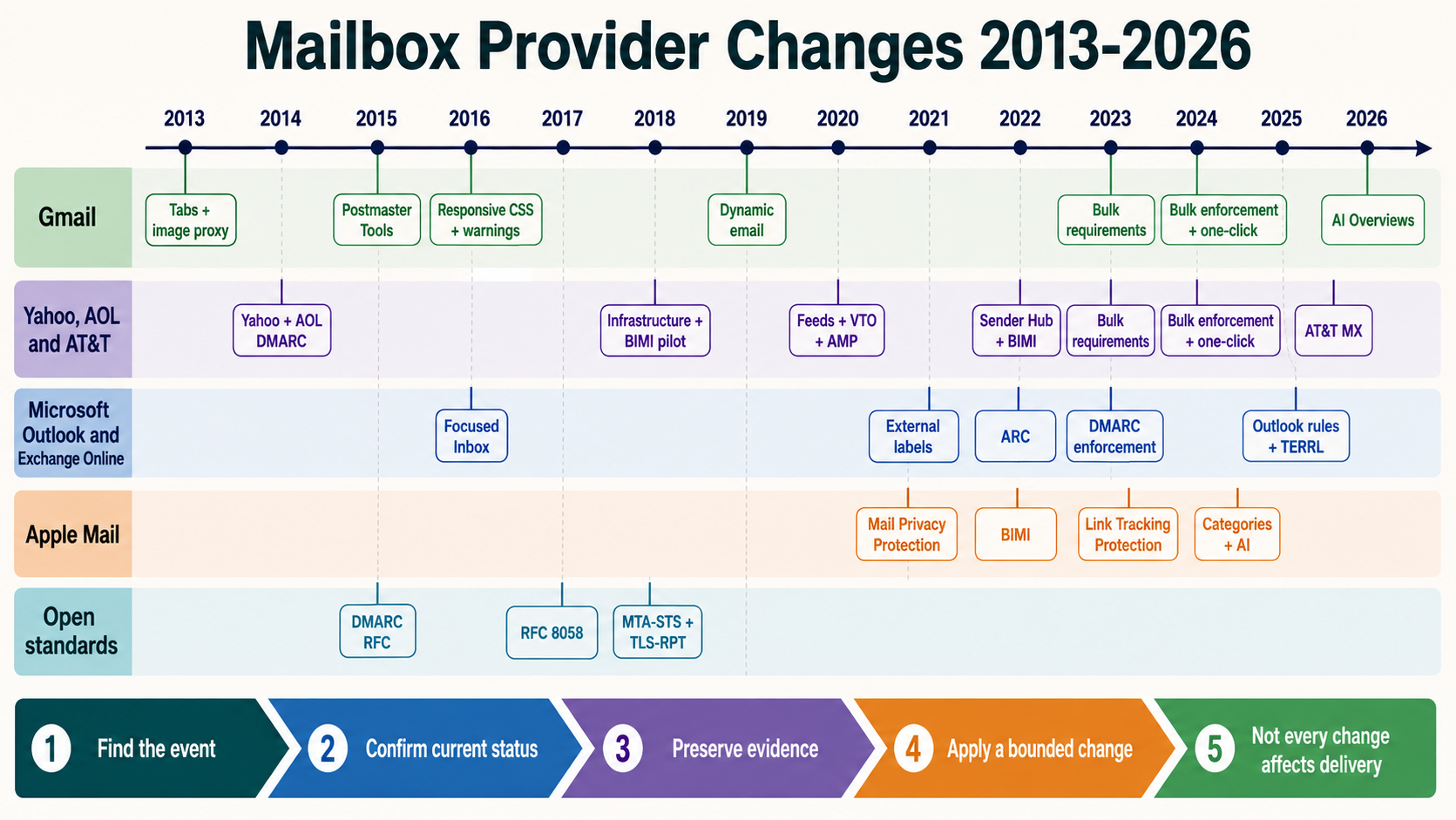
Gmail Image Proxy in 2013: What Automatic Image Loading Changed for Marketers
On December 12, 2013, Google announced that Gmail would display external images automatically and serve them through Google-controlled secure proxy servers. The change improved recipient safety and made image-rich messages easier to view, but it weakened several assumptions behind pixel-based measurement. A remote image request could no longer be treated as a direct connection from the recipient’s device, so IP address, user agent, location and repeat-load interpretation required new limits.
The dated mailbox-provider change
| Event field | Verified value | Why it matters |
|---|---|---|
| Historical event date | December 12, 2013 | This is the provider-change date, not the NitWings publication date. |
| Mailbox provider | Gmail | The affected provider estate determines which recipient cohorts require separate evidence. |
| Change area | Measurement/privacy | This identifies whether the change altered authentication, filtering, visibility, measurement or sender operations. |
| Current status | active-and-evolved | Historical instructions are interpreted against the feature or standard that exists now. |
Google’s announcement said desktop rollout would begin that day and Gmail mobile applications would follow in early 2014. Users who preferred per-message authorization could select “Ask before displaying external images,” and accounts already using that preference would retain it. The change therefore combined a new default with an available user control rather than forcing an identical experience on every mailbox.
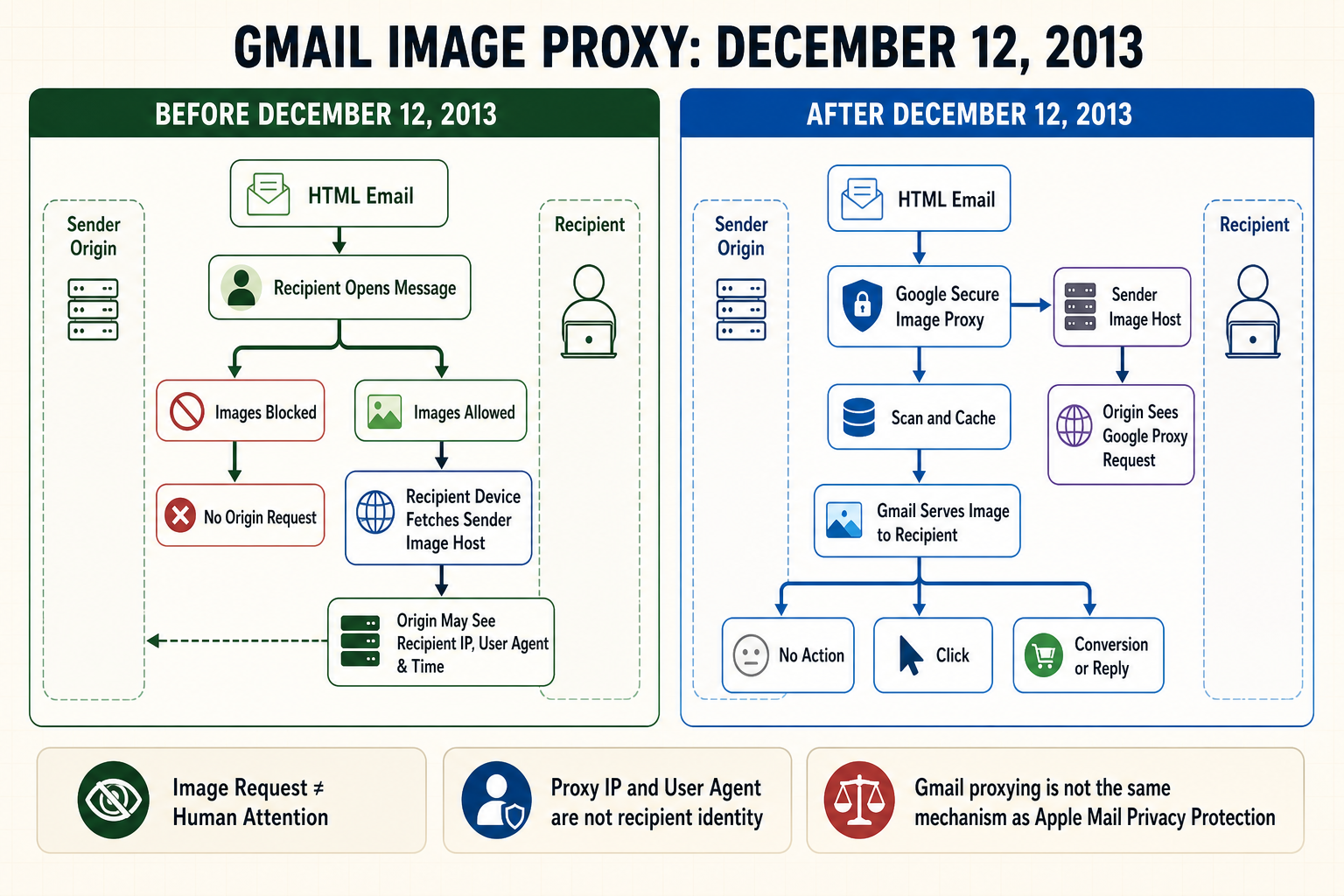
At the time, many campaign systems embedded a unique one-pixel image URL in each HTML message. When a client requested that URL, the sender or analytics service recorded a presumed open together with the connecting IP address, timestamp and HTTP headers. Some systems used those attributes for approximate geography, device classification, real-time content and repeated-open analysis. Gmail’s proxy inserted provider infrastructure between the mailbox client and the sender’s image server.
The event is often described too broadly as “Gmail killed open tracking.” That is inaccurate. A unique image URL could still be requested and produce an observable event. What changed was the meaning and network origin of that request. The sender could see Google infrastructure instead of a recipient connection, caching could reduce later origin requests, and automatic display increased the chance of an image request when a message was viewed. The measurement became more indirect, not universally absent.
This change preceded Apple Mail Privacy Protection by almost eight years and should not be conflated with it. Gmail’s 2013 proxy was primarily described as secure image serving and automatic display. Apple’s later privacy system introduced preloading behavior that could create machine-generated loads without a conventional human open. Both reduce recipient-level network inference, but their event-generation behavior and operational interpretation are not identical.
How the system worked before the change
Before the proxy change, Gmail commonly asked before showing external images from an unfamiliar sender. If a recipient allowed the images, the client could request each remote asset from the sender’s image host. That connection exposed an IP address and HTTP request attributes to the host. Depending on the client and network, those attributes could be interpreted as approximate location, device family and load time.
Direct fetching also created a security and privacy boundary. A malicious or compromised image host could observe requests, vary content after send, attempt device-specific responses or serve harmful content. Gmail could block suspicious images and offer user controls, but the sender-controlled origin still participated directly when the client fetched an asset.
For marketers, image blocking suppressed some open-pixel events even when a person read the visible text. Open rate was therefore never a complete count of human readers. The pre-2013 model contained at least four populations: people who opened and loaded images, people who read with images blocked, messages opened in clients with different image behavior, and messages never viewed. The proxy change altered those populations but did not create the original blind spot.
Dynamic-image systems could also return different content based on request time, location, device or inventory. A countdown, weather block or local-store image might be selected at the moment of fetch. Direct requests made some of those decisions possible, although they also created privacy, cache, accessibility and consistency risks.
What changed on the provider side
After the change, Gmail fetched remote images through Google’s secure proxy and served the resulting assets to Gmail users. The sender’s image host saw a request associated with Google infrastructure rather than a clean recipient-to-origin connection. Google described scanning images for known viruses or malware and improving safety, speed and convenience by displaying images automatically.
The proxy changed the trust boundary. Gmail became the retrieval intermediary, and the origin no longer controlled a direct network relationship with the mailbox client. IP-based geolocation and user-agent-based device detection could identify the proxy rather than the recipient. Systems that personalized image bytes from those request attributes could return the wrong variant or the same cached response to later views.
Caching behavior also complicated repeated-open analysis. If Gmail reused an image already retrieved for the same URL, the origin might not receive a new request for every display. Conversely, a unique URL, cache state, forwarding behavior or provider implementation could produce more than one origin request. A sound measurement policy therefore stopped translating one request into one person and stopped translating several requests into several reading sessions without additional evidence.
Automatic display improved the probability that an HTML message would show its intended imagery, but it did not guarantee image visibility. Users could keep image prompting, network failures could occur, an image URL could fail, Gmail could reject unsafe content, and plain-text or accessibility experiences might not use the image. Critical meaning still needed to exist in live text with appropriate alternative text.
Message path before and after
Before
Sender sends HTML email
        |
        v
Gmail accepts and places message
        |
        v
Recipient opens message
        |
        +----> Images blocked: no origin request
        |
        +----> Recipient permits images
                    |
                    v
Recipient device requests sender image host
                    |
                    v
Origin sees device IP, headers and request time
After
Sender sends HTML email
        |
        v
Gmail accepts and places message
        |
        v
Google secure image proxy requests sender image host
        |
        +----> Origin sees Google proxy request
        |
        v
Gmail serves image to mailbox client
        |
        v
Recipient may view, ignore or act
        |
        +----> Click and conversion systems provide separate evidence
Who and what the change affected
| Traffic or stakeholder | What changed | Required interpretation |
|---|---|---|
| HTML marketing messages with remote images | Images were normally displayed through Gmail’s proxy instead of a direct client-origin request. | Keep image hosting reliable, but do not identify proxy network data as recipient network data. |
| Unique tracking pixels | A proxy request could still generate an event, while its origin and repeat behavior changed. | Define the metric as an observed image load, not a verified human open. |
| Location and device personalization | IP address and user agent could describe Google infrastructure. | Use declared preferences, account data or click/session context where lawful and appropriate. |
| Dynamic images and countdowns | Caching and proxy retrieval could prevent per-view or per-recipient refresh assumptions. | Provide stable useful fallback content and test Gmail behavior with the production URL pattern. |
| Recipients concerned about remote content | Google scanned and intermediated image delivery, while a per-message preference remained available. | Respect the user setting and never make critical information image-only. |
| Deliverability and abuse teams | Open telemetry became less suitable for distinguishing wanted mail, inactivity or placement. | Use complaints, bounces, clicks, conversions, replies and provider evidence alongside image loads. |
Effect on delivery, placement and recipient visibility
The image proxy did not directly change SMTP authentication, acceptance or queue behavior. A message still needed valid addressing, acceptable content, healthy reputation and successful provider evaluation. The change occurred after or around message presentation, so an image request could not prove that the sending transaction was healthy across the whole audience.
Automatic image display could improve the visual experience for recipients who previously saw blank boxes or prompts. Better presentation could support recognition and interaction when the design remained accessible. That potential benefit did not override spam filtering or category classification. A message in spam could still be spam, and a Promotions-tab message could still be successfully delivered to the inbox.
The larger deliverability consequence was analytical. Teams that used non-openers as the main definition of inactivity could classify Gmail subscribers incorrectly if proxy and cache behavior changed event counts. An aggressive sunset or re-engagement decision based on a distorted open field could suppress people who were active through clicks or purchases, or continue mailing people whose proxy-related event was mistaken for engagement.
Location-based send-time optimization and device-specific creative decisions also became less dependable when derived from the image request. If the proxy IP mapped to a Google facility, a marketer might send at the wrong local hour. If the user agent represented a proxy fetcher, the platform might choose an inappropriate image or misreport the client mix. Deliverability operations should not use such inferred attributes to justify reputation changes without corroboration.
The proxy strengthened a principle that remains current: sender reputation and recipient value cannot be reduced to open rate. Gmail provider signals, spam complaints, bounces, unsubscribes, qualified clicks, conversions and long-term retention provide different pieces of evidence. Each has limitations, but together they are safer than treating one remote asset request as human intent.
Effect on measurement and diagnosis
An image-load event after December 2013 answered a narrower question: the URL was requested through the Gmail image-delivery system. It did not reveal the recipient’s public IP, reliable physical location or direct device user agent. It did not prove that the person noticed the image, read the copy or understood the offer. Even before proxying, those stronger claims were unjustified; the proxy made the gap more visible.
Open rates could move upward when images displayed automatically for people who previously left them blocked. A trend break near rollout should therefore be annotated in historical reporting. Comparing a pre-change open baseline directly with a post-change baseline without provider segmentation can create a false improvement. The appropriate response is not to “correct” the numbers with an invented universal factor, but to document the measurement regime and prioritize consistent outcome metrics.
Repeated opens became especially difficult to interpret. An origin might see one proxy fetch followed by several recipient displays served from cache, or several requests caused by URL differences and system behavior. Neither pattern maps reliably to reading sessions. Frequency, time-spent and “forwarded to colleagues” claims based only on pixel requests should be removed from decision logic unless independently supported.
Clicks remain imperfect but usually require a more deliberate interaction than an image load. Conversion, purchase, product use, renewal, reply and authenticated account events sit even closer to business outcomes. Use unique, privacy-respecting identifiers and declared attribution windows; do not compensate for lost network data by hiding fingerprinting or evading provider privacy controls.
Advantages for email marketers
| Potential advantage | When the advantage is real | Evidence to verify |
|---|---|---|
| Images display with less recipient friction | The user retains automatic display and the image host responds correctly. | Successful proxied image responses, reduced broken-image reports and downstream interaction. |
| Provider-side security scanning | Gmail can retrieve and evaluate remote assets before serving them. | Google’s documented proxy behavior and absence of unsafe-resource warnings. |
| More consistent visual presentation | Templates include proper dimensions, fallbacks and stable URLs. | Rendering tests across Gmail web and mobile plus image-blocked review. |
| Less exposure of recipient network attributes | The proxy prevents a direct image-origin connection. | Origin logs show proxy infrastructure rather than recipient IP and device data. |
| Pressure to improve outcome measurement | Teams replace pixel-only engagement logic with clicks, conversions and provider evidence. | Documented metric definitions and decisions that do not depend on an unverifiable human open. |
Disadvantages and operational risks
| Cost or risk | How it appears | Control |
|---|---|---|
| Loss of recipient IP and user-agent fidelity | Reports show Google infrastructure or generic request attributes. | Remove recipient geography and device claims from proxy requests. |
| Caching hides or reshapes repeat loads | Origin request counts differ from visible displays. | Do not use pixel requests as a session counter; use deliberate downstream events. |
| Dynamic images become stale or incorrect | A countdown, stock status or location creative does not refresh as expected. | Put essential truth in live text and test cache-safe, non-deceptive fallbacks. |
| Historical trend discontinuity | Open rate changes near rollout without a comparable change in clicks or conversion. | Annotate the measurement change and segment by mailbox provider and client regime. |
| False engagement in lifecycle rules | A proxy-related event keeps an inactive address eligible for more mail. | Use a hierarchy of clicks, purchases, replies, account activity and bounded open evidence. |
| Tracking-evasion temptation | Teams rotate URLs or use covert fingerprinting to defeat caching or privacy. | Respect provider controls, minimize data and measure outcomes transparently. |
What email teams needed to do at the time
- Annotate December 12, 2013 in reporting. Mark the Gmail measurement-regime change before comparing historical open trends.
- Segment Gmail from other mailbox providers. Avoid allowing unaffected traffic to hide or exaggerate the change.
- Remove IP-based recipient claims. Treat connecting addresses and user agents as proxy infrastructure unless separately proven.
- Test unique and shared image URLs. Observe cache behavior without attempting to circumvent user privacy.
- Validate image fallbacks. Ensure live text, dimensions, alternative text and CTA meaning survive blocked or failed images.
- Review dynamic-image dependencies. Move price, deadline, order and safety-critical facts into reliable message text.
- Rebuild inactivity rules. Combine open observations with clicks, purchases, replies and other legitimate account activity.
- Preserve raw event semantics. Store “image request observed” separately from any derived “open” field so models can be corrected later.
What email teams should do now
- Define opens as directional telemetry. Do not describe an image request as proof that a person read the message.
- Distinguish Gmail proxying from Apple MPP. Both affect privacy and measurement, but do not assume identical prefetch or cache behavior.
- Use outcome-led engagement states. Prefer clicks, conversions, replies, authenticated activity, subscription changes and purchase events.
- Keep image infrastructure dependable. Serve HTTPS assets with correct MIME type, dimensions, availability and controlled cache behavior.
- Design for no-image use. Maintain useful live text, semantic structure, alternative text and a visible accessible action.
- Stop recipient fingerprinting from proxy attributes. Do not infer location, device or identity from Google network requests.
- Audit automated journeys. Check whether proxy-related opens trigger lead scoring, resend logic, sales alerts or sunset decisions.
- Use controlled incrementality. When measuring campaign value, compare eligible treatment and holdout groups rather than optimizing a proxy metric.
- Retain privacy and data-governance evidence. Document collection purpose, retention, access and metric limitations for message events.
Worked deliverability scenario
A publisher’s automation sends a second subject line to everyone who did not open within six hours. After Gmail automatic image display expands, its reported Gmail open rate increases, and the resend audience shrinks. Revenue does not rise, while some subscribers complain that the program still feels repetitive.
The original workflow equated an image-load timestamp with meaningful reading. It also ignored clicks on the website and authenticated article views. The team inspects raw events and finds that Gmail requests originate from proxy infrastructure and repeat-load patterns do not match user sessions. The “opened” field is unsuitable as the only branch condition.
The corrected workflow gives strongest weight to subscription changes, clicks, authenticated content use and conversions. A recent image load can remain a bounded weak signal, but it cannot by itself trigger sales outreach or prevent sunset review. The resend uses a minimum delay, excludes anyone with a click or site session, enforces a recent-contact cap and maintains a randomized no-resend holdout.
Results show that the resend adds little incremental content consumption and produces more unsubscribes among high-frequency Gmail subscribers. The team removes the blanket resend rather than attempting to recover more precise recipient IP or device data. It retains the original image-load event for audit, documents the new interpretation and evaluates future changes using incremental outcomes.
Evidence and diagnostics
- Origin request logs: URL, timestamp, response status, cache headers, connecting network and user agent, explicitly labelled as proxy-observable data.
- Message identity: campaign, recipient key, Message-ID, template checksum, image URL strategy and send timestamp.
- Client regime: mailbox provider, known client family when legitimately available, image-setting fixture and test-account configuration.
- Downstream actions: privacy-respecting click, qualified session, conversion, reply, account activity, unsubscribe and complaint events.
- Automation decisions: rule version, input evidence, branch selected, frequency cap, suppression check and holdout assignment.
- Rendering evidence: Gmail web and mobile screenshots, image-blocked state, alternative text, HTTPS response and failed-origin behavior.
- Trend annotation: rollout window, pre/post metric definition, Gmail cohort size and any unrelated campaign or audience changes.
- Governance evidence: collection purpose, retention period, access controls, user notice and prohibited inferences.
Failure modes and incorrect conclusions
- Claiming every Gmail image request is a human open. Proxy retrieval proves a request, not attention or comprehension.
- Claiming Gmail proxying is identical to Apple MPP. Similar privacy consequences do not make their fetch behavior interchangeable.
- Using proxy IP for geolocation. The location can describe provider infrastructure and route personalization incorrectly.
- Counting origin requests as reading sessions. Caching, URL structure and system behavior can merge or multiply requests.
- Making critical content dynamic-image only. Cached, failed or inaccessible imagery can present stale or missing facts.
- Evading privacy controls. Cache-busting or fingerprinting may increase data risk without producing trustworthy engagement evidence.
- Changing delivery infrastructure to repair analytics. IP or domain rotation cannot restore recipient-level image telemetry and may damage reputation continuity.
Current status and superseding changes
Gmail continues to use an image URL proxy architecture for external images, and Google Workspace administrators can manage allowlist behavior for internal image proxy use cases. The 2013 change remains operationally relevant, but modern analysis must also account for many later client and privacy changes. The historical event should not be used as a universal specification for every present-day request sequence.
Open telemetry is now affected by mailbox-provider proxying, client prefetching, security scanners, privacy products, corporate gateways and user settings. A mature event model stores the raw observation and its source, then assigns confidence according to the decision being made. A weak signal may be acceptable for aggregate creative diagnostics but unsafe for individual lead scoring, inactivity suppression or claims of human attention.
The practical marketer advantage remains improved automatic image presentation and a safer recipient experience. The cost is reduced recipient-level network information and more ambiguous repeated-open data. The correct modern response is not to defeat the proxy. It is to design resilient messages, measure deliberate outcomes and govern automated decisions according to evidence strength.
Operator checklist
- Display December 12, 2013 as the provider-change date and note the early-2014 mobile rollout.
- Store raw image requests separately from derived open and engagement classifications.
- Label IP, user-agent, location and repeat-load fields as unreliable for proxied Gmail images.
- Test Gmail web, Android, iOS, image-blocked and failed-image message states.
- Keep important claims, dates, prices and actions in accessible live text.
- Review automation, scoring, resend and sunset logic for pixel-only decisions.
- Use clicks, conversions, replies, account activity and provider evidence where appropriate.
- Separate Gmail proxy effects from Apple MPP and other security-scanner behavior.
- Respect privacy controls and prohibit cache-evasion or recipient fingerprinting.
- Annotate metric-definition changes before comparing historical performance.
Primary and contemporaneous references
- Google: Images Now Showing: The December 12, 2013 announcement, proxy description and rollout.
- Google Workspace Admin: Set up an image URL proxy allowlist: Current administrative description of Gmail image proxy behavior.
- Google: Email sender guidelines: Current sender and message-quality requirements, separate from image measurement.
- Apple: Mail Privacy Protection: Primary documentation used to distinguish Apple preloading from Gmail proxying.