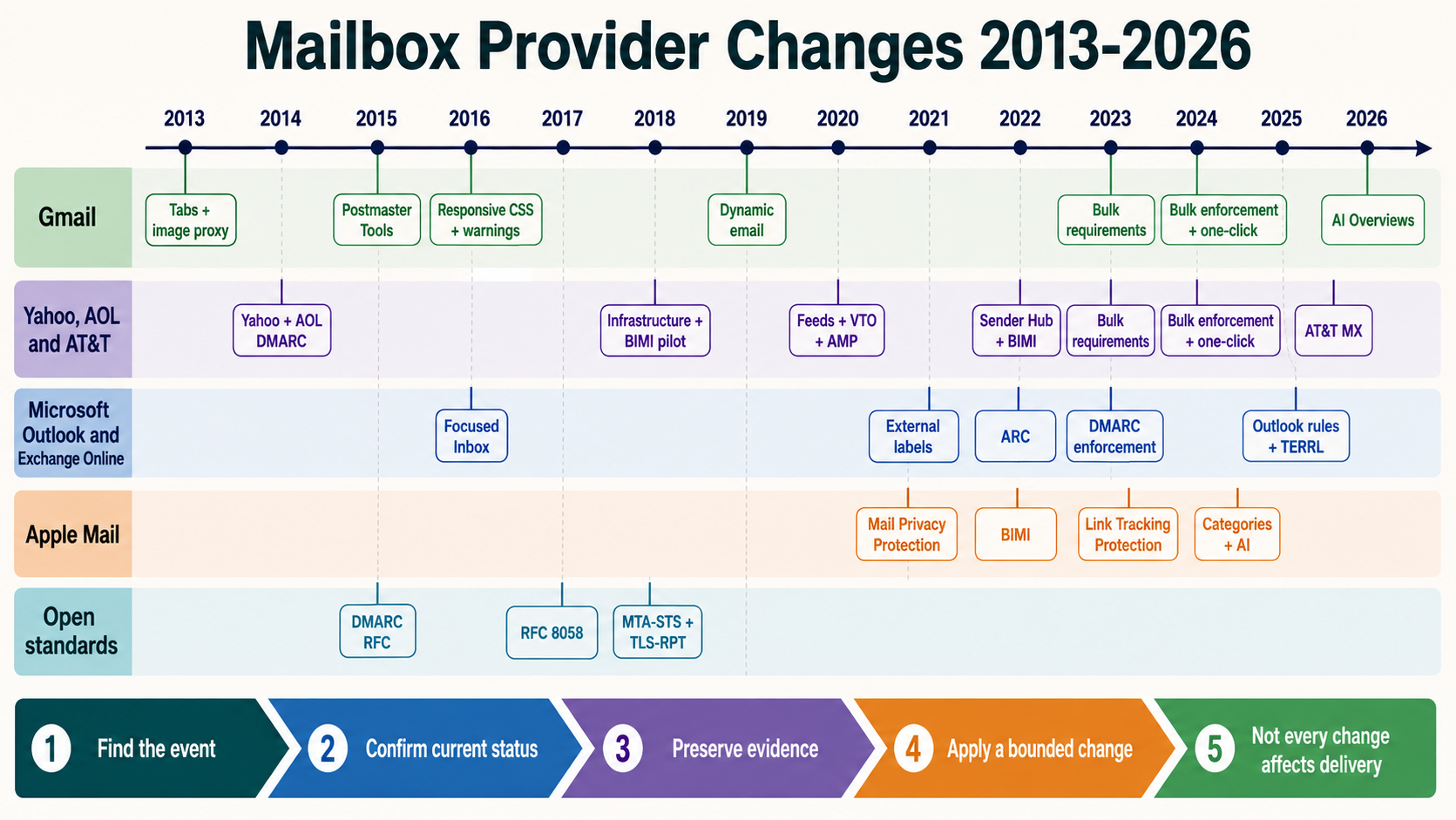
Yahoo View Time Optimization in 2020: Delivery Timing Moved Closer to Inbox Access
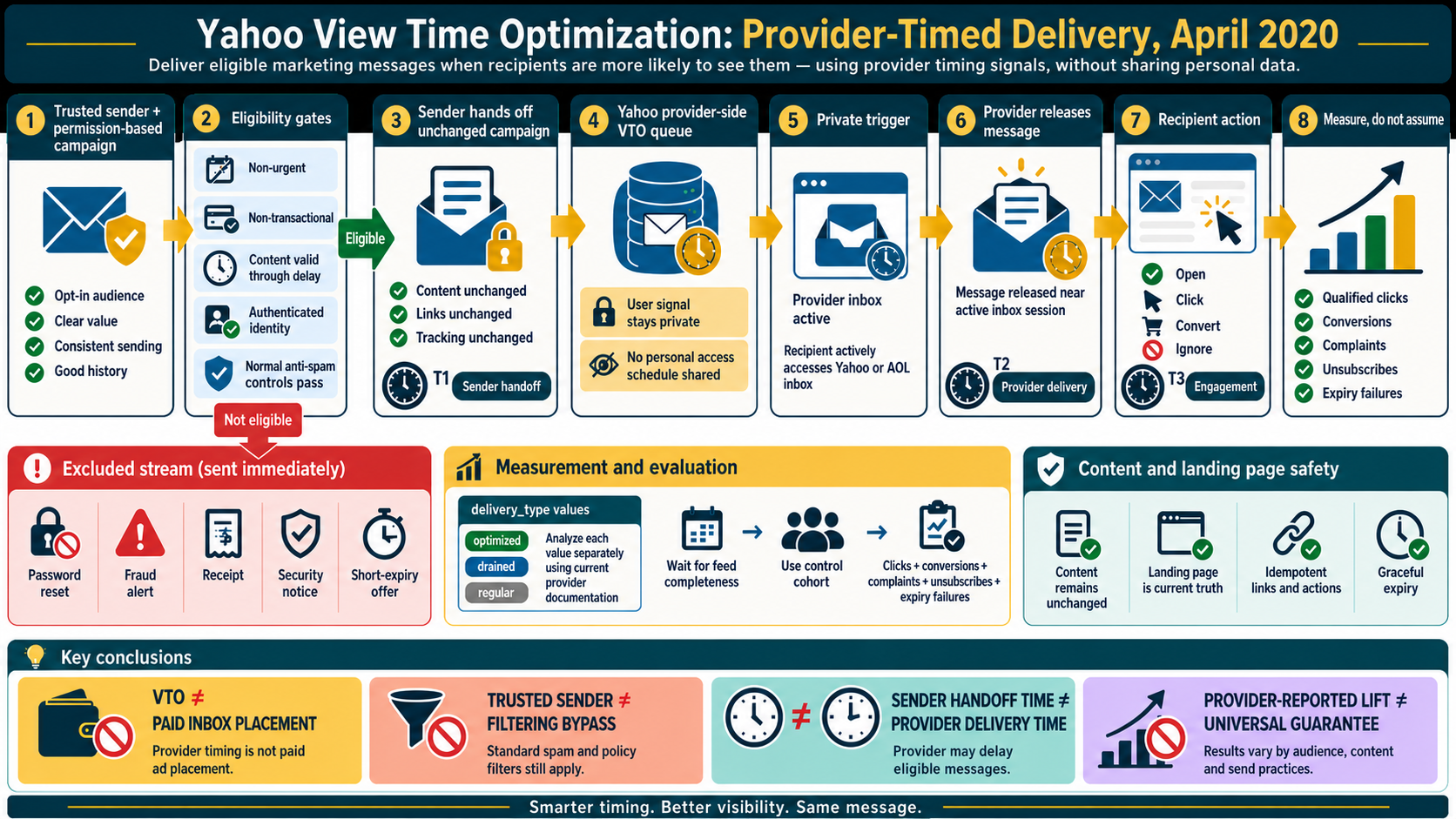
On April 8, 2020, Yahoo Postmaster announced View Time Optimization, or VTO, for trusted senders and brands. Instead of asking a sender to infer when a recipient might open mail from tracking history, the provider could queue an already accepted, permission-based campaign and trigger delivery when that Yahoo or AOL user actively accessed the inbox. A detailed April 21 clarification said the content stayed the same, VTO was not paid inbox advertising, anti-spam controls still applied, and user access signals or personal data were not shared with the sender. VTO changed delivery timing inside the mailbox-provider estate. It did not create permission, bypass filtering, guarantee an open or make every campaign safe to hold.
The dated mailbox-provider change
| Event field | Verified value | Why it matters |
|---|---|---|
| Historical event date | April 8, 2020 | This is the provider-change date, not the NitWings publication date. |
| Mailbox provider | Yahoo Mail ecosystem | The affected provider estate determines which recipient cohorts require separate evidence. |
| Change area | Delivery timing | This identifies whether the change altered authentication, filtering, visibility, measurement or sender operations. |
| Current status | provider-controlled-trusted-sender-capability-documented-in-current-performance-feed | Historical instructions are interpreted against the feature or standard that exists now. |
Send Time Optimization traditionally predicted an individual’s likely open time from historical engagement. That history often depended on tracking pixels and sender-side models. Image proxying, privacy restrictions and incomplete open evidence weakened the precision of those predictions.
Yahoo argued that the provider already knew when a user was actively accessing its service and could make a timing decision without exporting that signal. VTO moved the final timing decision closer to the inbox and kept the access event inside the provider boundary.
The April 8 announcement described improved visibility near the top of the inbox and reported that participating senders had observed four-times opens and two-times clicks. Those were provider-reported program observations, not a universal performance guarantee or an experimental benchmark for every sender.
The April 21 clarification narrowed common misunderstandings. VTO worked with messages consumers had subscribed to and would otherwise receive. It changed timing, not content, did not sell inbox access and did not turn promotional mail into an ad product exempt from normal controls.
How the system worked before the change
With ordinary campaign delivery, the sender chose a send time and transmitted the message. Yahoo accepted, filtered and placed it according to current policy and reputation. If the recipient opened the inbox hours later, newer mail could appear above the campaign.
STO attempted to improve that timing before handoff. A model predicted the recipient’s likely activity window, and the sender scheduled delivery accordingly. Predictions could be wrong, time zones could change and privacy controls could distort open histories.
The sender owned one principal campaign timestamp but still needed to distinguish queue injection, SMTP acceptance and provider placement. Many dashboards collapsed all three into “sent,” making timing experiments difficult to reproduce.
Urgent messages were already poor optimization candidates. A password reset, fraud warning, receipt or short-lived deadline needs prompt processing based on purpose, not a predicted future inbox session.
What changed on the provider side
VTO inserted a provider-side queue after the sender handed off an eligible campaign. The provider could release the message when the recipient accessed Yahoo Mail or AOL Mail, placing the message nearer that active inbox session.
The provider stated that it did not share the triggering activity or personal data with the brand. The sender received an optimized capability and aggregate performance evidence, not the recipient’s private inbox-access schedule.
Yahoo said anti-spam and anti-abuse systems remained in effect. A sender could not pay to place unsolicited mail or use VTO to avoid reputation controls. Recipients retained blocking and unsubscribe controls.
Current Campaign Performance Feed documentation includes a delivery_type dimension with optimized, drained and regular values. That field lets approved analysts separate provider-timed delivery states instead of mixing them into one campaign total.
Message path before and after
Before
Sender chooses campaign time or predicts with STO
    |
    v
Sender MTA -> Yahoo acceptance and filtering -> inbox delivery
    |
    v
Recipient may access inbox much later
    |
    v
Campaign can be below newer messages
After
Trusted sender hands off eligible permission-based campaign
    | authentication + reputation + anti-abuse checks
    v
Yahoo provider-side VTO queue
    | content remains unchanged; user signal stays private
    v
Recipient actively accesses Yahoo or AOL inbox
    | provider trigger
    v
Optimized delivery near active inbox session
    |
    v
Aggregate feed reports delivery type and campaign outcomes
Who and what the change affected
| Traffic or stakeholder | What changed | Required interpretation |
|---|---|---|
| Trusted senders and brands | Approved permission-based campaigns could use provider-timed delivery. | Program access and eligibility remain provider-controlled. |
| Yahoo and AOL recipients | Subscribed mail could arrive near an active inbox session. | Users still control blocking and unsubscribe. |
| Campaign planners | Sender handoff and provider delivery became separate clocks. | Offers and content must remain valid through queue delay. |
| Deliverability teams | Normal authentication, reputation and filtering still applied. | Do not treat VTO as an allowlist or placement guarantee. |
| Analytics teams | Delivery type distinguished optimized, drained and regular states. | Segment before comparing performance. |
| Privacy teams | Inbox-access triggers remained inside Yahoo. | Do not reconstruct individual activity from aggregates. |
Effect on delivery, placement and recipient visibility
VTO is not sender certification. Trusted access does not guarantee that every submitted message reaches inbox or that future traffic bypasses spam controls. The program operates within Yahoo’s authentication, reputation, complaint and anti-abuse systems.
Permission quality is foundational. Yahoo’s clarification repeatedly described messages users had opted into and wanted. Timing an unwanted message near inbox access can make it more visible and may accelerate complaints. VTO amplifies relevance only when the underlying subscription and content are sound.
Campaign purpose determines whether delay is safe. Newsletters, broad promotions and evergreen discovery may tolerate a provider queue. Security notices, password resets, receipts, regulatory notices, expiring authentication links and operational alerts should follow prompt-purpose delivery.
Creative and landing-page state must survive the hold. Inventory, price, code and expiry can change between sender handoff and provider release. Use sufficiently long validity, server-side current truth and graceful expired-offer behavior. Never make a recipient act on stale terms merely because the email appeared at an optimized time.
Suppression deserves special attention. A recipient may unsubscribe after the sender hands off a campaign but before provider delivery. The sender should follow the provider program’s documented eligibility and cancellation behavior and avoid assuming it can recall mail already accepted. Use appropriate campaign selection, short safe validity and prompt future suppression.
Effect on measurement and diagnosis
Store at least three clocks: sender campaign release, Yahoo acceptance or handoff, and provider delivery event. Engagement belongs after the provider delivery clock. Calculating “time to open” from sender handoff makes a deliberate hold look like slow engagement.
Segment by delivery_type. Compare optimized, drained and regular delivery only after defining how each state enters the feed and waiting for complete reporting. Do not silently pool types when evaluating a VTO test.
Use randomized or otherwise defensible controls where the program allows. Eligible optimized recipients can differ from regular recipients in activity and provider context, producing selection bias. A simple optimized-versus-regular average does not prove the timing mechanism caused the difference.
Report outcomes beyond opens: clicks, conversions, revenue, complaints, unsubscribes, expiry failures, delayed-message support contacts and long-term retention. The provider’s historical four-times-open and two-times-click observations should be labelled as reported results, not planning assumptions.
Protect privacy. Aggregate feed dimensions can show campaign and delivery behavior, but teams should not reverse-engineer an individual’s inbox-access schedule. Apply minimum cohort sizes, access control, approved retention and documented uses.
Advantages for email marketers
| Potential advantage | When the advantage is real | Evidence to verify |
|---|---|---|
| More timely visibility | A wanted message is released near active inbox access. | Qualified outcomes improve without complaint harm. |
| Less sender-side tracking dependence | Provider retains the private activity trigger. | No user access schedule is exported. |
| Reduced prediction error | Provider uses current service access rather than stale open history. | Controlled cohort timing improves. |
| Clear delivery-state evidence | Campaign feed retains delivery type. | Optimized, drained and regular rows remain separate. |
| Better evergreen discovery | Content remains valid throughout allowed delay. | Expiry and inventory failures stay low. |
Disadvantages and operational risks
| Cost or risk | How it appears | Control |
|---|---|---|
| Urgent mail is held | A critical action arrives too late. | Exclude transactional, security and deadline-critical streams. |
| Offer expires in queue | Recipient sees invalid price or code. | Use long validity and authoritative landing-page checks. |
| Selection bias is called lift | More active users enter optimized cohorts. | Use defensible controls and disclose eligibility. |
| VTO is treated as paid placement | Teams assume filtering no longer applies. | Maintain normal sender and permission controls. |
| Trigger data is reconstructed | Aggregates are used to infer personal routines. | Enforce privacy thresholds and purpose limits. |
| One timestamp drives analytics | Provider delay corrupts time-to-action. | Store handoff, delivery and engagement clocks. |
What email teams needed to do at the time
- Confirm program eligibility. Use the provider channel for trusted senders and approved campaigns.
- Classify campaign purpose. Exclude urgent, transactional and short-expiry messages.
- Validate permission. Use confirmed expected subscriptions and clear frequency.
- Extend content validity. Keep offers and links correct throughout possible delay.
- Capture multiple clocks. Separate sender handoff, provider delivery and action.
- Segment delivery type. Preserve optimized, drained and regular feed values.
- Create a control design. Avoid simple observational lift claims.
- Review privacy. Keep provider trigger data inside the provider boundary.
What email teams should do now
- Verify current access and documentation. Do not assume a historical enrollment path remains open.
- Keep transactional mail immediate. Route security, receipt and deadline-critical streams separately.
- Use governed campaign eligibility. Approve purpose, audience, expiry and owner before VTO handoff.
- Make landing pages authoritative. Check current inventory, terms and eligibility at action time.
- Preserve delivery-type dimensions. Reconcile optimized, drained and regular rows independently.
- Wait for feed completeness. Respect grain, SLA and late-arriving data.
- Measure causal outcomes. Use controls and include complaints, unsubscribes and conversion.
- Label historical claims. Do not promise four-times opens or two-times clicks.
- Protect aggregate privacy. Use minimum cohorts, restricted access and bounded retention.
- Maintain sender fundamentals. Authentication, complaint control, easy unsubscribe and relevant content still govern.
Worked deliverability scenario
A retailer enrolls a broad sale campaign in VTO. The email has a coupon expiring six hours after sender handoff. Some recipients do not access Yahoo until the next day, when the provider releases the message near their inbox session. The coupon is already invalid.
The campaign dashboard uses sender handoff as the start time and reports long open latency for optimized recipients. It also compares the most active optimized cohort with all regular recipients and claims that VTO caused a large conversion lift.
The retailer changes eligibility to evergreen or long-validity campaigns and uses the landing page as the authority for inventory and terms. Security and transactional streams are excluded. Analytics stores handoff, provider delivery and engagement separately, preserves delivery type and waits for complete feed partitions.
A controlled comparison shows a smaller but credible gain in qualified clicks without higher complaints. Expired-offer failures fall to zero. The report labels provider-reported 2020 observations as historical context and does not infer individual inbox schedules from aggregate timing.
Evidence and diagnostics
- Eligibility: sender, campaign purpose, trusted-program status, permission and excluded urgency class.
- Identity: DKIM domain, From domain, campaign ID, template goal and recipient provider cohort.
- Clock: sender release, SMTP handoff, provider delivery, engagement and conversion in UTC.
- Delivery type: optimized, drained or regular retained from provider feed.
- Content validity: offer start, expiry, inventory policy, token life and landing-page result.
- Provider evidence: delivered, opened, clicked, complaint and other aggregate campaign metrics.
- Sender outcome: conversion, revenue, refund, unsubscribe, support contact and retention.
- Experiment: eligibility, assignment, control, observation window, exclusions and guardrails.
- Privacy: cohort size, approved use, access, retention and export audit.
Failure modes and incorrect conclusions
- Calling VTO Send Time Optimization. The provider queues and releases mail from current inbox access rather than exporting a predicted send time.
- Calling it paid inbox advertising. Yahoo described existing subscribed campaign mail, not purchased placement.
- Using it for urgent transactions. Provider timing can conflict with message purpose.
- Assuming content can change. Yahoo said timing changes while campaign content remains the same.
- Measuring from sender handoff only. Deliberate queue time corrupts engagement latency.
- Claiming historical lift as a guarantee. The announced observations are not a universal benchmark.
- Ignoring delivery type. Optimized, drained and regular populations are mixed.
- Inferring personal access routines. The privacy model keeps triggers inside Yahoo.
- Treating trust as an allowlist. Anti-spam and reputation controls remain active.
Current status and superseding changes
Yahoo’s historical VTO announcement and clarification remain the primary description of the capability. Current Sender Hub Campaign Performance Feed documentation retains the delivery_type dimension with optimized, drained and regular values, demonstrating that provider-timed delivery remains part of the data model.
The public current VTO landing route does not provide a complete self-service enrollment contract. Senders should confirm availability, eligibility and operating rules directly with Yahoo rather than assuming the 2020 contact path or program terms remain unchanged.
Current Yahoo sender requirements still govern authentication, complaint rates, DNS, RFC compliance and easy unsubscribe. VTO cannot substitute for these controls and should never be used to increase frequency beyond the recipient’s expectation.
The durable insight is architectural: a mailbox provider can optimize final delivery timing using a private real-time service signal without exporting that signal. Safe use requires non-urgent wanted content, sufficient validity, separate timing clocks, provider-feed completeness, privacy-respecting analysis and honest causal measurement.
Operator checklist
- Record April 8, 2020 as the announcement and April 21 as the clarification.
- Describe VTO as provider-side queued delivery near inbox access.
- State that content remains unchanged and anti-spam controls still apply.
- Exclude urgent, security, transactional and short-expiry mail.
- Use only permission-based campaigns from trusted identities.
- Store sender handoff, provider delivery and engagement times separately.
- Preserve optimized, drained and regular delivery types.
- Wait for complete provider-feed windows before comparison.
- Use controls and disclose eligibility or selection bias.
- Measure complaints, unsubscribes, expiry failures and conversions.
- Do not infer or export individual inbox-access behavior.
- Verify current program access directly with Yahoo.
Primary and contemporaneous references
- Yahoo Postmaster: Stop Guessing: Primary April 8, 2020 VTO announcement.
- Yahoo Postmaster: Increasing Relevance and Performance Through VTO: Primary April 21, 2020 clarification.
- Yahoo Sender Hub: Deliverability and Performance Feeds: Current delivery-type and campaign metric documentation.
- Yahoo Sender Hub: Best practices: Current authentication, complaint and unsubscribe controls.