BIMI Draft 15 in 2026: Implementation and Current Status
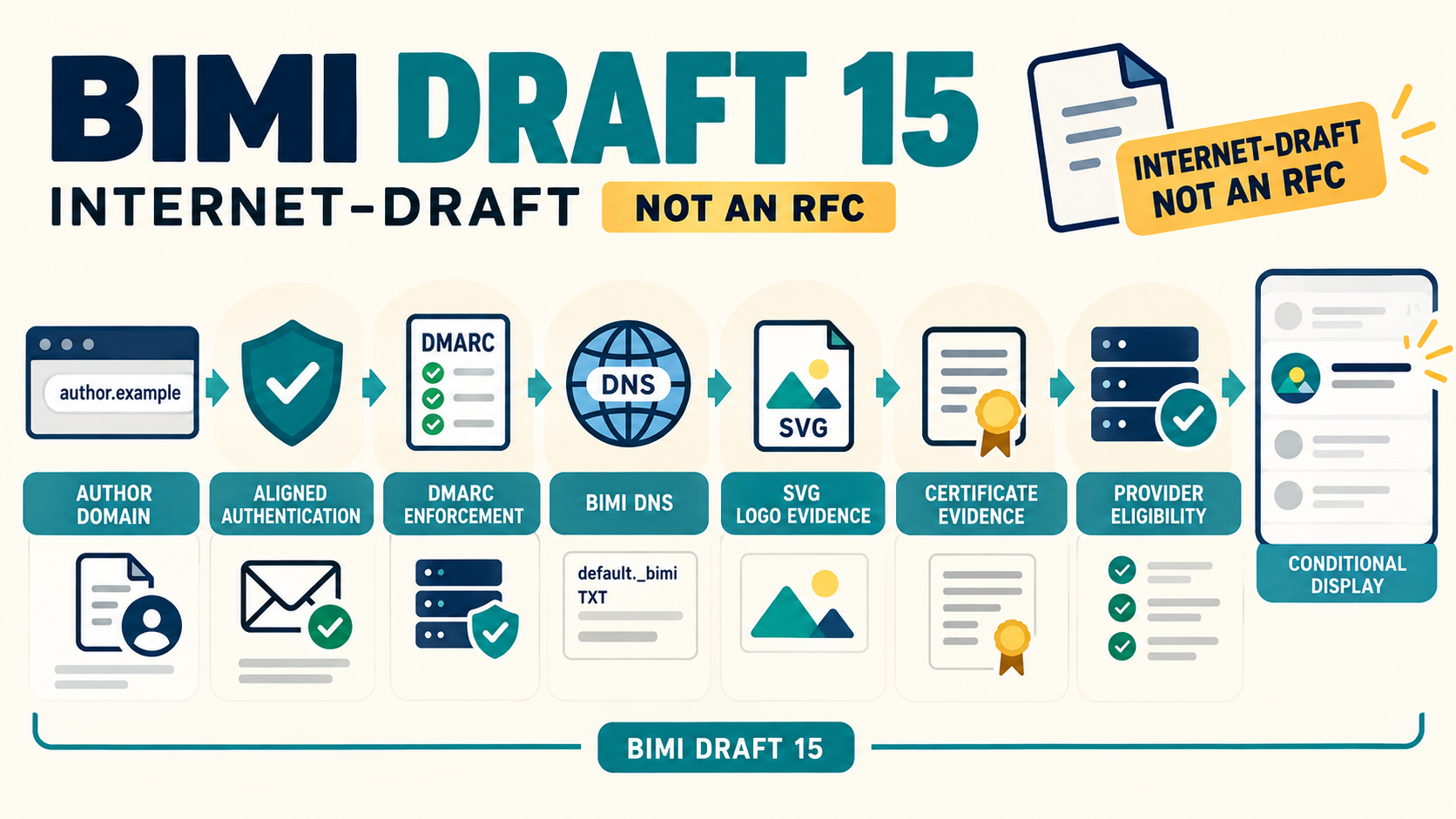
On May 1, 2026, revision 15 of the BIMI general implementation-guidance Internet-Draft was published. It described how brands, mail receivers, MTAs, MUAs and logo designers can connect DMARC-authenticated mail to a receiver-vetted brand indicator. Revision 15 was a work in progress, not an RFC. It expired on November 2 and was superseded by revision 16 on October 31, 2026.
This article preserves the draft-15 timeline event while applying the current revision-16 status as reviewed on November 16. It explains the implementation boundary: BIMI DNS and SVG publication are only part of a chain that includes message-level alignment, enforced DMARC, evidence documents, receiver security, reputation, classification, caching and client display. It does not duplicate the evergreen NitWings BIMI deployment guide or promise that a published record will produce a logo.
What happened on May 1, 2026
The authors published revision 15 of “General Guidance for Implementing Branded Indicators for Message Identification.” The document is a companion to the core BIMI protocol draft. Its purpose is operational: it discusses who implements which components, receiver validation, MTA-to-MUA communication, image retrieval, hosting, SVG production, reputation and troubleshooting.
The event matters because teams often reduce BIMI to a TXT record and logo file. The guidance shows a multi-party trust and presentation system. A domain owner requests an indicator; a receiver authenticates and classifies a message, applies local policy and validates resources; a mail client decides whether and how to display the vetted result.
Draft 15 is historical; draft 16 is current
| Document | 2026 event | Status on November 16, 2026 | How to cite it |
|---|---|---|---|
| General BIMI implementation guidance | Revision 15 was published May 1, 2026. | Revision 16, published October 31, is the active revision and expires May 4, 2027. | Work in progress; identify the exact revision. It is not an RFC or IETF-endorsed standard. |
| Core BIMI protocol draft | Revisions 13 and 14 appeared May 1, 2026. | Revision 15, published October 31, is active and expires May 4, 2027. | Work in progress with an intended Standards Track status, not a published RFC. |
| Provider requirements | Provider policies continued to govern actual display. | Live and provider-specific; may be stricter than a draft’s protocol baseline. | Cite the receiving provider’s current documentation separately. |
| Certificate and mark evidence | VMC and CMC deployment continued across supported providers. | Product, issuer, mark and provider acceptance remain separate from draft publication. | Cite current issuer and provider requirements; do not call a certificate an inbox-placement guarantee. |
Revision 16 is an individual active Internet-Draft dated October 31, 2026. The Datatracker states that it has no formal standing in the IETF standards process. Its front matter labels the intended status as Best Current Practice, but intended status is not publication as a BCP or RFC. The current core BIMI protocol is also a draft.
Implementation documents should record a draft revision and provider-policy date. “IETF BIMI standard” is inaccurate today. A draft can change, expire or be replaced, while providers can deploy a subset or impose additional requirements.
How this article differs from the evergreen BIMI guide
The evergreen “Implementing BIMI for Brand Recognition” article explains a sender deployment from beginning to end. The BIMI Readiness Analyzer inspects live DNS, HTTPS, SVG and evidence metadata. Historical Gmail and Yahoo articles explain provider-specific launches and checkmarks.
This page has a narrower timeline intent: what revision 15 represented, why revision 16 supersedes it, how the guidance divides responsibilities, and which evidence proves each layer. Keeping those intents separate prevents a second generic “how to set up BIMI” page from competing with the established guide.
BIMI is a receiver-controlled presentation system
The domain owner publishes a preferred indicator. It does not insert a trusted logo directly into the inbox interface. The receiver decides whether the message is authenticated, whether the domain and message satisfy local trust and classification policy, whether the published resources are acceptable, and whether its MUA should receive an authorized indicator.
This distinction is a security boundary. If an MUA loaded any sender-provided image merely because a header or DNS record existed, attackers could exploit lookalike domains, unsafe assets or forged headers. BIMI couples sender publication with receiver verification and discretion.
Keep six evidence layers separate
| Layer | Question it answers | Evidence | What it does not prove |
|---|---|---|---|
| Message authentication | Did aligned SPF or DKIM produce a DMARC pass for the visible From domain? | Received headers, trusted Authentication-Results, DKIM identity, SPF identity and alignment. | That the receiver will display a logo. |
| DMARC policy | Is the organizational and author-domain policy strong enough for the target provider? | Live DMARC discovery, applicable policy, disposition and percentage. | Reputation, certificate acceptance or client support. |
| BIMI assertion | Which selector and DNS record publish the indicator and optional evidence location? | Exact TXT owner, single record, parsed tags and DNS response. | That referenced files are safe, reachable or accepted. |
| Indicator asset | Is the HTTPS resource available and valid under the required SVG profile? | Final response, content type, bytes, redirects, SVG validation and cache state. | Trademark or domain rights. |
| Evidence document | Does the optional or provider-required document validate and cover the relevant domain and mark? | Chain, validity period, covered domains, embedded indicator and issuer result. | Universal display across providers. |
| Receiver policy and MUA | Did the mailbox provider choose BIMI processing and did the client render the result? | Provider eligibility, reputation state, supported surface and observed message. | Inbox placement, safety of content or recipient consent. |
Who implements each part
| Actor | Implementation responsibility | Failure to avoid |
|---|---|---|
| Brand or domain owner | Deploy enforced authentication, publish BIMI DNS, host stable assets, govern mark evidence and document every From domain. | Buying a certificate before the domain and sending inventory is complete. |
| Sending platform | Produce aligned DKIM, preserve the visible identity, sign the BIMI-Selector header when used and expose received-message evidence. | Treating a DNS record as a substitute for message-level alignment. |
| Mail receiver or MBP | Authenticate the message, apply local eligibility and reputation, fetch and validate BIMI resources, create trusted results and remove forged external results. | Loading arbitrary sender-supplied imagery before trust checks. |
| MTA implementation | Perform policy discovery and pass a bounded, trusted result to the display layer. | Trusting externally supplied BIMI-Location or BIMI-Indicator headers. |
| MUA implementation | Render only receiver-vetted indicators, respect product and user preferences, and fail safely. | Fetching an untrusted SVG directly because a message contains a BIMI-looking header. |
| Logo and security teams | Create SVG assets in the required profile, manage certificate coverage and test hosting, redirects, cache and renewal. | Using a visually correct desktop SVG that contains unsupported or unsafe constructs. |
A sender-side project usually needs messaging operations, DNS, web hosting, brand, trademark or legal, certificate, security and vendor owners. A receiver-side project needs authentication, DNS and HTTPS retrieval, safe parsing, certificate validation, abuse classification, caching, MTA headers and MUA presentation. A checklist owned by only the marketing team is incomplete.
Start with the received message, not the logo
BIMI processing depends on DMARC-authenticated identity. A real message needs aligned SPF or aligned DKIM for the RFC5322.From domain under DMARC rules. The guidance notes that receivers may demand both aligned mechanisms or apply additional SPF, DKIM, TLS, feedback-loop and reputation conditions.
Validate headers added by the receiving trust boundary, not sender-injected Authentication-Results. Preserve the DKIM signing domain, selector, signature result, SPF identity, From domain, organizational domain and alignment. A screenshot of a logo cannot replace message evidence.
DMARC enforcement is a policy and inventory project
The guidance expects strong DMARC policy at the organizational domain, not only on a convenient marketing subdomain. Before moving to quarantine or reject, inventory every authorized sender, align legitimate traffic, monitor aggregate reports and handle forwarding or indirect flows deliberately.
Provider rules can specify acceptable disposition, percentage and domain coverage. Do not copy one provider’s threshold into a universal protocol claim. Also note that the draft text may reference the DMARC document current when it was written; current operations should follow the now-published DMARC standards and the target provider’s live requirements.
BIMI assertion DNS is necessary but not sufficient
| Component | Example | Operational check |
|---|---|---|
| Owner name | default._bimi.example.com | Resolve the selector against the RFC5322.From domain and apply only the fallback behavior defined by the implemented draft and receiver. |
| Version tag | v=BIMI1 | Require one supported version declaration in the correct position. |
| Indicator location | l=https://assets.example.com/brand/bimi.svg | Use HTTPS, validate the final resource and redirects, and avoid confusing reachability with profile validity. |
| Authority evidence location | a=https://assets.example.com/brand/evidence.pem | Treat publication, cryptographic validation, domain coverage and provider acceptance as different checks. |
| Selector header | BIMI-Selector: v=BIMI1; s=campaign; | If used, cover it with the aligned DKIM signature; otherwise receivers are advised to ignore it. |
| Empty or declined assertion | v=BIMI1; l=; | Interpret it according to the exact active specification and local receiver policy; do not invent a logo from another record. |
Publish one valid TXT assertion at the intended owner. Multiple TXT records at the same BIMI owner can make the result ambiguous or unusable. Record the actual DNS response from multiple resolvers, including CNAME behavior, DNSSEC evidence when relevant, TTL and negative caching.
Example assertion and DMARC policy
default._bimi.example.com. 3600 IN TXT (
  "v=BIMI1; "
  "l=https://assets.example.com/bimi/example.svg; "
  "a=https://assets.example.com/bimi/example-vmc.pem;"
)

_dmarc.example.com. 3600 IN TXT "v=DMARC1; p=reject; rua=mailto:[email protected]"
This is a syntax illustration, not a universal provider recipe. The URLs and evidence must belong to the deployment, and the applicable DMARC policy must cover real messages. A low TTL helps planned change but does not force receiver image caches to refresh immediately.
Treat selector choice as a signed message decision
The default selector supports a simple deployment. An alternate selector can associate a stream with another assertion. When a BIMI-Selector header is used, the core draft says it should be covered by the aligned DKIM signature; otherwise a receiver should ignore it. That prevents an intermediary or attacker from freely choosing another logo assertion.
Test the final message after the ESP has inserted and signed headers. Confirm that the selector header appears before signing, the DKIM h= list covers it, the signature aligns for DMARC, and the DNS record exists for the exact selector and author domain under the implemented discovery rules.
LPS and avatar preference are advanced controls
The guidance discusses Local-part Selector and Avatar Preference deployment. LPS can differentiate use cases such as a marketing address that should show the brand logo and employee addresses that should retain personal images. AVP can express whether a personal avatar should take precedence over the brand indicator.
These controls add DNS and client-policy complexity and are not a reason to skip the baseline deployment. Confirm that the target receiver implements the relevant draft behavior, document fallback, test exact local parts and avoid claiming consistent results across clients that have different address-book and avatar systems.
A visible SVG can still fail the BIMI profile
BIMI indicators use a constrained SVG profile designed for portable and safer rendering. A designer’s ordinary export can contain scripts, external references, unsupported elements, metadata, transformations or sizing that a validator rejects. Visual inspection in a browser does not validate the profile.
Validate the exact hosted bytes and, when evidence documents embed or bind an indicator, compare the expected asset. Test decompression when supported, size limits, XML parsing, square presentation, light and dark surfaces, small-avatar legibility and absence of network-dependent content.
Logo hosting needs production controls
Use stable HTTPS hosting with a valid certificate chain, appropriate content type, bounded redirects and public reachability. Receivers may retrieve from infrastructure that differs from a normal browser, so avoid authentication, geography blocks, bot challenges or cookies that prevent deterministic access.
A CDN can improve availability but also introduce redirects, content negotiation, stale objects and inconsistent edge content. Monitor the final connected destination and response hash. Treat an unexpected change as a security and brand incident, not merely a broken image.
Evidence documents require more than an HTTP 200
A VMC or other supported evidence document is a cryptographic and identity artifact. Validation can include HTTPS retrieval, certificate chain and validity, approved roots, domain coverage, mark relationship and extraction or comparison of the indicator. Provider acceptance remains a separate decision.
Plan renewal before expiry. Inventory every From domain and brand variant covered by each document. When the logo, mark, legal entity, domain or issuer changes, coordinate DNS, hosting, evidence and cache behavior rather than replacing one file in isolation.
Logo display and verified checkmark are different outcomes
Provider implementations can distinguish certificate types and visual treatments. Gmail, for example, has documented a CMC route that can support logo display without the verified checkmark associated with eligible VMC use. Other providers have their own presentation and eligibility rules.
Track at least four results separately: message delivered, message placed in a particular folder, BIMI logo displayed and verification mark displayed. A change in one does not prove a change in the others.
Receiver implementation is a security pipeline
receive message
  -> remove or distrust externally supplied receiver-only BIMI result headers
  -> validate SPF, DKIM and DMARC using the visible From identity
  -> apply local DMARC-policy, TLS, reputation and abuse requirements
  -> classify phishing, malware and spam before display authorization
  -> discover selector and BIMI DNS assertion
  -> fetch through bounded HTTPS with redirect, size and address controls
  -> validate evidence document and extract/compare indicator when required
  -> validate SVG under the supported profile
  -> cache a vetted result for a bounded period
  -> communicate trusted result from MTA to MUA
  -> let the supported MUA apply final display and user preference
The guidance allows receivers to skip BIMI processing based on classification and to record a skipped result. It advises against displaying an indicator for phishing or malware and leaves spam presentation to receiver policy. A valid certificate must not override a harmful-message decision.
Receiver-produced BIMI headers belong to a trust boundary
The core draft defines headers used between receiving infrastructure and its MUA. Externally supplied receiver-only BIMI result headers must not be trusted. A BIMI-aware boundary removes or ignores forged copies before creating its own validated result, much like other receiver authentication evidence.
In a multi-stage internal system, document which MTA is authoritative, how later services preserve the result and how the MUA recognizes the trusted source. If ARC is used as additional evidence, its validation and local trust decision must remain explicit; ARC does not make every upstream assertion trustworthy.
Image retrieval has privacy and network consequences
A receiver can proxy or cache a vetted indicator rather than directing every client to a brand-controlled URL. This reduces repeated external retrieval and can limit disclosure of recipient network activity. MUA authors should also allow user control over BIMI display as described by the guidance.
Sender hosting should not encode a recipient, message or mailbox identifier in a BIMI asset URL. BIMI is not an open-tracking mechanism. Separate brand-indicator retrieval from campaign analytics and apply applicable privacy and storage-access rules to any other email tracking.
Cache design affects both safety and brand changes
Receivers need bounded caching for DNS, assets and validation results. Excessively short caching creates retrieval load and attack surface; excessively long caching can preserve a revoked document or obsolete logo. Tie cache keys to the relevant domain, selector, resource URL, content hash and evidence state.
Document invalidation for certificate revocation, domain compromise, harmful classification and asset change. Domain owners should not assume a DNS TTL controls every downstream image proxy or MUA cache.
Sender deployment sequence
Inventory every RFC5322.From domain and sending stream
        -> align DKIM and SPF identities with the From domain
        -> deploy DMARC enforcement safely and monitor outcomes
        -> select default or documented alternate BIMI selector
        -> publish exactly one BIMI assertion at selector._bimi.domain
        -> host HTTPS SVG and optional/required evidence document
        -> validate SVG profile, certificate chain and domain coverage
        -> send controlled messages through the real production path
        -> inspect trusted receiver results and each supported client
        -> monitor DNS, HTTPS, renewal, reputation and display separately
Do not start by purchasing the most expensive artifact. First prove inventory, authentication and DMARC coverage. Then map provider requirements and certificate coverage so budget follows an eligible design. A staged deployment can use a controlled subdomain or stream, but organizational-domain policy still needs review.
Store layered evidence for every observation
{
  "author_domain": "news.example.com",
  "organizational_domain": "example.com",
  "selector": "default",
  "bimi_owner": "default._bimi.news.example.com",
  "bimi_record_hash": "sha256:...",
  "dmarc_policy_domain": "example.com",
  "dmarc_effective_disposition": "reject",
  "aligned_dkim": "news.example.com",
  "aligned_spf": null,
  "indicator_final_url": "https://assets.example.com/bimi/example.svg",
  "svg_profile_result": "pass",
  "evidence_domain_covered": true,
  "provider": "target-provider",
  "client_surface": "webmail",
  "observed_logo": true,
  "observed_checkmark": false,
  "ruleset": "bimi-guidance-16+provider-policy-2026-11",
  "observed_at": "2026-11-16T11:30:00Z"
}
The record separates protocol readiness from provider presentation. Use hashes and references rather than copying sensitive certificate or message content into every log. Retain the ruleset and timestamp because draft revisions, provider policies, DNS, reputation and client surfaces change.
Diagnose missing logos as a dependency tree
| Observed result | Check first | Do not conclude |
|---|---|---|
| DMARC passes but no logo appears | Applicable DMARC policy, BIMI lookup, asset, evidence document, provider eligibility and client support. | That delivery failed or the IP must be replaced. |
| Logo appears without a verified checkmark | Provider certificate path and UI rules, including distinctions such as CMC versus VMC. | That the logo is fraudulent or authentication failed. |
| Logo appears for one From domain only | DNS owner, organizational-domain relationship, certificate domain coverage and reputation per domain. | That one certificate automatically covers every sibling brand. |
| Logo changed but an old image remains | HTTP caching, receiver proxy cache, TTL, asset URL/versioning and evidence-document consistency. | That changing DNS forces immediate client refresh. |
| Record validates in a checker but provider shows nothing | A real received message, trusted authentication results, provider policy and supported client. | That syntactic DNS validity guarantees presentation. |
| Logo disappears after forwarding | Authentication survival, ARC use under receiver policy and whether BIMI was skipped after classification. | That BIMI is designed to override broken identity. |
Turn the draft’s playbook into monitored controls
The guidance lists failures including VMC verification, indicator extraction, SVG validation, compressed SVG parsing, client loading, connectivity, incorrect brand association and stale caching. Convert each into an owner, signal and test rather than keeping one launch checklist.
DNS monitoring should detect record count and content changes. HTTPS monitoring should validate final public destinations and hashes. Certificate monitoring should cover expiry and domain scope. Seed messages should observe authentication, BIMI results, logo and checkmark on named provider/client combinations.
BIMI inherits SPF, DKIM and replay risks
The implementation guidance discusses weak SPF configurations, overly broad authorization, loose platform validation, DKIM algorithm and key choices, signature lifetime and replay. BIMI does not repair those foundations. Receivers may apply stricter local requirements, and senders should maintain both SPF and DKIM appropriately even though DMARC needs one aligned pass.
DKIM oversigning and the x= expiry tag can contribute to replay controls, but they are not complete defenses by themselves. Limit who can send with the aligned identity, rotate keys deliberately, sign identity-relevant headers and monitor anomalous volume and content.
Test matrices must name provider and client
A result from one webmail account does not establish support in mobile applications, desktop clients, forwarded mail or delegated enterprise tenants. Record provider, account type, client, version, From domain, selector, authentication results, folder placement, logo and checkmark.
Use real production routing because test harnesses can omit DKIM signing, use a different return path, change the From domain or bypass reputation. Preserve the received source and screenshots as different evidence types.
Logo changes need coordinated change control
Prepare the new SVG, evidence document and hosting before DNS change. Verify mark and domain coverage, choose whether to version the asset URL, account for receiver caches and maintain rollback artifacts. Avoid overwriting the only known-good file without retaining its hash.
After release, monitor both retrieval and presentation. A successful origin response does not mean every receiver refreshed its cache. Communicate a bounded propagation expectation rather than promising an instant global logo change.
Build a receiver implementation only when you control the trust boundary
A sender does not need to install a BIMI Milter to publish BIMI. The Milter path is for an operator that receives mail, evaluates authentication and supplies trusted results to its own mailbox or MUA environment. Installing receiver software on an outbound relay does not make Gmail, Yahoo or another provider display the sender’s logo.
The receiver must own the point where untrusted Internet headers are removed, the authoritative Authentication-Results identity, local reputation and classification, safe DNS and HTTPS retrieval, evidence validation, result storage and MUA trust. If the operator controls only Postfix but not the downstream client’s trust model, it can evaluate BIMI and log results, but it cannot safely force third-party clients to display them.
What Fastmail authentication_milter actually provides
authentication_milter is a Perl application that combines SPF, DKIM, DMARC, ARC, BIMI and other handlers. Its BIMI handler requires the DMARC handler, uses Mail::BIMI for evaluation, checks the RFC5322.From domain, uses the default selector when an alternate selector is absent or untrusted, and can add a bimi= result plus locally generated BIMI headers after a pass.
The current handler supports local allowlist or blocklist policy, a separate allowlist for domains permitted without evidence documents, a BIMI operation timeout and sanitization of existing BIMI-Location and BIMI-Indicator. These are receiver-policy controls, not universal protocol requirements. A production operator must choose the zones, trust sources and fail behavior rather than copying empty example values.
Choose native Milter or SMTP after-queue mode deliberately
| Integration mode | Where evaluation occurs | Strength | Important limitation |
|---|---|---|---|
| Native Milter protocol | During the Postfix SMTP transaction through smtpd_milters. | Preserves SMTP session context and can detect authenticated connections when Postfix supplies the relevant macros. | DNS, HTTPS and verification latency affect the before-queue SMTP transaction; timeout and failure policy need capacity testing. |
| SMTP after-queue filter | After Postfix has queued the message; the filter receives SMTP and relays to a dedicated reinjection smtpd. | Decouples the first queue acceptance from the scanning transaction and supports XFORWARD context. | The project says SMTP mode cannot detect authenticated connections. The listener must never be reachable by untrusted clients, and loop prevention is mandatory. |
| Offline or checker-only use | Outside delivery, against DNS, assets or stored samples. | Safe for readiness and diagnostics without changing mail flow. | It cannot create a trusted receiver result for a live message or prove provider display. |
For a new Postfix receiver, native Milter mode is the clearer starting point because session context remains available and no second SMTP queue path is required. Start in dry-run or annotation-only behavior, validate latency and results, then decide whether any authentication result should affect SMTP acceptance. BIMI failure alone normally should not reject a message; it should suppress trusted logo presentation.
Install and inventory the exact software build
The project documents installation from CPAN with cpanm Mail::Milter::Authentication, from a released source tarball using perl Makefile.PL, make, make test and make install, or from a repository checkout using Dist::Zilla. Prefer a reproducible released artifact or a pinned commit. Record the application, Mail::BIMI, Mail::DMARC, public-suffix data and Perl dependency versions.
After installation, run authentication_milter --help installed. The BIMI handler appears only when its dependencies are present. Use --help BIMI and --help default_config from the installed build rather than assuming that a web example matches the deployed version. The default-config output is a reference, not a safe production policy.
Create bounded runtime ownership
Use a dedicated account such as authmilter. Pre-create the cache, spool and library directories with ownership restricted to that account. Protect /etc/authentication_milter.json and /etc/mail-dmarc.ini, especially when the latter contains database or relay credentials. The process needs outbound DNS and HTTPS for authentication and BIMI resources, but the Milter and metrics listeners should remain on a Unix socket or loopback interface unless a separately protected design requires otherwise.
The application keeps the current message in memory rather than storing it on disk in the ordinary filter path. Capacity planning therefore needs message-size, concurrency, prefork child and timeout testing. Do not copy the sample minimum of twenty children onto a small host without measuring memory.
A minimal review-first authentication_milter configuration
{
  "debug": 0,
  "dryrun": 1,
  "extended_log": 1,
  "legacy_log": 0,
  "connection": "inet:[email protected]",
  "protocol": "milter",
  "runas": "authmilter",
  "rungroup": "authmilter",
  "cache_dir": "/var/cache/authentication_milter",
  "spool_dir": "/var/spool/authentication_milter",
  "lib_dir": "/var/lib/authentication_milter",
  "dns_timeout": 5,
  "dns_retry": 1,
  "connect_timeout": 20,
  "command_timeout": 20,
  "content_timeout": 240,
  "tempfail_on_error": "1",
  "metric_connection": "inet:[email protected]",
  "metric_basic_http": 1,
  "metric_config_http": 0,
  "handlers": {
    "Sanitize": {
      "remove_headers": "yes",
      "hosts_to_remove": ["mx.example.net"]
    },
    "SPF": {},
    "DKIM": {"check_adsp": 0},
    "DMARC": {"detect_list_id": "1"},
    "ARC": {"trusted_domains": ["mx.example.net"]},
    "BIMI": {
      "timeout": 5000000,
      "sanitize_location_header": "yes",
      "sanitize_indicator_header": "yes",
      "bimi_options": {}
    },
    "!SenderID": {}
  }
}
This JSON is an annotated starting design, not a drop-in universal file. Replace the receiver hostname, trusted ARC domains, directory paths and policy. dryrun begins enabled so the initial deployment can observe behavior. The Sanitize handler’s trusted-host list must describe the local Authentication-Results boundary; using the wrong hostname can preserve forged results or remove legitimate internal evidence.
The explicit BIMI sanitization settings remove externally supplied location and indicator headers before locally validated replacements can be created. Leave the optional RBL policy unset until a maintained, documented internal or external zone exists. Never invent an allowlist domain merely to make BIMI return pass.
Configure the DMARC prerequisite separately
The project documents that its DMARC module needs a database and /etc/mail-dmarc.ini. The supplied example supports SQL storage and contains organization, DNS, SMTP, IMAP, HTTP and HTTPS sections. Copying it literally would create placeholder credentials, paths and report destinations. Build the database and reporting flow from the installed Mail::DMARC documentation, then test DMARC independently before enabling BIMI.
BIMI’s handler declares DMARC as a dependency. If there is no usable DMARC result, it returns an error-class result; when DMARC does not pass, BIMI should be skipped. Do not transform bimi=skipped into a spam verdict automatically. It means the logo verification path did not become eligible.
Connect Postfix using native Milter mode
# /etc/postfix/main.cf
# authentication_milter uses inet:PORT@HOST in its JSON.
# Postfix uses inet:HOST:PORT here.
milter_protocol = 6
smtpd_milters = inet:127.0.0.1:8893

# Choose this deliberately after testing the failure model.
milter_default_action = tempfail
milter_connect_timeout = 20s
milter_command_timeout = 20s
milter_content_timeout = 300s

# Do not add non_smtpd_milters merely to make the settings look symmetric.
# It is needed only when locally submitted/non-smtpd mail belongs in this
# receiver policy, and that path has been tested for recursion and trust.
Postfix evaluates smtpd_milters for mail entering through smtpd. Its endpoint syntax differs from the application JSON. Use per-Milter braces on Postfix 3.0 and later when this service needs timeouts or a default action different from other Milters. When multiple Milters are configured, document their order and every header or body mutation.
tempfail protects the trust decision when the verifier is unavailable but creates an availability dependency. accept preserves mail flow but requires downstream systems to recognize that trusted authentication or BIMI results may be absent. A mature design can fail open for ordinary delivery while failing closed for logo authorization. Do not reject a message merely because an SVG, certificate or BIMI DNS lookup fails.
Milter ordering and message mutation
Inbound authentication should evaluate the message as received from the external peer before a later filter rewrites signed headers or body content. The locally generated result can remain valid evidence of the ingress state even if a trusted internal system later modifies the message, but the boundary and modification must be documented. If the altered message is forwarded outside that boundary, the original DKIM result does not become a new signature for the modified content.
authentication_milter verifies DKIM; it is not a substitute for an outbound DKIM signer. For outbound mail, all content-changing filters must run before the signer, and any BIMI-Selector chosen by the sender must exist before the aligned DKIM signature is generated so it can be included in the signature’s header list.
Run the filter under a supervised service
# /etc/systemd/system/authentication-milter.service
[Unit]
Description=Authentication Milter for inbound email identity checks
After=network-online.target
Wants=network-online.target

[Service]
Type=simple
User=authmilter
Group=authmilter
RuntimeDirectory=authentication_milter
RuntimeDirectoryMode=0750
ExecStart=/usr/local/bin/authentication_milter \
  --pidfile=/run/authentication_milter/authentication_milter.pid
Restart=on-failure
RestartSec=5s
NoNewPrivileges=true
PrivateTmp=true
ProtectHome=true
ProtectSystem=strict
ReadWritePaths=/run/authentication_milter /var/cache/authentication_milter /var/lib/authentication_milter /var/log /var/spool/authentication_milter
RestrictAddressFamilies=AF_UNIX AF_INET AF_INET6

[Install]
WantedBy=multi-user.target
The unit is illustrative and assumes the binary runs in the foreground, the dedicated account and writable directories already exist, and configuration is in /etc. Adjust the binary path, hardening and write paths for the distribution. Test name resolution, CA trust, database access and log ownership after hardening; a service that starts but cannot retrieve DNS or HTTPS evidence will produce misleading failures.
Do not expose the metrics endpoint publicly. Keep metric_config_http disabled because the effective configuration can contain sensitive values. The project can expose Prometheus-compatible metrics and a Grafana dashboard; place any broader access behind authenticated monitoring infrastructure.
SMTP after-queue integration is an alternative, not an extra Milter
# /etc/postfix/main.cf
content_filter = authmilter:[127.0.0.1]:10025

# /etc/postfix/master.cf
# Postfix transport to the filter; preserve connection context with XFORWARD.
authmilter unix  -       -       n       -       -       smtp
  -o smtp_send_xforward_command=yes
  -o disable_mime_output_conversion=yes

# Dedicated reinjection service. It must not reapply content_filter.
127.0.0.1:10026 inet n  -       n       -       -       smtpd
  -o content_filter=
  -o receive_override_options=no_unknown_recipient_checks,no_header_body_checks
  -o smtpd_recipient_restrictions=permit_mynetworks,reject
  -o mynetworks=127.0.0.0/8
  -o smtpd_milters=
  -o non_smtpd_milters=

# Corresponding authentication_milter JSON fragments:
"protocol": "smtp",
"connection": "inet:[email protected]",
"smtp": {
  "server_name": "scan.example.net",
  "sock_type": "inet",
  "sock_host": "127.0.0.1",
  "sock_port": "10026",
  "queue_type": "after",
  "timeout_in": "30",
  "timeout_out": "30"
}
This example shows the required shape: Postfix sends queued mail to a loopback-only filter, the filter relays to a dedicated reinjection service, and the reinjection service clears content_filter so the message does not loop. The project supports XFORWARD to retain original connection details. Exact master.cf fields vary by Postfix packaging and existing restrictions, so compare the final design with the official Postfix after-queue content-filter documentation.
The project warns that untrusted clients must never connect directly to its SMTP-mode listener. SMTP mode also cannot detect authenticated connections, so it must not be substituted blindly for a Milter-mode policy that exempts authenticated submission. Disabling MIME output conversion on the filter transport helps avoid breaking DKIM signatures during SMTP relaying.
Remove forged result headers at the external boundary
Before trusting locally produced results, remove or rename untrusted Authentication-Results claiming the local authserv-id, external receiver-only BIMI headers and any other internal decision header. The BIMI handler can sanitize BIMI-Location and BIMI-Indicator; the wider Sanitize policy must match the actual receiving domains and trusted relays.
Preserve BIMI-Selector only as sender input, not as a receiver verdict. The handler checks whether an alternate selector was signed by the author or organizational domain, or accepted through its ARC-aware path. An unsigned or third-party-signed value falls back to default. Multiple selector or From fields are error conditions, not an invitation to choose the first convenient value.
Expected result examples
# Illustrative locally generated result; exact properties depend on Mail::BIMI,
# authentication_milter version, evidence and receiver policy.
Authentication-Results: mx.example.net;
    dmarc=pass header.from=example.com;
    bimi=pass header.d=example.com header.selector=default

# A message that fails the prerequisite should not receive a trusted logo path.
Authentication-Results: mx.example.net;
    dmarc=fail header.from=example.com;
    bimi=skipped (DMARC did not pass)
Never parse these examples with a substring such as bimi=pass. Parse Authentication-Results using its grammar, accept only a trusted authserv-id, preserve result properties and distinguish pass, fail, none, skipped, temperror and permerror. A downstream MUA still needs a documented trust path before using any indicator.
Authentication pass does not override phishing classification
Run malware, phishing and spam classification before authorizing presentation. The guidance says phishing or malware should not receive a logo, and a receiver may suppress the logo for spam. Store authentication and classification as separate states so investigators can see that a message was genuinely sent by a compromised or abusive authenticated domain.
Local allowlists used by the BIMI handler should control whether expensive verification or evidence-free display is considered; they should not bypass content safety. Maintain change ownership, expiry and review for every allowlist entry.
Validate configuration and behavior before enforcement
# Confirm the installed build exposes the required modules and current defaults.
authentication_milter --help installed
authentication_milter --help BIMI
authentication_milter --help default_config > /tmp/authmilter-defaults.json

# Validate Postfix syntax and inspect the effective Milter settings.
postfix check
postconf -n | grep -E '^(smtpd_milters|non_smtpd_milters|milter_)'

# Confirm listeners are loopback-only and inspect service state.
ss -lntp | grep -E ':(8893|8894|10025|10026)\b'
systemctl status authentication-milter --no-pager

# Send controlled messages through the real ingress path, then inspect:
# - trusted Authentication-Results authserv-id
# - dmarc= and bimi= results
# - removal of forged BIMI-Location/BIMI-Indicator
# - default selector behavior for an unsigned BIMI-Selector
# - alternate selector behavior when covered by aligned DKIM
The first deployment should use a test domain and seeded messages. Include valid aligned DKIM, SPF-only DMARC pass, DMARC failure, unsigned selector, aligned-signed alternate selector, two selector fields, two From fields, forged receiver BIMI headers, unreachable SVG, redirect loop, oversized response, invalid XML, expired evidence and a DNS timeout. Measure SMTP latency and memory at normal and peak concurrency.
Then test failure injection: stop the Milter, block DNS, block HTTPS, make the reporting database unavailable and exhaust the worker pool. Confirm the chosen Postfix default action, queue behavior, alerts and recovery. A BIMI dependency must not silently become a broad mail outage.
Monitor protocol, resources and presentation separately
Collect process availability, child saturation, callback duration, DNS failures, BIMI result counts, DMARC results, evidence type, timeouts and sanitization events. Alert on sudden changes rather than treating every bimi=none as an incident. Most inbound domains will not publish BIMI.
Resource monitoring should record BIMI DNS changes, final HTTPS address, redirect count, content hash, SVG profile result, evidence expiry and revocation state. Presentation monitoring should use controlled mailboxes and named clients. Do not expose recipient identifiers or full message content in metrics labels.
Design rollback before changing mail flow
Keep the previous Postfix configuration, service package and JSON policy available. A rollback can remove the Milter endpoint or set a tested fail-open action while preserving mail delivery, but downstream systems must then stop treating missing BIMI results as passes. For after-queue mode, rollback must remove the content filter and verify that no messages remain stranded between the filter and reinjection listener.
After rollback, examine queued mail, duplicate-delivery risk and header state. Replaying a message through a changed filter can add another result header or alter evidence; use controlled queue operations and retain incident timestamps.
Removal, replacement and deprecation matrix
| Remove, disable or replace | Scope | Reason and replacement |
|---|---|---|
| Draft 15 described as current | Documentation | Revision 16 superseded it on October 31, 2026. Keep revision 15 only as the dated timeline event. |
| “BIMI is an IETF standard” | Documentation | The guidance and core protocol are Internet-Drafts, not RFCs. Name the revision and call it work in progress. |
| DMARC pct, ri and rf tags | New DNS policy | RFC 9989 removed these historic tags. Do not add pct=100 merely because the BIMI guidance draft still mentions the older DMARC model; document the mismatch and follow current receiver policy. |
| Untrusted inbound BIMI-Location and BIMI-Indicator | Receiver boundary | A sender can forge receiver-to-MUA results. Strip or rename them before producing locally validated results. |
| Unsigned or third-party-signed BIMI-Selector | Message processing | Ignore it and fall back to the default selector unless it is protected by the accepted aligned signature or explicitly trusted ARC path. |
| Direct MUA trust in message BIMI headers | Client design | Use a trusted store or Authentication-Results boundary, validated ARC where designed, or receiver-controlled embedding/proxying. |
| SenderID and DKIM ADSP in a fresh milter deployment | authentication_milter configuration | They are legacy authentication mechanisms. Disable SenderID and ADSP checks unless maintaining a specifically documented historical dependency. |
| metric_port and metric_host | authentication_milter monitoring | The project marks them deprecated. Use a loopback or protected metric_connection instead. |
| Universal logo or checkmark promise | Reporting | Replace it with provider, client, domain, certificate-path and observation-specific evidence. |
The active BIMI guidance still contains older DMARC language, including a statement that pct must be absent or 100. RFC 9989 removed pct, ri and rf. Our DMARC Builder intentionally does not generate them, and the Analyzer reports them as historic. The correct response is not to revive pct; it is to use a fully enforced current DMARC policy and verify the target receiver’s current BIMI requirements.
Use the NitWings tools as an evidence sequence
Start with the DMARC Policy Builder to create a current RFC 9989 draft without historic tags. Publish through normal DNS change control, then use the DMARC Analyzer to verify discovery, effective policy and external-report authorization. Use the SPF Analyzer and DKIM Inspector to validate each real sender identity rather than assuming the DMARC record authenticates mail.
Next, run the BIMI Readiness Analyzer against the exact From domain and selector. It checks assertion DNS, bounded HTTPS retrieval, SVG structure and evidence metadata without rendering the SVG. Finally, use the Header Analyzer on a received message to inspect the trusted authentication and BIMI results. These tools provide evidence; none can promise provider reputation, logo display or checkmark presentation.
Claims that should fail the quality gate
- “BIMI is now an IETF standard.” Both the guidance and protocol remain Internet-Drafts.
- “A VMC guarantees the inbox.” Certificates concern identity evidence, not placement.
- “DMARC pass guarantees a logo.” Receiver reputation, resource validation, provider eligibility and client display remain.
- “The BIMI record authenticates the message.” SPF, DKIM and DMARC authenticate the relevant identities before BIMI processing.
- “One successful screenshot proves deployment.” Testing must identify the message, provider, client, domain, certificate path and time.
- “Draft 15 is current.” Revision 16 superseded it on October 31, 2026.
Current operational conclusion
The May revision-15 publication is a valid timeline event, but it is no longer the current text. Use revision 16 for present guidance, the current core protocol revision for DNS and header behavior, current DMARC standards for authentication policy, and each target mailbox provider’s live eligibility rules.
BIMI success is a chain, not a badge purchase: aligned authentication, safe DMARC enforcement, correct assertion discovery, safe resources, valid evidence where required, receiver trust, supported MUA and observed display. Maintain each link and report uncertainty honestly.
Primary sources
- IETF Datatracker: BIMI general implementation guidance revision 15: Historical May 1, 2026 revision recorded by this timeline event.
- IETF Datatracker: current BIMI general implementation guidance: Current status and revision 16 text as reviewed November 16, 2026.
- IETF Datatracker: current core BIMI protocol draft: Current protocol work covering assertion discovery, BIMI headers and receiver behavior.
- Google Admin Help: Set up BIMI: Current Gmail-specific deployment and certificate requirements; provider policy is separate from the drafts.
- Yahoo Sender Hub: BIMI: Current Yahoo-specific eligibility and presentation information.