DMARC RFC 9989: Core Protocol, DNS Tree Walk and Migration
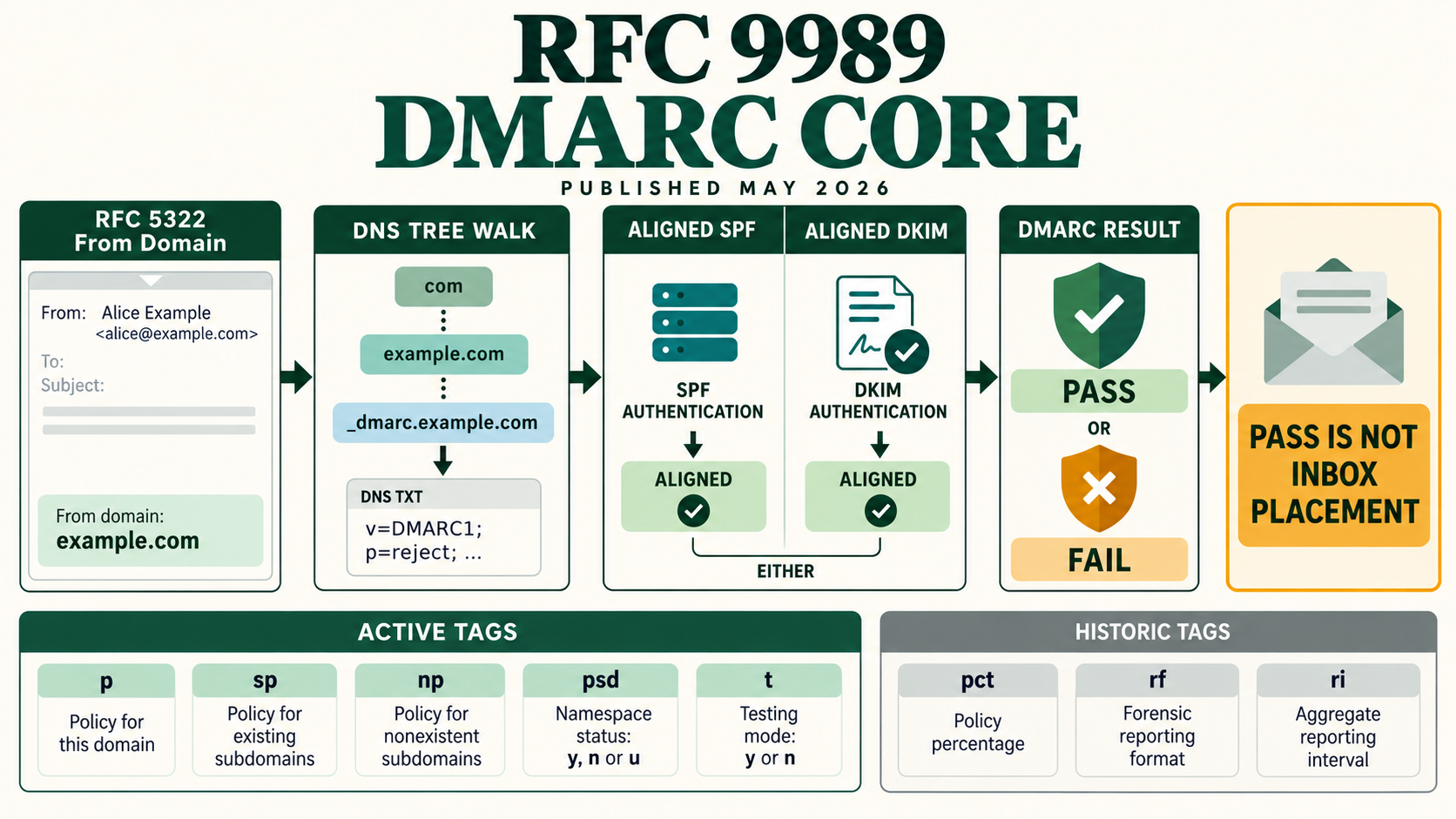
RFC 9989 is the current DMARC core protocol. Published in May 2026, it obsoletes RFC 7489 and RFC 9091, replaces Public Suffix List policy discovery with a bounded DNS Tree Walk, defines current policy tags, and separates aggregate and failure reporting into RFC 9990 and RFC 9991. This is an implementation guide for domain owners, receiver engineers, ESPs, MTA operators and anyone who must explain why one message passed, failed or was not evaluated.
What RFC 9989 owns, and what it does not
RFC 9989 owns the core evaluation: Author Domain identification, SPF and DKIM alignment, DNS policy discovery, record grammar, policy selection and the result supplied to receiver handling. It no longer carries the complete reporting formats. Aggregate XML generation and consumption belong to RFC 9990. Message-specific failure reporting belongs to RFC 9991.
This separation matters in software architecture. A receiver can upgrade policy discovery without replacing its aggregate parser in the same release. A report processor can accept RFC 9990 extensions without changing the message-time authentication result. Keep versioned tests and rollback for each layer.
Start with the exact identity DMARC evaluates
| DMARC input | Identity evaluated | What can satisfy DMARC | Common mistake |
|---|---|---|---|
| Author Domain | The domain in the single RFC 5322 From field | At least one aligned authenticated identifier | Using Return-Path or Sender as the DMARC author identity. |
| SPF | The RFC 5321 MAIL FROM domain | SPF pass plus alignment with the Author Domain | Using HELO for DMARC alignment when MAIL FROM is present. |
| DKIM | The d= domain of each valid DKIM signature | Any one passing signature whose d= aligns | Requiring every DKIM signature to pass or align. |
| Policy | The applicable exact, Organizational Domain or PSD record | Consulted only when authentication and alignment produce DMARC fail | Treating p=reject as an authentication mechanism. |
| Receiver disposition | Local receiver policy after the DMARC result | Receiver chooses final handling | Assuming pass guarantees inbox or reject compels rejection. |
The Author Domain comes from precisely one syntactically valid RFC 5322 From field. A message with no usable From domain, multiple From fields or an unsupported multi-address construction is outside normal DMARC evaluation. Do not silently select the first mailbox and call the result standards compliant.
SPF contributes the MAIL FROM identity. HELO can be evaluated by SPF when the reverse path is empty, but DMARC alignment is defined around the RFC 5321 MAIL FROM domain. DKIM can contribute several signatures. DMARC needs one passing, aligned d= identity, not unanimity across signatures.
The core pass and fail decision
INPUT
  one RFC 5322 From Author Domain
  SPF result for RFC 5321 MAIL FROM
  all DKIM verification results and d= domains

AUTHENTICATION AND ALIGNMENT
  spf_aligned  = SPF passed AND MAIL FROM aligns with Author Domain
  dkim_aligned = any DKIM signature passed AND its d= aligns with Author Domain

  if spf_aligned OR dkim_aligned:
      DMARC = pass
  else:
      DMARC = fail

POLICY
  discover applicable DMARC record with RFC 9989 DNS Tree Walk
  if no applicable record:
      DMARC does not apply
  if DMARC fails and policy exists:
      determine p, sp or np according to exact/inherited/existence scope
      apply t=y step-down when requested
      receiver makes its own final disposition
Alignment is a domain relationship test layered on top of authentication. An SPF pass for bounces.esp.example does not satisfy DMARC for brand.example unless the selected alignment mode says those identifiers align. A DKIM pass for an unaligned vendor domain has the same limitation.
Relaxed alignment compares Organizational Domains discovered under the current model. Strict alignment requires exact domains. Therefore DNS Tree Walk affects more than policy lookup. It can affect the boundary used when comparing the Author Domain with a passing SPF or DKIM identifier.
DMARC result is not the final delivery verdict
A DMARC pass says that at least one authenticated identifier aligned. It does not say the recipient requested the message, the source has good reputation, the content is safe, the message belongs in the inbox, or the receiver must accept it. Spam, phishing, malware, complaint, rate and local policy systems still operate.
A DMARC failure also does not mechanically dictate one result. The discovered policy is a domain-owner request. Receivers retain local discretion and may accept a failing message, particularly when forwarding or a mailing list provides credible context. The RFC cautions that general-purpose email domains should not deploy reject without understanding indirect flows, and receivers should not reject solely because a record says p=reject.
Record syntax and candidate selection
A DMARC policy is a DNS TXT record under _dmarc. The v=DMARC1 tag must be first, and its value is case-sensitive. Tags are separated by semicolons. Unknown tags are ignored so future extensions do not invalidate an otherwise usable record.
At one query name, a receiver discards records that do not identify the current DMARC version. If more than one current DMARC record remains, all DMARC candidates at that target are discarded. Publishing two records for staged rollout is not valid. Combine the tags into one logical record; DNS may split that logical value into character strings for transport.
A syntactically valid record without p has special handling
If p is absent but a valid rua request is present, the record is processed as if p=none. This supports monitoring records. If both usable p and usable rua are absent, the record does not cause DMARC processing. Parsers must not invent p=reject, inherit an unrelated parent value, or report a pass.
Operationally, publish p explicitly. It makes reviews, change control and third-party tooling less ambiguous even where the protocol defines the missing-tag case.
Current RFC 9989 policy tags
| Tag | Allowed values or form | Default or fallback | Operational meaning |
|---|---|---|---|
| v | DMARC1 | Required and first; value is case-sensitive | Identifies the record as the current DMARC version. |
| p | none, quarantine, reject | No universal default | Requested disposition for the publishing domain and inherited cases. |
| sp | none, quarantine, reject | Falls back to p | Requested policy for an existing subdomain when policy is inherited. |
| np | none, quarantine, reject | Falls back to sp, then p | Requested policy for a nonexistent subdomain when policy is inherited. |
| adkim | r or s | r | Relaxed or strict DKIM identifier alignment. |
| aspf | r or s | r | Relaxed or strict SPF identifier alignment. |
| psd | y, n or u | u | Declares PSD status, Organizational Domain boundary, or unspecified status. |
| t | y or n | n | When y, asks validators to step a requested quarantine or reject policy down one level. |
| rua | Comma-separated mailto URIs | Absent | Requests aggregate reports under RFC 9990. |
| ruf | Comma-separated mailto URIs | Absent | Requests failure reports under RFC 9991; receivers may decline. |
| fo | 0, 1, d, s joined with colons | 0; ignored without ruf | Selects conditions under which failure reports are requested. |
Failure-report requests can expose message-specific data and are not guaranteed. A receiver may decline ruf for privacy, security or operational reasons. Aggregate reporting is also a request, not a command. The core authentication result must remain correct even if no reports arrive.
pct, ri and rf are historic tags
| RFC 7489-era element | RFC 9989 treatment | Required operator action |
|---|---|---|
| Public Suffix List policy discovery | Replaced by bounded DNS Tree Walk | Test policy-domain and alignment results with a current implementation. |
| pct | Historic and removed | Remove percentage enforcement assumptions; use controlled traffic rollout outside the record. |
| pct=0 testing pattern | Replaced by t=y semantics | Understand that t=y steps quarantine or reject down one policy level. |
| ri | Historic and removed from the core record | Treat aggregate report timing according to RFC 9990 and receiver behavior. |
| rf | Historic and removed from the core record | Implement failure report format and privacy under RFC 9991. |
| Report URI size suffix such as !10m | Obsolete and ignored | Do not depend on it to control report delivery or parser resource use. |
| Combined core and reporting specification | Split across RFC 9989, RFC 9990 and RFC 9991 | Version core evaluation and both reporting pipelines independently. |
The removal of pct is not permission to move every source directly from monitoring to rejection. Percentage rollout belongs in the sender or receiver change system where traffic cohorts, domains, streams and rollback thresholds can be measured. DNS policy should express the intended policy, not pretend to be a deployment controller.
What t=y actually changes
t=y asks a validator to reduce the requested policy by one level: reject becomes quarantine, and quarantine becomes none. A requested none policy remains none. The tag does not reduce the DMARC result from fail to pass, and it does not disable reporting.
Testing therefore needs two values in logs: the published requested policy and the effective requested policy after the step-down. If a dashboard stores only “none,” the operator cannot tell whether the owner published p=none or published p=quarantine; t=y.
DNS Tree Walk replaces Public Suffix List discovery
1. Query TXT at _dmarc.<exact Author Domain>.
2. At one target, ignore records that are not the current DMARC version.
3. If more than one current DMARC record remains, discard all candidates at that target.
4. If one valid record is found, retain it as the best candidate.
5. If it contains psd=y or psd=n, stop at the declared boundary.
6. Otherwise continue upward using the bounded DNS Tree Walk.
7. For very deep names, shorten the parent-walk starting point after the exact query.
8. Never exceed the RFC's bounded set of eight relevant DMARC queries.
9. Select Author Domain, Organizational Domain, or PSD policy in that priority order.
The exact Author Domain query always happens. That protects a deep active name from being skipped. After it, the bounded walk prevents an attacker from forcing unbounded DNS work with an extremely deep From domain. Implementations must test the exact query and the shortened parent-walk start independently.
Do not implement the walk as “query until the top-level domain” without limits and stop conditions. Retain every qname, response code, candidate count, parsed psd value and stop reason. Otherwise a later dispute cannot distinguish record absence, ambiguity, boundary selection or resolver failure.
psd identifies a namespace boundary, not a disposition
psd=y says the publisher is a Public Suffix Domain. It is intended for an authorized Public Suffix Operator, not an ordinary company protecting its own domain. psd=n says the publisher is not a PSD and identifies an Organizational Domain boundary. Omission means psd=u, an unspecified state.
The selected PSD boundary determines the Organizational Domain immediately below it. Two registrants under one suffix do not align merely because they share that suffix. That is the security property the boundary must preserve.
How p, sp and np are selected
| Discovery result | Domain condition | Policy tag | Reason |
|---|---|---|---|
| Valid record at the exact Author Domain | Existing or nonexistent is irrelevant for exact publication | p | The domain explicitly published its own policy. |
| Record inherited from a parent | Author Domain exists | sp, otherwise p | sp is the parent record's subdomain policy. |
| Record inherited from a parent | Author Domain is NXDOMAIN | np, otherwise sp, otherwise p | np distinguishes abuse through nonexistent descendants. |
| Record discovered on a subdomain during the walk | Record does not establish a higher organizational boundary | p/sp/np according to applicable scope; psd marker handling still controls the walk | A record found during discovery is not automatically a PSD record. |
| No applicable valid record | Any | None | DMARC does not apply. Absence is not DMARC pass. |
| DNS temporary error | Timeout, SERVFAIL or equivalent | No DMARC pass or fail is produced from unavailable policy | Receiver may defer or apply local handling; temporary failure is not NXDOMAIN. |
sp applies only when a policy record is inherited for an existing subdomain. It does not override p on the exact publishing domain. np applies only to an inherited policy for a nonexistent subdomain. Its fallback is deliberately ordered: np, then sp, then p.
RFC 9989 uses NXDOMAIN semantics for nonexistence. NODATA for one record type is not the same thing. A name can lack A records and still exist through MX, TXT or another node. SERVFAIL and timeout are temporary errors, never proof of nonexistence.
Policy record examples with their limits
# Monitoring while inventory is incomplete.
_dmarc.example.com. IN TXT "v=DMARC1; p=none; rua=mailto:[email protected]"

# Quarantine requested, but validators are asked to test one level lower.
# Effective requested disposition while t=y is none.
_dmarc.example.com. IN TXT "v=DMARC1; p=quarantine; t=y; rua=mailto:[email protected]"

# Organizational boundary with separate existing and nonexistent subdomain policy.
_dmarc.example.com. IN TXT "v=DMARC1; p=reject; sp=quarantine; np=reject; psd=n; rua=mailto:[email protected]"

# Public Suffix Operator example. A normal domain owner must not copy psd=y.
_dmarc.bank.example. IN TXT "v=DMARC1; p=reject; sp=reject; np=reject; psd=y"
These are teaching records, not universal copy-and-paste answers. Reporting addresses need capacity, privacy controls and, when external to the policy domain, authorization under the reporting specification. Enforcement needs source inventory and evidence from real indirect flows.
A defensible sender migration sequence
- Inventory every visible From domain. Include subdomains, regional brands, customer-configured identities and dormant streams that may resume.
- Map all authentication paths. Record MAIL FROM domains, DKIM d= domains and selectors by ESP, application, MTA and forwarding path.
- Publish one valid monitoring record. Use explicit
p=noneand a controlled aggregate destination. Fix duplicate or malformed records first. - Collect a complete business window. Include billing cycles, infrequent alerts, support systems, delegated vendors and seasonal traffic.
- Remediate alignment. Prefer durable aligned DKIM for forwarded paths and aligned MAIL FROM where the platform supports it.
- Investigate unknown sources. Distinguish abuse from a forgotten legitimate sender before blocking it.
- Choose subdomain scope deliberately. Decide whether
spandnpshould differ fromp. - Test the current Tree Walk. Compare selected policy and Organizational Domain with any older PSL-based implementation.
- Stage enforcement operationally. Use bounded domains or traffic cohorts, not historic
pct. - Define rollback before change. Roll back policy only for evidenced legitimate failure, while keeping the authentication repair active.
Receiver implementation requirements
function evaluate_dmarc(message, smtp_session): result
    author = parse_single_from_domain(message)
    if author is absent, malformed, or multiple:
        return out_of_scope("From is not a single valid mailbox domain")

    policy = tree_walk(author)
    if policy.dns_error:
        return temporary_or_local_handling(policy.error)
    if policy.absent:
        return not_applied("no applicable DMARC record")

    spf_ok  = spf_pass_for_mailfrom(smtp_session) and aligns(mailfrom, author, policy.aspf)
    dkim_ok = any(signature.pass and aligns(signature.d, author, policy.adkim))

    if spf_ok or dkim_ok:
        return pass_with_evidence(spf_ok, dkim_ok, policy)

    requested = select_p_sp_np(policy, author.existence, policy.discovery_scope)
    effective = step_down_if_testing(requested, policy.t)
    return fail_with_requested_policy(effective, receiver_local_disposition())
The receiver should preserve the result and the evidence used to reach it: Author Domain, record domain, discovery method, alignment modes, SPF identity, every relevant DKIM identity, policy requested, test step-down and local disposition. Reducing all of that to one green or red badge makes protocol defects difficult to reproduce.
When policy retrieval fails temporarily, a receiver can defer with a 4xx response or use another local strategy. It must not manufacture a permanent DMARC fail from missing DNS evidence. When rejecting, rejection during SMTP is preferable to accepting and later generating a backscatter message. A response such as 550 5.7.1 Email rejected per DMARC policy for example.com gives the sender an actionable domain while avoiding message-content disclosure.
Early SPF rejection can hide traffic from DMARC reports
An MTA can reject at MAIL FROM or RCPT time because of SPF or local policy before it receives DATA. At that point it has not seen the RFC 5322 From field, so it cannot perform the complete DMARC evaluation or include that message in ordinary DMARC aggregate reporting. This is why a sender must reconcile SMTP logs with aggregate reports instead of treating the reports as a complete count of all attempts.
The clean design is to record the SMTP-stage rejection separately. If the receiver wants DMARC-informed handling, it needs the message headers and therefore must reach the relevant stage without creating unsafe backscatter behavior.
Manual DNS inspection
# Exact Author Domain policy.
dig +dnssec TXT _dmarc.mail.sales.example.com

# Candidate parent records used during discovery.
dig +dnssec TXT _dmarc.sales.example.com
dig +dnssec TXT _dmarc.example.com
dig +dnssec TXT _dmarc.com

# Determine whether the Author Domain itself is NXDOMAIN.
dig +dnssec A mail.sales.example.com

# Preserve the resolver, UTC retrieval time, status/rcode, authority section,
# complete TXT strings and AD bit where DNSSEC validation is relevant.
These commands inspect evidence; they are not a complete DMARC validator. A correct tool must join TXT character strings, filter versions, handle duplicates, enforce query bounds, determine boundaries, classify NXDOMAIN correctly, parse tags and evaluate alignment. Use the NitWings DMARC analyzer for a structured result, then retain raw DNS evidence for important changes.
Mixed receiver implementations are expected
Publication of an RFC does not update every mailbox provider, gateway and library at once. A receiver using RFC 7489 PSL logic may select a different Organizational Domain or parent policy from a receiver using RFC 9989 Tree Walk. DNS caches and resolver policy can add short-lived differences even between current implementations.
During migration, compare the selected policy domain and alignment boundary, not only the final pass or fail. An unchanged result can conceal a different algorithm that will diverge on another subdomain.
Forwarders and mailing lists remain the difficult path
Forwarding normally changes the connecting IP and breaks the original SPF path. A mailing list can also modify the subject, footer or MIME structure and break DKIM. If neither remaining identity aligns, DMARC fails even when the message began legitimately.
ARC can preserve authenticated custody evidence, but ARC validation is not automatic trust. The final receiver decides whether to trust a sealer. Domain owners should test important indirect paths before enforcement, and intermediaries should minimize destructive changes rather than rely on every receiver to override DMARC.
Troubleshoot from protocol evidence
| Symptom | Likely protocol cause | Evidence to collect | Correct response |
|---|---|---|---|
| Record exists but receiver says no policy | Wrong owner name, multiple DMARC records, invalid version placement or syntax | TXT answer at every queried _dmarc name | Publish one valid record with v=DMARC1 first. |
| SPF passes but DMARC fails | MAIL FROM domain does not align with visible From | SPF smtp.mailfrom and header.from results | Align the bounce domain or rely on aligned DKIM. |
| DKIM passes but DMARC fails | Passing d= is outside the permitted alignment boundary | All DKIM d= values, results and Author Domain | Sign with an aligned domain and verify the exact signature result. |
| Unexpected parent policy applies | No exact record or Tree Walk selected a parent boundary | Complete discovery trace including psd values | Publish an exact record or correct the authoritative boundary record. |
| Nonexistent cousin domain gets wrong policy | NXDOMAIN was confused with NODATA or np fallback is wrong | Rcode and selected np/sp/p value | Use NXDOMAIN semantics and np, then sp, then p fallback. |
| Some receivers disagree | Mixed PSL and Tree Walk implementations or cached DNS | Receiver-specific Authentication-Results and DNS timestamps | Compare receivers; do not make a global change from one sample. |
| Reports miss SPF-rejected traffic | Message rejected before DATA, before RFC 5322 From was available | MTA stage, reply and message acceptance logs | Do not treat aggregate report absence as proof the traffic did not exist. |
| Forwarded or list mail fails | SPF path changed and DKIM was broken by modification | ARC chain, original/final authentication and message diff | Preserve DKIM where possible; evaluate trusted ARC and intermediary design. |
Evidence and allowed conclusions
| Evidence | What it proves | What it does not prove | Retain |
|---|---|---|---|
| DNS query trace | Names queried, answers, errors and selected record at one time | That every receiver selected the same record | Resolver, UTC time, qname, rcode, answer, TTL and DNSSEC state if available. |
| Authentication-Results | What the receiving administrative domain reported for that message | Universal provider behavior or future placement | Full trusted header, authserv-id, method, property, result and reason. |
| Aggregate report | Receiver-observed source/authentication counts under RFC 9990 | Individual recipient placement or engagement | Reporter, policy published, source, count, disposition and identifiers. |
| SMTP reply | How one transaction was accepted, deferred or rejected | The exact DMARC algorithm unless the reply states it | Enhanced status, text, recipient domain, queue ID, timestamp and retry outcome. |
| Controlled mailbox sample | Final headers and visible placement for a controlled recipient | Portfolio-wide behavior | Raw source, folder, client, account type and capture time. |
Acceptance tests for a current implementation
- The exact Author Domain is queried before any parent.
- A valid exact record wins over an inherited record.
- Two current records at one target are not merged.
- Unknown tags are ignored without corrupting known tags.
- v=DMARC1 is first and matched case-sensitively.
- A record without p but with valid rua behaves as p=none.
- A record without usable p or rua does not activate processing.
- SPF alignment uses MAIL FROM, not an unrelated HELO result.
- Any one passing aligned DKIM signature can satisfy DMARC.
- Relaxed and strict alignment produce the expected boundaries.
- The walk stops correctly on psd=y and psd=n.
- A deep Author Domain stays within the eight-query bound.
- NXDOMAIN, NODATA, SERVFAIL and timeout remain distinct.
- Existing inherited subdomains use sp, while nonexistent inherited subdomains use np.
- t=y steps reject to quarantine and quarantine to none without changing fail to pass.
- Historic pct, rf and ri do not drive current core behavior.
- No discovered policy is reported as not applied, not pass.
- Requested policy and final local disposition are recorded separately.
Rollback and incident response
Before increasing policy, record the previous TXT value, DNS provider change ID, TTL, authorized approver and a rollback value. A rollback lowers requested policy while the team repairs the legitimate authentication path. It must not restore an unauthorized source or erase forensic evidence.
Trigger rollback from evidence such as a material rise in legitimate DMARC-related rejections tied to a named stream, not from a general engagement change. Preserve raw headers, SMTP responses, DNS answers and report rows before TTL expiry or vendor retention removes them.
What to monitor after deployment
- Aligned DKIM and SPF pass rates by Author Domain, stream and provider.
- Policy-domain and discovery-method changes after DNS updates.
- Unknown sources, new selectors and new MAIL FROM domains.
- DMARC-related SMTP rejects and deferrals by enhanced status code.
- Forwarder and mailing-list failures with ARC and header evidence.
- Aggregate report completeness, duplicates, late arrivals and parser errors.
- DNS NXDOMAIN, SERVFAIL and timeout rates for policy queries.
- Legitimate traffic affected by sp, np, psd or t behavior.
Security and privacy boundaries
DMARC DNS records are public. Report destinations receive security telemetry and may receive data about sources, identifiers and message failures. Restrict access, validate external authorization, minimize retention and treat compressed XML or failure-report content as untrusted input.
Do not expose recipient addresses, full message bodies or report archives in broad dashboards. Protect authoritative DNS and change credentials because a policy record can affect a large domain population. DNSSEC can authenticate DNS data where deployed, but it cannot prove that the operational policy is wise.
Current standards status
As reviewed on November 18, 2026, RFC 9989 is the Standards Track DMARC core protocol and obsoletes RFC 7489 and RFC 9091. RFC 9990 defines aggregate reporting. RFC 9991 defines failure reporting. Implementations and operating procedures should name which member of that family they support rather than claiming generic “DMARC compliance.”
Primary standards references
- RFC 9989: Domain-based Message Authentication, Reporting, and Conformance: Current DMARC core protocol, DNS Tree Walk, alignment, record grammar and policy processing.
- RFC 9990: DMARC Aggregate Reporting: Current aggregate report format and processing specification.
- RFC 9991: DMARC Failure Reporting: Current failure-report request, format and privacy specification.
- RFC 8601: Authentication-Results: Trusted receiver result header syntax and administrative-domain boundary.
- RFC 7960: DMARC Interoperability Issues: Operational analysis of indirect-mail failures and mitigation limits.