California DROP Deletion Requests: Data Broker Workflow for 2026
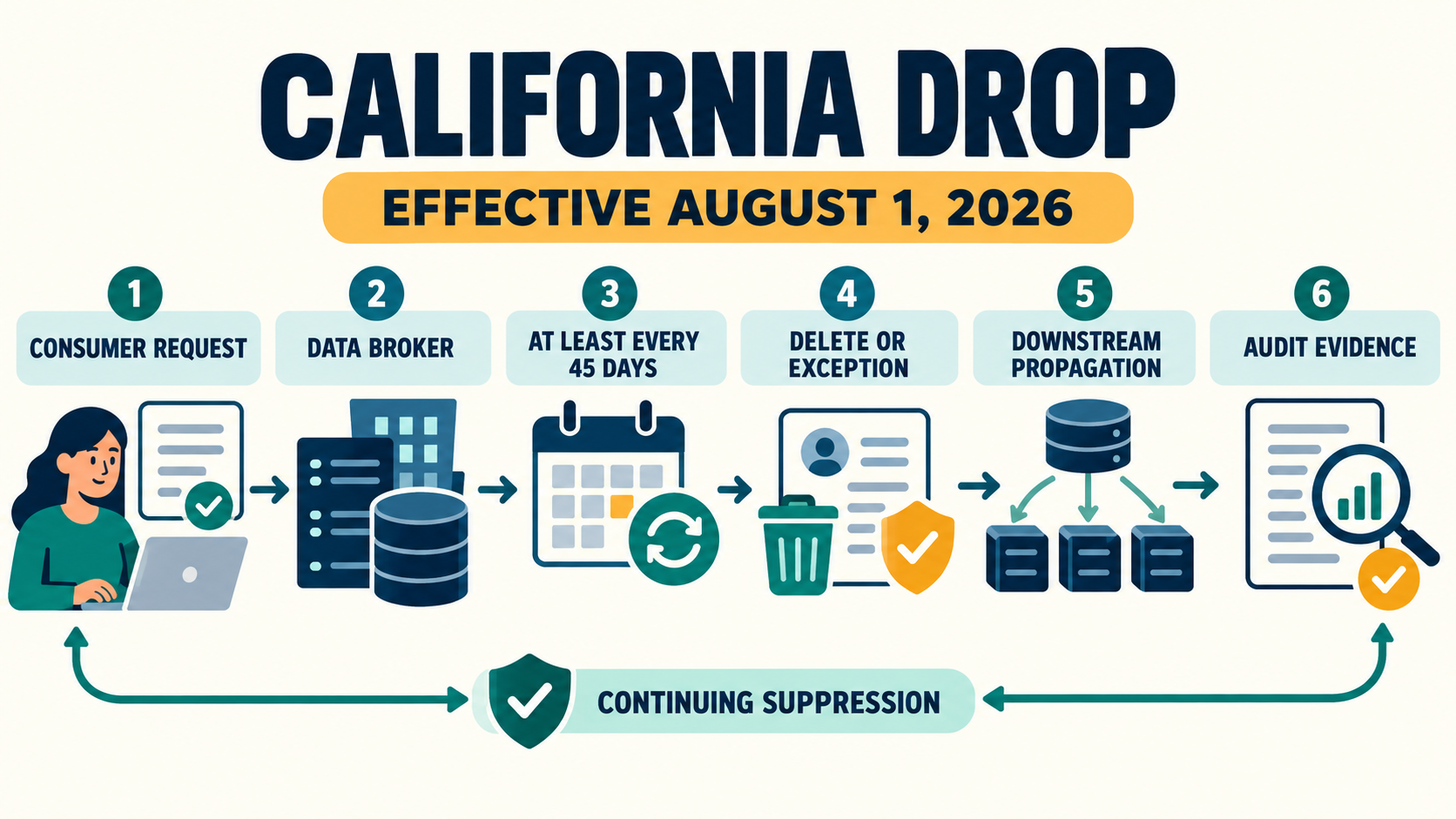
Since August 1, 2026, a covered California data broker must retrieve and process consumer deletion requests through the Delete Request and Opt-out Platform, known as DROP. The work is a rolling operating cycle: access selected lists at least once every 45 calendar days, compare identifiers using the prescribed method, take the required action, report an accurate status and keep future acquisition from undoing the consumer's choice.
This guide translates the final California Privacy Protection Agency regulations into an engineering and governance workflow. It does not decide whether a particular company is a data broker, whether a record is exempt, or what legal position an organization should take. Those are scope-specific legal determinations.
What changed on August 1, 2026
Consumers could begin submitting DROP requests in January 2026. The operational change on August 1 was the start of data-broker processing. CPPA states that brokers must access DROP at least once every 45 days and process the requests, subject to limited exceptions.
| Milestone | What changed | Operational meaning |
|---|---|---|
| January 1, 2026 | The DROP regulations took effect and consumers could submit deletion requests. | Account, registration, list-selection and readiness work could no longer be treated as a future concept. |
| August 1, 2026 | Covered data brokers began processing DROP deletion requests. | The recurring production access and processing obligation started. |
| Every 45 calendar days or sooner | A data broker must access DROP and download each selected consumer deletion list. | A monthly cadence is safer than scheduling exactly at the legal boundary. |
| Each subsequent access session | The broker reports the status of requests received in the previous session. | Download, processing and status upload form a rolling cycle, not a one-time deletion project. |
| January 1, 2028 | Independent third-party audits begin on the statutory three-year cycle. | Evidence design should already support later audit testing. |
The 45-day period is not a 45-day extension available after every internal handoff. It defines the recurring platform-access cycle. A reliable program uses an earlier internal schedule so a failed automated retrieval, holiday or absent owner does not consume the entire margin.
First decide whether the organization and data are in scope
The data-broker definition and its exclusions are legal questions, not fields that engineering should infer from an industry label. Maintain a signed scope record identifying the legal entity, covered activities, systems, first-party relationships, data sources and approved exceptions.
A company that buys an audience is not automatically the broker responsible for the DROP account. It may still receive deletion or suppression instructions through contracts or another privacy-rights workflow. Map each entity's role instead of sending the same response to every vendor.
Account and deletion-list selection
The regulations require the broker to select all consumer deletion lists containing identifiers that match personal information in its records. A narrower selection is allowed where identifiers across lists would produce a completely duplicative consumer population. If newly collected identifier categories make another list relevant, selection must be updated before the next DROP access.
Treat list selection as a controlled data-inventory decision. Product teams should notify the DROP owner before adding a new identifier type, onboarding an enrichment source or changing the identity graph.
The end-to-end DROP processing cycle
| Stage | Required result | Evidence to retain | Owner question |
|---|---|---|---|
| Access | Selected deletion lists downloaded at least once every 45 calendar days. | DROP access time, list identifier, file hash, row count and retrieval result. | Can we prove the last successful access without relying on a dashboard screenshot? |
| Normalize | Internal identifiers transformed using the regulatory rules before comparison. | Normalization version, identifier category and controlled test fixtures. | Would the same input produce the same comparison value tomorrow? |
| Hash and match | The same algorithm supplied in the deletion list is applied to the comparable internal identifier. | Algorithm metadata, job version, source snapshot and match counts. | Can engineering replay the decision without exposing raw identifiers? |
| Delete or limit | Matched records are deleted, or the prescribed multiple-consumer or exemption treatment is applied. | System-by-system task results, exception authority and completion time. | Did the action cover inferences, replicas and downstream processors? |
| Continue | Nonmatches and the minimum compliance record remain available only for the continuing statutory purpose. | Restricted suppression state, cancellation state and later-match checks. | Could newly acquired data be sold or shared before this check runs? |
| Report | The transaction identifier receives one accurate DROP response code in the next access session. | Submitted response file, acceptance receipt, rejected-row handling and reconciliation. | Does the reported code agree with the underlying system evidence? |
Assign one accountable owner to the cycle but do not make it a one-person process. Privacy, legal, security, data engineering, application owners and vendor management each supply evidence the others cannot create.
Retrieve each selected list and preserve provenance
DROP supports manual access and supported automated means. Automation reduces repetitive handling, but the regulation requires manual download when an automated connection cannot complete a timely retrieval. Therefore the runbook needs tested credentials, an authorized manual operator and a secure destination before the automation fails.
Record retrieval time, environment, selected-list name, byte count, row count, cryptographic hash and result. Do not put consumer identifiers, access tokens or full deletion files into tickets, source control or ordinary observability tools.
Understand incremental downloads
After the first download of a deletion list, subsequent downloads contain new or amended requests received since the most recent download. A broker may request a complete current list from the Agency for compliance, reconciliation or audit purposes.
This makes checkpoint integrity important. A job must not mark a list downloaded merely because an HTTP response arrived. Validate authentication, content type, schema, file completeness and secure persistence before advancing the checkpoint.
Know the six deletion-list types
| List code | Identifier input | Hash construction | Common implementation risk |
|---|---|---|---|
| Email address | Standardize one value, SHA-256, Base64 output. | Removing dots or plus tags changes the address and prevents a valid match. | |
| Phone | Phone number | Digits only, last ten digits or all digits when fewer than ten, then SHA-256 and Base64. | Assuming the source country code can be reconstructed after it was discarded. |
| MAID | Mobile advertising identifier | Keep hexadecimal characters, lowercase, require 32 characters, then hash. | Mixing another device-ID format into the MAID comparison population. |
| CTVID | Connected TV identifier | Keep alphanumeric characters, lowercase, require 8 to 32 characters, then hash. | Treating punctuation-preserving vendor IDs as if they already match DROP normalization. |
| NDZ | First name, last name, date of birth and ZIP | Hash each standardized field, concatenate four Base64 hashes in the documented order, then hash again. | Concatenating raw values, changing field order or decoding the intermediate Base64 values. |
| NameVIN | First name, last name and VIN | Hash each standardized field, concatenate three Base64 hashes in order, then hash again. | Hashing the concatenation only once or using uppercase VIN data. |
Every downloaded CSV uses an Id,Hash schema. The Id is a case-sensitive, 12-character Base62 work-item identifier permanently tied to that item. The Hash is SHA-256 output encoded as Base64. It is not a consumer ID and must not be replaced with an internal customer key.
A ZIP contains one CSV for each selected list. A selected list with no new work contains its header only. A separate Removed CSV can identify previously delivered work items removed after a consumer cancellation or change. Removed rows do not require a response status, but the internal continuing-control state must be updated safely.
Implement the current API contract defensively
| Operation | Success behavior | Retry behavior | Evidence |
|---|---|---|---|
| GET /data/download | A ready result is a ZIP; a valid no-data response is JSON; a preparing response can be HTTP 202. | Poll a preparing response later. Do not mistake JSON for an empty ZIP. | HTTP status, content type, filename, hash, files and row counts. |
| POST /data/upload | New Id,Status response CSV files are accepted and queued for validation. | Fix rejected files; do not assume queue acceptance means every row passed validation. | Accepted files, rejected files, validation outcome and submitted file hash. |
| POST /data/amend | A previously reported work item is corrected or updated. | Use when an official status changes, such as Not found becoming Deleted. | Prior status, new status, detection time, reason, accepted amendment. |
| HTTP 429 | No work completed. | Wait at least the documented interval and retry with a bounded backoff. | Attempt number and next retry time, without logging the API key. |
| HTTP 401/403/404/400/409 | A configuration, access, request or workflow problem exists. | Do not blind-retry. Correct the named condition and require an owned resolution. | Sanitized response, endpoint, timestamp, owner and resolution. |
| HTTP 500/503 | Temporary service error is possible. | Retry later with bounded exponential backoff, then use the manual fallback before the deadline. | Outage window, attempts, fallback decision and final access result. |
The July 2026 technical documentation identifies production at https://api.drop.privacy.ca.gov and sandbox below the /sandbox path. Requests use an API key in the X-API-KEY header and TLS 1.2 or later. Store that key in a secrets manager, scope it to the selected lists and regenerate it if compromised or when the documented list-selection workflow requires it.
Never decide response type from HTTP status alone. A successful download path can return a ZIP, a no-data JSON response or a preparing response. Check status, content type and body contract before writing a file. Save downloads atomically so an interrupted transfer cannot become an apparently valid processing input.
Validate filenames and CSVs before matching
The documented filename pattern is YYYYMMDD_DataBrokerId_DataType[_OptionalSuffix].csv. Data type is NDZ, Email, Phone, MAID, NameVIN or CTVID. Upload individual UTF-8 CSV files using multipart form data, not the downloaded ZIP. The response header must be exactly Id,Status.
Reject missing headers, unexpected columns, duplicate work-item IDs, invalid Base64, malformed status codes and files whose type disagrees with the filename. Keep a quarantine area and a row-level reason count. Do not silently skip malformed records and still declare the batch complete.
Normalize identifiers exactly for comparison
| Identifier | Regulatory comparison preparation | Implementation caution |
|---|---|---|
| Names and text | Use lowercase, remove specified extraneous or special characters, and convert non-English characters to the closest matching English character. | Keep the original value separate; this transformation is for DROP comparison, not a reason to rewrite the source record. |
| Email address | Lowercase treatment applies, while the special-character removal rule expressly excludes email addresses. | Do not invent provider-specific dot or plus-tag rules unless the current DROP specification requires them. |
| Date of birth | Format as eight digits in year, month, day order. | Reject impossible or incomplete dates instead of silently guessing missing components. |
| ZIP code | Use the first five characters of the ZIP code. | Record whether the input was absent, malformed or transformed; these are different states. |
| Phone number | Use the last ten digits without dashes or country code. | Do not apply this U.S.-oriented comparison form as a universal customer-data normalization rule. |
| Multiple identifiers | Hash each applicable identifier, concatenate the hashes without spaces or other characters, then hash the combined value. | The order, encoding and algorithm must follow the current supplied specification exactly. |
The regulation says the broker need only standardize its personal information for this comparison. Preserve the original business record and store the transformation as a versioned, isolated processing step. A global cleanup job could damage names, international phone numbers or account identifiers for unrelated purposes.
Hashing protects the comparison, but does not remove risk
After standardization, use the same hashing algorithm provided in the consumer deletion list for the same category of internal identifier. For specified multi-identifier lists, hash the individual values, concatenate those hashes in the required order without added characters, then hash the combined identifier.
Hashed email addresses and phone numbers remain linkable and can be vulnerable to guessing. Limit access, separate comparison data from marketing systems, encrypt storage and transport, and avoid exposing value-level results in logs.
Make matching deterministic and reviewable
Every match decision should be reproducible from the source snapshot, identifier category, normalization version, hashing method and job version. Test empty values, malformed dates, accented names, punctuation, plus-tagged email addresses, reused phone numbers and identifiers linked to several people.
Do not add fuzzy matching simply because it increases deletion volume. The final regulations define comparison steps. Any additional technique needs legal, privacy and security review and must not turn DROP data into an enrichment source.
Reference processing algorithm
for each downloaded CSV:
  verify UTF-8 header is exactly Id,Hash
  reject duplicate or malformed case-sensitive work-item Ids
  for each eligible internal identifier:
    normalized = normalize_by_list_type(source_value)
    candidate_hash = sha256_base64_utf8(normalized)
    compare candidate_hash to the downloaded Hash
  if a match exists:
    resolve every in-scope linked record
    create idempotent deletion or opt-out tasks
    wait for required internal and contractor evidence
  else:
    create the minimum ongoing comparison state
  emit Id,Status only after the decision gate passes
reconcile input, task, response, rejection and amendment counts
This is architecture pseudocode, not a substitute for the official specification. The important boundaries are explicit: validate before processing, normalize by list type, never compare raw DROP identifiers, make actions idempotent, wait for evidence and reconcile every state.
Composite hashing step by step
For NDZ, standardize first name, last name, date of birth and ZIP independently. Hash each UTF-8 string with SHA-256 and encode each 32-byte digest as Base64. Concatenate the four Base64 strings in exactly that order, with no delimiter, spaces or line breaks. Hash that concatenated text again and Base64-encode the final digest.
NameVIN follows the same design with first name, last name and VIN. A frequent error is to concatenate raw standardized values and hash once. Another is to concatenate binary digests instead of their Base64 text. Both produce a different result. Use the official sandbox standardization and hashing tool as a conformance oracle, and save non-personal fixtures in automated tests.
Normalization edge cases need fixtures
Email normalization removes whitespace and lowercases while preserving dots, plus signs and other characters. Name rules include specified transliteration of accented Latin, Greek and Cyrillic characters. ZIP processing keeps alphanumeric characters, applies the documented ZIP+4 behavior, lowercases and removes leading zeros under the current version. MAID and CTVID enforce length and character constraints.
Pin tests to the technical-documentation version, currently 1.2.0 as reviewed for this article. When CPPA publishes a later version, diff the rules, add new fixtures, run both versions against a controlled sample, define the cutover and retain which version produced each decision.
What a matched identifier requires
For a match, the regulations require deletion of all associated consumer personal information in scope, including inferences based wholly or partly on personal information collected from third parties or from the consumer in a non-first-party capacity. Deleting one contact row while retaining scores, segments, device links and exported audiences is not a complete implementation.
The rule provides for exempt information and first-party information as defined by the governing law and regulations. Classify those records deliberately. The existence of some first-party data does not automatically convert every linked field, inference or acquisition source into first-party information.
What delete means across systems and backups
For this regulation, deletion can be achieved by permanently and completely erasing the information from existing systems, deidentifying it, or aggregating consumer information, subject to the minimum compliance record. Archived or backup information may be delayed until the archive is restored to an active system or accessed for sale, disclosure or another commercial purpose.
A backup exception is not permission to restore deleted data into production. The restore procedure needs a gate that reapplies active DROP states before restored records become available for ordinary use.
Build a deletion map before claiming completion
| Data location | Deletion design question | Pass evidence |
|---|---|---|
| Identity and profile store | Can one matched identifier locate every linked person, household, device and pseudonymous profile that is in scope? | Documented identity graph traversal and sampled deletion trace. |
| Audience and activation platform | Are segments, lookalike seeds, exports and scheduled activations removed or rendered unusable? | Audience job cancellation, export inventory and destination confirmation. |
| Email and messaging systems | Are marketing profiles, enrichment fields and queued campaigns addressed without erasing a necessary suppression control? | Campaign removal plus a purpose-limited do-not-reacquire or do-not-sell state. |
| Analytics and inference store | Are scores, predictions and derived attributes based on third-party or non-first-party data included? | Feature-store and model-output task results tied to the request. |
| Service providers and contractors | Can each processor receive a minimum-data instruction and return completion evidence? | Contractor task ID, sent time, acknowledgement, completion and retry history. |
| Archives and backups | Will delayed deletion occur when the archive is restored or accessed for sale, disclosure or another commercial purpose? | Restore-time control, access gate and tested re-deletion procedure. |
Give each system task a stable request ID, scope, owner, deadline, retry policy and terminal evidence. A central orchestrator can coordinate the work, but the evidence must show what each destination actually did.
Direct service providers and contractors to delete
The regulation directs the data broker to instruct its service providers and contractors to delete personal information related to a consumer associated with a matched identifier. Maintain a living processor inventory, deletion endpoint or documented manual route, acknowledgement deadline and escalation owner.
Send only the minimum information necessary. A processor response saying a ticket was opened is not completion evidence. Reconcile the processor's task state and retain enough proof to support the broker's own DROP status.
When one identifier maps to multiple consumers
If several consumers are associated with a matched identifier and the request cannot be verified for deletion, the regulation requires opting each associated consumer out of sale or sharing and using the corresponding response code. Shared household emails, recycled phone numbers and family accounts make this a real production case.
Do not pick one person arbitrarily or delete unrelated first-party accounts without authority. Preserve the ambiguity evidence and verify that the opt-out reaches all associated in-scope records.
Record not found is a continuing state
When no current record matches, the broker must maintain the deletion list for the sole purpose of comparing newly collected records before that personal information is sold or shared, unless the consumer later cancels. Record not found therefore is not equivalent to request closed.
Place the check at the earliest controllable point before sale or sharing: acquisition import, identity resolution, audience activation or outbound data feed. A nightly job that runs after the information was already disclosed is too late.
Keep only the minimum compliance record
The regulations allow the minimum personal information necessary to facilitate continuing compliance. That state must not become a marketing suppression list used for segmentation, analytics or enrichment. Document its permitted purpose, access group, retention trigger and cancellation handling.
Use a pseudonymous internal control where it still performs the required comparison. Keep raw Agency-supplied information isolated and prohibit sale or sharing of that information.
Do not contact the consumer to verify a DROP request
The Agency verifies California residency before request submission, and the regulations state that a data broker must not contact the consumer to verify a DROP request. Internal support scripts must distinguish DROP from other privacy-right workflows that may permit or require direct verification.
Questions about a transaction should follow the DROP and Agency support process. Do not use the supplied details to send a confirmation, marketing message or data-correction request to the consumer.
Report one of the prescribed statuses
| DROP response code | Use when | Evidence needed before reporting |
|---|---|---|
| Record deleted | The supplied identifier matched and the associated personal information was deleted as required. | Match trace plus completed deletion and downstream task evidence. |
| Record opted out of sale | Multiple consumers are associated with the matched identifier, preventing verification for deletion, and all associated consumers were opted out of sale or sharing. | Ambiguous-match record and proof that the opt-out reached every associated consumer record. |
| Record exempted | The identifier matched, but all related personal information is exempt under the cited law, so no personal information was deleted. | A scoped, approved exemption determination covering all retained information. |
| Record not found | The required comparison produced no match in the broker records at that time. | Completed comparison evidence and enrollment in the continuing later-acquisition check. |
After the first access, each subsequent access session reports the status of requests received in the prior session. For manual processing, the previous statuses are uploaded before downloading new lists, in the specified machine-readable CSV format with response codes added.
Use a state model that separates work from reporting
An internal workflow can have pending, retrying, partially complete, review and failed states even though DROP accepts a defined response code set. Do not force an official response code until the underlying facts support it.
{
  "drop_transaction_id": "agency-supplied-transaction-id",
  "downloaded_at": "2026-11-01T09:15:00Z",
  "comparison_version": "drop-match-v1.2",
  "match_state": "matched",
  "required_action": "delete",
  "systems_expected": 8,
  "systems_completed": 8,
  "contractors_expected": 2,
  "contractors_completed": 2,
  "response_code": "Record deleted",
  "reported_at": "2026-12-01T09:10:00Z"
}
This example contains no consumer identifier and uses placeholder counts. Production evidence should be immutable, access-controlled and linked to separate system-level task records.
Make retries idempotent
Use the case-sensitive DROP work-item Id plus action version as an idempotency key. Retrying a timed-out deletion should resume or confirm the existing task, not create an unrelated second task. A processor acknowledgement must bind to the same request and system scope.
Keep separate timestamps for discovered, dispatched, acknowledged, completed, reconciled, submitted and accepted. One generic completed time hides whether deletion finished before or after the status upload.
Amend a status when the facts change
The technical API provides POST /data/amend. CPPA guidance gives the important example: a request reported Not found can later match newly collected information, requiring deletion and a change to Deleted within 45 days of detecting the change. Treat amendments as first-class events, not overwrites.
Store prior status, new status, detection time, reason, reviewer and accepted amendment result. A cancellation delivered in the Removed file is different from a status amendment and should follow a tested removal workflow.
Reconcile every cycle
For each selected list, reconcile downloaded transactions, valid rows, invalid rows, matches, ambiguous matches, exemptions, nonmatches, system tasks, processor tasks, response rows, rejected uploads and accepted statuses. Differences must create owned exceptions, not disappear into an aggregate success percentage.
Keep the official transaction identifier as the cross-system join key. If a tool creates its own job ID, retain both values and prevent duplicate execution through idempotency controls.
Protect DROP information as restricted compliance data
The regulations require reasonable security appropriate to the information supplied by the Agency and restrict its use to compliance. Apply least privilege, strong authentication, encryption, isolated storage, monitored exports and incident handling. Production access should not be shared through personal accounts.
Logs should identify job, list, transaction and result without revealing the consumer's values. Debug exports need expiry, access approval and secure destruction.
What marketing and email teams must change
DROP is not an unsubscribe button and an email unsubscribe is not proof of DROP compliance. Email suppression generally stops a channel; DROP can require deletion or continuing controls across a wider data-broker record. Keep the legal purpose and outcome of each state distinct.
Marketing operations should block re-import, enrichment, audience activation and vendor resale for applicable DROP states. Vendor contracts should define who receives requests, how quickly deletion evidence returns, and how later-acquired data is checked.
Failure modes that deserve runbook entries
| Failure | Why it is unsafe | Bounded response |
|---|---|---|
| API download fails | The access deadline continues to run. | Use the supported manual download path and document the failure; follow the Agency notification rule when its conditions are met. |
| Raw identifiers copied into ordinary logs | Deletion-list data becomes a new privacy and security exposure. | Stop the job, restrict the evidence, rotate affected credentials if needed and redesign logging around transaction IDs and counts. |
| Only the CRM row is deleted | Derived profiles, activation copies and processors may continue using the information. | Run the data-system and downstream inventory, then reconcile every scoped task. |
| Not-found treated as closed forever | A later-acquired record could be sold or shared despite the continuing requirement. | Keep the purpose-limited comparison state and check new records before sale or sharing. |
| Exemption label without scope | One exempt field can be used incorrectly to retain unrelated information. | Require field-level rationale, authority, reviewer, date and expiry or review trigger. |
| Status uploaded before processing completes | DROP can show an outcome that the broker cannot prove. | Gate response creation on reconciled completion and separately queue unresolved failures. |
Pre-production and recurring quality gates
| Quality gate | Pass condition | Test |
|---|---|---|
| 45-day clock | The next deadline derives from the last successful access and has an earlier internal alert. | Simulate weekends, holidays, failed API runs and manual fallback. |
| Selected-list coverage | Every identifier category held by the broker maps to an appropriate selected deletion list, subject to the duplicative-list rule. | Reconcile data inventory changes before each access cycle. |
| Deterministic matching | Documented fixtures reproduce the expected normalized and hashed result. | Run boundary cases for accents, punctuation, email, phone, date, ZIP and multiple identifiers. |
| Deletion completeness | All in-scope stores and processors finish, or a narrowly documented exception remains. | Sample matched requests from source through downstream confirmation. |
| Continuing suppression | A previous nonmatch or deletion prevents later sale or sharing unless the consumer amends or cancels the request. | Inject a later-acquired matching record in a controlled environment. |
| Status accuracy | Each transaction has exactly one current prescribed response code supported by evidence. | Reconcile downloaded, processed, reported, rejected and pending counts. |
| Security and purpose limitation | DROP-supplied information is isolated, access-controlled and used only for compliance. | Review permissions, logs, exports, retention and incident alerts. |
Prepare evidence for the audit requirement
The Delete Act calls for an independent third-party audit every three years beginning January 1, 2028. Do not wait until 2028 to reconstruct 2026 decisions. Preserve policy versions, access evidence, inventory changes, match tests, exceptions, downstream confirmations, response receipts and remediation records.
Evidence retention should be proportionate and secure. An audit trail is not a reason to retain full consumer deletion files broadly or indefinitely. Legal and security owners should approve the evidence schedule.
A practical 30-day operating cadence
A 30-day internal retrieval target leaves margin inside the 45-calendar-day requirement. In week one, download and validate. In weeks one and two, compare and dispatch tasks. In weeks two and three, reconcile deletions, processors and exceptions. Before the next access, approve and upload statuses, then retrieve the next increment.
This is an operational recommendation, not a replacement legal deadline. Higher volume, complex processors or incident recovery may require daily or weekly processing.
Current status as of November 14, 2026
The final DROP regulations are effective, and processing has been required since August 1, 2026. CPPA materials describe a rolling 45-day processing cycle. Separately, CPPA opened proposed rulemaking on November 13, 2026 concerning data-broker updates and DROP audits. Proposed audit rules are not the same as adopted requirements and should be tracked without being presented as final.
Before changing production logic, recheck the maintained CPPA data-broker page, final regulations and current DROP technical documentation. Platform formats can change even when the statutory obligation remains.
DROP readiness checklist
- Confirm the covered legal entity, data-broker scope and approved legal interpretations.
- Maintain the DROP account, authorized operators and tested manual fallback.
- Reconcile selected deletion lists against every identifier category held.
- Run deterministic normalization and hashing fixtures against the current specification.
- Inventory in-scope records, inferences, archives, service providers and contractors.
- Keep exemption, first-party and ambiguous-match decisions narrow and reviewable.
- Prevent later sale or sharing when a current request does not yet match.
- Reconcile every transaction and upload only an evidence-supported response code.
- Protect Agency-supplied information and prohibit secondary use.
- Retain proportionate audit evidence and test the workflow every cycle.
Primary sources
- CPPA final Data Broker Registration and Accessible Deletion Mechanism Regulations: Effective January 1, 2026; sections 7610 through 7622 define the operational rules summarized here.
- CPPA information for data brokers: Maintained account, registration and August 2026 processing guidance.
- CPPA DROP regulation rulemaking page: Final-rule status, approval record and supporting rulemaking documents.
- CPPA announcement approving the DROP regulations: Agency summary of the effective dates, deletion scope and status reporting.
- CalPrivacy DROP technical specifications: Current API documentation hub, version history and OpenAPI specification.
- CalPrivacy working with DROP data reference: Official list types, CSV schemas, standardization and SHA-256 Base64 examples.
- CalPrivacy DROP API operations: Official endpoint, response and retry behavior.