Canada CASL Email Compliance: Consent, Message Fields and Unsubscribe Controls
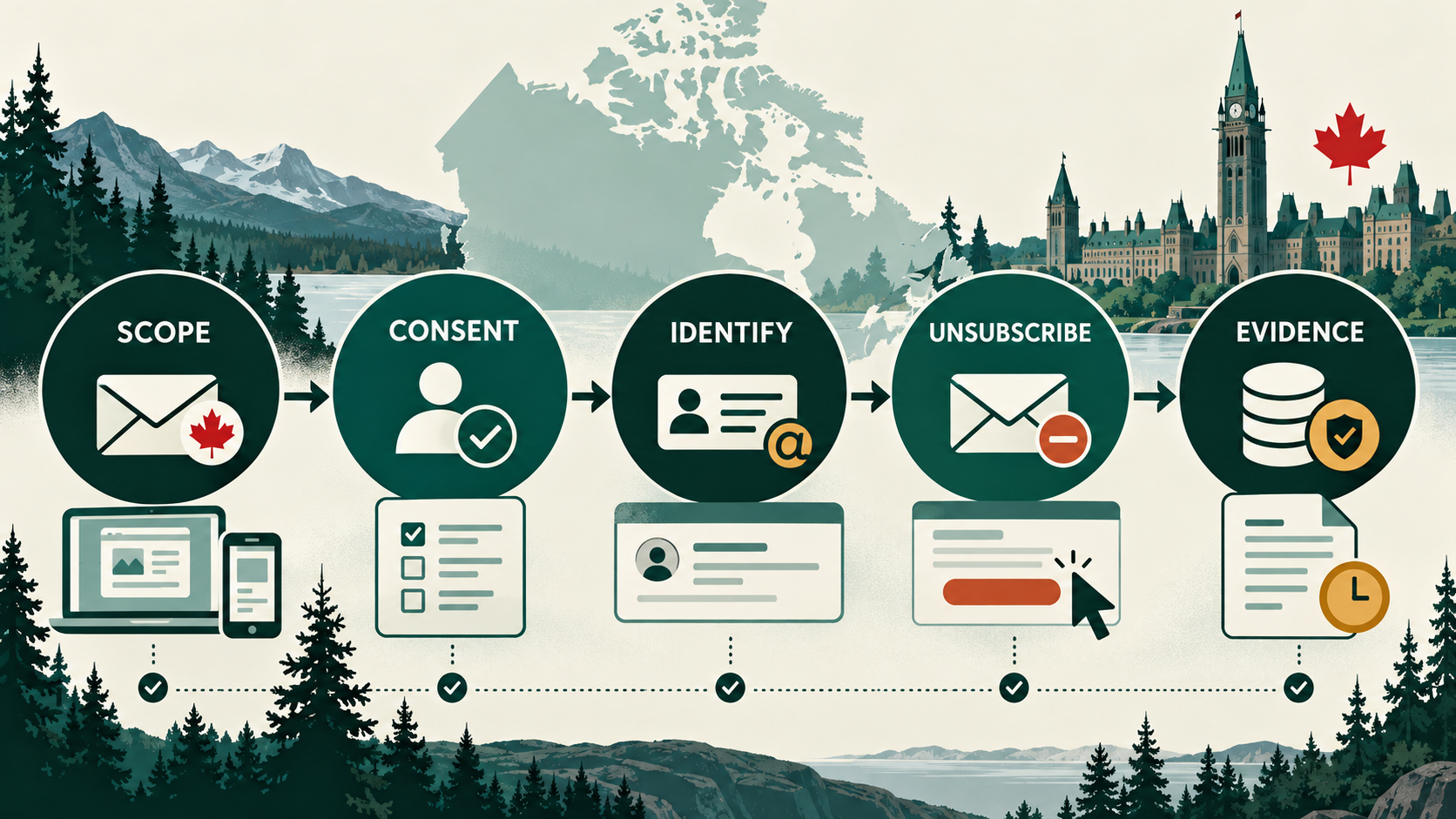
Most of Canada’s Anti-Spam Legislation provisions governing commercial electronic messages took effect on July 1, 2014. CASL generally requires a sender to prove express or implied consent, identify the sender and any represented person, provide prescribed contact information and operate an unsubscribe mechanism. These are separate controls: valid consent does not repair a missing footer, and a perfect unsubscribe link does not create permission to send.
This guide translates the current Act and regulations into email-system decisions: classifying a commercial electronic message, selecting and proving a consent route, calculating implied-consent expiry, handling referrals and published addresses, rendering required fields, suppressing across platforms and retaining send-time evidence. It is technical operating guidance, not legal advice; Canadian counsel should review disputed scope, exceptions and organizational facts.
What took effect on July 1, 2014
The majority of CASL provisions governing commercial electronic messages came into force on July 1, 2014. Section 6 prohibits sending, causing or permitting a commercial electronic message to an electronic address unless the recipient has express or implied consent and the message meets the prescribed content requirements, unless a specific exception or exclusion applies.
CASL is broader than ordinary marketing email terminology. A commercial electronic message is assessed using its content, hyperlinks and contact information, and commercial encouragement can be one of several purposes. A request for consent to send a CEM is itself treated as a CEM. A system therefore cannot repair a missing permission record by sending an unsolicited email that asks for permission.
How this article differs from a general consent guide
A general permission-based email guide explains audience expectations, list acquisition, proof and suppression across jurisdictions. This article has a narrower statutory purpose. It maps CASL sections 6 and 10 through 13 and the two Electronic Commerce Protection Regulations to specific data fields, expiry calculations, message rendering and release gates.
The same subscriber may be eligible under CASL but still be inappropriate for a campaign because of another law, a contractual promise, a platform policy, a brand preference or a global suppression. Treat CASL eligibility as one mandatory decision input, not a universal send authorization.
When an email enters the CASL decision path
Under section 12, a section 6 contravention requires a computer system located in Canada to be used to send or access the message. The sender’s incorporation country and ESP location are not reliable substitutes for this test. Recipient geography, account access and sending architecture need a documented scope assessment.
Section 6 also says transmission is considered sent once initiated. Whether the destination address exists or the message reaches it is immaterial. A hard bounce does not erase the permission decision that should have been made before queue release.
Cross-border delivery requires a route-specific assessment
A global campaign should not classify CASL solely from the contact’s country field. Section 12 refers to a computer system in Canada being used to send or access the message. The regulations also contain a limited exclusion when the sender reasonably believes the message will be accessed in a listed foreign state and the message complies with substantially similar local law.
Record the factual basis and legal rule used for each cross-border segment: recipient and account context, sending route, expected access location, listed-state check, applicable foreign rule and approving legal owner. A VPN, travel, shared mailbox or inaccurate CRM country can make a simple geolocation rule unreliable. When the evidence is uncertain, use the stricter approved path rather than silently excluding the recipient from CASL controls.
Consent, implied-consent and exclusion routes
| CASL route | Conditions that must be proved | Time boundary | System evidence |
|---|---|---|---|
| Express consent | The request states the purpose, identifies the requester and any represented person, supplies prescribed contact information and states that consent can be withdrawn. | No two-year or six-month implied-consent window. Consent must remain provable and can be withdrawn. | Exact form or script version, affirmative action, timestamp, address, source, identity shown, purpose, policy version and withdrawal state. |
| Existing business relationship | A qualifying purchase, lease, accepted opportunity, barter, written contract, inquiry or application connects the recipient with the sender or represented person. | Generally two years for qualifying transactions and current or recently expired contracts; six months for an inquiry or application. | Qualifying event type, event date, contracting entity, recipient identity, calculated expiry and source transaction ID. |
| Existing non-business relationship | Qualifying donation, gift, volunteer work, meeting attendance or membership with an eligible organization. | Generally two years, with statutory rules for ongoing relationships and membership termination. | Organization class, qualifying event, date, membership termination if applicable and source record. |
| Conspicuously published address | The recipient published the address without a statement against unsolicited CEMs, and the message is relevant to the recipient’s business, role, functions or duties. | No reusable permanent entitlement is created. Conditions must be true for the send being evaluated. | Source URL, capture time, displayed address, absence of contrary statement and documented role relevance. |
| Address disclosed to sender | The recipient disclosed the address without indicating they do not want unsolicited CEMs, and the message is relevant to their business role or duties. | Depends on the continuing facts and any later withdrawal or contrary indication. | How the address was disclosed, date, recipient context, relevance assessment and suppression check. |
| First message after qualifying referral | The referrer has a qualifying relationship with both parties; the first CEM discloses the referrer’s full name and says it follows a referral. | Consent exception applies only to the first qualifying message. | Referrer identity, both relationship proofs, first-message lock and exact disclosure rendered in the message. |
| Section 6 exclusion | A specific statutory or regulatory exclusion applies, such as a qualifying response to a request, defined inter-organization message or legal-notice case. | Only while every element of the selected exclusion is satisfied. | Exact provision, factual test, approving owner and message-purpose evidence. |
Do not store a single boolean named casl_consent. Express consent, implied consent and a regulatory exclusion have different facts, expiries and message obligations. The send decision needs the exact provision and evidence that applied at the time of that send.
Build express consent as a reproducible event
CASL section 10 and the CRTC regulations require a request for express consent to state the purpose clearly and simply, identify the person seeking consent and any person on whose behalf consent is sought, include prescribed contact information and state that consent can be withdrawn. The regulations permit oral or written consent and require consent to be sought separately for the acts described in sections 6 through 8.
A defensible web implementation stores the exact copy version, unchecked initial state, affirmative action, timestamp, submitted address, page or application source, displayed identities, disclosed purposes and policy version. For oral consent, retain the approved script, agent, date, method and a record sufficient to prove what the person agreed to. CASL section 13 places the onus of proving consent on the person alleging it.
Test the consent interface, not only the database row
A stored timestamp does not prove that consent was obtained correctly. Preserve the rendered form or script and test its default state, labels, nearby disclosures, represented entities, contact information, withdrawal statement and submitted values. Consent for commercial email should not be inferred from silence, an unchecked form that front-end code silently changes, or acceptance of unrelated terms.
Run negative tests. Submit without selecting the email choice, select another channel only, withdraw and return, change locale, use keyboard navigation, block JavaScript and repeat through the mobile application. The permission service should record only the action the person actually completed. A tag manager, CRM sync or import must not upgrade an unknown or transactional-only state to express consent.
Calculate implied-consent windows at send time
An existing business relationship can arise from a qualifying purchase, lease, accepted opportunity, barter or written contract within the statutory conditions. The commonly used period is two years immediately before the send, while an inquiry or application generally uses six months. Ongoing subscriptions, accounts, loans and similar relationships have specific rules for when the period begins.
Store the qualifying event rather than only a computed expiry. If legislation, facts or relationship status changes, the organization must be able to recalculate eligibility. A purchase by one entity does not automatically establish a relationship with every affiliate, brand or acquired database record.
A business sale is not the same as an affiliate transfer
CASL subsection 10(12) provides that when a business is sold, the purchaser is considered to have the seller’s existing business relationship in respect of that business. That rule does not mean every corporate affiliate, parent, franchise, newly introduced brand or data recipient automatically inherits permission.
For a genuine business transfer, retain the effective date, transferring and receiving legal entities, business scope, source relationship, applicable recipient records, original qualifying events and every suppression. Limit use to the acquired business context and calculate the remaining relationship window from the statutory event. Never reset the two-year clock merely because data moved to a new CRM.
A published business address is not blanket permission
Implied consent based on conspicuous publication requires all statutory elements: the recipient published or caused publication of the address, publication was not accompanied by a statement against unsolicited CEMs, and the message is relevant to the recipient’s business, role, functions or duties. Address availability alone is insufficient.
For each send based on this route, retain the source URL, retrieval time, page capture, visible no-solicitation state and a specific relevance explanation. Scraped lists normally cannot prove these conditions recipient by recipient. A later removal or contrary statement should stop further reliance until reviewed.
A referral exception is a one-message workflow
The regulatory referral condition is narrow. The individual making the referral must have a qualifying family, personal, existing business or existing non-business relationship with both the recipient and the sender. The first commercial electronic message must disclose the referrer’s full name and state that it is sent as a result of the referral.
Implement this as an atomic first-message entitlement, not a reusable consent flag. Store the referrer, proof of both relationships, recipient, sender, message ID and consumption time. Lock the entitlement before queue release so parallel campaigns cannot each claim to be the first message. A reply, purchase or valid consent can create a later route; silence after the referral message does not.
Purchased and partner lists need recipient-level proof
A contract stating that a list is “CASL compliant” is not recipient-level evidence. The importing organization needs the exact consent language, identity of the person who obtained consent, represented persons, purpose, address, affirmative action, timestamp, source and withdrawal history. If the consent named only the list owner, it may not authorize an unrelated buyer.
Quarantine imports until identity, permission route, expiry and suppression reconciliation pass. Sample screenshots and aggregate assurances cannot fill missing rows. When proof is incomplete, do not send a consent request by email: the request is itself a CEM and needs its own valid route.
Distinguish full section 6 exclusions from consent-only exceptions
Subsection 6(6) removes the consent requirement in paragraph 6(1)(a) for narrowly defined messages that solely perform functions such as providing a requested quote, facilitating an agreed transaction, supplying warranty or recall information, giving specified factual account information or delivering an entitled product or update. It does not remove the message-content requirements in subsection 6(2).
By contrast, section 3 of SOR/2013-221 excludes defined message classes from section 6, including certain messages within an organization, between organizations with a relationship when the message concerns the recipient organization’s activities, responses to a request or complaint, and specified legal-notice cases. “B2B” is not a universal exemption. The exact parties, relationship and message purpose must meet the selected provision.
Required fields in the final message
| Control | Required implementation | Acceptance test |
|---|---|---|
| Sender identity | Show the business name, or legal name if there is no different business name, of the sender. | The rendered message names the accountable sender unambiguously. |
| On-behalf-of identity | When different, identify the person on whose behalf the message is sent and state who is sending and for whom. | A vendor or platform name does not replace the represented organization. |
| Contact information | Include a mailing address plus either a telephone number reaching an agent or voice system, an email address, or a web address. | The contact route is usable and remains valid for at least 60 days after sending. |
| Placement | Set identification and unsubscribe information clearly and prominently. A clearly prominent no-cost web link can carry it when direct inclusion is not practicable. | Mobile and text-only versions expose the information without hidden, broken or inaccessible controls. |
| Unsubscribe method | Allow a no-cost indication through the same electronic means, or another practicable electronic means, using an address or web page. | No login, password, account creation, survey or additional confirmation is required to give effect to the request. |
| Unsubscribe availability | Keep the electronic address or web page valid for at least 60 days after the message. | Automated monitoring verifies the endpoint throughout the complete period. |
| Suppression deadline | Give effect without delay and no later than 10 business days after the indication is sent. | No covered CEM is released after the effective suppression deadline. |
Validate these controls against the final MIME after template assembly, localization and vendor footer insertion. A correct database setting does not prove that the HTML, plain-text and mobile presentation contains the required information.
Unsubscribe is a distributed suppression transaction
The mechanism must let the recipient indicate at no cost that they no longer wish to receive any CEMs, or a specified class of CEMs, from the sender or represented person. It must use the same electronic means where practicable, or another electronic means, and provide an address or web page for the indication.
Giving effect requires more than displaying a success page. The request must reach every system capable of releasing covered mail, including the ESP, CRM, customer-data platform, lifecycle automation, support imports and queued campaigns. The law sets an outside deadline of 10 business days, but the operational target should be immediate durable suppression.
Suppression propagation model
request_received_at -> normalize scope -> durable suppression write
  -> propagate to ESP, CRM, CDP, automation and queued campaigns
  -> cancel pending covered sends -> verify propagation acknowledgements
  -> monitor for post-request sends -> retain completion evidence

Deadline: without delay, and no later than 10 business days.
Endpoint validity: at least 60 days after each message that exposed it.
Minimum evidence record
The evidence record should identify the recipient without exposing unnecessary personal data in broad logs. It must still connect the send decision to an authoritative source record. Hashing an address can reduce exposure in analytics, but the restricted permission service needs a reliable lookup key and a controlled method for correcting or deleting data.
{
  "recipient_id": "internal-8f31",
  "electronic_address_hash": "sha256:...",
  "casl_route": "existing_business_relationship",
  "provision": "CASL 10(9)(a), 10(10)(a)",
  "qualifying_event": "purchase",
  "qualifying_event_at": "2026-04-18T14:25:00Z",
  "route_expires_at": "2028-04-18T14:25:00Z",
  "sender_legal_entity": "Example Canada Inc.",
  "represented_entity": null,
  "source_system": "orders-ca",
  "source_record_id": "order-41827",
  "evidence_snapshot": "evidence://casl/order-41827/v1",
  "withdrawn_at": null,
  "reviewed_at": "2026-10-28T09:00:00Z"
}
Pre-send decision gate
INPUT: recipient, proposed message, sender entity, represented entity, send time

1. Classify whether the message is a CEM using content, links and contact data.
2. Check global and program suppressions before evaluating permission.
3. Resolve exactly one documented consent route or section 6 exclusion.
4. Recalculate time-limited implied consent at the proposed send time.
5. Verify sender, on-behalf-of and contact fields in the final rendered MIME.
6. Verify the unsubscribe endpoint and its 60-day monitoring coverage.
7. Write the permission decision, rule version and evidence IDs to the send ledger.
8. Recheck suppression immediately before queue release.
9. Block the send when evidence is missing, expired, contradictory or unreviewed.
The gate should fail closed for marketing CEMs when permission evidence is absent or expired. A manual override should require a named approver, exact provision, expiry, affected population and immutable audit record. An ESP “accepted” response is delivery evidence, not CASL permission evidence.
Worked example: an inquiry expires before campaign release
A prospect submits a product inquiry on March 2 and supplies an email address. The organization records an existing-business-relationship route based on the inquiry, with the statutory six-month window calculated from that event. A sales employee schedules a promotional campaign for September 8. The address is valid, the message footer is complete and the unsubscribe endpoint works, but the implied-consent route has expired before queue release.
The send gate blocks the recipient because the qualifying event no longer supports that send. It does not convert the address to conspicuous publication, extend the window because sales activity continued internally or send a new request for consent. If the prospect made a qualifying purchase during the period, that separate source event could establish a different relationship window. The system must retrieve and prove that event rather than edit the old expiry.
If the recipient had previously withdrawn consent, the suppression would block the send before any relationship calculation. This ordering matters: a qualifying transaction is not permission to ignore a later unsubscribe request.
Mixed transactional and promotional content
The section 6(6) consent exceptions apply when the message solely performs the listed purpose. Adding an offer, cross-sell, referral promotion or unrelated commercial link can move a transactional message outside that narrow condition. Classification must inspect subject, preheader, HTML, text, links, annotations and dynamic blocks in the final message.
Maintain purpose-limited transactional templates and block unreviewed promotional modules. When a message contains both operational and promotional content, evaluate the complete message as a CEM and require an applicable permission route rather than labelling the stream “transactional.”
The brand cannot outsource accountability to an ESP
Section 6 covers a person who sends, causes or permits a CEM to be sent, and section 9 prohibits aiding, inducing, procuring or causing prohibited conduct. Contracts should assign identity fields, consent imports, suppression synchronization, evidence export, endpoint monitoring, incident notification and deletion obligations. The organization should be able to stop a campaign and retrieve the exact evidence used for every recipient.
Before migrating platforms, reconcile consent sources and suppressions rather than importing only active subscribers. Verify that historical withdrawals, program-level preferences and global suppressions survive identifier changes and deduplication.
Make ownership and due diligence visible
A compliance program needs more than policy text. Assign an executive owner, legal interpretation owner, permission-service owner, campaign approver, suppression owner, vendor owner and incident commander. Document how employees, officers, directors, agents and platforms can stop an unsafe send and where evidence is preserved.
CRTC corporate-compliance guidance describes senior-management involvement, risk assessment, written policy, record keeping, training, auditing, complaint handling and corrective action. Turn those elements into controls with named evidence: approval records, access reviews, test results, training completion, vendor attestations, exception registers and incident follow-up. A due-diligence claim is stronger when routine operation can be reproduced.
Retain the decision, not unlimited customer data
CASL puts the onus of proving consent on the person relying on it, but that does not justify retaining every source-system field forever. Separate the minimum permission evidence from broad behavioral and campaign data. Protect raw form captures, contracts and call records with restricted access while exposing only the state needed by the send gate.
Define retention from legal advice, limitation considerations, active relationships, audit needs and other privacy obligations. Record deletion and correction events. If an address is erased from a marketing profile, preserve only the bounded suppression or compliance fact needed to prevent reacquisition from causing another send. Hashing can reduce exposure in analytics but does not make linkable evidence anonymous.
Failures a CASL audit should detect
- Consent request sent without a valid route: the request is itself a CEM.
- Boolean permission field: no basis, evidence, party, purpose or expiry can be proved.
- Expired implied relationship: a two-year or six-month window was never recalculated.
- Public address treated as permission: role relevance and no-solicitation conditions were not captured.
- Blanket B2B flag: the organizations, relationship and message purpose were not tested.
- Vendor identity only: the person on whose behalf the message was sent is missing.
- Broken plain-text footer: required information exists only in HTML.
- Unsubscribe requires login: further action is demanded before suppression.
- Endpoint expires early: the link stops working inside the 60-day period.
- Suppression propagation lag: an automation sends after withdrawal.
- Transactional label hides promotion: the final content does not solely meet the claimed exception.
Respond to a suspected non-compliant send
- Contain: pause the affected campaign, journey, audience export and queued retries without deleting evidence.
- Preserve: retain the final MIME, recipient decision ledger, source events, consent copy, suppression state, vendor logs and UTC release time.
- Scope: identify the legal entity, represented person, permission route, affected recipients, access location and every downstream platform.
- Correct: write missing suppressions, stop invalid routes, repair templates and prevent imports from restoring the audience.
- Escalate: involve the legal, privacy and incident owners for notification, response and regulator-contact decisions.
- Verify: test the corrected send gate and search for the same defect in other programs, brands and vendors.
Do not “fix” the evidence record after a send to make the decision appear valid. Preserve the original state, record the correction separately and document which control failed. An audit trail must distinguish facts known at release from facts discovered afterward.
Operational acceptance checklist
- Classify the final message using content, hyperlinks and contact information.
- Resolve a specific consent route or section 6 exclusion for every recipient.
- Retain proof supporting every fact required by that route.
- Recalculate time-limited implied consent at queue release.
- Identify the sender and represented person correctly.
- Render the mailing address and required contact method clearly.
- Test HTML, plain text, mobile and localized variants.
- Monitor the unsubscribe endpoint for at least 60 days after each send.
- Apply withdrawal without delay and within 10 business days at the latest.
- Cancel queued covered sends after suppression.
- Retain send-time evidence and the rule version used.
- Obtain qualified legal review for disputed scope or exemptions.
Current status as of November 16, 2026
The Justice Laws site identifies the consolidated Act as current to October 19, 2026 and last amended January 1, 2026. The current section 6 still contains the consent, identification, contact and unsubscribe framework described here. It also contains a specific subsection 6(7.1) exception for qualifying program transmissions by an online undertaking. That narrow provision is not a blanket exemption for newsletters, promotions or ordinary platform email.
CASL enforcement is shared among the CRTC, Competition Bureau and Office of the Privacy Commissioner according to their mandates. Government guidance notes that serious violations can attract administrative monetary penalties up to $1 million for an individual and $10 million for a business, with statutory factors affecting the amount.
This article does not determine whether a particular message, organization, relationship or jurisdictional fact is covered. Preserve the evidence and obtain legal advice before relying on an exception, especially for acquired lists, referrals, cross-border programs, charities, political messaging, mixed-purpose messages and inter-company campaigns.
Primary and official references
- CASL consolidated statute: Official consolidated Act, including sections 1, 6, 10, 11, 12 and 13.
- Electronic Commerce Protection Regulations (CRTC), SOR/2012-36: Prescribed sender identity, contact, consent-request and presentation requirements.
- Electronic Commerce Protection Regulations, SOR/2013-221: Regulatory exclusions, referral conditions and organizational-message provisions.
- Government of Canada CASL overview: Official overview of scope, enforcement agencies and administrative monetary penalties.
- CRTC corporate compliance program guidance: Official guidance for documented compliance programs and organizational controls.
- CRTC guidance on express-consent toggling: Official interpretation guidance for affirmative consent choices and form design.