CNIL Email Tracking Pixel FAQ: Implementation Answers for 2026
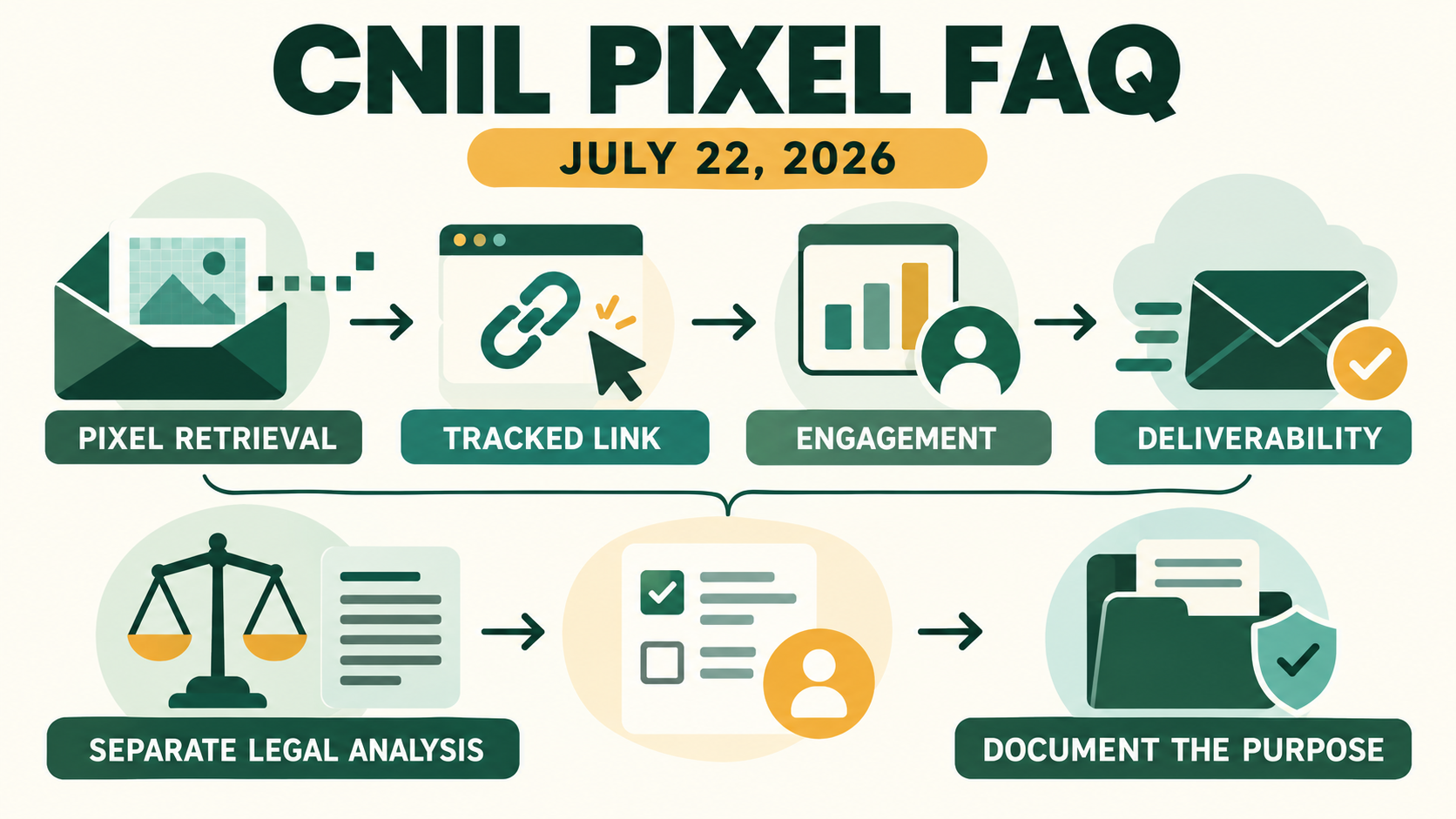
The CNIL published 27 operational answers on July 22, 2026 to clarify how its email tracking-pixel recommendation works in real systems. The answers resolve practical questions about tracked links, territorial reach, providers, newsletters, transactional messages, mixed-purpose pixels, consent records, withdrawal and the transition for addresses collected before April 14, 2026.
This guide turns those answers into implementation and test decisions for privacy, email, product and infrastructure teams. It complements the broader CNIL email-pixel implementation guide without repeating it. It is technical operating guidance, not legal advice. Organizations should obtain scope-specific advice for their roles, recipients and jurisdictions.
What the July 2026 FAQ clarified
The adopted recommendation established the framework. The FAQ tests that framework against situations teams actually configure: tracked redirects, employee messages, processors using data for themselves, precise event fields, global campaign statistics, mixed-purpose endpoints, commercial messages, newsletters, preference centers and historic address lists.
The central lesson is that a label such as transactional, analytics, security or deliverability does not decide the result. The decision follows the exact purpose, whether the message relates to a service expressly requested by the person, the fields collected, the action taken, the actors involved and the ability to honor the person's choice.
Four scope questions to settle first
| Question | CNIL clarification | Operational decision | Evidence to retain |
|---|---|---|---|
| Are tracked links directly covered by the email-pixel recommendation? | No, but terminal access and the purpose of the link tracking still require a separate Article 82 and GDPR assessment. | Inventory redirect tracking separately. Do not treat a pixel decision as authorization for click tracking. | Redirect domains, parameters, purposes, fields collected, retention, consent or exemption analysis and withdrawal behavior. |
| Does the guidance apply only to organizations established in France? | No. The applicable territorial conditions can include actors elsewhere and tracking of people located in France. | Ask privacy counsel to map establishment, users, actors and processing rather than relying on server location. | Territorial assessment, affected population, controller and processor locations and transfer analysis. |
| Are employee, B2B or public-sector messages automatically outside scope? | No. The context can affect the consent analysis, but the use of a tracker in email is not excluded merely by recipient category. | Classify the purpose and message relationship for every stream. | Recipient class, message trigger, requested-service basis, purpose and approved configuration. |
| Can a provider make the sender compliant by contract? | No. Roles and duties depend on actual purposes and means. Delegated consent collection still requires demonstrable proof and oversight. | Map controller, processor and possible joint-controller roles for each operation. | Instructions, Article 28 or Article 26 terms, audits, subprocessor list and consent evidence. |
What a pixel operation actually does
A remote image URL in an email causes the recipient terminal or a mailbox proxy to request an asset. The request can carry a unique identifier and expose network and client information to the image host. Article 82 analysis concerns this terminal access operation even before a team decides whether the resulting data is personal data or how later processing fits the GDPR.
Document both the message-side instruction and the server-side collection. Removing a field from the analytics dashboard is not enough when a CDN, reverse proxy, web server or vendor retains it elsewhere.
Are tracked links covered?
The FAQ says tracked links are not directly covered by the email-pixel recommendation. That is not a declaration that tracked links are unrestricted. A personalized redirect can read or write information on the terminal, associate a click with a recipient and collect data under Article 82 and the GDPR. Apply a separate purpose and necessity assessment.
A link used only to provide a simple and secure withdrawal route is the FAQ's example of an operation that can be strictly necessary to the requested service. That narrow example does not convert every click-tracking redirect into an exempt operation.
Who can fall within the scope?
Do not limit the inventory to French companies or French-hosted servers. The FAQ explains that the CNIL may act when the applicable legal conditions are met, including processing in the context of a French establishment and certain tracking of people located in France by an actor outside the European Union. Employee, customer, prospect and professional addresses are not categorically excluded.
Record the controller and processor establishments, user locations, campaign populations, contracting entities, tracking endpoints and support access. Territorial analysis belongs with privacy counsel; DNS geolocation or a cloud region alone does not settle it.
Who is responsible when several vendors are involved?
An ESP or image host acting only on documented sender instructions is generally a processor for that operation. If a provider also uses pixel data for its own product improvement, list enrichment or another accepted purpose, controller or joint-controller questions arise. A contract label cannot override the actual purpose and decision-making.
The organization delegating consent collection must still demonstrate valid collection on its behalf. Require testable consent evidence, purpose-specific configuration, audit rights, subprocessor transparency, security, rights support, deletion and change notification.
When can deliverability measurement avoid consent?
Every condition must be satisfied. The email must be expressly requested or tied to a requested service. The pixel must be limited to the deliverability purpose described by the CNIL: identifying inactivity so the sender can reduce frequency or stop sending. Collection must be strictly necessary and the sender must perform the promised action.
If any condition fails, consent is required for that purpose. Calling the field deliverability in a vendor interface does not repair an unrequested message, excessive collection, personalization, precise behavioral history or an inactivity rule that never changes sending.
How message type affects the decision
| Message type | Requested-service assessment | Possible pixel outcome | Important boundary |
|---|---|---|---|
| Purchase or subscription confirmation | Normally triggered by a user action and functionally tied to the service. | A strictly minimized deliverability pixel may qualify for exemption if every condition is satisfied. | Promotional content can change the classification. |
| Subscription renewal notice | Can remain tied to a user-initiated contractual service. | A limited exemption may be available. | Do not add unrelated engagement or cross-sell measurement. |
| Password reset or authentication message | Tied to a requested account-security process. | A narrow user-centered security exemption may be available. | General bot, advertising-fraud or campaign analysis is not the same exemption. |
| Legal, privacy or contractual update | Can relate directly to an existing requested service. | A minimized pixel may qualify if the remaining conditions are met. | Keep the message informational and preserve its trigger. |
| Newsletter expressly requested by the recipient | Can be an expressly requested service. | Deliverability-only measurement may qualify. | Personalization, optimization or profiling still needs the appropriate consent. |
| Similar-products marketing sent under a separate marketing exception | The ability to send does not itself mean the message was expressly requested. | The deliverability exemption does not automatically follow and pixel consent is generally required. | Email-send permission and terminal-access permission are separate tests. |
| Abandoned-cart reminder | The FAQ treats this as promotional rather than transactional. | Do not claim the transactional exemption solely because a cart event exists. | Classify the actual purpose, not the automation label. |
Email permission and pixel permission are separate
The FAQ distinguishes the rule allowing a commercial email to be sent from the Article 82 rule governing pixel access. A promotional email may be sendable under a products-or-services-analogous exception without becoming a service expressly requested by the recipient. The pixel therefore does not inherit an exemption automatically.
Keep two explicit decisions in the send pipeline: may this message be sent, and may each tracking purpose run for this recipient? A single marketing_eligible flag cannot answer both questions safely.
Which data can the narrow exemption collect?
| Data or event | Exempt deliverability design | Consent-required or separate review signal | Control |
|---|---|---|---|
| Last known opening date | In principle, the calendar date may be sufficient to reduce frequency or stop sends to inactive recipients. | Precise timestamp used for behavioral optimization. | Overwrite the prior value and document the inactivity action. |
| IP address | Not normally necessary for the narrow deliverability purpose. | Collection remains excessive even when deleted or anonymized soon afterward. | Avoid collection at the application and proxy layers; verify raw logs. |
| User-Agent or device data | Not normally necessary. | Device profiling, client analysis or personalization. | Disable capture or require the appropriate consent and disclosure. |
| Individual open history | A continuing event history is difficult to justify for a last-open-only exemption. | Sequence and timing analysis for campaign or profile decisions. | Store the minimum state rather than an append-only event trail. |
| Campaign-wide aggregate | Effectively anonymized aggregation may be produced from lawfully collected data. | Calling identifiable or reversible grouped data anonymous. | Test re-identification risk, access, minimum group size and deletion of source data. |
| No-open state | May support reducing frequency, stopping sends or another documented permitted action. | Treating no open as proof of abandonment or lack of legal receipt. | Use bounded operational rules and additional evidence. |
The FAQ says the last opening date is, in principle, the only data needed for the limited deliverability action unless the sender documents why another field is necessary. Short-lived collection of IP or user-agent does not become necessary merely because the system anonymizes or deletes it later.
Can exempt data produce global open statistics?
Yes, the FAQ permits reuse of lawfully collected data for a global campaign statistic after effective anonymization, for example through aggregation. The anonymization process remains subject to the GDPR. This answer does not authorize excessive source collection or recipient-level performance analysis.
Define the aggregation threshold, isolation from recipient identifiers, access controls, re-identification testing and source-data deletion. A segment of one recipient, a stable pseudonymous identifier or reversible token is not effectively anonymous merely because the dashboard omits the address.
What must happen when no open is observed?
The exempt deliverability purpose must cause a real operational result. Depending on the communication, the sender can stop sending, reduce frequency or use another lawful channel. Document the threshold, message class, action, exception and review evidence.
An absent open is weak evidence. Remote images can be blocked while a person reads; proxies and scanners can fetch without human attention. Do not call the mailbox abandoned, do not suppress essential service notices solely from pixel evidence and do not treat an open as a contact initiated by the prospect.
How to handle a mixed-purpose pixel
The FAQ allows one technical pixel to serve exempt and consent-required purposes, but only the exempt operation may run without consent. Optional purposes must remain off until valid consent exists. A pixel cannot be placed with no current purpose merely in case consent arrives later.
Purpose separation must be enforceable in data collection, not just reporting. If the shared endpoint always records precise time, IP, user-agent and campaign profile events before applying a filter, split the endpoint or identifiers.
What qualifies as a security exemption?
The security clarification is user-centered. A pixel in an authentication or password-reset message may support protection against interception or unexpected automated access when the requested-service and minimization conditions are met. The inactivity-cleaning conditions belong to deliverability and do not automatically apply to this security purpose.
Broad bot detection, advertising-fraud analysis and general fraud intelligence do not become exempt merely because a security team uses the result. Where consent is unsuitable, use methods that do not depend on terminal access.
How detailed must consent be?
Present every purpose clearly before the choice. The FAQ supports a first-level global acceptance control when a second level permits independent choices for distinct purposes. A single consent may cover genuinely connected purposes, but the person must understand the scope.
Consent does not always need to be organized by message category. It may be tied to an email address or account if the interface makes clear whether the choice covers one stream or all future email. Separate categories when different platforms or operational needs make that clearer.
What should the consent record contain?
| State field | Purpose | Example value | Failure to avoid |
|---|---|---|---|
| Subject and address scope | Defines whose choice applies and whether it covers one address, an account or a message category. | internal_subject_842 and address_scope: account-primary | Putting the email address in the public pixel URL. |
| Purpose set and version | Proves the exact choices presented. | campaign_optimization:v2; cross_context_profile:v1 | One ambiguous tracking=true flag. |
| Decision and UTC time | Distinguishes acceptance, refusal and withdrawal. | refused at 2026-11-13T09:30:00Z | Keeping only the current value with no defensible audit trail. |
| Notice and interface version | Shows what the person saw. | pixel_notice_fr_v4 plus immutable content hash | A screenshot as the only evidence. |
| Source and actor | Identifies the collection context and responsible system. | newsletter_signup_v7; controller example | Unnecessary device fingerprinting. |
| Propagation receipts | Proves every sending and tracking system received the decision. | ESP, image gateway and profile store acknowledged | Assuming an API 200 means every downstream copy changed. |
{
  "subject_id": "internal-842",
  "address_scope": "account-primary",
  "pixel_mode": "exempt_deliverability",
  "allowed_fields": ["last_open_date"],
  "optional_purposes": {
    "campaign_optimization": "refused",
    "cross_context_profile": "refused"
  },
  "notice_version": "pixel-notice-fr-v4",
  "propagation": {
    "esp": "acknowledged",
    "image_gateway": "acknowledged",
    "profile_store": "acknowledged"
  }
}
The example is an internal data model, not a universal schema. Use opaque internal identifiers, protect the ledger, limit access and keep audit history proportionate. Never expose consent state, an email address or an authorization token in a public asset URL.
How should refusal be handled?
Refusal must prevent consent-required operations before message generation and at the endpoint. The recommendation treats inaction as refusal when consent is requested. The CNIL recommends that explicit refusal be as easy as acceptance and that the choice be stored so the user is not pressured on every message.
The FAQ describes six months without re-solicitation after a refusal as good practice, not as a universal retention period for all data. Choose and document the period in the context of the relationship.
What changes after withdrawal?
Stopping injection in future mail is only the first control. Already-delivered messages cannot be recalled, so requests to their old pixel URLs must be ignored for the withdrawn purpose. Where subsequent personal-data processing relies on consent, assess deletion of previously collected data unless another valid basis supports retention.
A combined preference center may manage pixels, subscription and other communication preferences if it remains simple, fast and non-deceptive. Withdrawal must be as easy as consent and must propagate to the ESP, image gateway, analytics store and profile systems.
What happened to the three-month transition?
The transition concerned addresses collected before the recommendation was published on April 14, 2026. Clear information and an easy opposition route were expected within a period that should not ordinarily exceed three months, ending July 14, 2026. A reasonable extension required objectively justified and documented operational difficulty.
As reviewed on November 13, 2026, this is historical transition evidence, not a new rollout path. If the information was not sent in time, consent-required pixels should have stopped unless valid consent was obtained. Continued absence of opposition remains relevant only while the sending conditions stay unchanged and no new consent is otherwise required.
A practical decision path
Email contains a remote image or personalized redirect
        |
        v
Inventory technology, purpose, message class and every collected field
        |
        +-- personalized redirect? --> separate tracked-link assessment
        |
        v
Is the pixel purpose optional optimization, personalization,
profiling, broad fraud analysis or non-minimal measurement?
        |                              |
       yes --> prior valid consent     no
                                       |
                                       v
Is the message expressly requested or tied to a requested service?
        |                              |
       no --> consent required         yes
                                       |
                                       v
Collect only what is strictly necessary and perform the promised
deliverability or user-centered security action
        |
        v
Re-test generated EML, endpoint behavior, logs, withdrawal and retention
Implementation architecture
- Maintain a versioned inventory of every remote image, redirect domain, purpose, event field and vendor.
- Classify message streams from the real trigger and content, not their platform label.
- Resolve send permission and tracking permission separately for every recipient.
- Generate consented, exempt and no-tracking MIME deterministically.
- Enforce the same purpose state at asset and redirect endpoints.
- Minimize CDN, proxy, web-server and application logs.
- Propagate refusal and withdrawal with verifiable receipts.
- Expire data and prove deletion across vendors.
- Re-test after template, vendor, proxy or consent-interface changes.
Quality-gate tests before release
| Test | Pass condition | Evidence | Blocking failure |
|---|---|---|---|
| Consent-state message generation | Consented, exempt and disabled recipients produce three expected EML variants. | Complete sanitized EML, body diff and tracker inventory. | One global template injects the same tracker for every recipient. |
| Mixed-purpose endpoint | Optional events are rejected without consent while any valid exempt operation remains purpose-limited. | Endpoint responses and data-store diff for each state. | The endpoint records all fields first and filters them later. |
| Withdrawal after message delivery | An old pixel URL no longer records or updates the withdrawn purpose. | Controlled request, edge logs, application state and profile state. | Already-sent messages continue producing usable tracking events. |
| Infrastructure minimization | Proxy, CDN, web-server and application logs do not retain prohibited extra fields for the exempt path. | Effective configuration and sampled redacted logs. | The application is minimal but upstream logs retain IP, precise time and user-agent. |
| Preference center | Accept, refuse and withdraw are clear, fast and equally effective. | Mobile and desktop test, step count and propagation timing. | Withdrawal requires more friction or a support request. |
| Retention and deletion | Expired events and consent-based data after withdrawal are removed where required. | Scheduled-job result, database query and vendor deletion receipt. | A dashboard hides data while raw stores retain it indefinitely. |
Do not confuse privacy permission with measurement accuracy
Mailbox proxies, privacy protection, prefetching, scanners, caching and disabled remote images can create opens without a person, hide real reading or collapse repeated events. Consent or exemption determines whether a purpose may run; it does not make the signal accurate.
For deliverability decisions, keep SMTP acceptance, deferrals, bounces, complaints, unsubscribe, provider telemetry and controlled received-message tests separate from pixel observations. Authentication and a legal tracking configuration do not guarantee inbox placement.
Build an audit pack that can be reproduced
Retain the approved purpose register, message classification, notice version, consent or exemption decision, sanitized EML samples, tracker inventory, endpoint schema, logging configuration, consent-state test, withdrawal test, retention result, vendor agreements and accountable owner. Record the retrieval date for changeable regulatory guidance.
Evidence should show both configuration and behavior. A policy document without an EML sample and endpoint test is incomplete; a successful technical test without an approved purpose and role assessment is also incomplete.
Failure modes that should block release
- A global open-tracking switch ignores recipient consent state.
- An exempt endpoint retains IP, user-agent or precise event history in upstream logs.
- Transactional templates contain promotional blocks but keep the exempt classification.
- A vendor uses events for its own purposes without role and consent review.
- Withdrawal affects future sends but old messages still generate events.
- Tracked redirects remain active when the interface says tracking is disabled.
- Aggregated reporting is reversible or exposes very small groups.
- No-open data is collected but never changes sending frequency or list state.
Current operating conclusion
The July 2026 FAQ does not create a broad analytics exemption. It narrows the implementation questions: links need their own assessment; all message contexts remain in scope; roles follow actual behavior; the deliverability exemption is conditional; data minimization applies at every layer; and consent, refusal and withdrawal must be technically enforceable.
A defensible system can explain why each tracker is present, which fields it collects, what decision permits it, how the recipient choice is enforced and what evidence proves the result. If the team cannot answer all five questions, default to the no-tracking variant until the design is corrected.
Primary and contemporaneous references
- CNIL: Questions and answers on the email-pixel recommendation: July 22, 2026 operational clarifications and transition answers.
- CNIL: Email tracking-pixel recommendation announcement: April 14, 2026 publication, scope and transition overview.
- CNIL: Adopted recommendation on tracking pixels in emails: Detailed purposes, exemptions, consent, roles and minimization guidance.
- EDPB: Guidelines 2/2023 on the technical scope of ePrivacy Article 5(3): European technical analysis of terminal information access, including tracking pixels and links.