Apple Mail Privacy Protection: Measure Email Beyond Opens
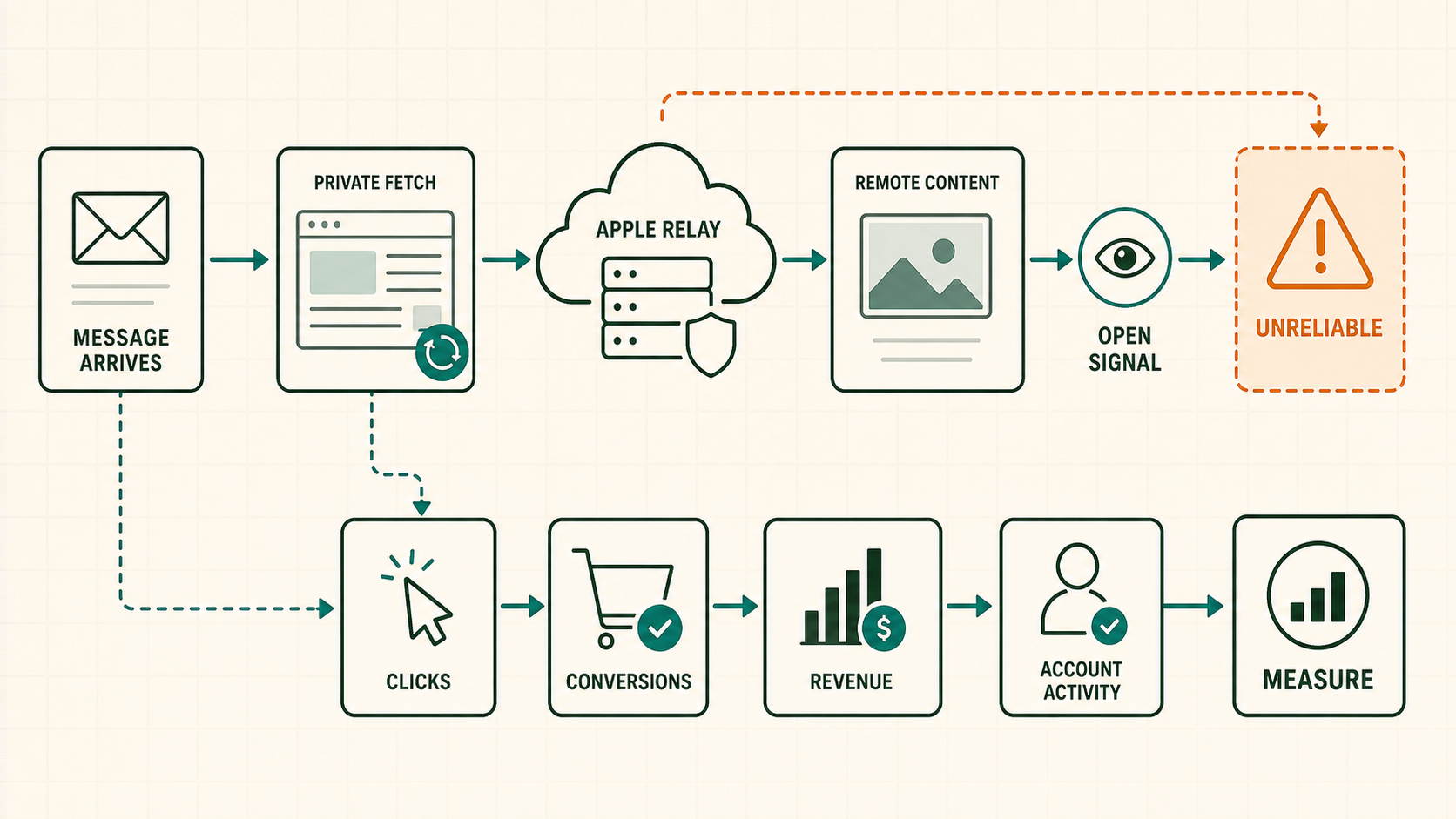
Apple Mail Privacy Protection changes what an open pixel can prove. When Protect Mail Activity is enabled, Apple can privately download remote message content in the background, independently of a person reading the message. The image request is real network activity but unreliable person-level engagement evidence. Preserve the raw event, label its uncertainty and move decisions toward qualified clicks, conversions, replies, revenue and authenticated account activity.
How the private content fetch works
Apple states that Mail Privacy Protection prevents senders from learning whether a recipient opened an email and masks the recipient IP. Remote content can be downloaded privately in the background when mail is received. Requests pass through relays so the content provider does not receive a directly identifying IP.
This affects remote images, including a tracking pixel. It does not mean every Apple-domain address behaves identically: the feature depends on supported Apple Mail clients and user settings. A Gmail address read in Apple Mail can be affected, while an iCloud address read elsewhere may behave differently. Client behavior, not recipient domain alone, drives distortion.
Interpret an image request precisely
| Event | Supports | Does not prove |
|---|---|---|
| Pixel request | Remote content was fetched | A person viewed the message |
| Repeated requests | The resource was fetched again | Multiple human reads |
| Masked IP | A privacy relay may be involved | Recipient location |
| No request | No observable fetch reached tracking | The message was unread |
Some requests can coincide with a real view, but the event cannot distinguish it from prefetch.
Preserve raw events and confidence
email_event(recipient_key, message_id, event_type,
 event_time_utc, user_agent_class, proxy_class,
 source_system, confidence_class, ingestion_version)
Keep the original event and versioned classification. Useful classes include human-supported, machine-likely and unknown. Do not silently discard proxy-like opens because methods change and reports must be reproducible. Minimize IP retention and apply privacy controls; the objective is honest measurement, not fingerprinting around a privacy feature.
Replace one open dashboard with a metric stack
| Layer | Evidence | Decision |
|---|---|---|
| Transport | Accepted, deferred, rejected | Can the receiver accept? |
| Safety | Complaints, unsubscribes, hard bounces | Is the program healthy? |
| Interaction | Qualified clicks, replies | Was there observable action? |
| Business | Conversion, retention, revenue, margin | Did the intended outcome occur? |
| Experiment | Lift against a holdout | What did email cause? |
Replace open-triggered automation deliberately
Inventory workflows that branch on open: resend-to-non-openers, lead score, subject winner, next-message timing and sunset logic. Map each to its business intent.
- Use qualified click or authenticated page activity for expressed interest.
- Use purchase, renewal, feature use or login for lifecycle activity.
- Use delivery plus elapsed time where interaction is unnecessary.
- Use complaint, unsubscribe and hard bounce as immediate exclusions.
- Use multi-channel evidence for inactivity, never pixel silence alone.
Choose A/B outcomes before launch
An open-rate subject test can select the variant that caused more image requests rather than more value. Randomize recipients, hold other variables fixed, preselect one primary outcome and choose a suitable observation window. Qualified click may suit navigation; conversion or incremental margin is stronger for an offer.
Report exposure, delivery, exclusions and client/provider mix by variant. Retain opens only as a secondary diagnostic with the limitation visible.
Do not turn proxy opens into intent
A recent open should not automatically create a hot-lead or high-frequency segment. Combine qualified clicks, authenticated product views, purchase recency, reply, account use and explicit preferences. Apply frequency caps before selection.
Likewise, do not call every non-opener inactive. Image blocking, plain text and privacy features create false non-openers. A sunset policy combines consent, delivery, complaints, clicks, transactions and lifecycle evidence while honoring stronger suppressions first.
Treat scanner clicks as a separate problem
Security gateways and link scanners can request URLs before a person acts. Moving from opens to clicks without filtering transfers the bias. Classify timing, user agent, network pattern, impossible multi-link sequences and confirmed web sessions. Keep raw data and avoid claiming human action from heuristics alone.
A qualified click can require a browser session, dwell or downstream action depending on risk. Keep the definition stable across experiment variants.
Migrate an open-driven nurture flow
A flow advances immediately after an open and resends after 48 hours to non-openers. Private prefetch advances some users before reading, while image-blocking users receive unnecessary resends. The team changes the branch to qualified click or product activity and uses elapsed-time education where no action is required.
A conversion holdout measures value. Opens remain as uncertain diagnostic data. The workflow becomes explainable across clients and frequency-related complaints decline.
Keep reporting definitions stable and visible
Publish a metric dictionary that identifies the raw event, classification rule, attribution window, exclusions and owner. When proxy-detection logic changes, create a new metric version and backfill only when the change is documented. Otherwise a dashboard trend can move because the classifier changed rather than because customers behaved differently.
Give stakeholders both the defensible measure and its limitation. For example, report qualified click rate with its scanner-filter version and conversion rate with its attribution window. Do not rename a filtered image request as a verified open. Product, privacy, analytics and deliverability teams should approve material definition changes together.
Mail privacy measurement checklist
- Separate client behavior from recipient domain.
- Preserve raw requests and classification version.
- Label opens as uncertain, not human activity.
- Audit journeys, scoring and resend rules.
- Use qualified clicks, replies, conversions and account activity.
- Filter scanner clicks with a documented method.
- Randomize tests and preselect outcomes.
- Use holdouts where practical.
- Minimize event and IP data.
Understand what the remote-content request can represent
Mail Privacy Protection separates a remote image request from a person’s reading action. Apple Mail can fetch remote content privately, route the request through relays and mask the direct IP address. Timing may relate to message receipt and client/network conditions rather than the moment a person views the message. A request therefore supports “this resource was fetched,” not “this recipient read at this time.”
| Observed field | Potential effect | Unsafe use |
|---|---|---|
| Request time | Background or later fetch | Exact read time |
| Relay IP | Broad regional/service routing | Recipient location or company |
| User agent | Client/proxy clue | Verified individual identity |
| Repeated fetch | Cache or client behavior | Number of human reads |
The affected population cannot be derived reliably from recipient domain. Gmail, corporate or other addresses read in supported Apple Mail clients can be affected, while an iCloud mailbox accessed in another client may not produce the same behavior.
Store raw fetches and versioned interpretations separately
remote_content_event(
  message_id, recipient_key, resource_id,
  request_time_utc, received_time_utc,
  network_class, user_agent_class,
  raw_event_id, classifier_version
)
derived_interaction(
  message_id, metric_name, metric_value,
  confidence_class, definition_version
)
Do not delete proxy-like requests or relabel them as verified opens. Preserve governed raw events and produce an interpreted metric whose method can change without rewriting history. Apply retention, access and minimization because IP and user-agent data can be personal or security-sensitive.
Publish event coverage, unknown classification and classifier release date. If the method changes, compare a fixed historical sample and annotate dashboards. An apparent open-rate trend can be caused by client mix or classification rather than customer behavior.
Find every business rule that still depends on opens
| Open-driven rule | Failure after privacy fetching | Safer alternative |
|---|---|---|
| Advance nurture on open | People advance before reading | Qualified click, product event or elapsed-time education |
| Resend to non-openers | Image blockers are overmailed; proxy users excluded | Use capped non-response logic and stronger relationship evidence |
| Lead score | Machine fetch inflates intent | Authenticated activity, reply or qualified visit |
| Sunset eligibility | Proxy fetch keeps stale records active | Multi-signal relationship and explicit inactivity policy |
| Subject winner | Variant may optimize fetch behavior | Preselected qualified or business outcome |
Inventory logic in ESP journeys, CRM scoring, warehouse models, BI reports and sales alerts. Updating the campaign dashboard while leaving open-triggered automation untouched does not solve the operational risk.
Do not replace noisy opens with unqualified scanner clicks
Security gateways can visit every URL before a message reaches a person. A move from open to raw click therefore transfers measurement error. Store request time, link, sequence, network/user-agent class, browser/session correlation and downstream action. Define a qualified click for the decision at hand.
qualified_click = link_request
  AND not_known_security_scanner
  AND plausible_timing_sequence
  AND (browser_session OR downstream_action)

confidence remains: supported, machine_likely, unknown
Heuristics are imperfect. Keep unknown rather than calling every remaining request human. A conversion, reply or authenticated feature event is often stronger, but attribution and identity assumptions still need publication.
Redesign email tests around decisions and incrementality
Randomize eligible recipients before sending, choose one primary outcome, define maturity and keep assignment. If the decision is subject line selection, qualified clicks may be useful; if it is offer economics, conversion or incremental margin is stronger. Include complaints and unsubscribes as guardrails.
| Test | Primary outcome | Important guardrail |
|---|---|---|
| Subject/preview | Qualified downstream visit or conversion | Complaints and cohort balance |
| Content hierarchy | Intended qualified action | Rendering and accessibility |
| Send timing | Matured outcome in fixed window | Frequency and timezone |
| Lifecycle program | Lift versus eligible holdout | Cross-journey contamination |
Retain opens as a secondary diagnostic with limitation. Do not stop a test early because a noisy open-rate graph looks decisive.
Migrate reporting without breaking historical interpretation
- Catalog open-based dashboards, segments, journeys, lead scores and contractual reports.
- Name the business question each rule was intended to answer.
- Select a stronger event or explicit unknown state.
- Run old and new definitions in parallel for a bounded period.
- Measure population and decision changes by provider/client cohort.
- Release under a new metric version and annotate history.
- Remove the old rule only after downstream consumers switch.
Do not backfill a new “human open” metric from data that cannot support it. Keep historical raw open/fetch observations labeled under their original definition. Stakeholders need a bridge explaining why rates and populations change.
Worked case: open-driven resend doubles frequency for the wrong people
A publisher resends after 48 hours to everyone without an open and advances openers into a higher-frequency series. Apple proxy fetches move some recipients immediately into the high-frequency branch, while image-blocking readers receive the resend. Complaints rise in both groups even though the dashboard reports strong opens.
The publisher replaces the branch with qualified site activity for the high-intent path and an elapsed-time education path for everyone else. Global frequency caps apply across journeys. A holdout measures subscription renewal, while complaints and unsubscribes remain safety outcomes.
The migration keeps raw fetch events but labels them uncertain. Population snapshots show who would have moved under each rule. After several matured cycles, renewal lift is stable and complaint exposure falls. The team has not “recovered true opens”; it has removed an unreliable signal from decisions that required human intent.
Do not diagnose deliverability from open-rate movement alone
A change in Apple client share, remote-content policy, image caching or classification can move reported opens while SMTP acceptance and folder behavior remain unchanged. Start diagnosis with complete SMTP replies, accepted/deferred/rejected recipients, queues, authentication, complaints and provider telemetry. Use placement observations only with sample limitations.
| Pattern | Next check |
|---|---|
| Opens fall; qualified outcomes stable | Measurement and client mix |
| Acceptance stable; complaints rise | Audience, cadence and reputation |
| Deferrals rise at one provider | Provider-hour traffic and replies |
| All interaction falls after template release | Rendering, links and final MIME |
Never estimate inbox placement as delivered multiplied by open rate. The measures represent different boundaries.
Rebase forecasts and models after measurement changes
Models trained on historical opens can mistake privacy fetching for intent and overweight Apple-heavy cohorts. Inventory features derived from opens, rebuild with qualified clicks, transactions, product use, replies and explicit preferences, and validate calibration by provider/client mix. Consent and suppression remain outside predictive scores.
When targets use open rate, provide a bridge showing raw content-request rate, former classified rate, new qualified outcome and historical overlap. Do not create a synthetic pre-privacy “equivalent open” unless assumptions are visible and the value is labeled modeled.
External benchmarks are weak because client mix and definitions differ. Prefer controlled internal baselines with versioned definitions and business outcomes.
Respect privacy intent while securing tracking infrastructure
Do not fingerprint around relays or combine unrelated identifiers to reconstruct a person’s location. Collect only data required for a defined decision, restrict recipient-level access and set retention. Tracking endpoints, redirects, tokens and logs also need security review.
| Risk | Control |
|---|---|
| Recipient/token leakage | Opaque identifiers and access control |
| Open redirect | Allowlisted destinations and signed parameters |
| Log overexposure | Minimize IP/user-agent retention |
| Weak classifier used adversely | Versioned rules and explicit unknown |
Measurement improves when unknown states are accepted rather than replaced by invasive guesses.
Publish definitions that prevent silent relabeling
metric: qualified_email_interaction
version: 5
included: reply, browser-correlated click, account action
excluded: known scanner, remote-content fetch
unknown: unclassified click without downstream session
window: 7 days from send UTC
owner: lifecycle analytics
State source event, identity join, exclusions, time window, bot/privacy treatment, delay and owner. A label such as “engaged” without this contract is unsuitable for eligibility. Test definition changes on fixtures and representative data. If populations move materially, release a new version and communicate impact before selection.
Run a recurring measurement integrity review
- Client/proxy classification coverage and unknown share.
- Open-driven rules remaining in ESP, CRM and warehouse.
- Scanner-click classifier precision on reviewed samples.
- Qualified event and conversion reconciliation.
- Metric-version changes and dashboard annotations.
- Retention, access and endpoint security.
- Complaint/frequency outcomes for migrated journeys.
Assign each issue an owner. Client behavior changes, so removing opens from high-stakes decisions is not a one-time task. Match evidence strength to the decision and retain unknown when human behavior cannot be proven.
Replace open-based decisions department by department
| Team | Former decision | Replacement |
|---|---|---|
| Lifecycle | Advance journey after open | Qualified action or elapsed-time design |
| Sales | Call every recent opener | Account intent, reply or authenticated visit |
| Deliverability | Infer inbox from open rate | SMTP, provider and controlled placement evidence |
| Analytics | Attribute engagement to opens | Versioned qualified outcomes and experiments |
| Executive | Compare teams on open rate | Safety, qualified action and incremental value |
Document the owner and migration date for each consumer. Otherwise an old CRM score can continue changing frequency long after dashboards stop showing opens.
Handle a proxy-classification failure as a data incident
A classifier release marks most Apple relay requests as human-supported and doubles the “engaged” population overnight. Pause downstream segment refresh and preserve raw events, classifier version and selected audiences. Do not undo complaints or unsubscribes while rolling back the derived classification.
Compare a reviewed fixture set, client mix and historical population by source. Restore the previous derived metric, invalidate only decisions created by the faulty version and reconcile journeys that already dispatched. Add maximum population-change gates and unknown-rate monitoring. Close after dashboards, CRM scores and segment snapshots agree on the corrected definition.
Production checklist for privacy-resilient measurement
- Never claim a remote-image request proves a human read.
- Keep client behavior separate from recipient domain.
- Version fetch and click classifiers.
- Preserve raw events under privacy controls.
- Remove opens from intent, resend and sunset decisions.
- Use qualified interaction and business outcomes.
- Maintain holdouts for recurring program lift.
- Publish unknown states and definition changes.
- Monitor tracking infrastructure security.
The objective is not to reverse Apple’s privacy design. It is to build email operations that remain useful when an individual read cannot be observed.
Worked reporting bridge for a board-level trend
A quarterly report shows opens rising from 24% to 46% after client mix shifts toward Apple Mail, while qualified clicks, orders and renewals remain flat. The marketing team initially describes stronger engagement. Analytics separates raw image fetches by classifier version and finds the increase is concentrated in privacy-likely requests.
The revised report keeps raw request rate as a diagnostic, adds qualified click rate, conversion by assigned recipient, complaints and incremental renewal from a persistent holdout. Historical quarters remain under their original definitions. A bridge quantifies how much of the apparent increase came from client mix and classifier changes, without pretending to reconstruct true human opens.
Lifecycle removes open-based scoring and resend rules. Sales receives only reply, authenticated visit and account-intent alerts. Finance uses settled margin and experimental lift. The board can now see that campaign reach stayed stable, recipient safety remained acceptable and no evidence supports a large engagement increase.
This approach is less visually dramatic than one open-rate line, but every metric maps to an observable boundary and decision. Future client changes can alter fetch reporting without rewriting the business story.
Acceptance criteria for the migration
No production journey, audience eligibility rule or lead score may require an open as proof of human intent. Dashboards must expose metric version and unknowns. Qualified events must be tested against scanner fixtures, and recurring programs need safety outcomes. Owners sign off only after downstream CRM, warehouse and ESP consumers use the new definitions.
Review cadence
Revalidate quarterly and after material client, classifier or journey changes.