Gmail Dynamic Email Reached Mobile in 2019: Android and iOS Impact
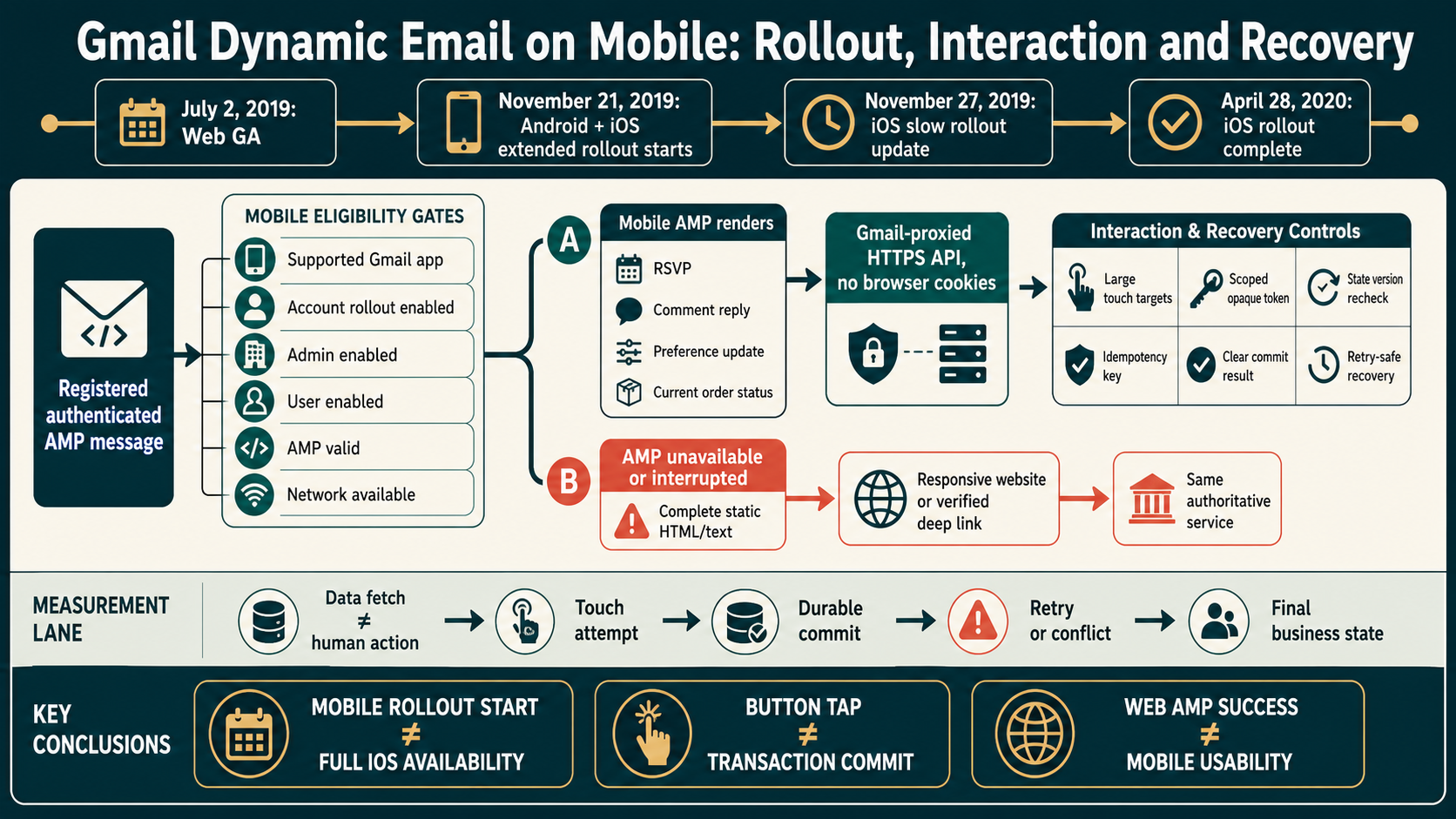
On November 21, 2019, Google began an extended rollout of dynamic email for Gmail on Android and iOS. Google added an iOS rollout update on November 27 and later recorded full iOS rollout completion on April 28, 2020. The mobile launch brought AMP actions such as RSVP, comment response, subscription management and current order or job information into handheld inboxes. It did not make web behavior universal overnight. Client version, rollout stage, administrator policy, user settings, authentication, sender registration, network state and AMP validity could all select a different experience. Mobile engineering therefore had to treat interrupted interaction and complete static fallback as primary paths.
The dated mailbox-provider change
| Event field | Verified value | Why it matters |
|---|---|---|
| Historical event date | November 21, 2019 | This is the provider-change date, not the NitWings publication date. |
| Mailbox provider | Gmail | The affected provider estate determines which recipient cohorts require separate evidence. |
| Change area | Interactive email | This identifies whether the change altered authentication, filtering, visibility, measurement or sender operations. |
| Current status | active-on-android-ios-and-web-with-ios-rollout-completed-april-2020 | Historical instructions are interpreted against the feature or standard that exists now. |
Gmail dynamic email became generally available on the web in July 2019. At that time Google explicitly said mobile support was coming. The web launch established the sender-registration, authentication, AMP MIME and fallback model, but mobile added a larger range of devices, app releases, network conditions and touch behavior.
The November 21 announcement described an extended rollout for Android and iOS. A November 27 update said iOS was rolling out slowly, while an April 28, 2020 update marked full iOS completion. These records show why “mobile launched” should not be interpreted as simultaneous availability for every device.
Mobile dynamic content could keep order status or job listings current and allow an action without switching applications. That convenience also narrowed the interaction canvas and increased sensitivity to latency, focus, tap size, orientation and interrupted sessions.
The sender architecture remained progressive enhancement. A registered authenticated message could carry AMP, but static HTML and text still served unsupported apps, disabled settings, forwarded messages, expired or invalid content and endpoint failures.
How the system worked before the change
Before mobile support, a Gmail app recipient generally saw the static alternative even when the same message rendered dynamically on web. The user followed a link into a mobile browser or installed application to act.
That handoff could be awkward, but it offered a new navigation context with established cookies and application state. The email itself did not need to preserve a half-completed form through an app interruption or changing network.
Testing teams frequently validated AMP only in desktop Gmail. A component that fit a wide browser could compress labels, bury errors or create tiny targets on a phone. Desktop success did not prove mobile usability.
Analytics also separated webmail and mobile mail-client clicks. Dynamic mobile actions introduced an outcome inside the app that might not generate a conventional website session, requiring a new surface dimension.
What changed on the provider side
The Gmail apps gained the ability to render eligible text/x-amp-html content and let recipients act inside the message. Google cited comment replies, event RSVPs, subscription preferences and current status or listing content as examples.
The rendering decision still depended on sender registration, authentication, policy, app support, administrator and user settings. Rollout timing meant two apparently similar iOS users could receive different experiences during the staged period.
Gmail continued to proxy dynamic HTTPS requests. Mobile endpoints could not assume browser cookies or a direct device IP. They needed supported CORS headers, bounded explicit authorization, replay protection and an authoritative response suitable for a small message surface.
Mobile state could change between data load and submit. Inventory might disappear, an RSVP capacity could fill, or a preference might already be updated elsewhere. The endpoint needed version or conflict handling and a clear recovery route rather than silently accepting stale state.
Message path before and after
Before
AMP-capable message reaches Gmail recipient
    |
    +----> Gmail web may render dynamic content
    +----> mobile app renders static HTML or text fallback
    |
    v
Recipient taps link -> browser or application
    |
    v
Current state and action handled outside email
After
Registered authenticated message reaches Gmail app
    | client version + rollout + settings + AMP validation
    v
Mobile eligibility decision
    |
    +----> AMP mobile view -> proxied API -> touch action -> durable result
    +----> unsupported or failed -> complete static fallback -> deep link or website
    |
    v
Cross-surface audit records mobile AMP, fallback, web and application outcomes
Who and what the change affected
| Traffic or stakeholder | What changed | Required interpretation |
|---|---|---|
| Android Gmail users | Dynamic email began extended rollout on November 21, 2019. | App version and account eligibility still determined rendering. |
| iOS Gmail users | Rollout began slowly and completed April 28, 2020. | Do not backdate full iOS availability to November. |
| Email designers | Interactive layouts entered a narrow touch surface. | Use accessible targets, readable hierarchy and bounded tasks. |
| API teams | Mobile interruptions and stale state became routine. | Use idempotency, state versions and resumable outcomes. |
| Analytics teams | Tasks could complete inside mobile Gmail. | Track surface without forcing a website-click model. |
| Support teams | Two users could see AMP and fallback from one send. | Capture client, rollout, settings and received MIME evidence. |
Effect on delivery, placement and recipient visibility
The mobile rollout did not alter basic SMTP filtering. AMP content is an eligible representation after authentication, sender policy and message delivery. A broken mobile component should be diagnosed as rendering or application behavior unless SMTP evidence shows a delivery failure.
Sender registration still applies per From address. Launching a special mobile identity can create an unregistered fallback and fragment recognition. Use the same reviewed production identity and verify the final received authentication on mobile test accounts.
Poor mobile interaction can create negative signals indirectly. Small controls, hidden errors, repeated submits or a form that loses state encourage deletion, support escalation or complaint. A shorter in-message path must be more reliable, not merely more novel.
Every transactional or marketing purpose needs a safe fallback. The message must state the order status, preference purpose or event context in static content and provide an accessible authoritative link. Do not place legally material terms only in an AMP panel.
Network failure is normal on mobile. The API should return actionable bounded errors and allow a safe retry. A recipient who taps twice after a timeout must not create two reservations, purchases or preference changes.
Effect on measurement and diagnosis
Create a surface taxonomy: Gmail web AMP, Android AMP, iOS AMP, static Gmail app, other mail client, mobile web and native application. Preserve the surface at action time while avoiding device fingerprinting beyond what is necessary.
Distinguish content fetch, visible interaction, action attempt, durable commit and business outcome. Gmail-proxied data requests do not prove the recipient intentionally engaged. A server commit with an idempotency key is stronger evidence than a button-tap event.
During phased rollout, compare only known eligible cohorts. A rising mobile AMP share can reflect app rollout rather than creative performance. Annotate November 21, November 27 and April 28 milestones in historical analysis.
Measure recovery: network timeout, retry, conflict, expired token, fallback-link use and successful continuation. Mobile quality is not captured by completion rate alone if recipients repeat actions or abandon after ambiguous status.
Retain privacy-minimized technical evidence: registered sender, message ID, AMP release, endpoint release, platform category, state version, action ID and result. Do not store a plaintext email address in dynamic request URLs or third-party analytics.
Advantages for email marketers
| Potential advantage | When the advantage is real | Evidence to verify |
|---|---|---|
| Lower app switching | A supported mobile user completes a bounded task in Gmail. | Durable completion and lower abandonment by surface. |
| Current mobile information | API returns current authoritative state. | Stale-display and conflict rates remain low. |
| Broad progressive enhancement | AMP and static experiences share one purpose. | QA passes across eligible and fallback clients. |
| Faster preference control | Recipient changes a supported setting safely. | Downstream state and confirmation reconcile. |
| Cross-device continuity | Action state is server-side and idempotent. | Retry or later web access shows the same result. |
Disadvantages and operational risks
| Cost or risk | How it appears | Control |
|---|---|---|
| Rollout is assumed simultaneous | iOS cohorts are misclassified. | Preserve staged rollout and completion dates. |
| Desktop layout is reused unchanged | Controls are cramped or inaccessible. | Design and test for touch, focus and narrow width. |
| Network retry duplicates action | Two commits follow one intent. | Use stable idempotency keys and response lookup. |
| Stale data is accepted | Underlying state changed after load. | Validate state version and return conflict guidance. |
| Fallback opens a broken deep link | Unsupported users cannot finish. | Provide verified web fallback and app-link recovery. |
| Device telemetry becomes excessive | Measurement creates privacy risk. | Collect only surface evidence required for operation. |
What email teams needed to do at the time
- Record staged mobile dates. Separate November rollout start from April iOS completion.
- Test supported Android and iOS apps. Include multiple account and setting states.
- Redesign for touch. Use clear hierarchy, large targets and concise forms.
- Handle interruption. Make actions retry-safe and state authoritative.
- Provide static mobile fallback. Verify HTML, text, web and deep-link routes.
- Secure proxied endpoints. Apply AMP CORS and explicit scoped authorization.
- Add surface analytics. Distinguish Android, iOS, web and fallback outcomes.
- Train support. Capture app, settings and received-source evidence before escalation.
What email teams should do now
- Follow current sender registration. Confirm each active From address remains eligible.
- Validate received AMP MIME. Test after every ESP or gateway change.
- Maintain mobile component QA. Cover width, text scaling, orientation, keyboard and screen reader.
- Use state-aware APIs. Validate version, scope, expiry and current authorization.
- Make commits idempotent. Return the prior result for repeated action IDs.
- Design offline-aware errors. Explain whether an action committed before offering retry.
- Keep website truth available. Complex, regulated or high-risk actions need authoritative fallback.
- Monitor by surface. Separate rollout, rendering, API and business changes.
- Minimize telemetry. Avoid unnecessary device and recipient data.
- Preserve static parity. Terms, identity, unsubscribe and essential context must not depend on AMP.
Worked deliverability scenario
A retailer adds an AMP preference form tested successfully on Gmail web. On mobile, the form requires horizontal scrolling and the save confirmation appears below the viewport. A commuter taps Save twice after a network pause.
The API lacks idempotency and creates two events with conflicting timestamps. The app displays an error even though the first request committed. The recipient later uses the HTML fallback and changes the preference again, leaving support unable to explain the final state.
The team redesigns the form for one-column touch interaction, keeps the primary action and error summary visible, and assigns one idempotency key per intended update. The API returns the existing commit result on retry and rejects stale state with a clear refresh response. The static link opens a responsive preference page using the same authoritative service.
QA covers Android AMP, iOS AMP, static fallback, screen-reader navigation, text scaling, network interruption and expired authorization. Analytics report attempts, durable commits, retries, conflicts and final preference state by surface. The program improves task completion without calling proxied data loads opens or assuming all iOS recipients had AMP in November 2019.
Evidence and diagnostics
- Rollout evidence: platform, app version, account type, feature setting and observation date.
- Message evidence: registered From address, received MIME, AMP validation and authentication.
- Layout evidence: viewport, text scale, orientation, tap target, focus order and error visibility.
- Network evidence: request ID, start, timeout, retry, proxy response and final commit lookup.
- Authorization: token scope, expiry, actor binding and CORS result.
- State: loaded version, submitted version, conflict and authoritative post-action value.
- Fallback: HTML or text selection, deep link, web recovery and accessibility.
- Outcome: fetch, attempt, commit, duplicate, conflict, abandonment and business completion.
Failure modes and incorrect conclusions
- Calling November 21 full iOS availability. Google recorded a slow rollout and April 2020 completion.
- Assuming web AMP proves mobile usability. Touch, width and interruptions differ.
- Using a button tap as transaction proof. Only the authoritative commit proves success.
- Retrying without idempotency. One intent creates multiple changes.
- Trusting loaded state at submit time. Mobile delay can make it stale.
- Depending on browser cookies. Gmail proxies AMP requests.
- Leaving fallback as a generic homepage. Unsupported users lose task context.
- Attributing rollout growth to creative lift. Availability itself changed over time.
Current status and superseding changes
Google’s update records dynamic email as available on Android, iOS and web, with full iOS rollout completed on April 28, 2020. Current sender registration and security requirements apply across supported Gmail surfaces.
AMP email still requires strong authentication, encrypted transport, registered sender identity, valid markup and secure HTTPS endpoints. Gmail proxies XHR, ordinary cookies are absent, and redirects are restricted. Static HTML and text remain necessary.
Mobile app and policy behavior can evolve independently of the open AMP specification. Test current production clients and do not assume an image from 2019 describes today’s layout. The receiver decides whether the AMP part renders.
Release management should join the email and API lifecycles. A message can remain in a mailbox after an endpoint version is retired. Maintain backward-compatible response contracts for the supported message lifetime, return a clear terminal state for expired actions, and preserve the static route. A routine backend deployment should not turn already delivered email into a broken interface.
Incident response also needs a safe kill path. If a dynamic endpoint exposes incorrect state, stop or constrain the affected action at the server, keep the message understandable, and direct recipients to an authoritative fallback. Do not rely on recalling an immutable delivered message.
The durable mobile pattern is narrow, recoverable interaction: show current state, request one clear action, authorize it minimally, commit it idempotently, display an unambiguous result, and provide an accessible web fallback that reaches the same authority.
Operator checklist
- Record November 21, 2019 as mobile rollout start.
- Record November 27 as the iOS rollout update and April 28, 2020 as completion.
- Verify registered sender identity and final authentication.
- Test current Android, iOS, web and static fallback surfaces.
- Design touch targets, hierarchy, focus and errors for mobile.
- Expect Gmail-proxied API calls without browser cookies.
- Use scoped expiring authorization and AMP CORS.
- Validate state again at submission time.
- Make all state changes idempotent and retry-safe.
- Provide responsive HTML, text and authoritative web fallback.
- Separate fetch, attempt, commit and business outcome in analytics.
Primary and contemporaneous references
- Google Workspace Updates: Dynamic email on Android and iOS: Primary rollout, iOS update and completion record.
- Google Developers: Register to send dynamic email: Current sender registration requirements.
- Google Developers: AMP email security requirements: Current authentication, proxy, TLS and CORS requirements.
- Google Workspace Help: Dynamic email and content filtering: Current compliance and dynamic-state guidance.