Newsletter Growth: Build a Consent-Based Subscriber Engine
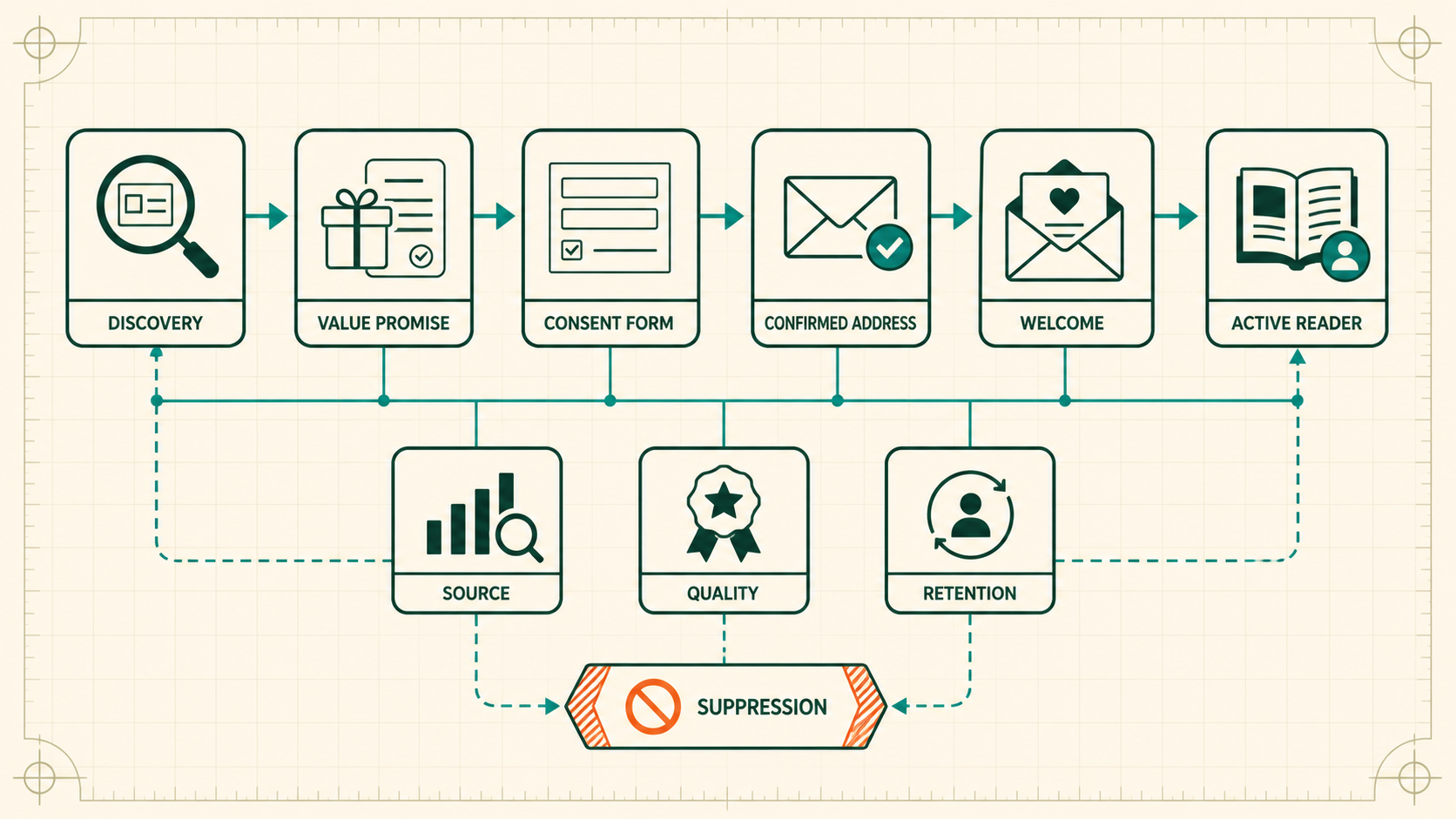
A large subscriber count is not the same as a healthy newsletter. Durable growth combines a clear value promise, traceable permission, valid address intake, useful onboarding, sustainable frequency and source-level retention. Measure how acquired subscribers behave over weeks and months, not only how many forms were submitted today. Complaints, unsubscribes and dormant volume are acquisition feedback.
Define the subscription promise
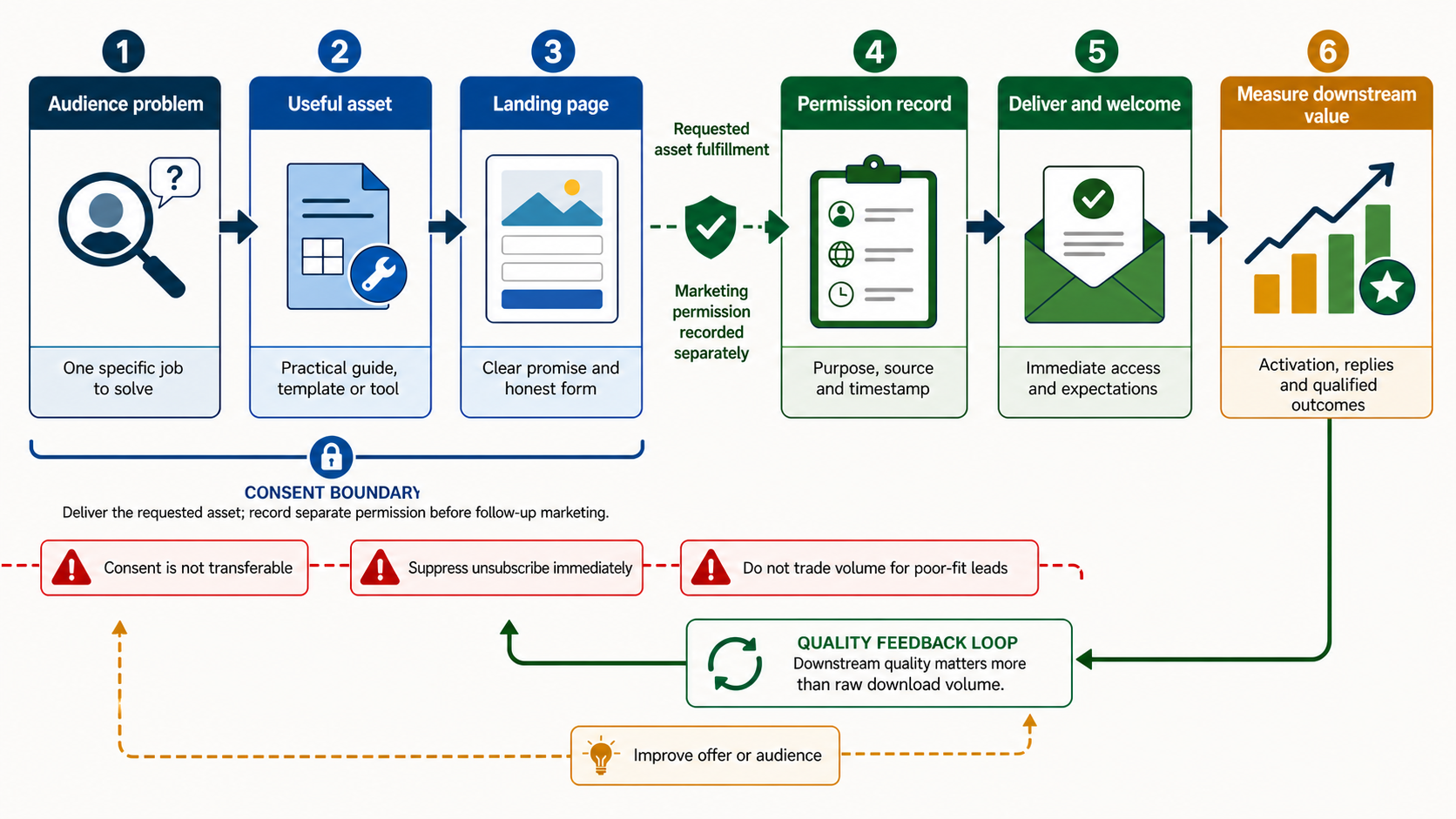
State who the newsletter is for, what it contains, how often it arrives and which brand sends it. Place that promise beside the form rather than hiding it in terms. Do not pre-check consent or bundle unrelated partner promotions into an ambiguous checkbox.
Match the first messages to the promise. A weekly technical digest that immediately sends daily offers creates complaints even if the address was valid.
Tag every acquisition source
| Source data | Why retain it |
|---|---|
| Form and page version | Connect consent wording and placement to quality |
| Timestamp and timezone | Establish when the action occurred |
| Notice/purpose version | Prove the promised program |
| Referral or campaign | Compare downstream retention and complaints |
| Confirmation state | Separate submitted from verified addresses |
Minimize IP and device data according to policy. The evidence should support consent and quality analysis, not unlimited profiling.
Protect the signup path
Normalize syntax carefully, reject obvious malformed input, rate-limit abuse and use bot controls proportionate to risk. Confirmation mail can prove control of the mailbox and reduce typo or malicious signups. It does not prove unlimited consent beyond the stated purpose.
Do not buy, scrape or append addresses. Suppression lists must be applied before welcome mail so a previously unsubscribed or complained address is not reactivated by an import.
Use onboarding to create an active reader
- Confirm what the person requested and identify the sender.
- Deliver the promised resource without forcing extra consent.
- Set frequency expectations and provide preference controls.
- Show one high-value action, not many competing links.
- Collect explicit topic preferences where useful.
- Stop or adapt the sequence after purchase, reply, unsubscribe or complaint.
Measure source quality beyond conversion
| Window | Measure |
|---|---|
| Immediate | Valid confirmation, hard bounce, abuse and duplicate rate |
| 30 days | Qualified action, complaint, unsubscribe and active retention |
| 90 days | Continued readership, conversion, margin and sunset rate |
| Incremental | Lift against a comparable holdout or source experiment |
Open pixels are not reliable human-read proof. Prefer qualified clicks, replies, authenticated activity and business outcomes.
Grow with controlled experiments
Test one acquisition change at a time: value proposition, page placement, form length, referral incentive or content partnership. Randomize where possible, define the primary outcome and wait long enough to observe retention. A source with cheap submissions but high complaints is expensive.
Keep channel and cohort holdouts to distinguish organic behavior from newsletter impact. Report eligible visitors, submissions, confirmations, delivered welcomes, retained subscribers and value.
Define growth as retained permissioned value, not form submissions
net_active_growth = new_confirmed_subscribers
                  - unsubscribes
                  - complaints
                  - hard_bounce_suppressions
                  - policy_sunsets

quality_adjusted_value = incremental_margin_or_value
                         - acquisition_cost
                         - complaint/support/risk_cost
A list can grow while the reachable, wanted audience shrinks. Report confirmed/marketable subscribers by cohort and source, retention after several sends, complaint/bounce risk and incremental business outcome. Do not celebrate imported rows before first-delivery quality matures.
Create an acquisition contract for every signup path
| Required field | Why |
|---|---|
| Source/form/event/partner | Accountability and cohort analysis |
| Notice version and program scope | What the person was told |
| Timestamp and identity context | Point-in-time permission evidence |
| Confirmation state | Capture accuracy and expectation |
| Preference/cadence promise | Content and frequency alignment |
| Suppression precedence | Prevent reactivation by new capture |
UTM source is marketing attribution, not consent evidence. Preserve the original capture source even when a CRM or CDP transforms the record.
Design signup forms for clarity, accuracy and abuse resistance
State the publication, sender/brand, expected content and approximate cadence near the email field. Keep marketing permission separate from account/service requirements. Use syntax/domain feedback without silently changing the submitted address. Apply rate limits, bot controls and duplicate handling that do not lock out legitimate users.
| Failure | Control |
|---|---|
| Typo domain | Suggest correction and require user confirmation |
| List bombing | Rate/device controls and confirmation |
| Hidden prechecked consent | Clear affirmative choice where required |
| Duplicate signup | Idempotent response without exposing membership |
| Suppressed address re-entered | Reviewed state transition, not blind active overwrite |
Use confirmation where source risk and expectation require it
Confirmed opt-in proves control of the mailbox and reduces typos/abuse; it does not make a misleading notice lawful or grant unlimited scope. The confirmation message should identify the requested publication, expire safely, avoid marketing beyond the request and handle repeated clicks idempotently.
subscription_event(
  subject_key, program, action,
  notice_version, source, occurred_at_utc,
  confirmation_token_hash, confirmed_at_utc,
  state_version
)
Store token hashes rather than reusable clear tokens. Do not mail unconfirmed records indefinitely. Measure completion by source and investigate sudden changes.
Evaluate acquisition sources after enough sends mature
| Metric | Purpose |
|---|---|
| Confirmation completion | Capture accuracy and expectation |
| First-send hard bounce | Stale/fabricated addresses |
| First-campaign complaint | Permission/expectation mismatch |
| Early unsubscribe | Offer versus ongoing value |
| Qualified activation/retention | Human/business value |
| Incremental outcome | Causal value beyond self-selection |
Set minimum sample sizes and cohort windows. Stop/quarantine a source when safety evidence breaches policy; do not wait for blended totals.
Govern referrals, co-registration and partners conservatively
A referral can invite a person to sign up; it should not add the referred address directly to marketing without proper expectation and permission. Partner feeds need original notice, source, timestamp, scope and audit rights. “Partner consent” without record-level evidence is not adequate.
Separate partner cohorts, cap initial volume and require performance gates. Reject feeds that overwrite suppressions or cannot prove provenance. Contracts should allow immediate suspension and deletion/return when quality or compliance fails.
Never purchase, scrape or append addresses as a growth shortcut. Validation cannot manufacture permission.
Use the welcome series to establish expectation, not exploit attention
- Confirm what was requested and who sends it.
- Deliver the promised value immediately.
- Explain cadence and preference controls.
- Use one clear next action and accessible rendering.
- Apply global frequency caps across other journeys.
- Measure complaints, unsubscribes, qualified activation and retention.
A high first-email open can be privacy fetching. Use confirmation, qualified actions and later retention. Cancel queued welcome marketing immediately after unsubscribe/complaint.
Test growth tactics with downstream quality guardrails
Randomize eligible visitors/accounts to signup treatments. Choose a primary outcome that extends beyond form completion: confirmed subscription, retained active subscriber or incremental value. Track complaints and early unsubscribes after sufficient sends.
confirmed_rate = confirmed / assigned_visitors
retained_rate = retained_after_maturity / assigned_visitors
incremental_retained = retained_rate_treatment
                       - retained_rate_control
Keep assignment even if the form is not submitted. A popup that doubles submissions but creates no retained lift and more complaints is not successful growth.
Worked case: a giveaway triples signups but damages the newsletter
A retailer launches a prize draw with newsletter enrollment embedded in the form. Submissions triple, but confirmation completion is low and first-campaign complaints are six times the normal source. The blended list-growth graph remains positive.
The team pauses the source, separates giveaway entry from newsletter permission, clarifies cadence and requires confirmation. It keeps the cohort isolated and does not “clean” it through a validator. Matured retention and incremental purchase are compared with ordinary first-party signups.
Net active growth initially falls when unsafe rows are excluded, but retained readers and provider outcomes improve. The growth program is judged by wanted durable audience, not database size.
Build a cohort-based newsletter growth dashboard
- Visitor/exposure, submit, confirmation and marketable counts.
- Net active growth with suppression reasons.
- Source/form/notice version and acquisition cost.
- First-send bounce and early complaint/unsubscribe.
- Qualified activation, retention and frequency exposure.
- Incremental outcome and margin after maturity.
- Unknown provenance and suppression overwrite attempts.
Keep denominators and cohort ages visible. Do not compare a one-day source with a six-month mature cohort.
Tie acquisition promise to a durable editorial product
Define the audience problem, recurring value, voice, cadence and evidence subscribers can expect. A discount popup may acquire addresses but does not prove demand for a weekly editorial newsletter. Show representative content or an archive before signup and deliver the promised first issue.
| Promise | Proof |
|---|---|
| Frequency | Observed sends per subscriber and global cap |
| Topic | Content taxonomy and preference |
| Sender | Stable From identity and brand |
| Value | Qualified retention/outcome, not opens alone |
Growth quality starts with expectation, not form optimization.
Measure retention by source and signup month
cohort table:
  source, signup_month, confirmed_count,
  marketable_after_30d, marketable_after_90d,
  first_send_bounce, early_complaint,
  qualified_action, incremental_outcome

retention_90d = marketable_after_90d / confirmed_count
Define “marketable” and qualified action under versioned rules. Mature cohorts before ranking sources. Separate suppression causes: unsubscribe can reflect preference, complaint signals harm, hard bounce signals capture quality, and sunset reflects lifecycle policy.
Diagnose why subscribers leave instead of hiding churn
| Pattern | Likely hypothesis | Test |
|---|---|---|
| Unsubscribe after first issue | Signup promise mismatch | Source/notice/content comparison |
| Complaints after frequency increase | Cadence/frequency surprise | Provider/cohort exposure |
| Hard bounces on first send | Typo, stale or fabricated data | Capture/confirmation/source |
| Qualified actions decay | Editorial relevance or tracking | Content cohorts and measurement health |
Do not make unsubscribe harder to improve retention. Easy exit protects trust and reputation.
Include deliverability capacity in growth planning
Forecast new recipients by receiving organization, send hour, stream and IP/pool. Sudden spikes can create deferrals and sparse new-domain history. Keep authentication, one-click unsubscribe, complaint processing, feedback and queue controls ready before acquisition campaigns.
growth_launch_gate:
  source approved
  consent/suppression evidence current
  projected provider-hour capacity safe
  welcome queue and one-click tested
  complaint/source alerts active
  rollback can stop cohort immediately
Do not “warm” with low-quality giveaway records. Initial traffic should represent the future wanted program.
Use channels that let people preview and choose
Archives, search, useful tools, webinars, product education, social/community distribution and referrals can expose value before signup. Track source at first capture while avoiding dark patterns. A referral should send an invitation through the existing member or a safe flow, not directly enroll another person’s address.
Partnerships need audience fit and consent evidence; co-branded does not mean transferable permission. Retain content/source version so cohort outcomes can be explained.
Evaluate channels on confirmed retained subscribers and incremental value after cost, not raw leads.
Make signup, confirmation and newsletters accessible
Use labeled fields, keyboard operation, clear errors, adequate contrast, readable confirmation and plain-language expectations. Confirmation links need sufficient lifetime and a fallback support route that does not disclose membership. Preference centers should work without trapping users behind login when unsubscribe must remain easy.
Offer topic/cadence choices only when systems enforce them. A preference ignored by another ESP is worse than a simple honest subscription. Test text/plain, mobile and assistive-technology basics with the final received artifact.
Forecast net growth under acquisition and churn scenarios
ending_active = opening_active
              + confirmed_new
              - unsubscribe
              - complaint
              - hard_bounce
              - sunset

scenario inputs by source:
  traffic, conversion_to_confirmed, 90d_retention,
  acquisition_cost, incremental_value, provider_capacity
Use ranges, not one optimistic point. Model campaign burst and welcome capacity. Reforecast when early source safety differs materially. Do not offset complaints by buying more traffic.
Newsletter growth operating checklist
- Define the publication promise and audience.
- Capture source, notice, scope and confirmation.
- Protect forms and durable suppressions.
- Score sources after matured sends.
- Measure retained net active growth.
- Use experiments with safety guardrails.
- Plan provider/MTA capacity.
- Keep unsubscribe easy and preferences enforceable.
- Pause unsafe sources independently.
- Report incremental value, not submissions.
Calculate acquisition economics on retained incremental value
Attribute signup source for operational reporting, but use randomized or credible experiments to estimate what the tactic caused. Include creative/media cost, incentive/discount, confirmation loss, churn, support and deliverability risk. Gross revenue credited to subscribers is not incremental margin.
cost_per_retained = total_acquisition_cost
                    / retained_confirmed_subscribers

incremental_margin = treatment_net_margin
                     - expected_control_net_margin

payback_period uses matured cohort cash flows,
not first-click revenue alone
Compare sources at the same maturity and permission standard.
Test cadence as part of the subscriber promise
More sends can increase short-term clicks while accelerating complaint and unsubscribe. Randomize eligible cohorts to cadence/frequency treatments under a global cap and measure retained activity, incremental value and safety over several cycles.
| Evidence | Decision use |
|---|---|
| Qualified action per eligible | Content utility |
| Complaint/unsubscribe exposure | Recipient cost |
| Retained marketable state | Longer-term audience |
| Incremental value | Business outcome |
| Provider deferrals | Capacity/reputation safety |
Do not choose cadence on open rate.
Operate preferences as enforceable data, not a decorative page
Define topic, cadence and brand scope, effective time and source event. Every ESP/journey must evaluate the same current state and cancel queued mail after a change. Preference cannot weaken complaint or unsubscribe.
preference_event(
  subject_key, brand, program_or_topic,
  action, cadence, effective_at_utc,
  source, version
)
Test conflicts, duplicate identities, delayed sync and vendor failure. If a preference option cannot be enforced, remove it until implementation exists.
Respond to a low-quality acquisition surge
- Pause the exact source/form/partner.
- Preserve notice, creative, targeting, batch and confirmation evidence.
- Compare first-send bounce, complaint and early churn.
- Check bot/list-bombing and suppression overwrite.
- Correct form, expectation, targeting or contract.
- Resume through confirmation and a bounded cohort.
- Monitor matured retention and provider outcomes.
Do not spread the cohort across IPs or hide it within ordinary subscribers. Close only when the source process and downstream state are corrected.
Maintain a growth-channel catalog
Record owner, audience, offer, source codes, notice/version, confirmation policy, cost, allowed geographies/programs, launch/end dates and quality thresholds. Detect links/forms that remain live after campaigns end. A forgotten incentive page can continue sending low-expectation subscribers for years.
Review vendors and partners, data access and deletion. Archive final cohorts and outcome definitions. Require deliverability/data approval for material source or volume changes.
Treat reactivation as retention work, not new acquisition
Only include dormant subscribers who still have current permission under policy. Define a bounded sequence, current value, frequency and stop rule. Exclude complaints, unsubscribes, hard bounces, unknown provenance and people outside legal/program scope. Do not use a privacy-proxied historical open as current interest.
| Outcome | State |
|---|---|
| Qualified action or preference | Return under chosen cadence |
| No action after sequence | Sunset per policy |
| Unsubscribe/complaint | Immediate durable suppression |
| Hard bounce | Permanent invalid state |
Use a holdout to measure incremental retention, not clicks among responders.
Protect growth from list bombing and automated abuse
Attackers can submit victims to many newsletters, harming recipients and sender reputation. Apply rate/device/network anomaly controls, confirmation, token expiry, duplicate-safe responses and alerts on signup bursts. Avoid exposing whether an address is already subscribed.
capture_risk_event(
  form_id, source, occurred_at_utc,
  network_device_class, submission_velocity,
  confirmation_state, decision_reason,
  rule_version
)
Minimize and protect network/device data. A challenge should be proportionate and accessible. When bombing occurs, pause the form/source, preserve evidence, invalidate abusive pending records and protect confirmed subscribers.
Write a growth report that reconciles volume and quality
Start with assigned traffic and form exposure, then submit, confirmed, first-delivered, retained marketable and incremental outcome. Subtract suppressions by reason. Show acquisition cost and provider capacity. Break down by source and signup cohort.
Keep raw image opens outside retained-human definitions, classify scanner clicks and report unknowns. Annotate notice, form, offer and cadence changes. The final executive statement should explain whether the publication gained durable wanted readers, not merely addresses.
Make unsubscribe and preference exits trustworthy
Provide a visible body link and standards-based one-click for applicable bulk subscribed mail. Process one-click POST without login/confirmation and propagate suppression promptly. A GET by a scanner should not unintentionally unsubscribe; use RFC 8058 semantics and opaque tokens.
| Exit test | Expected |
|---|---|
| Valid one-click POST | Idempotent scoped suppression |
| Body unsubscribe | Accessible and easy |
| Queued newsletter | Canceled before dispatch |
| Other ESP/journey | Same suppression observed |
Easy exit is part of sustainable growth because it reduces complaints and preserves trust.
Operate the newsletter as a product
Name editorial, growth, lifecycle, deliverability, data and security owners. Maintain issue calendar, acquisition/source catalog, global frequency policy, provider capacity plan, measurement dictionary and incident route. Review content promise and source quality, not only campaign performance.
Before a major growth launch, exercise confirmation, suppression, one-click, queue admission and source shutdown. Afterward, review mature cohorts and archive the offer/form version. Retire obsolete landing pages and credentials.
Final review
Approve a growth channel only when capture expectation, permission evidence, confirmation, suppression, provider capacity and cohort monitoring are ready. After maturity, compare retained marketable subscribers, safety and incremental value with forecast. Pause channels that cannot prove provenance or remain within quality thresholds.
Record the form/notice/offer versions and responsible channel owner.
Make every acquisition source stoppable
Forms, partner feeds, referrals, events and paid campaigns need an independent source identifier and kill switch. Stopping a source must prevent new eligibility without deleting evidence or disrupting safe existing cohorts. Test the switch before launch.
When activated, preserve pending/confirmed states, invalidate abusive tokens where appropriate and reconcile downstream exports. Record who stopped it, why and the criteria for any restart.
Record review date
Store the current publication promise, form/notice versions, source owners, maturity windows and next quality review. Update after any material offer, cadence or acquisition change.
Sign-off
Approve only after permission, suppression, confirmation, source shutdown, provider capacity and cohort measurement have been tested end to end.
Archive
Archive the source and cohort evidence securely after review.