Yahoo and AOL Added One-Click Unsubscribe Support in 2019
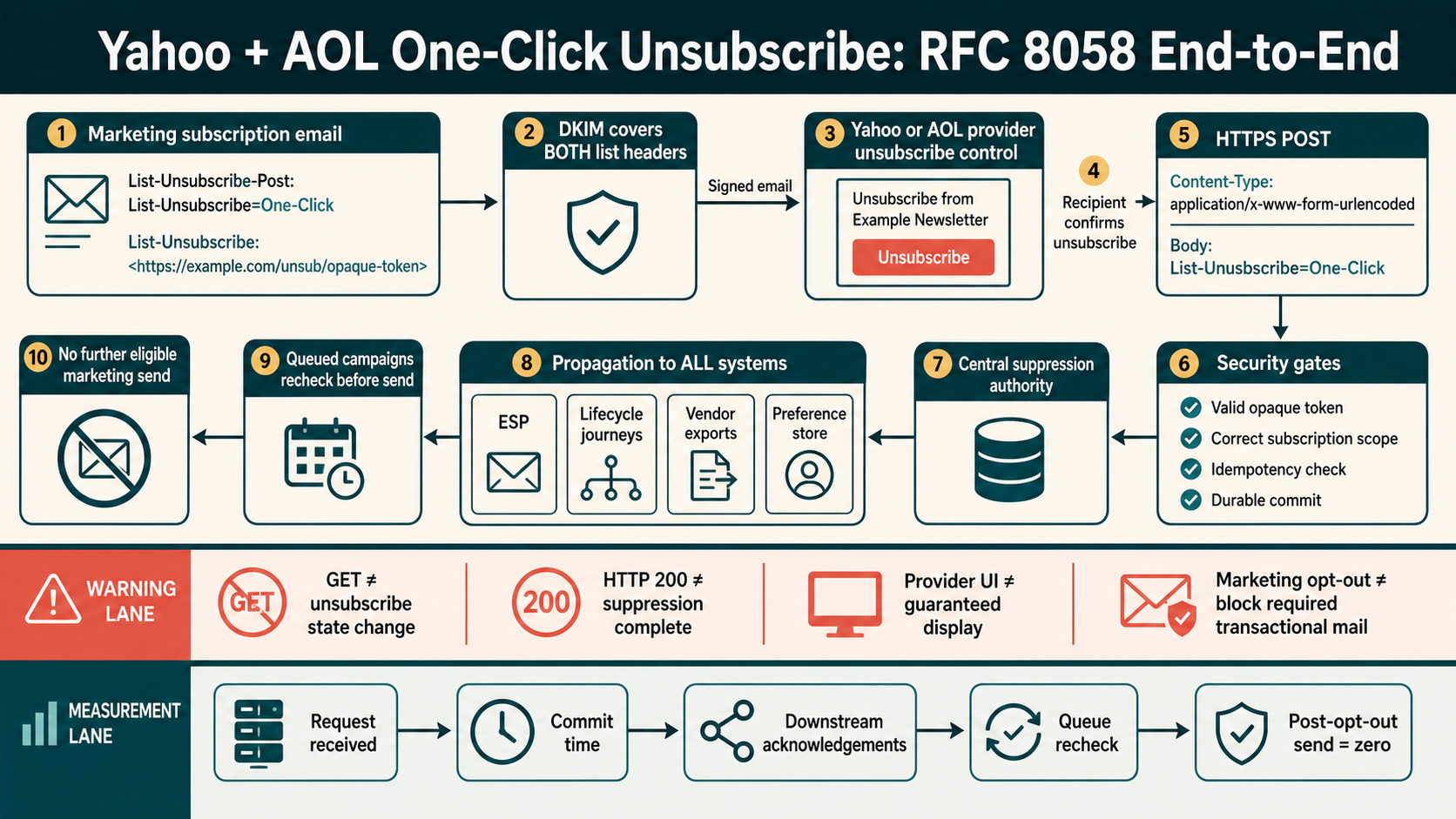
On February 19, 2019, Yahoo Postmaster announced that all Verizon Media based mailboxes supported RFC 8058 one-click unsubscribe. Senders could place a signed List-Unsubscribe-Post instruction and an HTTPS List-Unsubscribe URI in the message. When the recipient used the provider control, the mailbox service could submit a defined POST request without forcing the user through a preference page. Yahoo and AOL continued to accept mailto-style list-unsubscribe information, but the new mechanism created a direct, machine-actionable exit path. The operational promise was simple; implementing it securely and suppressing every eligible future send was not.
The dated mailbox-provider change
| Event field | Verified value | Why it matters |
|---|---|---|
| Historical event date | February 19, 2019 | This is the provider-change date, not the NitWings publication date. |
| Mailbox provider | Yahoo Mail ecosystem | The affected provider estate determines which recipient cohorts require separate evidence. |
| Change area | Unsubscribe | This identifies whether the change altered authentication, filtering, visibility, measurement or sender operations. |
| Current status | active-and-now-required-for-qualifying-bulk-marketing-mail | Historical instructions are interpreted against the feature or standard that exists now. |
RFC 2369 had standardized the List-Unsubscribe header long before 2019. It could advertise mailto and HTTP resources, allowing mail clients to expose an unsubscribe control outside the message body. A normal HTTP link, however, could be fetched by security scanners, link checkers or prefetch systems. Treating any GET as consent to unsubscribe risked removing recipients who had not made that choice.
RFC 8058 addressed automated one-click behavior by defining a separate List-Unsubscribe-Post header and a form-encoded POST. The header pair had to be protected by a valid DKIM signature so a receiver could trust that the advertised operation belonged to the signed message.
The Yahoo announcement arrived during the final Yahoo and AOL infrastructure migration. A capability from one platform could now be provided across the common mailbox estate. This expanded the recipient surface and pushed senders to make their suppression architecture consistent across both consumer brands.
The feature was promoted in 2019, while current Yahoo policy is stronger. Yahoo now places easy unsubscribe within bulk-sender requirements for marketing and subscribed mail, expects a visible body link, and states that requests must be honored within two days. Strong programs process them much faster.
How the system worked before the change
Before common RFC 8058 support, a Yahoo or AOL recipient might scroll to a body link, visit a preference center, compose an unsubscribe email, use a provider-specific control, block the sender or report spam. The result depended on message construction, client behavior and the sender’s back-end systems.
Preference pages often required a login, asked the recipient to re-enter an address, or placed the final confirmation behind several screens. That friction did not preserve permission. It encouraged recipients to choose the nearby spam button, producing reputation damage instead of a clean subscription exit.
Suppression was commonly fragmented. The email service provider stored body-link requests, customer support maintained manual removals, and a separate MTA parsed mailto requests. An overnight database export could allow another campaign to send after the person had opted out.
Unsafe HTTP implementations also used predictable identifiers or placed the plaintext email address in a URL. Forwarding the message exposed the token. Logs, analytics and third-party redirects retained personal data. A request could return HTTP 200 while no durable state changed.
What changed on the provider side
The announcement documented the two headers. List-Unsubscribe-Post: List-Unsubscribe=One-Click declares the RFC 8058 action. List-Unsubscribe: <https://example.com/unsubscribe/opaquepart> supplies the HTTPS endpoint. Yahoo also showed a POST body of List-Unsubscribe=One-Click with form URL encoding.
The endpoint is not a landing page click. It must accept the provider POST without requiring cookies, interactive authentication or additional confirmation. The token carries enough server-side context to identify the subscription safely, while remaining opaque and resistant to guessing or tampering.
RFC 8058 requires the relevant list headers to be covered by a valid DKIM signature. Signing only the body or From header is insufficient for receiver trust in the one-click instruction. Teams must inspect the final received message because ESP relays and gateways can add, change or sign headers after template generation.
Receiving the POST is only the first transaction. The sender must commit an idempotent suppression event, apply the correct subscription scope, propagate it to all campaign systems and recheck already queued recipients. The proof of success is no later eligible marketing send, not the web response alone.
Message path before and after
Before
Recipient receives unwanted subscription email
    |
    +----> finds body link and completes preference flow
    +----> sends mailto unsubscribe
    +----> blocks sender or reports spam
    |
    v
Separate systems update at different times
    |
    +----> exported or queued campaigns may still send
After
DKIM-signed message contains RFC 8058 header pair
    |
    v
Yahoo or AOL exposes provider unsubscribe control
    | recipient confirms action
    v
HTTPS form POST with opaque token
    |
    v
Validate token -> write idempotent central suppression event
    |
    +----> update ESP, journeys, vendors and preference store
    +----> recheck queued campaigns before delivery
    |
    v
No further eligible marketing send for the suppressed scope
Who and what the change affected
| Traffic or stakeholder | What changed | Required interpretation |
|---|---|---|
| Yahoo and AOL recipients | A common provider one-click control became available. | The control is provider-rendered and may depend on reputation and message validity. |
| Marketing senders | Signed machine-actionable unsubscribe became broadly useful. | Implement RFC 8058 plus an accessible body link. |
| ESPs and MTAs | Final headers and DKIM coverage became operational requirements. | Validate received MIME, not only application templates. |
| Security teams | Internet POST endpoints processed bearer-like opaque tokens. | Prevent guessing, replay harm, leakage and state ambiguity. |
| Data platforms | Suppression had to propagate across customer journeys. | Use one authoritative event with scoped downstream acknowledgements. |
| Deliverability analysts | Provider opt-outs could occur without an email open. | Keep unsubscribe source and denominator definitions explicit. |
Effect on delivery, placement and recipient visibility
Easy unsubscribe provides a safer alternative to reporting spam. It cannot make unwanted mail wanted, but it gives the recipient a direct exit and gives the sender actionable evidence. Hiding the body link or breaking the provider action increases the likelihood that uninterested recipients complain.
One-click support does not guarantee that Yahoo displays a blue unsubscribe control for every message. Current Yahoo documentation says display can depend on correct headers, reputation and engagement. Treat the headers as a sender obligation, not as a visual-placement entitlement.
Current Yahoo requirements distinguish promotional and subscription traffic from transactional messages. A password reset or receipt normally should not be globally suppressed because a recipient leaves a newsletter. Mixing promotion into transactional streams makes scope, complaint analysis and authentication reputation harder to control.
An unsubscribe endpoint failure can become a deliverability incident even when SMTP delivery is healthy. Expired tokens, blocked provider requests, TLS errors, slow responses, broken database writes or delayed replication can cause repeat sends. Monitor the full state transition, not merely endpoint uptime.
Do not rotate From domains or DKIM identities to avoid accumulated opt-out state. That fragments reputation and can mail someone from a new identity after a clear request. Stable purpose-specific identities and centrally enforced subscription policy are safer.
Effect on measurement and diagnosis
Measure from provider request to effective exclusion. Record request receipt, token validation, authoritative event commit, each downstream acknowledgement, queue recheck and last eligible send. The duration between these points exposes where a nominally successful request can fail.
Separate opt-out sources: RFC 8058 POST, body link, preference center, mailto, support request and complaint. Normalize all legitimate exits into one event model while preserving the source. Source comparison can reveal that a body link is inaccessible or that provider POST traffic is being blocked.
Use a meaningful denominator: delivered eligible subscription messages for the same stream, recipient estate and interval. Raw unsubscribe counts rise with volume. Current Yahoo complaint-rate calculations use provider-specific inbox delivery evidence, so sender-side complaint and unsubscribe ratios will not necessarily reproduce provider numbers.
Monitor unwanted post-opt-out sends as a zero-tolerance control. Sample test identities across each ESP, region and journey. Request unsubscribe after audience export and before final send to prove the queue performs a last-mile suppression check.
Do not rely only on opens when deciding who is inactive. Proxying, image blocking and privacy controls make them incomplete. Combine clicks, replies, purchases, explicit preferences, complaints, subscription age and promised cadence. Easy exit works best when contact pressure is already governed.
Advantages for email marketers
| Potential advantage | When the advantage is real | Evidence to verify |
|---|---|---|
| Lower complaint pressure | Recipients can exit through a trusted provider control. | Complaints and post-opt-out sends decline by cohort. |
| Faster suppression | POST events commit immediately to a central authority. | End-to-end propagation latency stays within target. |
| Better recipient trust | The exit does not require login or navigation. | Controlled tests complete from major mailbox surfaces. |
| Cleaner active audience | Every eligible system honors the same event. | Future audiences exclude suppressed identities. |
| Auditable compliance | Scope, time and acknowledgements are retained. | A request can be reconstructed without exposing its token. |
Disadvantages and operational risks
| Cost or risk | How it appears | Control |
|---|---|---|
| Header is not DKIM signed | Receiver cannot trust the advertised action. | Cover both list headers and inspect final MIME. |
| GET causes state change | Scanners unsubscribe users accidentally. | Use the RFC 8058 POST semantics only. |
| Token exposes identity | URLs leak addresses into logs and redirects. | Use opaque bounded tokens and minimize logging. |
| HTTP 200 precedes durable write | Recipient is mailed again. | Respond only after authoritative idempotent commit. |
| Suppression scope is unclear | Essential mail stops or promotions continue elsewhere. | Model subscription, brand, purpose and legal scope. |
| Queues ignore new events | A prepared campaign sends after opt-out. | Perform a final suppression check before delivery. |
What email teams needed to do at the time
- Add the RFC 8058 header pair. Use an HTTPS URI with an opaque token.
- Cover both headers with DKIM. Verify the signature on received production mail.
- Accept the defined POST. Do not require login, cookies or another confirmation.
- Centralize suppression. Convert provider actions into one authoritative event.
- Define scope. Separate subscription categories and required transactional mail.
- Keep the body link visible. Provide an accessible human-controlled alternative.
- Run Yahoo and AOL tests. Verify endpoint requests and downstream exclusion.
- Reconcile mailto handling. Continue honoring supported header and support channels.
What email teams should do now
- Meet current Yahoo requirements. Apply easy unsubscribe to qualifying bulk marketing and subscription messages.
- Honor within two days. Operate much faster internally and monitor the complete propagation clock.
- Use opaque authenticated tokens. Prevent guessing, tampering and unnecessary personal-data leakage.
- Make requests idempotent. Duplicate provider POSTs must produce one stable outcome.
- Protect the endpoint. Use reliable TLS, bounded payloads, rate controls and safe logs without blocking valid providers.
- Recheck queues. Apply suppression immediately before every eligible delivery.
- Audit vendors and exports. Obtain acknowledgements from every downstream sending platform.
- Monitor post-opt-out sends. Alert on any message that violates the effective scope.
- Retain a visible body link. Do not make preference management depend on provider UI.
- Coordinate total frequency. Easy unsubscribe is not permission to overmail.
Worked deliverability scenario
A retailer includes the correct-looking headers in its template and receives Yahoo one-click POSTs. The endpoint returns 200 immediately, then places a message on a queue for overnight processing. A promotional audience had already been exported to a second platform, so some recipients receive another campaign after opting out.
Received-message inspection also shows that the outbound gateway’s DKIM signature does not cover List-Unsubscribe or List-Unsubscribe-Post. Provider UI display is inconsistent. The body link updates only the retailer newsletter, while the RFC 8058 token has no documented scope.
The team changes the endpoint to validate an opaque signed token and commit an idempotent central suppression event before success. Every ESP consumes the event, acknowledges it and checks the authority again before send. The final gateway includes both list headers in DKIM coverage. Newsletter and promotional journeys share the correct marketing scope; receipts and security notices remain separate.
Controlled Yahoo and AOL accounts test provider POST, body link, duplicate POST, expired token, exported audience and already queued campaign cases. Post-opt-out sends fall to zero. Reporting distinguishes provider one-click events from complaints rather than treating lower complaint counts as proof that permission quality is solved.
Evidence and diagnostics
- Final headers: exact List-Unsubscribe, List-Unsubscribe-Post and URI syntax.
- DKIM evidence: passing signature, signing domain, selector and h= coverage for both headers.
- Request evidence: timestamp, method, content type, bounded body, token result and response.
- Token evidence: subscription identity, scope, expiry and integrity without storing plaintext in access logs.
- Commit evidence: immutable event ID, effective time and idempotency key.
- Propagation evidence: each ESP, vendor, region and journey acknowledgement.
- Queue evidence: export time, final eligibility check and delivery decision.
- Outcome evidence: no later eligible marketing send, complaint and opt-out source trends.
Failure modes and incorrect conclusions
- Calling any body link RFC 8058. The standard requires the header-declared POST mechanism.
- Using GET to unsubscribe. Automated scanners can cause unintended state changes.
- Leaving list headers outside DKIM coverage. The receiver lacks the required signed instruction.
- Returning success before persistence. A web response is not durable suppression.
- Sending the token through third-party analytics. Bearer-like subscription authority can leak.
- Suppressing only one campaign. Other eligible journeys continue mailing.
- Suppressing every message globally. Required account communications can be lost.
- Assuming provider UI always appears. Display remains provider-controlled.
Current status and superseding changes
Yahoo’s current Sender Hub requirements apply across consumer brands hosted by Yahoo Mail. Qualifying bulk senders must support easy unsubscribe for marketing and subscribed mail, include a visible body link and honor requests within two days. Yahoo documentation recommends the RFC 8058 POST method and continues to describe mailto support.
Yahoo’s Subscription Hub gives recipients another centralized management surface. Correct header support can make a sender eligible, but provider display also depends on reputation and engagement. The sender must make unsubscribe work even when that surface does not appear.
RFC 8058 remains the core machine-actionable method used across major mailbox-provider requirements. The lasting implementation requirements are signed headers, a safe POST endpoint, opaque tokens, prompt scoped suppression, and proof that all downstream systems stopped eligible mail.
The strategic interpretation is recipient centered. Unsubscribe is expected lifecycle behavior, not a failure to hide. Clean exits protect trust and reputation, while the remaining audience better reflects current interest. Frequency, acquisition quality and message value still determine how often recipients want to leave.
Operator checklist
- Record February 19, 2019 as the Yahoo provider announcement date.
- Include one HTTPS URI and the exact List-Unsubscribe-Post instruction.
- Cover both unsubscribe headers with a passing DKIM signature.
- Use POST, not GET, for the one-click state change.
- Use opaque tamper-resistant tokens without plaintext addresses.
- Commit an idempotent scoped suppression before returning success.
- Propagate the event to every sending platform and exported audience.
- Recheck suppression immediately before eligible delivery.
- Retain an accessible body unsubscribe link.
- Honor current Yahoo timing requirements and monitor faster internal targets.
- Prove zero post-opt-out marketing sends with controlled tests.
Primary and contemporaneous references
- Yahoo Postmaster: Support one-click unsubscribe: Primary February 19, 2019 announcement.
- Yahoo Sender Hub: Subscription Hub: Current RFC 8058 implementation and recipient surface.
- Yahoo Sender Hub: Best practices: Current requirements and processing expectations.
- Yahoo Sender Hub: FAQ: Current scope, display and enforcement details.
- RFC Editor: RFC 8058: Primary one-click unsubscribe standard.