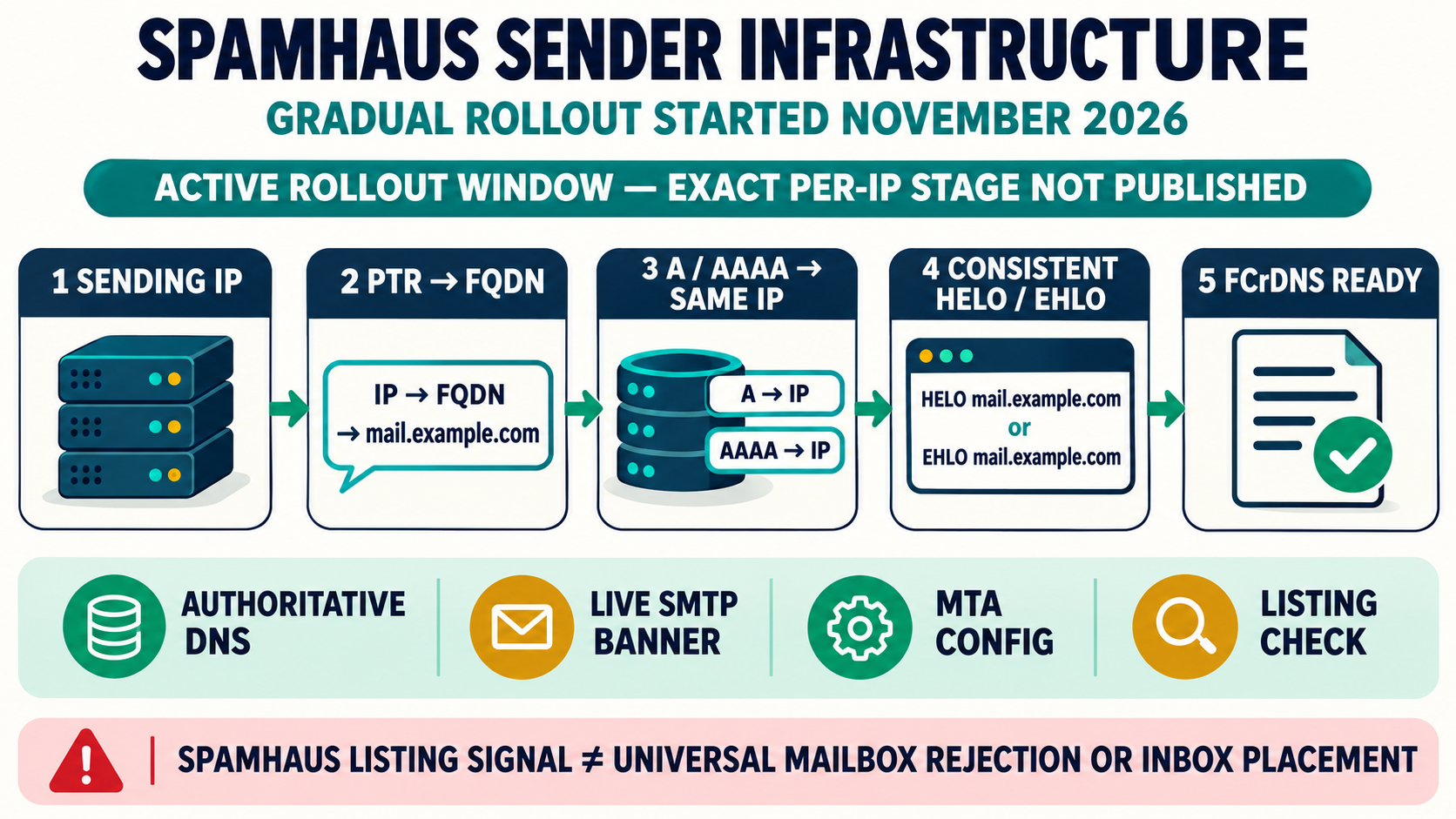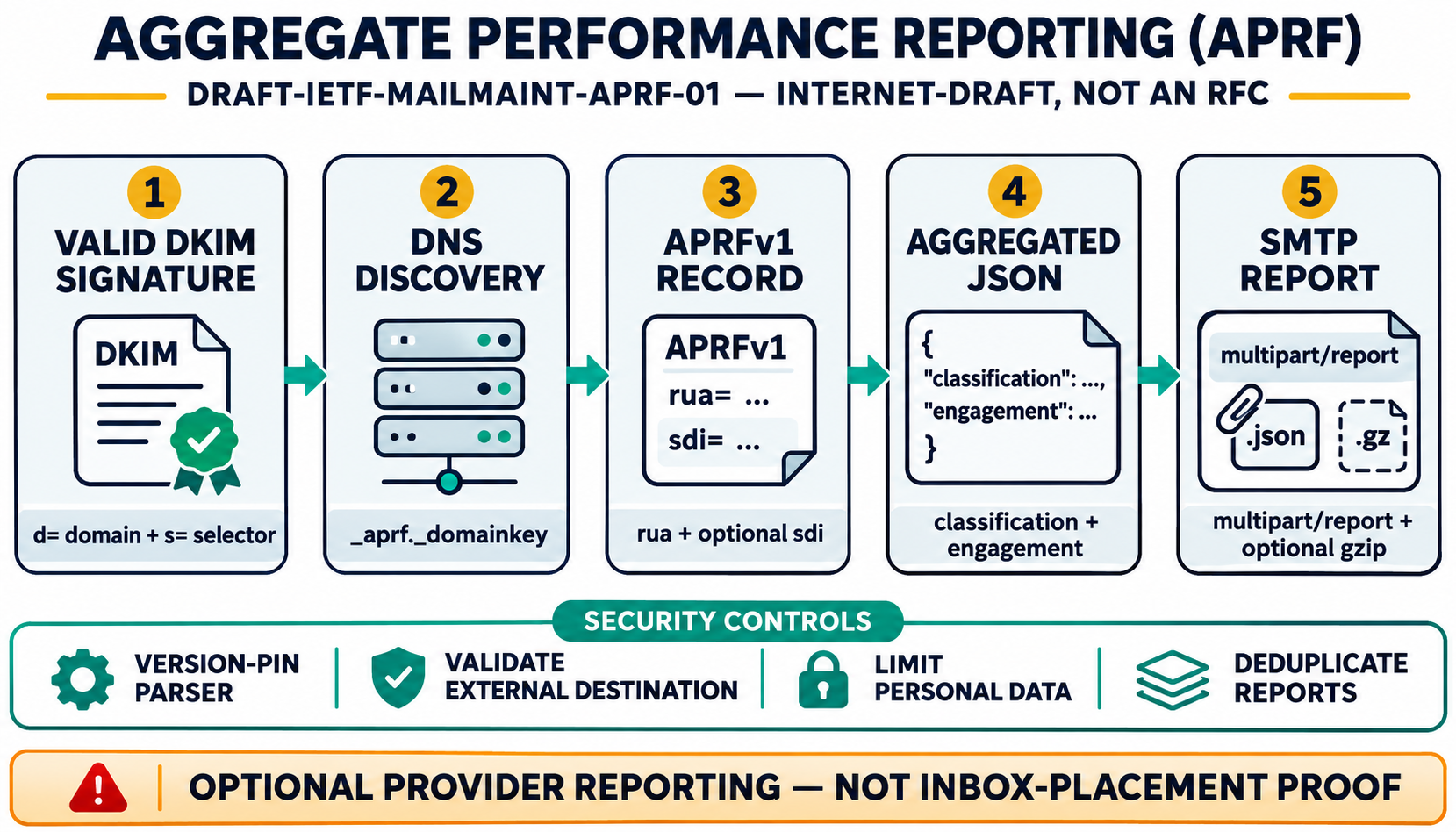
DMARC RFC 9990: Aggregate Reporting and Safe XML Processing
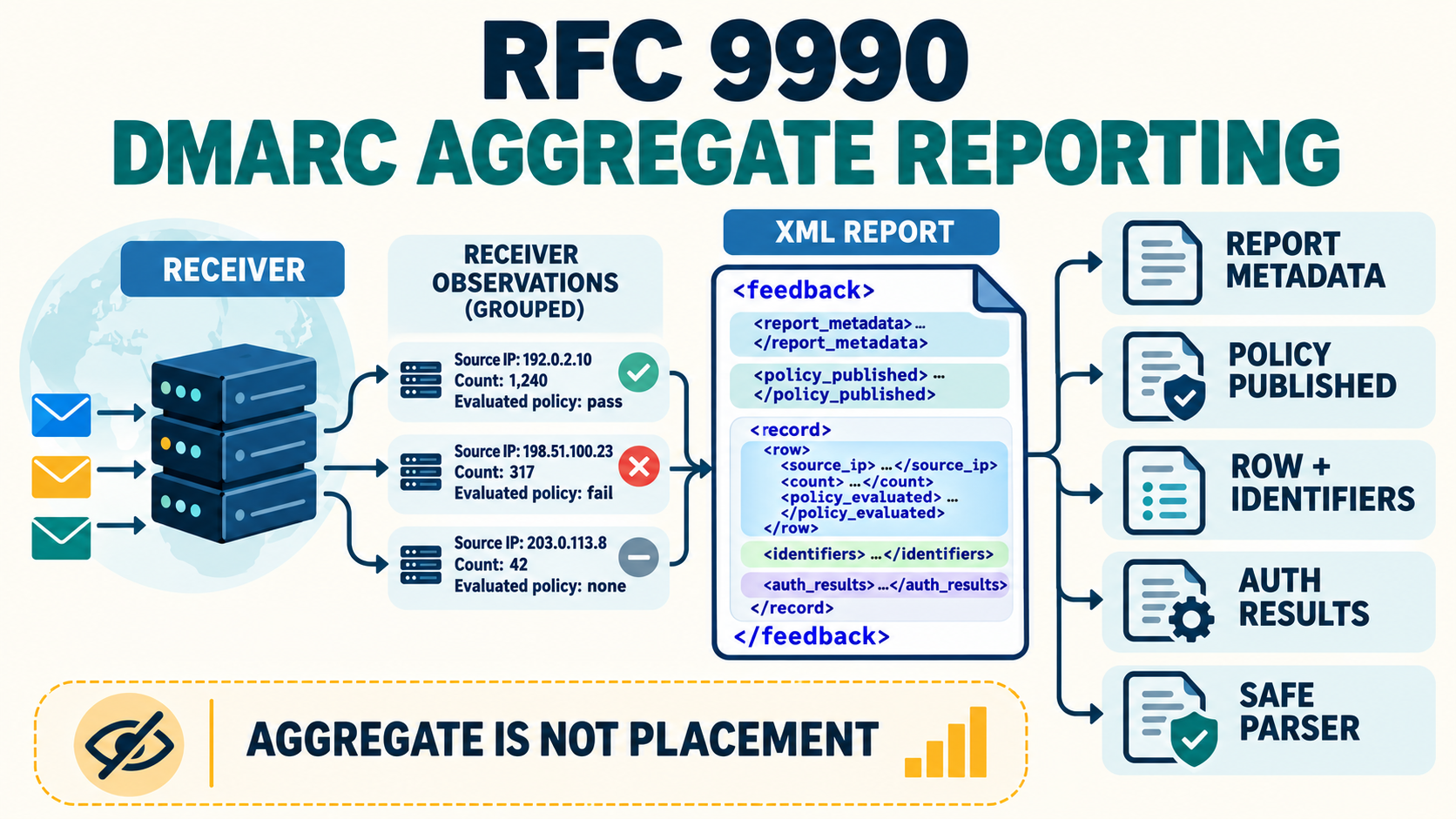
RFC 9990 is the current Standards Track specification for DMARC aggregate reports. Published in May 2026, it separates grouped receiver feedback from the RFC 9989 core protocol, defines the urn:ietf:params:xml:ns:dmarc-2.0 XML format, adds current policy and discovery fields, and gives report generators and consumers explicit rules for delivery, authorization, duplication, extensibility and safe processing.
Keep the three DMARC specifications separate
| Layer | RFC | What it decides | Do not infer |
|---|---|---|---|
| Core evaluation | RFC 9989 | Author Domain, policy discovery, alignment, DMARC pass/fail and requested handling | Aggregate XML structure or individual failure-report content. |
| Aggregate reporting | RFC 9990 | Grouped receiver observations, report request authorization, XML format and delivery | Recipient-level placement, opens, complaints or message bodies. |
| Failure reporting | RFC 9991 | Optional message-specific failure feedback and privacy constraints | That every receiver will generate forensic reports. |
| Receiver filtering | Local provider policy | Acceptance, rejection, quarantine, spam or inbox handling | That DMARC alone explains the final mailbox outcome. |
This article owns report production and ingestion. The RFC 9989 guide owns the message-time DMARC algorithm, DNS Tree Walk and policy tags. The RFC 9991 guide owns optional failure reports that can contain message-specific information. Linking these layers is useful; copying their full scope into one article creates ambiguous implementations.
The complete report lifecycle
RECEIVER
  evaluate DMARC under RFC 9989
  group observations by policy domain and record tuple
  build one RFC 9990 report per policy domain and policy configuration
  create a unique Report-ID and standards-compliant filename
  authenticate the report message with aligned DMARC pass
  deliver to each supported, authorized rua destination

REPORT CONSUMER
  authenticate and rate-limit message intake
  extract only supported .xml or .xml.gz attachments
  bound decompression before parsing
  parse without DTD, external entities, XInclude or network access
  validate namespace, schema, multiplicity and value ranges
  deduplicate report identity and overlapping periods
  retain provenance, then aggregate counts for analysis
A report is evidence supplied by one receiver about the population it observed. It is neither a global census nor an instruction to change DNS automatically. Store the reporter, reporting period, policy domain and source provenance with every imported row so later analysis can identify missing reporters, duplicates and provider-specific behavior.
One report covers one policy domain and one policy configuration
A receiver generates a separate aggregate report for each DMARC Policy Domain encountered in the reporting period. A report can contain several RFC 5322 From domains when they inherit the same policy domain. For example, traffic from example.com and mail.example.com can appear in the same report when the subdomain inherits the parent policy.
One report contains only one policy configuration. If DNS policy changes during the period, the reporter may send separate reports for the configurations or may send one report whose rows reflect old and new handling while policy_published shows only the final configuration. A consumer must retain the period and DNS change record instead of treating that temporary mismatch as corruption.
Which messages belong in aggregate counts?
Reports include messages that passed DMARC and messages that failed it. Counts are based on messages received by the reporting system even when another filtering agent ultimately blocks delivery. This makes reports useful for authentication inventory, but it does not make them a placement report.
Coverage varies by receiver participation, traffic volume, privacy or operational policy, delivery success to the report mailbox and the report consumer's parser. A missing row is not zero traffic. A source seen by one receiver may not have sent to another.
The RFC 9990 document starts with feedback
The root element is feedback, not report, and its namespace is urn:ietf:params:xml:ns:dmarc-2.0. The first-level elements appear in the specified order. A report contains at least one record.
Top-level XML elements
| Element | Multiplicity | Meaning | Ingestion rule |
|---|---|---|---|
| version | Zero or one | Report format version; when present it must be 1.0 | Store it explicitly; do not invent it when absent. |
| report_metadata | Exactly one | Generator identity, contact, Report-ID, UTC range, optional error and generator | Use for provenance, deduplication and period checks. |
| policy_published | Exactly one | Policy configuration observed by the receiver | Do not substitute the domain's current DNS value. |
| extension | Zero or one | File-level namespaced extension data | Ignore unknown extensions without rejecting the core report. |
| record | One or more | Grouped observations for a source/result/identifier tuple | Preserve every record and its count; never treat count as one message. |
Annotated RFC 9990 XML example
<?xml version="1.0" encoding="UTF-8"?>
<feedback xmlns="urn:ietf:params:xml:ns:dmarc-2.0">
  <version>1.0</version>
  <report_metadata>
    <org_name>mail.receiver.example</org_name>
    <email>[email protected]</email>
    <report_id>[email protected]</report_id>
    <date_range>
      <begin>1794960000</begin>
      <end>1795046400</end>
    </date_range>
    <generator>Receiver DMARC reporter 2.0</generator>
  </report_metadata>
  <policy_published>
    <domain>example.com</domain>
    <discovery_method>treewalk</discovery_method>
    <p>quarantine</p>
    <sp>reject</sp>
    <np>reject</np>
    <adkim>r</adkim>
    <aspf>r</aspf>
    <testing>n</testing>
  </policy_published>
  <record>
    <row>
      <source_ip>192.0.2.10</source_ip>
      <count>1240</count>
      <policy_evaluated>
        <disposition>pass</disposition>
        <dkim>pass</dkim>
        <spf>fail</spf>
      </policy_evaluated>
    </row>
    <identifiers>
      <header_from>example.com</header_from>
      <envelope_from>bounce.example.com</envelope_from>
    </identifiers>
    <auth_results>
      <dkim>
        <domain>example.com</domain>
        <selector>mta1</selector>
        <result>pass</result>
      </dkim>
      <spf>
        <domain>bounce.example.com</domain>
        <scope>mfrom</scope>
        <result>fail</result>
      </spf>
    </auth_results>
  </record>
</feedback>
The example shows a message population that passed through aligned DKIM even though SPF failed. The policy_evaluated/dkim and policy_evaluated/spf values describe DMARC alignment results. The nested auth_results elements describe the underlying verification results. Keep those meanings separate in the data model.
Report metadata is operational evidence
report_metadata requires the reporting organization, a contact address, a Report-ID and a UTC date range expressed as epoch seconds. The optional error can identify problems such as an invalid reporting URI or multiple policy records. The optional generator identifies reporting software and helps isolate implementation defects.
The begin and end timestamps describe the intended reporting period, not the first and last observed message. Periods should not overlap and commonly represent one UTC day. Consumers should flag a reversed range, an unreasonable duration or unexpected overlap without silently rewriting source timestamps.
policy_published is the receiver's observed configuration
The element requires the DMARC Policy Domain and p. It can contain sp, np, fo, adkim, aspf, testing and discovery_method. Unspecified policy tags carry their protocol defaults.
discovery_method distinguishes treewalk under RFC 9989 from historical psl discovery under RFC 7489. This is essential during migration because two receivers can reach different Organizational Domain or policy decisions. Do not overwrite the reported value with what the current DNS lookup returns today.
Each record is a grouped tuple, not a message
| XML path | Required data | Operational interpretation | Frequent error |
|---|---|---|---|
| record/row | source_ip, count, policy_evaluated | Connecting system and the number of matching messages | Reading disposition as inbox placement. |
| row/policy_evaluated | disposition, dkim, spf; optional reasons | Applied disposition plus DMARC alignment results | Confusing dkim/spf here with raw mechanism verification. |
| record/identifiers | header_from; optional envelope_from and envelope_to | Domains used to apply policy to the tuple | Treating envelope_to as an individual recipient address. |
| record/auth_results/dkim | domain, selector, result; optional human_result | Underlying DKIM verification evidence | Assuming the first signature is the aligned signature. |
| record/auth_results/spf | domain, result; optional scope and human_result | Underlying MAIL FROM SPF evidence | Accepting HELO as DMARC SPF scope; RFC 9990 permits only mfrom. |
| record extension | Namespaced extension elements | Future or separately defined evidence | Failing the entire report only because an extension is unknown. |
The RFC describes one record per combination of source IP, result and authentication identifiers. The count is the number of messages represented by that tuple. Analytics must sum counts, not count XML records. One source IP can produce many records because its Header From, envelope identity, DKIM selector, alignment or disposition changed.
RFC 9990 disposition has four values
The action disposition can be none, pass, quarantine or reject. Here pass means no policy action because DMARC passed while an enforcing policy existed. It does not mean inbox placement. none means no action was taken and can occur under monitoring, an override or another applicable condition.
If alignment fails and the applied disposition differs from the published policy, the report must include an override reason. A dashboard that displays only disposition without alignment and reason loses the explanation the operator needs.
Policy override reasons
| Override type | Meaning | How to use it | What it does not prove |
|---|---|---|---|
| local_policy | Receiver policy exempted the message from requested handling | Segment by reporter and inspect comments where supplied | That the message was wanted or placed in inbox. |
| mailing_list | Receiver heuristics identified a mailing-list path | Correlate with list domains, ARC and known modifications | That every failure from the source is legitimate list mail. |
| trusted_forwarder | Receiver recognized a trusted forwarding path | Review forwarding and ARC evidence separately | That the forwarder is trusted by other receivers. |
| policy_test_mode | The RFC 9989 t tag reduced requested handling | Compare published policy, testing value and disposition | That DMARC passed. |
| other | An exception outside the named types | Retain the optional comment and reporter | A universally defined reason. |
Multiple DKIM signatures need ordered handling
A message can contain several DKIM signatures with different domains, selectors and outcomes. RFC 9990 prefers: passing strict-aligned signatures, passing relaxed-aligned signatures, other passing signatures, then failing signatures. A report should contain no more than 100 signatures for a row in that priority order.
Store every supplied DKIM result as a child of the report row. Flattening to one selector discards evidence that can distinguish an aligned brand signature from an unaligned ESP signature or a broken signature added earlier in the path.
SPF reporting uses MAIL FROM
The optional SPF scope has only one valid value: mfrom. RFC 9990 does not use the HELO identity for DMARC SPF reporting. The envelope-from element can be empty when SMTP used a null reverse path. Your schema and application model must accept that valid case without fabricating a domain.
Report-ID and unique identifiers support deduplication
The Report-ID must be unique among reports to the same domain. The identifier used in metadata, subject and related unique-id positions must remain consistent for that report. When a generator retransmits, it must reuse the original filename, allowing the consumer to overwrite or discard the duplicate.
Deduplication should combine generator identity, policy domain, reporting period, Report-ID, attachment filename and content hash. Report-ID alone is not a safe global key because two reporters can choose the same string. Partial overlaps cannot be reliably split using aggregate rows, so quarantine or accept the whole overlap under an explicit policy.
Attachment and subject syntax
The attachment contains XML and should be GZIP-compressed. Compressed media uses application/gzip; plain XML uses text/xml. The filename is constructed as receiver!policy-domain!begin!end[!unique-id].xml.gz or the equivalent .xml form.
The subject begins with Report Domain:, names the policy domain, then Submitter: and the reporting domain, with an optional Report-ID. Treat subject and filename as routing hints. The authenticated, parsed and schema-validated content remains authoritative.
The report email itself must pass aligned DMARC
RFC 9990 requires mail streams carrying feedback to conform to DMARC and produce an aligned pass. This reduces fraudulent report intake, but it does not make the XML true. A compromised or misconfigured reporter can still send misleading data. Preserve Authentication-Results and apply sender-specific rate and anomaly controls.
rua requests delivery; it does not guarantee it
A receiver discovers reporting destinations from rua while evaluating mail. It evaluates URIs in order, ignores malformed destinations, attempts each remaining supported URI within its limits and may retry or discard undeliverable report data. TLS is recommended for email transport when the URI does not specify another secure mechanism.
Receivers can decline reporting because of resources, privacy or local policy. Domain owners should monitor mailbox capacity, transport failures, processor health and sender coverage before concluding that a quiet day means authentication is healthy.
External reporting requires destination authorization
| Situation | DNS owner queried by reporter | Minimum valid content | Outcome |
|---|---|---|---|
| Reports remain inside the policy Organizational Domain | No external authorization lookup required | The rua URI must still be syntactically usable | Reporter attempts supported destinations within its limits. |
| example.com sends to [email protected] | example.com._report._dmarc.processor.example.net | v=DMARC1 as the first tag | External destination is authorized. |
| Processor accepts reports for any policy domain | *._report._dmarc.processor.example.net | v=DMARC1 as the first tag | Wildcard can authorize multiple customers. |
| Authorization record supplies rua override | Same constructed authorization owner | v=DMARC1; rua=mailto:... using the same destination host | Reporter replaces the original URI without creating an authorization loop. |
| No valid authorization or temporary lookup cannot be resolved | Constructed authorization owner | None | Unauthorized URI is ignored; temporary DNS handling is receiver policy. |
The authorization owner is formed from the policy domain, ._report._dmarc., and the destination host. A valid record begins with v=DMARC1. A destination can publish a wildcard authorization. Removal stops new authorization only after cached positive answers expire.
Manual reporting and authorization checks
# Policy record requests reports at an external processor.
dig +short TXT _dmarc.example.com
# "v=DMARC1; p=none; rua=mailto:[email protected]"

# Current RFC 9990 external-destination authorization owner.
dig +short TXT example.com._report._dmarc.processor.example.net
# "v=DMARC1"

# Optional wildcard authorization for a multi-tenant processor.
dig +short TXT '*._report._dmarc.processor.example.net'
# "v=DMARC1"

# Preserve qname, complete TXT strings, rcode, TTL, resolver and UTC time.
These queries confirm current DNS evidence only. They do not prove that every receiver cached the same answer, supports the URI, delivered the report or used the same Tree Walk boundary. Record the exact owner and time when troubleshooting a missing reporter.
Extensions must be namespaced and optional
RFC 9990 provides one file-level extension area after policy_published and record-level extension elements after auth_results. Extension data must use a separate XML namespace that identifies its definition. A consumer unable to process an extension should ignore that extension and continue with valid core data.
Do not accept unqualified elements as if they were core fields. Do not let an extension redefine source IP, count or authentication results. Store supported extension versions separately so a new vendor payload cannot silently change a core metric.
Treat every report as hostile input
| Boundary | Required control | Failure disposition | Evidence retained |
|---|---|---|---|
| Message intake | Dedicated mailbox, authenticated transport evidence, attachment and message-size limits | Quarantine unsupported or oversized input | Message-ID, sender, subject, authentication results and received time. |
| GZIP | Compressed-size, expanded-size, member-count, ratio and time limits | Reject or quarantine limit violations before XML parsing | Hash, sizes, ratio, decompressor result and reason. |
| XML | Disable DTD, external entities, XInclude and network; enforce depth, node and text limits | Reject unsafe or malformed XML | Namespace, root, parser error and bounded sample metadata. |
| Schema | Validate DMARC 2.0 core shape and ordered top-level elements | Quarantine nonconforming reports unless a reviewed compatibility rule exists | Schema version and exact validation errors. |
| Extensions | Require namespaces; ignore unknown extension payloads | Keep valid core data while isolating unsupported extension data | Extension namespace and element names, not unrestricted content. |
| Database | Parameterized writes, integer bounds, normalized IP/domain values and transaction limits | Roll back the report transaction on integrity failure | Report key, row counts, count totals and import status. |
The RFC explicitly identifies decompression bombs, XML bombs and forged reports. Safe ingestion needs limits before parsing, not only after an XML object has consumed memory. Run the processor with no network access and minimal filesystem permissions. Never enable external entity loading to “fix” a report.
Bounded parser design example
function ingestAggregateReport(string $messageId, string $attachment): void
{
    assertMessageAndAttachmentWithinLimits($messageId, $attachment);
    $xmlBytes = boundedGunzipOrPlainXml(
        input: $attachment,
        maxCompressedBytes: 10_000_000,
        maxExpandedBytes: 100_000_000,
        maxRatio: 25
    );

    $reader = new XMLReader();
    $reader->XML($xmlBytes, null, LIBXML_NONET | LIBXML_NOERROR | LIBXML_NOWARNING);
    assertNoDoctypeOrExternalEntity($xmlBytes);
    assertRootAndNamespace($reader, 'feedback', 'urn:ietf:params:xml:ns:dmarc-2.0');
    validateAgainstPinnedRfc9990Schema($xmlBytes);

    $report = streamParseWithDepthNodeAndTextLimits($reader);
    assertIntegerAndRecordLimits($report);
    importIdempotently($messageId, $report);
}
The numeric limits in this design example are an operator policy, not limits mandated by RFC 9990. Set them from mailbox capacity and observed legitimate reports, keep them configurable, alert on violations and provide a quarantined manual-review path. The security properties are the important part: bounded expansion, no external resolution, schema validation, streaming and idempotent import.
A data model that preserves meaning
Store a report header keyed by reporter, policy domain, Report-ID, period, filename and content hash. Store policy as observed. Store each record row with source IP, message count, disposition, aligned DKIM/SPF results and every override reason. Store identifiers and raw DKIM/SPF authentication results in child tables.
Keep imported data immutable and build derived classifications separately. If an analyst labels a source as “known ESP,” retain the rule version, evidence, reviewer and effective dates. Reprocessing should change the derived label without changing what the receiver reported.
Queries that answer operational questions
-- Unknown sending sources using the domain in Header From.
SELECT source_ip, SUM(message_count) AS messages
FROM dmarc_rows
WHERE policy_domain = 'example.com'
  AND period_begin >= :window_start
GROUP BY source_ip
ORDER BY messages DESC;

-- DMARC failures split by alignment path and actual disposition.
SELECT reporter, disposition, dkim_aligned, spf_aligned,
       SUM(message_count) AS messages
FROM dmarc_rows
WHERE policy_domain = 'example.com'
  AND period_begin >= :window_start
GROUP BY reporter, disposition, dkim_aligned, spf_aligned;

-- Do not divide by an assumed total. Use the summed report population.
SELECT SUM(CASE WHEN dkim_aligned='pass' OR spf_aligned='pass'
                THEN message_count ELSE 0 END) AS aligned_messages,
       SUM(message_count) AS reported_messages
FROM dmarc_rows
WHERE policy_domain = 'example.com'
  AND period_begin >= :window_start;
Rates must use the sum of message counts in the selected report population. Never calculate a pass rate by dividing passing XML rows by total XML rows. State which reporters, policy domains and periods are present, and label incomplete data before presenting a percentage.
How to interpret common patterns
- DKIM aligned, SPF unaligned: the stream can pass DMARC through DKIM; confirm the signing domain and selector are controlled.
- SPF aligned, DKIM failing: DMARC may pass, but forwarding can break the SPF path; prioritize durable aligned DKIM.
- Both unaligned from a known source: fix the ESP configuration before enforcement.
- Both failing from an unknown source: investigate abuse, but do not block an infrastructure range solely from one aggregate row.
- Disposition none under enforcing policy: inspect override reasons, test mode and reporter-specific local policy.
- Sudden source disappearance: confirm report coverage and delivery before declaring the sender removed.
- treewalk and psl reporters disagree: compare selected policy domains and RFC 9989 boundary discovery.
Aggregate does not mean risk-free
Core aggregate reports contain domain-level authentication data, source infrastructure and counts rather than individual addresses or message content. That is a much narrower privacy surface than failure reporting. However, traffic analysis can reveal vendors, volumes, timing and organizational relationships. Restrict access and retain only what the operating purpose requires.
PSD reporting can expose information outside an Organizational Domain, particularly in multi-organization suffixes. RFC 9990 limits PSD DMARC feedback to aggregate reports because failure reports carry greater risk. Domain owners and receivers still need to review their policies before sending data to an external processor.
Troubleshooting missing or rejected reports
- Confirm
ruasyntax and the policy record selected under RFC 9989. - For an external destination, query the exact current authorization owner.
- Check positive and negative DNS caching around the failure time.
- Verify the report mailbox accepts the sender, message size, media type and attachment extension.
- Confirm the report message produced aligned DMARC pass.
- Inspect decompression, namespace, root, schema and ordered-element errors separately.
- Check duplicate keys and period-overlap policy before assuming an import vanished.
- Compare received files with expected reporter coverage; not every receiver sends reports.
- Quarantine malformed reports and preserve generator contact and error evidence.
Acceptance tests for an RFC 9990 pipeline
- Accept
feedbackin the DMARC 2.0 namespace and reject a falsereportroot. - Enforce one metadata and policy block with at least one record.
- Accept version 1.0 when present and preserve absence when omitted.
- Preserve treewalk and psl discovery values.
- Accept pass as an action disposition without calling it inbox placement.
- Keep policy alignment results separate from underlying authentication results.
- Accept a null reverse-path representation without fabricating envelope_from.
- Retain multiple DKIM signatures and their selectors.
- Ignore unknown namespaced extensions while retaining core data.
- Reject DTD, entity expansion, excessive depth, oversized expansion and invalid integer values.
- Deduplicate exact retransmission without double-counting message counts.
- Flag partial period overlap instead of attempting unverifiable row subtraction.
- Validate external authorization and same-host rua override behavior.
- Record policy changes without replacing observed policy with current DNS.
- Import one policy domain per report and support multiple Header From domains.
Deployment and rollback
- Run the new parser beside the existing pipeline on copied input.
- Compare accepted files, rejected reasons, report keys, total counts and policy-domain selection.
- Investigate every material difference rather than averaging totals.
- Enable production import for a bounded mailbox or reporter cohort.
- Keep the original attachment quarantine during the observation window.
- Rollback by stopping new imports and returning to the previous read path; do not delete accepted evidence.
- Reprocess from immutable originals after the defect is fixed and version the derived output.
Production monitoring
- Reports received, authenticated, parsed, quarantined and deduplicated by reporter.
- Compressed and expanded sizes, ratios and processing latency.
- Schema, namespace, extension and integer validation failures.
- Policy domains and reporting periods missing from the expected coverage baseline.
- Message-count totals by aligned mechanism, disposition and override reason.
- New source IPs, domains and DKIM selectors.
- External authorization lookup failures and report mailbox delivery errors.
- Pipeline version, configuration limits and last successful reprocessing test.
Current standards status
As reviewed on November 19, 2026, RFC 9990 is the Standards Track DMARC aggregate reporting specification and, together with RFC 9989 and RFC 9991, replaces the reporting material formerly carried in RFC 7489. New systems should emit and consume the DMARC 2.0 namespace while preserving compatibility decisions as explicit, tested rules.
Primary standards references
- RFC 9990: DMARC Aggregate Reporting: Current aggregate XML, delivery, authorization, extension, privacy and security specification.
- RFC 9989: DMARC Core Protocol: Current message evaluation, DNS Tree Walk, alignment and policy specification.
- RFC 9991: DMARC Failure Reporting: Current message-specific failure reporting and privacy specification.
- RFC 8601: Authentication-Results: Authentication result vocabulary used by report fields and report-message evidence.
- RFC 1952: GZIP File Format: Compression format used for aggregate report attachments.