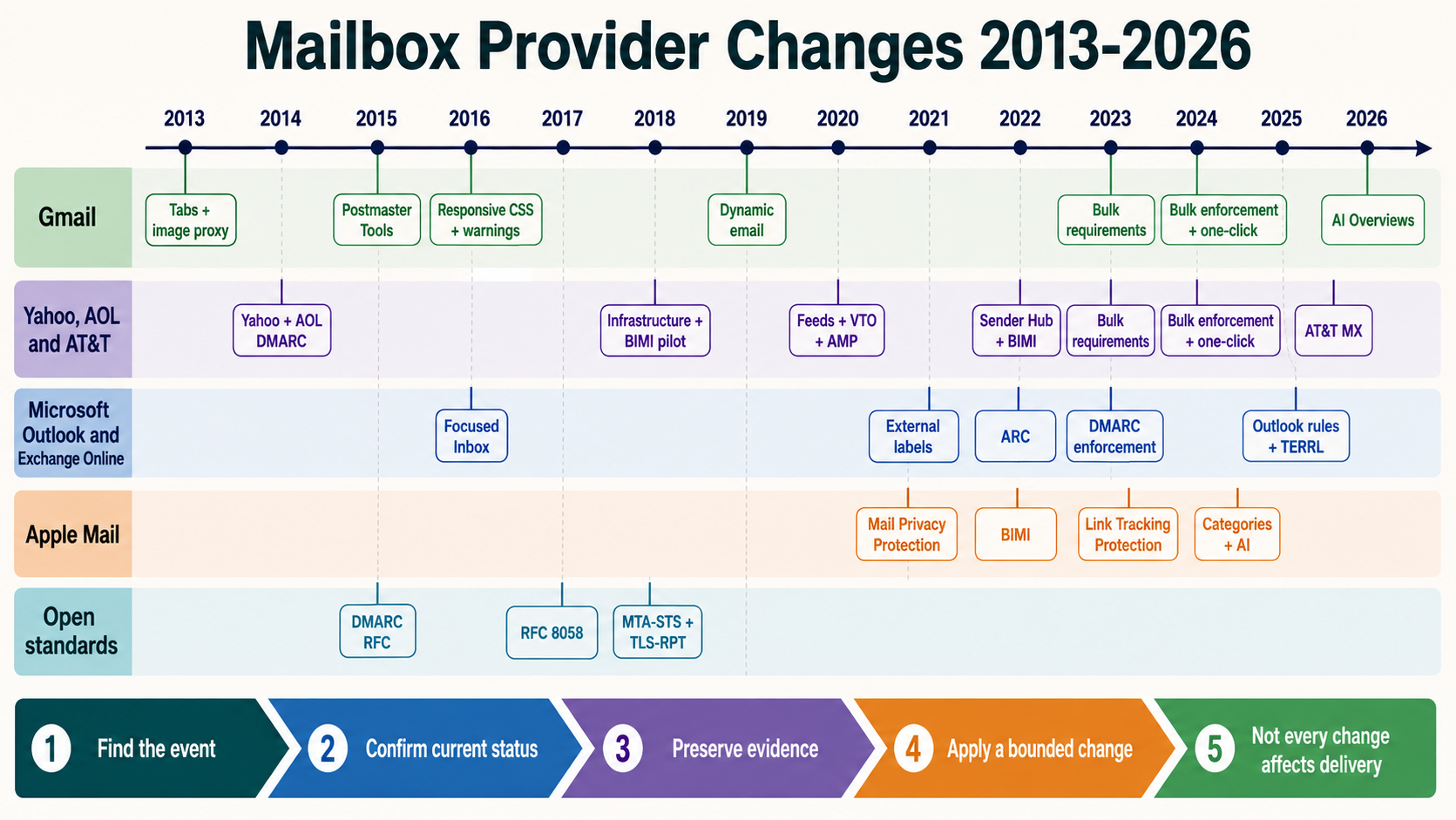
Gmail Neural-Network Spam Filtering in 2015: Personalized Classification Arrives
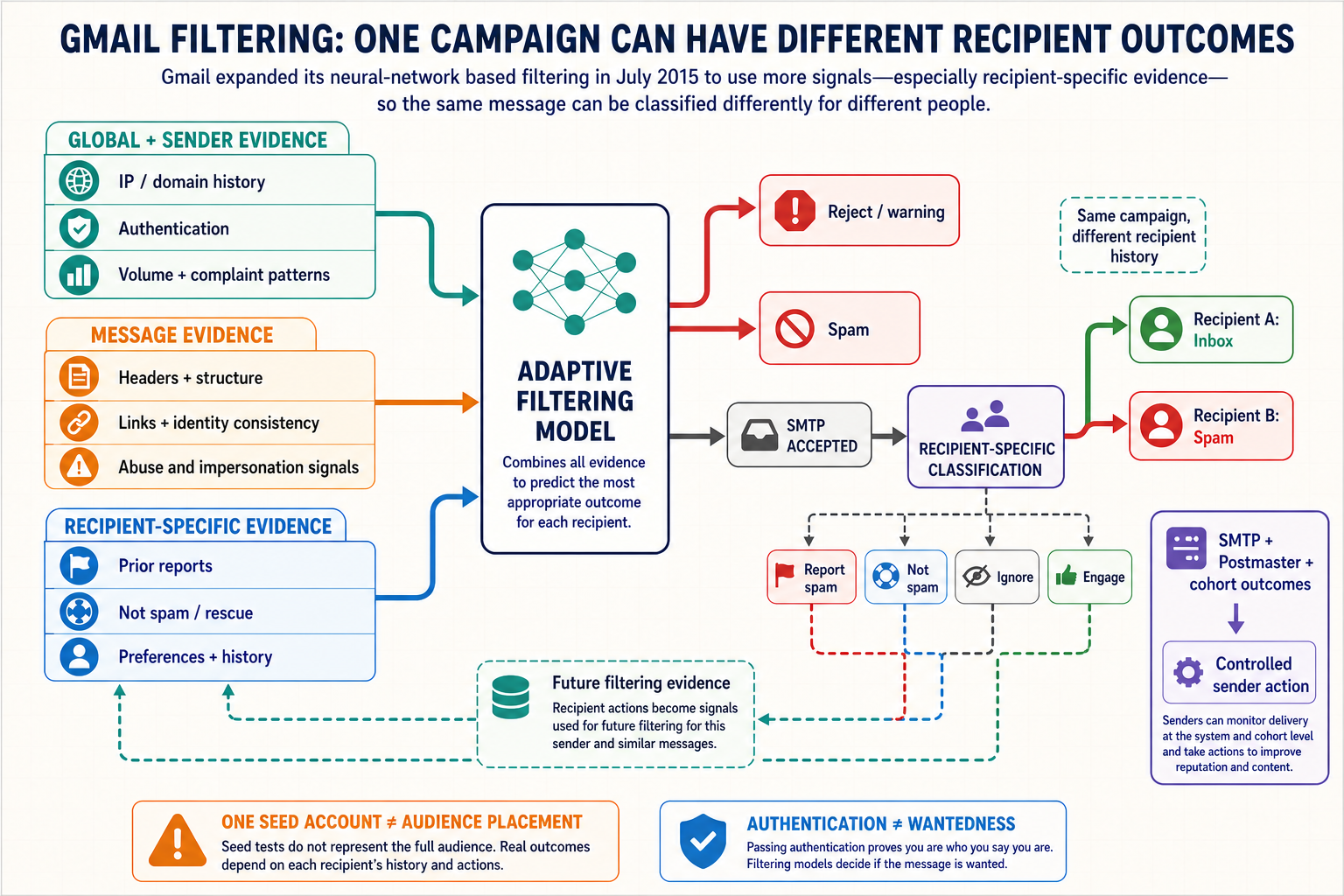
On July 9, 2015, Google announced an artificial neural network designed to catch deceptive spam that could resemble wanted mail, more personalized filtering based on individual preferences, and improved impersonation detection. Machine learning had already supported Gmail filtering, so this was an expansion rather than its first appearance. For senders, the lasting change was operational: the same campaign could produce different outcomes across recipients, and a single seed mailbox or one content edit could not explain a population-level delivery result.
The dated mailbox-provider change
| Event field | Verified value | Why it matters |
|---|---|---|
| Historical event date | July 9, 2015 | This is the provider-change date, not the NitWings publication date. |
| Mailbox provider | Gmail | The affected provider estate determines which recipient cohorts require separate evidence. |
| Change area | Spam filtering | This identifies whether the change altered authentication, filtering, visibility, measurement or sender operations. |
| Current status | active-and-continuously-evolved | Historical instructions are interpreted against the feature or standard that exists now. |
Gmail had used machine learning and recipient feedback before 2015. The launch announcement described new capabilities and a broader application of intelligence developed for other Google products. It specifically linked user actions such as Report spam and Not spam with future filtering, while recognizing that one person might welcome a newsletter another person dislikes.
The announcement also introduced Postmaster Tools, giving qualified high-volume senders aggregated evidence about delivery errors, spam reports and reputation. These changes belonged together: filtering was becoming more adaptive and individual, while senders gained better provider-level diagnostics.
Neural-network language attracted simplistic interpretations. Some teams looked for a hidden list of words, HTML patterns or sending times that would “beat the AI.” Google did not publish such a deterministic recipe. A model trained across abuse patterns, identity evidence, message features and recipient feedback cannot be diagnosed safely through one cosmetic change.
The date is a provider milestone, not a claim that Gmail’s current systems are identical to the 2015 implementation. Google has continued to evolve machine-learning, phishing, malware, authentication and sender-requirement controls. Current operations should preserve the enduring lessons without pretending that a historic model architecture is a current public specification.
How the system worked before the change
Before this announced expansion, Gmail already used rules, machine learning, reputation, authentication and user feedback. The practical sender model often remained provider-wide: teams asked whether “Gmail” liked a sender, and seed tests frequently treated a small controlled panel as if it represented all recipients.
Content testing sometimes relied on keyword removal. If a message landed in spam, teams changed phrases, image-to-text ratio or HTML and sent again. That could occasionally correlate with an outcome, but it rarely isolated identity, audience, prior engagement, complaint history, volume, infrastructure or the recipient’s own preferences.
Impersonation was also difficult to reduce to content. A message could look visually convincing while failing authentication or using a newly observed identity. Conversely, legitimate mail could contain patterns common in abuse. A receiving system needed to combine signals and estimate risk rather than depend on one static rule.
User-level variance existed before July 2015. The announcement made personalization more explicit and operationally important. A recipient who repeatedly rescued or engaged with a stream could present different evidence from a recipient who ignored or reported the same stream. That meant a population could not be represented by one mailbox state.
What changed on the provider side
Google described three related improvements. First, an artificial neural network targeted especially deceptive spam that could pass as wanted mail. Second, filtering reflected individual preferences more effectively. Third, new machine-learning signals improved detection of whether a message actually came from its claimed sender, addressing impersonation and phishing.
The change added no public sender command to request a score, no published model feature list and no guaranteed route to inbox. SMTP acceptance remained different from spam classification. Authentication supported identity evaluation but did not certify that content was wanted. Recipient feedback influenced the ecosystem but did not create an individual deterministic rule a sender could query.
Personalization increased the importance of distributional analysis. A campaign might be accepted for nearly every Gmail recipient while inbox and spam outcomes varied with recipient history. Complaints could increase within one acquisition cohort even when another cohort remained healthy. A single global average could hide both conditions.
Impersonation detection also linked deliverability with identity governance. Stable aligned domains, DKIM, SPF, DMARC, consistent visible From and controlled vendor access reduced ambiguity. Those practices did not guarantee inbox placement, but they supplied coherent identity evidence and limited abuse paths.
Message path before and after
Before
Sender, IP and message features
        |
        v
Rules + existing machine learning + reputation
        |
        +----> Spam or abuse handling
        |
        v
Inbox presentation
        |
        v
Recipient reports spam, rescues or engages
After
Global abuse patterns + identity + message evidence
                         |
Recipient-specific history and preferences
                         |
                         v
         Adaptive machine-learning evaluation
                         |
          +--------------+--------------+
          |                             |
   Spam or warning             Accepted inbox path
                                        |
                                        v
                       Recipient reports, rescues, ignores or engages
                                        |
                                        v
                              Future filtering evidence
Who and what the change affected
| Traffic or stakeholder | What changed | Required interpretation |
|---|---|---|
| Deceptive spam and phishing | Neural-network and impersonation signals targeted messages that resembled wanted mail. | Do not diagnose security filtering as a keyword-only problem. |
| Legitimate bulk senders | Outcomes could reflect provider-wide and recipient-specific evidence. | Analyze Gmail by stream, acquisition, recency and recipient state. |
| Seed-testing programs | One mailbox became even less representative of audience distribution. | Use seeds for controlled observations, never as a population percentage. |
| Identity and authentication teams | Impersonation evidence became more integrated with classification. | Maintain stable aligned domains, secure keys and vendor governance. |
| Content and lifecycle teams | Recipient preference and history affected wantedness. | Improve consent, expectation, frequency and relevance instead of imitating personal mail. |
| Incident responders | A single content or IP hypothesis could miss cohort-level root cause. | Join Postmaster, SMTP, header, complaint and business evidence. |
Effect on delivery, placement and recipient visibility
The most visible deliverability implication was variance. Two recipients could receive the same authenticated message through the same sending route and see different classification because their histories and preferences differed. This did not make infrastructure irrelevant. Shared IP, domain, authentication and campaign signals still influenced many recipients, but the outcome was not necessarily uniform.
SMTP logs could show acceptance without revealing spam placement. Postmaster Tools could show aggregated Gmail spam and delivery signals without identifying each recipient. Seed tests could show controlled account outcomes without representing the audience. Operations needed to understand what each evidence layer could and could not establish.
Trying to reverse-engineer the model through word replacement created risk. A content change also changed meaning, recipient response and campaign timing. If the sender simultaneously changed IP, subject, template and audience, a better result did not identify which factor mattered. Worse, language designed to disguise commercial purpose could increase complaints and trust problems.
Personalized filtering strengthened the case for consent and expectation. Recipients who knowingly requested a stream, recognized its identity and found it useful were less likely to report it as spam. That relationship did not make opens a model feature that senders should manipulate. It made recipient value and negative feedback durable operational controls.
Current Gmail requirements add explicit authentication, unsubscribe and spam-rate obligations for applicable senders. Those rules coexist with adaptive filtering. Meeting a requirement prevents certain compliance failures, but it does not disable Gmail’s abuse, reputation, content or recipient-specific decisions.
Effect on measurement and diagnosis
Averages can conceal polarization. Suppose overall Gmail clicks are stable while new-acquisition complaints rise and long-term subscribers improve. A provider-wide mean can suggest no change even though one cohort is damaging future reputation. Report by stream, source, consent evidence, recipient tenure, recent activity and frequency exposure.
Seed accounts answer narrow questions: whether a specific build reached a specific controlled mailbox under its existing history and settings. Seeds do not reproduce the recipient population, and “ten seeds in inbox” is not a 100 percent inbox-placement estimate. Their strongest use is detecting gross technical differences and retaining reproducible examples.
Open data should not be treated as proof of human attention or filtering preference. Image proxying, privacy features, caching and client behavior affect the signal. Clicks, replies, conversions, complaints, unsubscribes and explicit preference changes provide different evidence, and each has its own bias.
Postmaster spam rate needs its documented denominator and privacy limits. A low displayed rate can coexist with substantial spam placement because messages already filtered to spam are less available to generate an inbox complaint. Pair the trend with delivery errors, Feedback-ID cohorts and controlled placement observations.
Experiments should isolate one meaningful decision and retain a no-change control. Random assignment, mature outcome windows and negative-signal guardrails matter. Repeatedly editing until one seed lands differently is not an experiment and invites false conclusions from model and recipient variance.
Advantages for email marketers
| Potential advantage | When the advantage is real | Evidence to verify |
|---|---|---|
| Better detection of sophisticated abuse | Models generalize beyond simple static rules. | Reduced malicious exposure without relying on one feature claim. |
| More recipient-relevant filtering | Individual feedback and history provide useful preference evidence. | Cohort outcomes and explicit recipient actions over time. |
| Less incentive for keyword folklore | Teams accept multi-signal and personalized classification. | Controlled tests tied to recipient and business outcomes. |
| Stronger identity discipline | Authentication and impersonation controls are consistently governed. | Aligned SPF or DKIM, DMARC and stable visible identities. |
| More useful sender diagnostics | Postmaster aggregates are combined with internal logs. | Corroborated provider, message and cohort evidence. |
Disadvantages and operational risks
| Cost or risk | How it appears | Control |
|---|---|---|
| Outcome variance is misread as randomness | Different recipients receive different classifications. | Segment by recipient state and retain repeated evidence before acting. |
| Seed overconfidence | A small panel is reported as audience placement. | Label seeds as controlled observations and avoid percentage extrapolation. |
| Model-gaming changes | Teams disguise commercial purpose or churn content without evidence. | Keep identity and purpose truthful; run controlled tests. |
| One global metric hides a harmful cohort | Good established-recipient behavior offsets poor new-source complaints. | Monitor acquisition, tenure, stream and frequency cohorts separately. |
| Authentication is treated as a placement certificate | DMARC passes but mail is unwanted or filtered. | Continue consent, reputation, complaint and value controls. |
| Automated reaction amplifies damage | A noisy signal triggers domain or IP rotation. | Require corroboration, limits, observation windows and rollback. |
What email teams needed to do at the time
- Stop relying on one seed mailbox. Retain controlled accounts for examples but do not extrapolate a placement percentage.
- Create Gmail-specific cohorts. Separate acquisition source, stream, recipient tenure, recent activity and frequency.
- Stabilize identity. Use aligned authentication and consistent From domains so experiments do not mix authorization changes.
- Deploy Postmaster Tools. Use provider-level spam, delivery and reputation evidence with its privacy and delay limits.
- Preserve SMTP and header data. Separate acceptance, authentication and classification hypotheses.
- Measure negative feedback. Complaints and unsubscribes can reveal unwantedness hidden by an average engagement rate.
- Run controlled experiments. Change one meaningful factor with random assignment and a mature outcome window.
- Review impersonation exposure. Inventory vendors, signing domains, lookalike risk and unauthorized From use.
What email teams should do now
- Meet current Gmail sender requirements. Maintain authentication, valid DNS, TLS, low spam rates and required unsubscribe behavior.
- Use Postmaster Tools v2. Correlate compliance, spam, Feedback Loop, authentication and delivery errors with internal data.
- Model recipient state before sending. Enforce consent, suppression, preferences, frequency and lifecycle eligibility in the queue.
- Separate stream purpose. Diagnose promotional, transactional, support and security mail independently.
- Prefer stable identity over rotation. Domain or IP churn removes history and can resemble abuse.
- Use explicit holdouts. Measure incremental business effect and complaint guardrails, not only opens.
- Treat opens cautiously. Use clicks, conversion, replies and negative feedback with clear definitions.
- Investigate distributions. Look for harmed cohorts even when a global average appears healthy.
- Document inference. Gmail does not expose a recipient-level model score, so distinguish observed fact from hypothesis.
- Retain safe no-action decisions. Do not change infrastructure when evidence points to normal personalization or an unrelated business issue.
Worked deliverability scenario
A newsletter lands in inbox for four employee seeds but a customer-support sample shows several recipients finding it in spam. The sender concludes Gmail is inconsistent and proposes rotating the From domain. SMTP acceptance, DKIM and DMARC remain stable, and Postmaster delivery errors show no material change.
The team rebuilds the analysis by acquisition source and recipient tenure. Long-term subscribers have low complaints and stable clicks. A recently imported partner audience has weak consent evidence, high frequency from overlapping programs and a disproportionate Feedback-ID spam rate. The seed accounts belong to employees who regularly open and rescue company mail, so their history is not representative.
Operations suppress the questionable partner source, reconcile permission records and introduce global frequency arbitration. The established newsletter identity and infrastructure stay unchanged. A holdout measures incremental conversion among eligible subscribers, while complaints and unsubscribes serve as guardrails.
Gmail outcomes improve for the affected cohort over an appropriate observation window. The team does not claim it “trained the neural network” through a trick. It removed unwanted traffic and restored audience expectations, actions that remain useful even as Google’s models evolve.
Evidence and diagnostics
- Transport evidence: SMTP response, enhanced status, route, IP, queue timing and retries.
- Identity evidence: visible From, SPF, DKIM, DMARC, selectors and delivered Authentication-Results.
- Provider evidence: Postmaster spam rate, Feedback-ID, authentication and delivery-error trends with UTC windows.
- Recipient-state evidence: consent source, tenure, recent engagement, prior complaints, preferences and frequency exposure.
- Stream evidence: transactional, lifecycle, promotional or support purpose and responsible owner.
- Controlled observations: seed history, settings, exact build and timestamp without population extrapolation.
- Experiment evidence: hypothesis, random assignment, control, outcome window, guardrails and stopping rule.
- Business evidence: qualified clicks, conversion, revenue, replies, complaints, unsubscribes and retention.
Failure modes and incorrect conclusions
- Calling 2015 the first use of machine learning. Google said machine learning had helped Gmail filtering from the beginning.
- Assuming one message has one Gmail-wide outcome. Recipient history and preferences can produce different results.
- Using seed results as population percentages. Controlled accounts do not reproduce subscriber histories.
- Changing keywords until a seed moves. Repeated uncontrolled testing cannot isolate the cause.
- Rotating domains to escape a model. Churn removes trust history and leaves audience defects unresolved.
- Equating authentication with wantedness. Valid identity does not create permission or value.
- Treating the model as the only filter. Gmail also uses policy, reputation, security and current sender requirements.
Current status and superseding changes
The July 2015 neural-network announcement remains a historical milestone, while Gmail’s actual filtering systems have continued to evolve. Google’s later statements describe AI-powered defenses against spam, phishing and malware at very large scale. The provider does not publish a static feature recipe or recipient-level sender score that marketers can optimize directly.
Personalization remains operationally important. Recipient feedback, preferences and behavior can make outcomes differ even when messages share the same route and content. Provider-wide reputation and policy also matter, so the correct model is layered rather than purely personal or purely global.
Postmaster Tools v2 supplies current aggregated sender diagnostics, and Gmail’s sender requirements add explicit authentication, spam-rate and unsubscribe obligations for applicable traffic. Those controls make identity and program hygiene observable, but they do not disable adaptive filtering.
The durable response is not model gaming. It is controlled identity, permission, list quality, appropriate frequency, accurate purpose, useful content, low negative feedback and evidence-based incident response. These controls are technically sound even when the internal model changes.
Operator checklist
- Record July 9, 2015 as the announced expansion date.
- Do not call the event Gmail’s first use of machine learning.
- Separate SMTP acceptance from spam classification.
- Treat seed accounts as controlled observations only.
- Segment Gmail outcomes by recipient state and stream.
- Use stable aligned identity before testing content.
- Correlate Postmaster data with SMTP logs and headers.
- Measure complaints and unsubscribes as guardrails.
- Run randomized controlled tests with mature windows.
- Avoid keyword tricks, deceptive presentation and domain rotation.
- Label unsupported model explanations as inference.
- Retain a no-action outcome when evidence does not support change.
Primary and contemporaneous references
- Google: The mail you want, not the spam you don’t: Primary July 9, 2015 announcement.
- Google: How machine learning in G Suite helps: Google history of rules and machine-learning evolution.
- Google: New Gmail protections for a safer inbox: Current AI-defense and sender-requirement context.
- Google: Postmaster Tools dashboards: Current provider evidence definitions and limitations.