Gmail Postmaster Tools Launched in 2015: New Evidence for High-Volume Senders
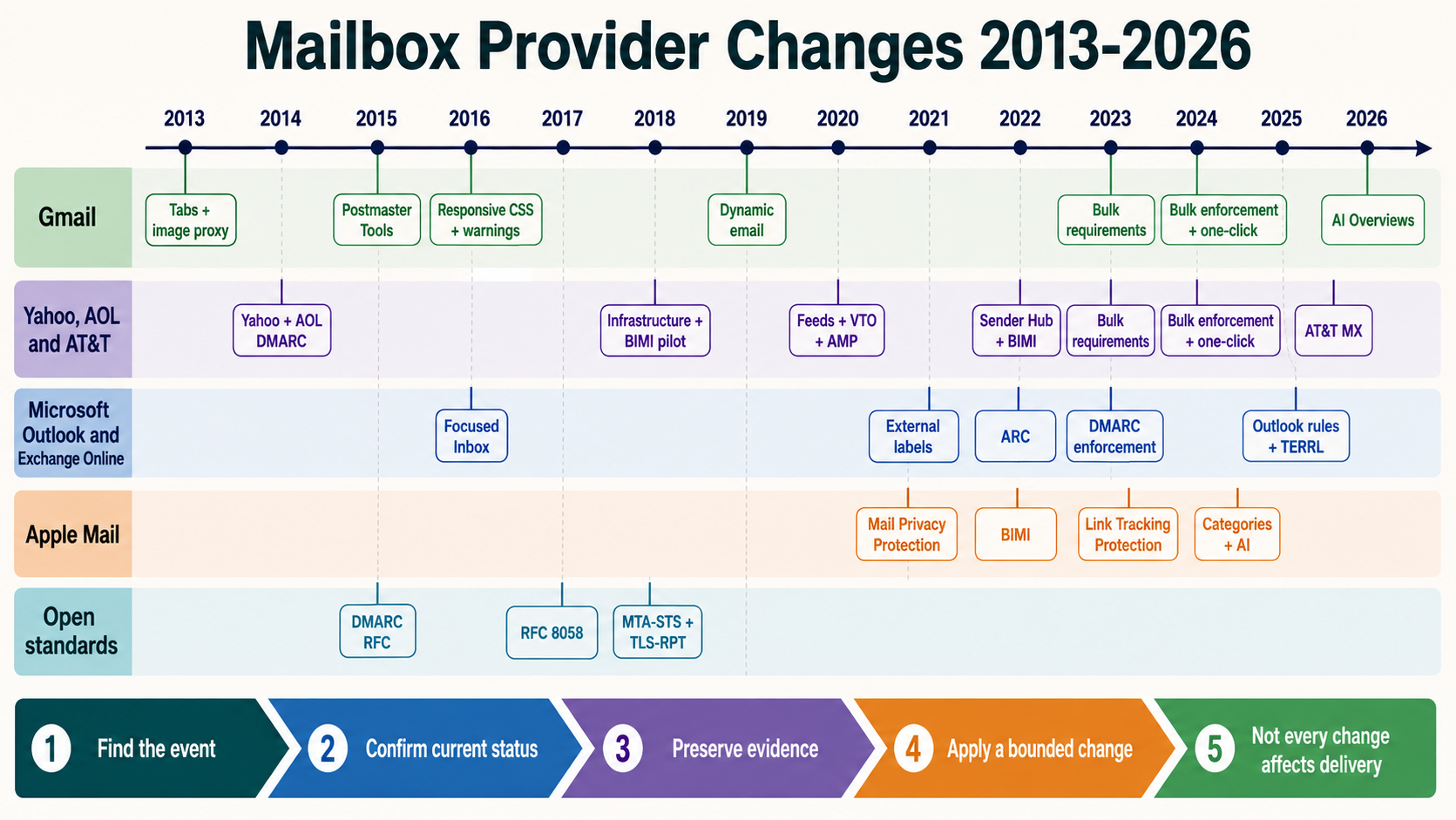
On July 9, 2015, Google launched Gmail Postmaster Tools for qualified high-volume senders. It gave operators provider-supplied evidence about Gmail traffic, including delivery errors, spam reports and reputation. That changed incident response because teams no longer had to infer every Gmail problem from ESP logs, seed accounts or campaign engagement. The tool remains active, but its interface and API have evolved: Postmaster Tools v2 launched in 2024, the v2 API is available, and v1 integrations need a controlled migration rather than new development.
The dated mailbox-provider change
| Event field | Verified value | Why it matters |
|---|---|---|
| Historical event date | July 9, 2015 | This is the provider-change date, not the NitWings publication date. |
| Mailbox provider | Gmail | The affected provider estate determines which recipient cohorts require separate evidence. |
| Change area | Sender tooling | This identifies whether the change altered authentication, filtering, visibility, measurement or sender operations. |
| Current status | active-and-migrating-to-v2 | Historical instructions are interpreted against the feature or standard that exists now. |
Before the launch, Gmail delivered very limited direct diagnostic data to senders. SMTP responses described acceptance, temporary failure or rejection at a particular attempt, but they did not provide a domain-level view of recipient spam reports, authentication rates, encrypted transport or reputation. Marketers often interpreted open-rate changes as a Gmail filtering signal even when the evidence could not separate tracking behavior, audience response and placement.
Google announced Postmaster Tools in the same July 2015 post that described neural-network filtering, personalized spam decisions and new impersonation signals. That pairing was important. Filtering was becoming more adaptive and recipient-specific, while qualified senders gained aggregated evidence for understanding their traffic.
The original service included dashboards for delivery errors, spam reports and reputation. Later versions added authentication, encryption, feedback-loop and compliance views. Current documentation distinguishes personal Gmail accounts from managed Google Workspace destinations and applies privacy thresholds that can leave low-volume days without data.
The current transition needs precise wording. Google says the old web interface will eventually be retired, but it postponed the deprecation schedule and has not supplied a final replacement date in the cited notice. The v1 API is scheduled for retirement after the v2 API launch. New integrations should use v2, while existing v1 users should track Google’s migration notice and validate schema differences.
How the system worked before the change
A sender could inspect its own MTA logs, ESP events, authentication records and sampled received headers. Those sources answered what the sending system attempted and what a receiving MX returned. They did not expose Gmail’s aggregated view of user-reported spam, provider reputation categories or the proportion of authenticated traffic encountering particular delivery errors.
Seed accounts were frequently used as a substitute. A controlled mailbox could show whether one message appeared in inbox, spam or a category, but it did not represent the sender’s entire recipient population. Gmail filtering already used user feedback and personalization, so a few seeds could not establish a population placement percentage.
Campaign engagement was also an unreliable diagnostic proxy. Opens depended on image loading and tracking, clicks depended on content and audience behavior, and accepted mail could still be filtered. A sender could see weak engagement without a transport failure or strong engagement while a smaller cohort experienced serious errors.
Escalation was slower because teams lacked a common Google-supplied dataset. Operations, marketing, ESP and provider-support conversations could begin with different assumptions. A provider dashboard did not eliminate uncertainty, but it created an evidence layer between individual SMTP events and broad business outcomes.
What changed on the provider side
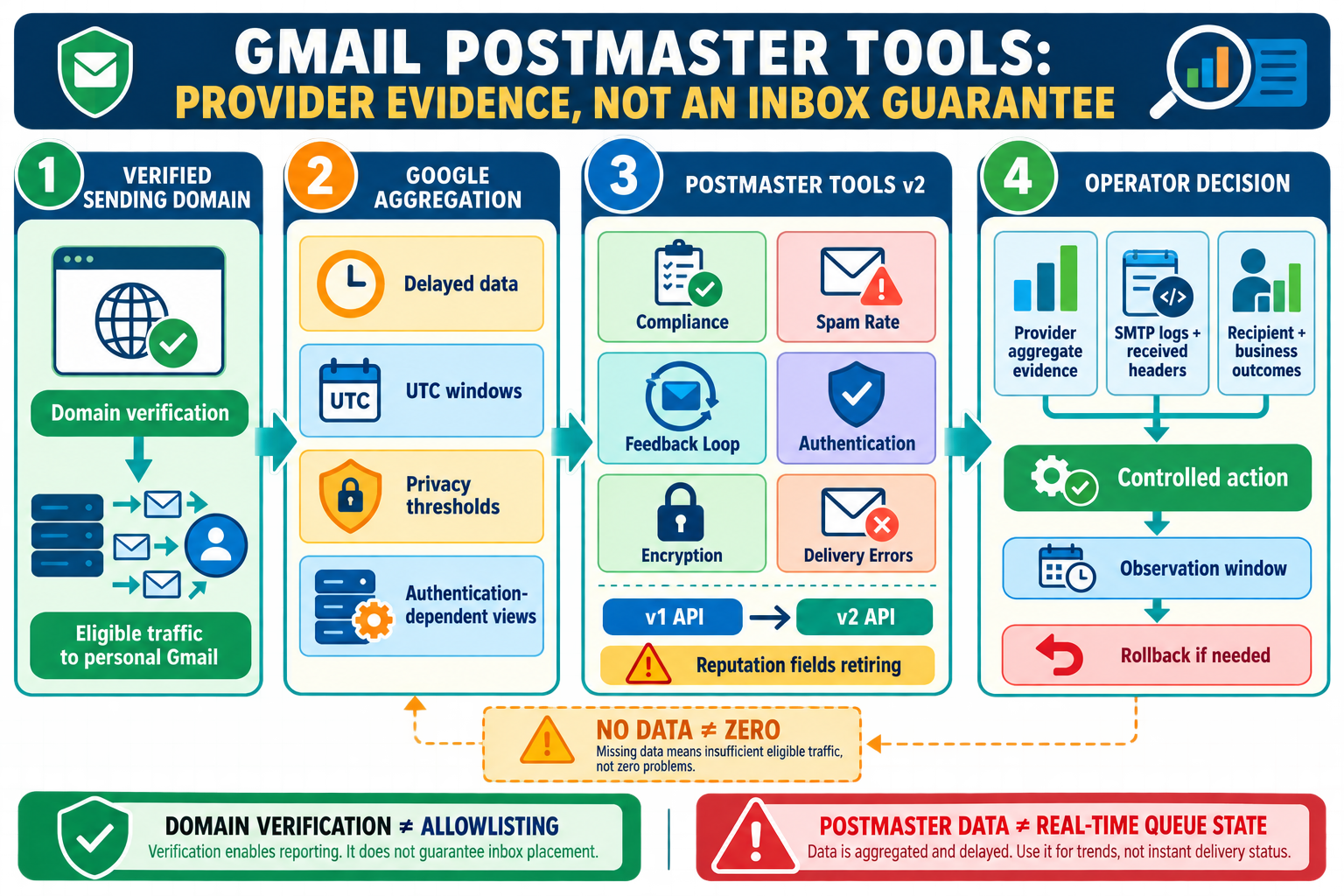
Postmaster Tools introduced domain verification and aggregated dashboards for traffic Google associated with the sender. The service enabled qualified senders to examine spam rate, IP and domain reputation, feedback-loop identifiers, SPF/DKIM/DMARC authentication, TLS encryption and delivery errors. Current v2 also exposes a Compliance status dashboard tied to Gmail sender requirements and a Deliverability analysis diagnostic.
The dashboards have important boundaries. Data applies to mail sent to personal Gmail accounts, not every Google-hosted corporate mailbox. Data is not real time, commonly updates within about 24 hours and can take longer. Privacy protections can hide low-volume data. Some views depend on DKIM authentication, and forwarded traffic can affect datasets even though Google attempts to exclude it.
Postmaster spam rate is not “complaints divided by all accepted messages.” Current Google documentation describes it as messages delivered to engaged recipients’ inboxes and then marked as spam, with messages rescued from spam contributing to the inbox side. If Gmail already sends substantial traffic to spam, the displayed rate can look deceptively low because fewer messages remain available for an inbox complaint.
The v2 transition changes automation. The v2 API provides domain management, verification, compliance status, domain-stat queries, batch queries and user-access operations. Google says v2 covers v1 functionality except Domain and IP reputation, which are being retired and replaced by more actionable approaches. A migration must therefore redesign dependencies on those reputation fields rather than only changing an endpoint URL.
Message path before and after
Before
Sender systems
    |
    +----> MTA or ESP SMTP logs
    +----> Authentication and DNS checks
    +----> Seed mailbox observations
    +----> Opens, clicks and complaints
    |
    v
Operator infers Gmail condition
without a provider-level aggregated dataset
After
Verified sending domain + eligible Gmail traffic
    |
    v
Google aggregation and privacy controls
    |
    +----> Compliance and authentication
    +----> Spam rate and Feedback-ID cohorts
    +----> Delivery errors and TLS
    +----> Reputation views during transition
    |
    v
Correlate with SMTP logs, headers and business cohorts
    |
    v
Controlled action, observation window and rollback
Who and what the change affected
| Traffic or stakeholder | What changed | Required interpretation |
|---|---|---|
| High-volume senders to personal Gmail | They gained provider-supplied aggregated diagnostics. | Verify domains and interpret missing data through volume and privacy limits. |
| Deliverability operations | Gmail evidence could be joined with SMTP and authentication data. | Use dashboard time windows and exact metric definitions before declaring root cause. |
| Marketing teams | Complaint and delivery signals became easier to correlate with campaigns. | Keep content, audience and commercial outcomes separate from provider telemetry. |
| ESP platforms | Customer domains and campaign Feedback-ID values could support diagnosis. | Expose aligned signing, stable identifiers and logs that customers can reconcile. |
| Low-volume programs | Privacy thresholds could produce missing or incomplete dashboards. | Use message-level logs and longer windows; do not interpret no data as healthy data. |
| API users | v2 introduces a new schema and endpoints while v1 retires. | Inventory dependencies, dual-run where possible and validate metric continuity. |
Effect on delivery, placement and recipient visibility
The launch improved diagnosis rather than granting delivery. Registering a domain did not whitelist it, raise reputation or force messages into the inbox. Google supplied evidence about mail it observed; the sender still had to correct permission, authentication, infrastructure, frequency or content problems.
Delivery Errors provided provider-side failure proportions and reasons for authenticated traffic. Those data could reveal a Gmail-specific rise not visible in normalized ESP categories. Operators still needed raw SMTP replies, queue timing and route details to understand affected IPs, retry behavior and individual recipients.
Spam Rate provided direct recipient-negative feedback within Google’s documented denominator. It was especially useful for trend and cohort analysis, but a low displayed rate could coexist with poor spam placement because filtered messages were less available to generate inbox complaints. The correct conclusion came from combining spam rate with delivery errors, campaign Feedback-ID, internal complaint data and business behavior.
Authentication and Encryption dashboards made configuration drift visible at provider scale. A sudden DKIM decline could identify a regional signer fault, while a TLS decline could reveal a route or relay difference. These signals were percentages over eligible observed traffic, not substitutes for checking a representative header or running DNS and TLS diagnostics.
Compliance status adds a requirements layer for current operations. It summarizes authentication, DNS, format, encryption, spam and applicable bulk-sender requirements such as DMARC and one-click unsubscribe. Status can lag and may be calculated across a primary domain using subdomain traffic, so teams must preserve their own stream-level controls.
Effect on measurement and diagnosis
Every dashboard needs a data contract. Record the selected domain, view, time zone, date window, metric definition and extraction time. Postmaster Tools uses UTC, data is delayed, and compliance can use rolling evaluation that takes days to reflect a correction. Comparing it with a local calendar-day dashboard without normalization creates false discrepancies.
Missing data has several possible explanations: insufficient eligible volume, privacy thresholds, failed or absent authentication, the wrong selected domain, a delayed update or a true absence of traffic. “No data found” is not the same as zero failures, zero complaints or full compliance.
Domain and subdomain behavior varies by dashboard. Current compliance status applies at the primary-domain level and can use subdomain traffic, while other dashboards can provide subdomain-specific views. Teams should document which identity a chart represents before mapping it to an internal stream.
Feedback Loop analysis depends on stable `Feedback-ID` headers. Too many unique identifiers can make cohorts unusable, while reused identifiers can mix unrelated programs. The ID should represent an actionable campaign or stream dimension without including personal information.
API migration requires parallel validation. Query the same supported date range in v1 and v2 where possible, compare domain registration and user access, account for schema differences and document fields that have no v2 replacement. Reputation automation needs a new decision model because Google says v2 excludes the retiring Domain and IP Reputation data.
Advantages for email marketers
| Potential advantage | When the advantage is real | Evidence to verify |
|---|---|---|
| Provider-supplied Gmail evidence | The verified domain has eligible traffic above privacy limits. | Dashboard trend reconciled with SMTP logs and authenticated headers. |
| Faster authentication incident detection | Traffic is consistently signed and dashboards have sufficient coverage. | Authentication percentage by identity plus signer-level internal telemetry. |
| Campaign complaint diagnosis | Feedback-ID values are stable and meaningful. | FBL spam rate by actionable campaign group. |
| Current sender-requirement visibility | Compliance status has enough data and evaluation time. | Requirement state joined with direct DNS, header and unsubscribe tests. |
| Programmatic monitoring | v2 API access, quotas and schema are governed. | Validated queries, alert thresholds, missing-data state and audit logs. |
Disadvantages and operational risks
| Cost or risk | How it appears | Control |
|---|---|---|
| Dashboard treated as real time | A correction is judged before Google’s delayed data updates. | Use documented lag, incident timestamps and a planned observation window. |
| No data treated as zero | Privacy or volume thresholds hide a problem. | Model missing, zero and unavailable as distinct states. |
| Spam rate denominator misunderstood | A low rate is called proof of good inbox placement. | Use Google’s definition and compare placement evidence separately. |
| Reputation category drives automatic routing | A coarse, delayed signal triggers unsafe volume or IP changes. | Require multiple direct signals, limits and human approval for material action. |
| v1 retirement breaks monitoring | Scripts depend on an API or fields scheduled for removal. | Migrate to v2, test schemas and redesign reputation dependencies. |
| Personal Gmail data generalized to Workspace | Consumer-domain evidence is applied to managed tenant destinations. | Keep receiving-estate cohorts and direct SMTP evidence separate. |
What email teams needed to do at the time
- Register the exact sending domains. Complete DNS verification and document the account that owns access.
- Baseline dashboard data. Capture spam, reputation, authentication, TLS and delivery-error history before using alerts.
- Normalize time. Align Postmaster UTC dates with internal MTA, ESP and campaign windows.
- Implement Feedback-ID. Use stable, non-personal identifiers that map complaints to an actionable campaign group.
- Preserve raw SMTP evidence. Keep remote responses and queue metadata because dashboard aggregates cannot diagnose one message.
- Separate no data from zero. Create an explicit unavailable state in reports and incident logic.
- Connect business cohorts. Compare provider telemetry with purpose, permission, volume and recipient behavior.
- Restrict dashboard access. Use accountable domain ownership and share access only with authorized operators.
What email teams should do now
- Use Postmaster Tools v2 for new work. Do not build a new dependency on the retiring v1 API or old interface.
- Inventory every v1 integration. Record endpoints, schemas, stored fields, alerts and downstream decisions.
- Redesign reputation dependencies. Google says Domain and IP Reputation are excluded from v2 and scheduled for retirement.
- Use Compliance status with direct tests. Verify DNS, headers, message format and one-click unsubscribe independently.
- Respect dashboard lag and privacy. Model missing data, UTC windows and delayed correction explicitly.
- Query v2 securely. Protect OAuth credentials, control domain users, handle quotas and log access.
- Correlate three evidence layers. Join provider aggregates with message-level SMTP or header evidence and recipient or business outcomes.
- Keep Feedback-ID actionable. Review identifier cardinality and ownership after campaign architecture changes.
- Retain rollback for automated actions. Dashboard movements should not directly rotate domains, halt critical mail or change pools without controls.
- Track Google’s deprecation notice. The old web-interface date is postponed, so use the official notice rather than inventing a shutdown date.
Worked deliverability scenario
A sender sees Gmail revenue fall and an executive claims Gmail reputation has collapsed. MTA acceptance is stable, Postmaster Tools shows no data for two recent days, and a seed campaign lands in Promotions. The team initially plans to move traffic to a new IP.
Operators confirm that the no-data period follows a DKIM deployment fault on one region. Because several dashboards depend on authenticated traffic and privacy eligibility, absence cannot be interpreted as a healthy zero. Raw headers show the region signing with an unintended domain, while other regions remain aligned.
The team repairs the signer, keeps traffic on the established IPs and waits through the documented dashboard lag. It separates Promotions category observations from spam placement and analyzes business cohorts. The largest revenue decline belongs to an exhausted offer segment, while the authentication defect affected a smaller transactional route.
The incident closes with two different corrections: DKIM change control for the regional route and frequency suppression for the marketing segment. The team also migrates its API extraction to v2 and removes an automated rule that treated a missing reputation value as “bad.” Postmaster evidence helped because it was interpreted with logs and recipient context, not used as a single verdict.
Evidence and diagnostics
- Domain registration: selected domain, DNS verification state, owner and delegated users.
- Time contract: UTC date range, extraction timestamp, expected update lag and internal comparison window.
- Traffic eligibility: personal Gmail destinations, volume, DKIM or SPF authentication and privacy-threshold state.
- Spam evidence: dashboard definition, Feedback-ID cohort, internal complaints and possible spam-placement denominator effect.
- Authentication evidence: Postmaster percentages plus representative SPF, DKIM and DMARC results from received headers.
- Delivery evidence: dashboard error category plus exact SMTP response, enhanced status, route, IP and retry history.
- Compliance evidence: displayed state, primary-domain scope, subdomain contribution and direct configuration test.
- API evidence: version, discovery document, query parameters, response schema, quota and missing-field handling.
- Outcome evidence: clicks, conversions, complaints, unsubscribes and support contacts by Gmail stream.
Failure modes and incorrect conclusions
- Calling domain verification an allowlist. Registration grants visibility, not preferential delivery.
- Reading a delayed chart as live queue state. Use SMTP logs for current attempts and Postmaster for aggregated trends.
- Reporting no data as zero complaints. Low volume, privacy filtering or authentication gaps can remove the denominator.
- Using spam rate as inbox-placement percentage. The displayed metric has a specific recipient-report denominator.
- Generalizing personal Gmail results to every Google Workspace tenant. Managed destinations can apply separate policies.
- Building new v1 automation. v1 retirement and v2 schema differences create avoidable rework.
- Automating major changes from one chart. Delayed aggregate evidence needs corroboration and safe approval controls.
Current status and superseding changes
Gmail Postmaster Tools remains active and central to current sender operations. The v2 web interface launched in 2024 and includes a modern dashboard experience and Compliance status. Google’s official deprecation notice says the old web interface will eventually be replaced, but the schedule has been postponed. It is therefore inaccurate to invent a final shutdown date.
The v2 API is available with domain management, verification, compliance, statistics, batch and user-access resources. Google states that the v1 API will retire and that v2 excludes Domain and IP Reputation, whose dashboards are being retired in favor of more actionable diagnostics. Existing integrations need migration and decision-model changes.
Current dashboards cover Compliance status, Spam Rate, IP and Domain Reputation during transition, Feedback Loop, Authentication, Encryption and Delivery Errors. Documentation warns about delayed data, privacy suppression, authentication dependencies, forwarded-message effects and scope limited to personal Gmail accounts.
The durable operating rule is to use Postmaster Tools as provider evidence, not a verdict. A strong incident combines Google’s aggregate view with raw SMTP and header data, a precise receiving-domain cohort and recipient or business outcomes. Registration, compliance and authentication still do not guarantee inbox placement.
Operator checklist
- Record July 9, 2015 as the launch date.
- Verify the correct sending domain and accountable owner.
- Treat Postmaster Tools as diagnostics, not an allowlist.
- Normalize UTC windows and documented dashboard lag.
- Model no data, zero and unavailable separately.
- Interpret spam rate using Google’s current denominator.
- Use Feedback-ID values that map to actionable campaigns.
- Correlate dashboards with raw SMTP responses and headers.
- Keep personal Gmail and Google Workspace evidence separate.
- Migrate API automation to v2 and validate schema changes.
- Redesign dependencies on retiring reputation data.
- Track Google’s official deprecation notice for schedule changes.
Primary and contemporaneous references
- Google: The mail you want, not the spam you don’t: Primary July 9, 2015 launch announcement.
- Google: Postmaster Tools dashboards: Current dashboard definitions, scope and data limitations.
- Google: Old Postmaster Tools interface deprecation: Current v1 and v2 transition status.
- Google Developers: Postmaster Tools API v2: Current REST resources and service endpoint.
- Google: Sender requirements and Postmaster FAQ: Current compliance and diagnostic use guidance.