Gmail Promotions Annotations in 2018: Inbox-Level Offer Presentation
In December 2018, Gmail expanded the Promotions tab with email annotations that could surface structured offer information before a recipient opened the message. Eligible promotional email could provide an image, deal description, discount code and expiration date for Gmail to consider when constructing a richer inbox presentation. This was a presentation change, not a new path around filtering. The message still had to authenticate, reach Gmail, be classified, satisfy provider quality controls and remain useful when no annotation appeared.
The dated mailbox-provider change
| Event field | Verified value | Why it matters |
|---|---|---|
| Historical event date | December 2018 | This is the provider-change date, not the NitWings publication date. |
| Mailbox provider | Gmail | The affected provider estate determines which recipient cohorts require separate evidence. |
| Change area | Promotions presentation | This identifies whether the change altered authentication, filtering, visibility, measurement or sender operations. |
| Current status | active-and-expanded-with-current-provider-controlled-annotation-formats | Historical instructions are interpreted against the feature or standard that exists now. |
The Promotions tab had existed since 2013, but a normal row exposed mostly sender, subject, snippet and time. The email body, product image and offer mechanics appeared only after the recipient opened the message. Marketers optimized the subject and preheader because those were the principal inbox-level creative surfaces under sender control.
Structured data offered a different contract. Rather than asking Gmail to infer every commercial detail from arbitrary HTML, a sender could describe selected properties in machine-readable form. Gmail could then decide whether, where and how to render those properties. The sender supplied claims; the provider retained presentation policy.
Contemporaneous December 2018 coverage described annotations for images, offers, promotional codes and expiration. Google’s current developer documentation retains this model and supports structured markup such as JSON-LD or Microdata. Current experiences also include product and deal cards, depending on account, client, message quality and provider experimentation.
The exact public launch day is not established by the primary record used for this series. The article therefore records December 2018 rather than manufacturing day-level precision. That distinction matters in change analysis because staged rollouts, experiments and documentation dates are not necessarily the same event.
How the system worked before the change
Before annotations, Gmail could classify a campaign as promotional and show it in the Promotions tab, but the sender’s offer image, price context, code and expiry lived inside the opened message. Subject lines often carried too much work: product, urgency, discount and brand competed for limited space.
A recipient who did not open could not act on a code or image exposed only in the body. Marketers compared open rate and click rate without an inbox-level promotional interaction between them. The visible row and the rendered email formed a simpler two-stage funnel.
Senders also used brittle tricks to influence snippets, including hidden preheader padding or repetitive symbols. These techniques did not provide typed meaning. A receiver could not reliably distinguish an expiration date from surrounding copy or know whether a code was intended for display.
Classification and creative presentation were frequently conflated. Teams treated the Promotions tab as a penalty and attempted to disguise commercial content. That interpretation ignored recipient expectation and made program diagnosis weak. Promotional classification, spam filtering, inbox tab placement and rich rendering are related provider decisions but are not one decision.
What changed on the provider side
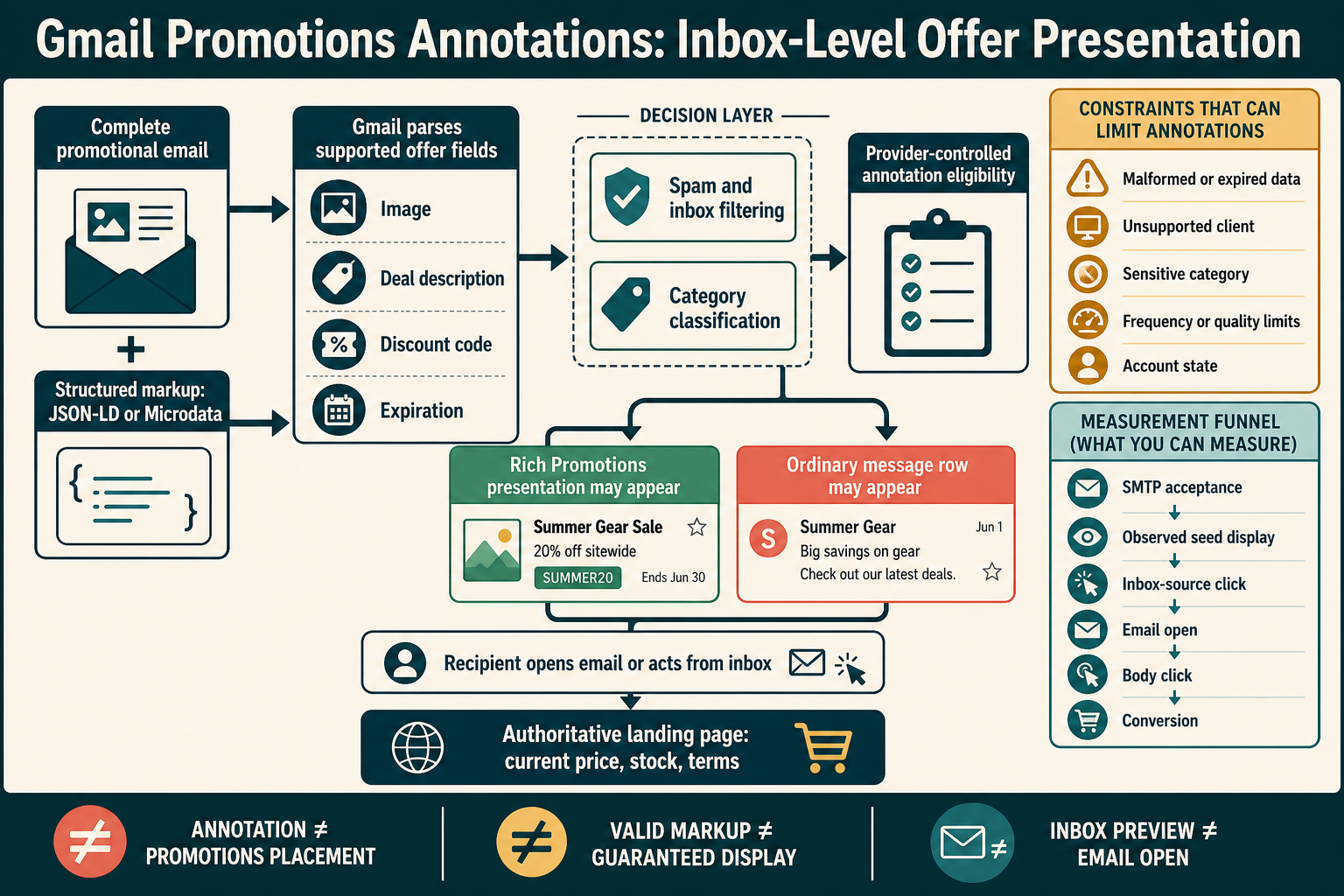
Gmail allowed a sender to place supported structured data in the email so Gmail could extract promotion attributes. The annotation described the offer rather than dictating a pixel-perfect layout. Gmail could display an image, deal badge, code or expiration in an eligible Promotions experience, show only part of the data, or use the normal message row.
The markup did not force a message into Promotions and did not guarantee inbox placement. It also did not guarantee that an eligible message would receive a card. Authentication, sender history, message quality, supported client, user state, frequency controls, competing mail and product experiments could all affect presentation.
An annotation created an action surface before the conventional open. A recipient could see an offer detail or select a card from the inbox. Analytics therefore needed to distinguish inbox presentation, email open, annotation-originated click and conversion. A campaign could gain visits without a conventional tracking-pixel event.
The email remained the fallback. Unsupported clients, missing account eligibility, malformed markup, sensitive categories, expired deals or provider policy could result in ordinary rendering. Critical price, terms, expiry and call to action still belonged in accessible message content and on an authoritative landing page.
Message path before and after
Before
Sender builds subject, preheader and HTML body
    |
    v
Gmail authenticates and filters the message
    |
    v
Gmail classifies inbox category
    |
    v
Recipient sees ordinary sender + subject + snippet row
    |
    +----> opens email to see image, code and expiry
    +----> ignores or deletes message
After
Sender builds complete email + supported structured annotation
    |
    v
Gmail parses markup and validates message context
    |
    +----> filtering and category classification remain separate
    |
    v
Eligible Promotions presentation decision
    |
    +----> rich image, deal, code or expiration may appear
    +----> ordinary message row may appear instead
    |
    v
Recipient may open email or act from inbox surface
    |
    v
Landing page supplies current price, inventory and terms
Who and what the change affected
| Traffic or stakeholder | What changed | Required interpretation |
|---|---|---|
| Promotional senders | Structured deal attributes gained a possible inbox surface. | Treat markup as optional enhancement, not placement control. |
| Recipients | Offer context could appear before the conventional open. | The inbox preview must be accurate and non-deceptive. |
| Creative teams | Image and offer data needed coordination with the email body. | Build one truthful offer with graceful fallback. |
| Analytics teams | An inbox action could bypass pixel-based open evidence. | Preserve action source and use outcome metrics. |
| Developers and ESPs | Email markup required valid supported syntax. | Generate, test and monitor structured data per campaign. |
| Compliance teams | Displayed price, code and expiry became provider-visible claims. | Review terms, geography, consent and expiration. |
Effect on delivery, placement and recipient visibility
Annotations do not repair reputation, authentication or unwanted mail. Gmail can reject, defer or place a message in spam before rich presentation is relevant. A sender with a damaged complaint profile should investigate permission, traffic shape, identity and message quality rather than adding markup and expecting recovery.
The Promotions category is not equivalent to spam. For commercial mail it can be the expected inbox context, and annotations were designed to make that context more useful. Attempts to misclassify promotions as personal correspondence can reduce clarity and create recipient distrust. Optimize wantedness and value, then let the provider apply its category policy.
Markup errors normally affect enhancement rather than core SMTP delivery, but unsafe generation can still damage the message. Broken JSON, improper escaping, duplicated properties or invalid HTML can complicate QA. Generate markup from a typed offer object, escape it correctly and validate the final MIME content after the ESP has transformed it.
Frequency remains relevant because Gmail limits and ranks presentation. Repeating an annotation does not entitle every campaign to a prominent card. Coordinate campaign pressure and rotate only genuinely distinct offers. A sender should not fabricate changing codes, expiry or imagery merely to appear fresh.
Landing-page consistency supports recipient trust. The displayed code must work, the expiry must use the intended time zone, and the linked page must reflect current inventory and terms. A rich preview that overstates the actual offer can produce quick exits, complaints and weaker long-term engagement even when delivery remains technically successful.
Effect on measurement and diagnosis
Start with an exposure model rather than assuming every delivered Gmail message displayed an annotation. The sender typically lacks a complete provider event saying that a particular card was rendered. Use controlled seed accounts, supported-client tests and campaign-level comparisons, and label any inferred exposure explicitly.
Keep four events separate: SMTP acceptance, inbox or category evidence, email open, and link action. An annotation-originated click may occur without the message body loading. Pixel-based open rate can therefore understate the path to action. Add source parameters to distinct supported links where implementation permits, without exposing recipient data.
Compare annotated and non-annotated treatments only when audience, offer, timing and traffic quality are controlled. Provider selection creates bias: messages that receive a rich surface may already differ in quality or recipient context. Randomized campaign design cannot force Gmail display, so analyze intention to treat alongside observed seed rendering.
Validate expiry behavior across UTC and campaign markets. A date without a clear operational cutoff can show a stale offer. Retain the exact annotation payload, compiled MIME, send timestamp, landing-page version and test screenshots so discrepancies can be reproduced.
Business outcomes matter more than card appearance. Track qualified clicks, code redemption, revenue, margin, complaint rate, unsubscribes and repeat engagement. A high click rate caused by ambiguous preview copy can produce low conversion and higher dissatisfaction. The useful question is whether accurate inbox context helped the right recipient complete the intended task.
Advantages for email marketers
| Potential advantage | When the advantage is real | Evidence to verify |
|---|---|---|
| Richer inbox context | Gmail selects accurate supported markup for display. | Controlled client screenshots and current documentation. |
| Faster offer recognition | Image, code and expiry match recipient expectation. | Qualified click and redemption behavior. |
| Reduced subject overload | Subject remains clear while annotation carries typed details. | Subject comprehension and downstream action. |
| Machine-readable offer data | Generation uses validated source-of-truth fields. | Payload-to-landing-page reconciliation. |
| More useful Promotions experience | Commercial mail is wanted and timely. | Retention, complaints and repeat conversion. |
Disadvantages and operational risks
| Cost or risk | How it appears | Control |
|---|---|---|
| Display is assumed | Critical information exists only in annotation. | Make the full email work without enhancement. |
| Markup is treated as placement control | Teams ignore reputation and permission problems. | Diagnose delivery and annotation separately. |
| Expired or inconsistent offer | Inbox preview conflicts with landing page. | Use governed offer data and expiry monitoring. |
| Open reporting is distorted | Inbox action occurs before body load. | Measure clicks and conversions by action source. |
| Unsupported client is ignored | Recipients receive an ordinary row or fallback. | Test broad clients and accessible HTML. |
| Presentation is overoptimized | Misleading urgency increases dissatisfaction. | Apply legal and brand review to preview claims. |
What email teams needed to do at the time
- Identify eligible promotional campaigns. Start with clear offers rather than every message.
- Create a governed offer object. Store image, description, code, expiry and landing page together.
- Add supported markup. Use documented JSON-LD or Microdata syntax.
- Validate compiled MIME. Test the message after ESP transformations.
- Preserve fallback content. Repeat essential terms and action inside the email.
- Test supported Gmail accounts. Record whether and how the annotation appears.
- Separate classification from presentation. Do not promise Promotions placement.
- Annotate analytics definitions. Recognize that action can precede an open event.
What email teams should do now
- Follow current Google developer documentation. Supported fields and surfaces can evolve.
- Use product or deal cards selectively. Match current campaign purpose and eligibility.
- Automate schema validation. Fail the campaign build on malformed required data.
- Monitor landing-page truth. Verify price, code, stock, geography and expiration.
- Test with real supported clients. Preview tools alone cannot guarantee provider selection.
- Keep annotation optional. Accessible body content must carry the complete proposition.
- Measure action source. Distinguish inbox-level clicks from email-body clicks where possible.
- Control total frequency. Rich presentation does not create additional permission.
- Protect recipient data. Do not place plaintext identity in image or action URLs.
- Review experiments honestly. Account for provider selection and missing exposure evidence.
Worked deliverability scenario
A travel sender promotes a two-day fare sale. The email contains a hero image, discount code and expiry, and the team adds matching structured data. Test accounts sometimes show a rich Promotions card, but some recipients see an ordinary row.
The first build uses an expiry interpreted in the sender’s server time zone while the landing page closes in the destination market. A seed account displays the deal after the page has stopped accepting the code. The issue is not a spam decision; it is inconsistent offer governance.
The team creates one offer record with an explicit UTC cutoff, regional eligibility, image version and landing-page release. Both email and annotation compile from that record. A monitor checks the code and page before send, near expiry and after closure. The email includes the terms in live text and remains useful without the card.
Reporting separates delivered Gmail messages, controlled seed display, inbox-source clicks, body clicks, redemptions, complaints and unsubscribes. The richer surface helps qualified recipients act sooner, while the team avoids claiming that every delivered message displayed it or that annotations improved inbox placement.
Evidence and diagnostics
- Offer source: identifier, description, code, price, locale, eligibility and authoritative expiry.
- Markup: syntax type, supported properties, escaping, validation result and generated version.
- MIME evidence: final received source after ESP signing and transformation.
- Rendering evidence: account type, client, version, time, category and screenshot.
- Delivery evidence: SMTP result, authentication, complaint and reputation context kept separate.
- Action evidence: inbox or body source, redirect chain, landing status and conversion.
- Fallback evidence: images-off, unsupported client, accessibility tree and body terms.
- Expiry evidence: time zone, provider display, landing behavior and cache state.
Failure modes and incorrect conclusions
- Claiming annotations force Promotions placement. Classification remains provider-controlled and separate.
- Claiming valid markup guarantees display. Eligibility and presentation remain discretionary.
- Calling an inbox click an email open. The body may never have loaded.
- Removing offer details from the body. Unsupported recipients lose essential information.
- Using a dynamic claim without governance. Preview and landing page drift apart.
- Testing only source HTML. ESP compilation can change or remove markup.
- Inventing an exact launch day. The verified record supports December 2018 precision.
Current status and superseding changes
Google continues to document Promotions tab annotations. Current implementation guidance describes structured data for richer previews and supports deal and product-oriented experiences. The provider can change layouts and eligibility without granting the sender a permanent presentation entitlement.
Current documentation explicitly treats annotation as an enhancement. Gmail performs quality filtering and can limit display based on frequency, supported surface, account context and message suitability. Troubleshooting therefore begins with valid markup and a controlled test but cannot end with a promise that the production recipient saw a card.
Authentication and sender requirements have also advanced since 2018. Bulk senders must meet current Gmail authentication, complaint and unsubscribe expectations independently of annotation. A campaign that fails those requirements cannot use structured offer data as a substitute.
The durable architecture is progressive enhancement. One governed offer feeds accessible email content, optional annotation and an authoritative landing page. Each layer is truthful on its own. Measurement records what can be proven and labels provider-controlled exposure as observed or inferred rather than certain.
Operator checklist
- Record the event as December 2018 without inventing an exact day.
- Use current supported annotation fields and syntax.
- Generate email, annotation and landing page from one governed offer.
- Keep classification, inbox placement and rich presentation separate.
- Validate the final received MIME, not only the template source.
- Test ordinary-row and unsupported-client fallbacks.
- Put price, code, terms and expiry in accessible email content.
- Measure inbox-source actions separately from body opens and clicks.
- Monitor offer validity through the full displayed period.
- Never claim that valid markup guarantees display or delivery.
Primary and contemporaneous references
- Validity: Google introduces email annotations: Contemporaneous December 2018 coverage.
- Google: Promotions tab overview: Current official concept and eligibility guidance.
- Google: Annotate email in the Promotions tab: Current official implementation fields and examples.
- Google: Promotions annotation troubleshooting: Current official display constraints and diagnostics.