ICO Charitable Soft Opt-In: 2026 Email Compliance Guide
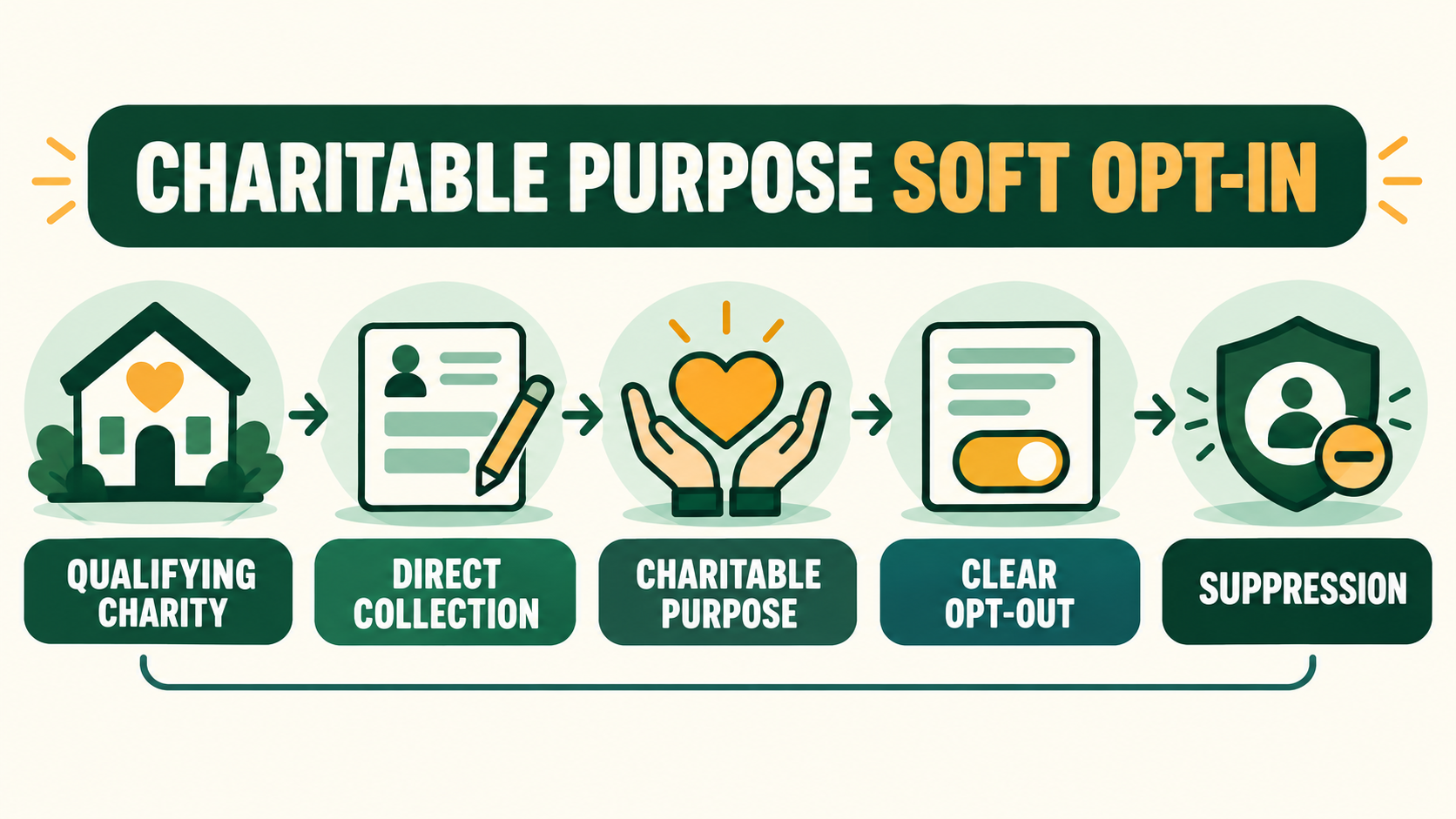
On April 28, 2026, the UK Information Commissioner’s Office updated its electronic-mail marketing guidance for the new charitable purposes soft opt-in. The underlying change to regulation 22 of PECR took effect on February 5, 2026. A qualifying charity can now send some fundraising, volunteering and mission-related electronic marketing without prior consent, but only when every statutory condition is satisfied.
This is a narrow evidence-based route, not permission to email an old supporter database. The charity must have obtained the contact details directly on or after commencement while the person expressed interest in, or offered or provided support for, its charitable purposes. It must have offered a simple upfront refusal, every message must offer another refusal, and the sole purpose of the marketing must be to further that charity’s own charitable purposes. This guide translates those conditions into collection, data, campaign and suppression controls. It is technical guidance, not legal advice.
What changed in 2026
Section 114 of the Data (Use and Access) Act 2025 inserted regulation 22(3A) into the Privacy and Electronic Communications Regulations. The provision commenced on February 5, 2026. On April 28 the ICO updated its detailed guidance with examples covering direct collection, connected organisations, supporter activity, transactional purchases, mixed soft opt-ins and data-protection duties.
Before this change, the familiar soft opt-in was tied to selling or negotiating to sell products or services. That route did not allow a charity to convert an existing supporter relationship into permission for fundraising or campaigning email. The new route addresses charitable purposes specifically; it does not remove the commercial route or lower the standard for consent.
The six conditions must pass together
| Required condition | Operational question | Evidence to retain |
|---|---|---|
| The sender is a qualifying charity | Does the sending legal entity meet the applicable England and Wales, Northern Ireland or Scotland definition used by PECR? | Registered identity, jurisdiction, governing document and the charitable purposes applicable when the details were collected. |
| The charity obtained the details directly | Did the individual provide the address to this charity, rather than to a trading subsidiary, another charity, data broker or independent fundraiser? | Form owner, domain, controller notice, collection-system event and any processor contract. |
| A qualifying interaction occurred | Was the person expressing interest in, or offering or providing support for, one or more of the charity’s purposes? | Interaction type, campaign or purpose, form copy, timestamp and source record. |
| The message has one sole purpose | Does every marketing component further one or more of this charity’s own charitable purposes? | Approved message class, content review, linked destinations and final rendered message. |
| An upfront refusal was offered | At initial collection, could the person clearly and simply refuse this charity’s electronic-mail marketing? | Exact opt-out copy and placement, unchecked or ticked state, form version and submission event. |
| Every later message has a refusal route | Can the recipient opt out simply and without charge apart from transmission cost? | Working unsubscribe link or reply route, processing timestamp, suppression result and test evidence. |
Treat the requirements as an AND gate. A donation does not cure a missing upfront opt-out. A perfect opt-out does not cure third-party collection. Charity status does not cure promotion of another organisation. If one fact is absent or cannot be demonstrated, the system should not label the address eligible under regulation 22(3A).
Only the legally qualifying charity can use the route
PECR now defines charity by reference to the relevant national frameworks. It covers a charity within section 1(1) of the Charities Act 2011, a charity within section 1(1) of the Charities Act (Northern Ireland) 2008 including the stated transitional category, and an eligible body entered in the Scottish Charity Register. The relevant legislation also supplies the meaning of charitable purpose.
Do not reduce this test to a brand name or a boolean copied across a corporate group. A registered charity, its retail trading company, a membership body, a social enterprise and a fundraising agency can sit in one operating model while remaining different legal entities. Record which entity obtained the address and which entity is sending or instigating the message.
Direct collection is an identity and data-lineage test
The charity must obtain the contact details directly from the person. ICO guidance rejects reliance on details collected by another organisation, including a closely connected trading subsidiary or an independent third-party fundraising platform. Calling the transfer a warm lead, first-party partnership or supporter import does not change who collected it.
A service provider can operate a collection interface as the charity’s processor, but the implementation should make that relationship real and visible: the charity is the named collector and controller, determines the wording and purposes, receives the person’s submission, and has an appropriate processor contract. Do not assume a platform is a processor merely because the charity pays it. Map the actual parties, notices, instructions and reuse of data.
The route is not retrospective
The ICO says the charitable purposes soft opt-in may be used only where the charity obtained the details on or after February 5, 2026. A supporter record created in 2025 does not become eligible because it contains a donation, a newsletter flag or a recent import date. Import time is not collection time.
A later qualifying interaction can create new evidence. If the same person donates directly after commencement, provides the address again and sees the required opt-out, retain that event rather than overwriting history with a generic last-updated timestamp. Historical valid consent remains a separate route and should remain labelled as consent.
What counts as interest or support
The statutory alternatives are expressing an interest in one or more of the charity’s purposes, or offering or providing support to further one or more of those purposes. The explanatory notes give requesting campaign information, volunteering and donating as examples. ICO guidance also identifies annual membership, sponsoring an animal, entering a charity raffle and paying to participate in a fundraising event as interactions that may qualify.
Context matters. The record should link the interaction to the relevant charitable purpose as it existed at the time, rather than recording only supporter=true. Active engagement with a mission-related campaign differs from passively visiting a page. Providing an address solely for administration, service delivery or a receipt is not necessarily an expression of interest in future marketing.
A purchase is not automatically charitable support
The ICO distinguishes a purchase meaningfully connected to the mission from an ordinary consumer transaction. Crafts produced through a charity skills programme, or a campaign T-shirt sold with a clear statement that proceeds support the campaign, may demonstrate support. A drink bought for convenience at a charity café ordinarily does not.
Make that context clear before collecting the address. Back-office staff should not infer a charitable motive later from the seller’s ownership. If the transaction qualifies only as a sale, test the products-and-services soft opt-in for similar products or services and keep that permission separate from charitable fundraising.
Collection scenarios and outcomes
| Collection scenario | Likely result | Why |
|---|---|---|
| A person donates on the charity’s own website after seeing a prominent charitable-marketing opt-out. | Potentially eligible. | The charity directly collected the address during support for its purpose, subject to the other conditions. |
| A person asks the charity for information about a mission-related campaign and receives the upfront opt-out. | Potentially eligible. | Active engagement can express interest even without a donation. |
| A volunteer applies directly to help a programme and is offered the opt-out. | Potentially eligible. | Offering time or skills may be support for the charitable purpose. |
| A person donates through an independent fundraising platform which collects the address and later passes it to the charity. | Not eligible on that event. | The charity did not obtain the details directly from the person. Consent naming the charity may provide another route, but the soft opt-in does not. |
| A charity’s trading subsidiary collects a shop customer’s address. | Not eligible for the parent charity’s charitable soft opt-in. | A connected company is still another legal entity. Test the products-and-services route for its own similar offers or obtain valid consent. |
| A passerby buys a drink at a charity café and supplies an email for a receipt. | Normally not enough. | An incidental convenience purchase does not by itself show meaningful interest in or support for the mission. |
| A supporter supplied an address in 2025 but never supplied it again after commencement. | Not eligible through the new soft opt-in. | ICO guidance says the details relied on must have been obtained on or after 5 February 2026. Existing consent may still be used within its scope. |
| A supporter supplied an address in 2025 and makes a new direct donation in April 2026 through a compliant form. | Potentially eligible from the new collection. | The post-commencement interaction can create a new evidence event if every condition is met. |
The message must solely further the sender’s own charitable purposes
The word solely is a content boundary. Donation requests, requests for volunteer time or skills, and information about the charity’s programmes, projects and campaigns can fall within it. The route does not authorize promotion for a sponsor, a commercial affiliate, another group company or even another charity.
Review the rendered message, not only its campaign label. A permitted appeal can become mixed when a dynamic block inserts a partner offer, a footer promotes a sister organisation, or a destination page redirects into unrelated commercial marketing. Incidental administrative content needed to operate the message is different from adding another marketing purpose, but the boundary should be documented.
Classify content before selecting an audience
| Proposed content | Charitable route | Release decision |
|---|---|---|
| Donation appeal for the sender’s stated charitable programme | Within the route when it furthers the sender’s own charitable purpose. | Release only to records passing every eligibility and suppression check. |
| Invitation to volunteer for the sender’s mission activity | Within the route when volunteering furthers that purpose. | Keep the purpose link and qualifying interaction in the evidence record. |
| Update about the charity’s programmes, projects or campaigns | May further the charity’s purpose even without a direct request for money. | Classify it as direct marketing and apply the same gate; informative tone is not an exemption. |
| Promotion for another charity or a corporate sponsor | Outside this route. | Remove it, obtain appropriate consent, or send under another independently valid route. |
| Shop products plus a donation appeal | Potentially two different soft opt-ins. | Send only where the recipient qualifies for both routes and has separate preferences, or split the message. |
| Tracking pixel measuring individual opens | Not authorized by the email soft opt-in. | Apply PECR storage-and-access rules and UK GDPR separately; remove it unless its own lawful conditions are met. |
Do not merge consent and the two soft opt-ins
| Permission route | Collection trigger | Permitted marketing | Preference design |
|---|---|---|---|
| Consent | A valid, specific, informed and unambiguous affirmative choice naming the sender and channel. | The content and purposes covered by that consent. | Record the consent wording and action; make withdrawal as easy as giving consent. |
| Products and services soft opt-in | The same organisation obtains details during a sale or negotiation for a sale. | That organisation’s own similar products or services. | Offer an upfront opt-out and one in every message. It does not authorize charity fundraising or campaigning. |
| Charitable purposes soft opt-in | The qualifying charity directly obtains details during interest in, or support for, its charitable purposes on or after 5 February 2026. | Marketing whose sole purpose is to further that charity’s own charitable purposes. | Use a distinct charitable-marketing opt-out at collection and in every message. |
| Corporate-subscriber route | A message is sent to a corporate subscriber rather than an individual subscriber. | PECR regulation 22 consent rules differ, but identification, opt-out, UK GDPR and other rules still matter. | Classify the subscriber correctly; do not assume every work address is corporate. Sole traders and some partnerships are treated as individuals. |
One person may qualify under more than one route, but the routes remain distinct. The ICO says a charity using both soft opt-ins at collection should provide separate opt-out boxes for products and services marketing and charitable-purpose marketing. Each later message must allow the person to refuse each applicable category.
If one email combines both categories, include only content permitted by routes that apply to that recipient. A database segment containing people with different route combinations needs recipient-level content enforcement or separate campaigns. The safest data model does not silently choose the most permissive flag.
The first opt-out belongs inside the collection journey
The refusal mechanism must be clear, simple and available when the details are initially collected. An opt-out hidden in a privacy policy, delivered later in a confirmation message or presented only after form submission does not satisfy that timing. The nearby copy should identify charitable-purpose electronic marketing and the charity that will send it.
An unticked opt-out box can implement a soft opt-in, for example: “I do not want to receive emails about Example Charity’s campaigns, fundraising and volunteering.” Preserve the exact wording, its visual position, the form and notice version, and whether the person selected it. Accessibility and mobile rendering are part of whether the opportunity is real.
Every message needs a working, simple refusal
Each subsequent electronic-mail communication needs a simple means to refuse the charity’s direct marketing, free apart from the cost of transmitting the refusal. For email, a direct unsubscribe link is usually simpler than requiring an account login. For text, a usable reply instruction may be appropriate. Do not require the recipient to create an account, remember a password or explain why they are leaving.
Test the complete path in production-like conditions: the link resolves, the preference is written, the screen accurately confirms it, queued sends stop, and the address is not reactivated by another source. A footer that looks compliant while returning an error or updating only one list is not an operational opt-out.
Electronic mail is broader than email
PECR’s electronic-mail concept covers more than ordinary email. ICO guidance includes text and picture messages, video messages, voicemail and direct messages through social media. Store the channel and collection wording explicitly. An email opt-out shown on a donation form does not automatically prove that text or social direct-message marketing was explained.
The individual-subscriber rules are central to this soft opt-in analysis. Corporate subscribers have a different regulation 22 position, but sole traders and some partnerships are treated as individual subscribers. Classification should be based on the subscriber and context, not simply whether an address ends in a business domain.
Sender identity and contact details still matter
The soft opt-in is an exception to prior-consent requirements, not an exception to the rest of PECR. A sender must not disguise or conceal its identity and must provide a valid address through which the recipient can request that communications cease. Use a recognizable From identity, working reply or contact path and consistent legal-entity information.
A platform and charity may both carry responsibility when one sends and the other instigates. Contracts should define campaign approval, audience selection, suppression synchronization, incident handling and evidence access. Outsourcing the send does not outsource the statutory decision.
PECR permission does not replace a UK GDPR lawful basis
Where the program processes personal information, the charity also needs a UK GDPR lawful basis, transparency, minimization, security, retention and rights handling. The ICO says legitimate interests is likely to be relevant when a soft opt-in is used, but that is not an automatic result. Perform a legitimate interests assessment covering purpose, necessity and balancing in the actual context.
People have an absolute right to object to processing for direct marketing. Once exercised, stop that processing; an earlier failure to use the soft-opt-in box does not override the objection. Keep a proportionate suppression record so an import or later donation does not accidentally restore marketing without a valid new basis.
A technically eligible record can still be unsafe to contact
The ICO gives the example of a domestic-abuse charity. Even if collection satisfies the PECR soft opt-in, marketing email visible to an abusive partner could expose a beneficiary to harm. The balancing test may show that legitimate interests cannot be used. Similar care may be needed for health, debt, refuge, immigration, addiction and other sensitive support contexts.
Do not place sensitive labels in subject lines, sender names, push previews or unsubscribe pages without assessing the risk. Separate beneficiary communications from supporter fundraising, minimize inference-rich segmentation, and offer safe contact preferences. Consent may be considered in some contexts, but it is not a magic cure for coercion, vulnerability or avoidable danger.
The email route does not authorize tracking pixels
The ICO explicitly separates the electronic-mail marketing rules from PECR’s storage-and-access rules. Qualifying for the charitable soft opt-in says whether the email may be sent without consent under regulation 22; it does not authorize a unique pixel, tracked link, device access or profiling. Assess those operations independently.
Inspect the final HTML after the fundraising platform, ESP and template engine have modified it. If the untracked route is required, disable vendor-injected opens and person-specific redirects as well as visible analytics. UK GDPR purpose, lawful basis, transparency and retention also apply to the resulting event data.
Build an evidence record, not a marketing checkbox
The record must answer who collected what, when, from whom, through which interaction, for which purpose, with which opt-out and under which sending route. Do not overwrite collection evidence when staff update an address or a vendor sync changes a timestamp. Link immutable evidence events to a current preference and suppression state.
{
  "contact_id": "supporter-7d31",
  "channel": "email",
  "sender_legal_entity": "Example Relief Charity",
  "charity_jurisdiction": "England and Wales",
  "collection_at": "2026-06-14T10:23:18Z",
  "collection_owner": "Example Relief Charity",
  "collection_mode": "direct_web_form",
  "interaction": "donation",
  "charitable_purpose_id": "relief-of-poverty-v3",
  "notice_version": "support-form-2026-02",
  "upfront_opt_out_shown": true,
  "upfront_opt_out_selected": false,
  "pecr_route": "charitable_purpose_soft_opt_in",
  "uk_gdpr_basis": "legitimate_interests",
  "lia_version": "fundraising-email-lia-4",
  "objected_at": null,
  "suppressed_at": null
}
The example is a model, not a mandatory schema. Avoid retaining excessive donation or vulnerability detail merely to prove marketing eligibility. A purpose identifier and evidence reference may be enough. Apply role-based access, retention schedules and deletion rules while preserving minimum suppression data needed to respect objections.
Use an explicit decision path
Identify the legal entity that will send or instigate the message
        |
        v
Is that entity a charity under the PECR definition? -- no --> charitable route unavailable
        |
       yes
        v
Did it directly obtain the address on/after 5 February 2026?
        | no --> use valid consent or another applicable route; do not inherit soft opt-in
       yes
        v
Did the interaction express interest in or support for its charitable purpose?
        | no --> charitable route unavailable
       yes
        v
Was a clear, simple opt-out offered at that collection? -- no --> route unavailable
        |
       yes
        v
Does the final message solely further this charity's own charitable purpose?
        | no --> split content or use another permission route
       yes
        v
Check UK GDPR lawful basis, vulnerability, objections, suppression and message opt-out
        |
        v
Release with a recorded decision; fail closed if any required evidence is missing
This gate should run at audience creation and again immediately before release. Eligibility can change because the person objects, the campaign content changes, the sending entity changes, a purpose is retired or evidence is corrected. Exporting a static “marketable” list days before send creates a stale authorization problem.
Enforce the rule at recipient and rendered-message level
FOR each recipient at final send time:
  require recipient.route == "charitable_purpose_soft_opt_in"
  require recipient.sender_legal_entity == campaign.sender_legal_entity
  require recipient.collection_at >= 2026-02-05T00:00:00Z
  require recipient.collection_mode proves direct collection
  require recipient.interaction links to a qualifying charitable purpose
  require recipient.upfront_opt_out_shown == true
  require recipient.upfront_opt_out_selected == false
  require campaign.sole_purpose is one of that sender's charitable purposes
  require not globally_suppressed(recipient)
  require not channel_suppressed(recipient, campaign.channel)
  require lawful_basis_and_risk_review_are_current(recipient, campaign)
  require rendered_message_has_working_simple_opt_out()
  otherwise suppress and record the failed rule
Record the failed rule without exposing unnecessary personal data in general campaign logs. A fail-closed outcome is appropriate when collection date, collector, opt-out evidence or purpose link is unknown. Staff can investigate and choose consent or another route; they should not fill missing facts with assumptions.
Suppression must survive every system boundary
unsubscribe link, STOP reply, objection or staff request
        -> authenticate the event without adding unnecessary friction
        -> write immutable receipt plus current suppression state
        -> stop queued and recurring journeys
        -> propagate to CRM, ESP, SMS, fundraising and audience tools
        -> prevent re-import from donation, volunteer and event systems
        -> retain the minimum suppression evidence needed to avoid re-contact
        -> test completion and alert on any later attempted send
Scope preferences carefully. A person might refuse charitable fundraising email but retain event administration, or refuse shop offers but retain mission updates. A global objection to direct marketing must be honored globally. Transactional or requested service messages should not carry marketing merely because the address is not globally suppressed.
How to migrate an existing supporter database
Do not bulk-convert old records. Inventory every current route: valid consent, post-commencement charitable soft opt-in, products-and-services soft opt-in, corporate subscriber logic and non-marketing service contact. Quarantine records whose collector, date, form wording or interaction cannot be proven.
For each post-February form, capture its owner and version, verify that the opt-out was present at the initial address collection, and test direct collection. Map legacy supporter and donor tables without changing their historical meaning. If a person later returns through a compliant direct journey, add a new eligibility event; do not rewrite the original event.
Audit fundraising platforms, agencies and trading subsidiaries
For every source, identify the legal collector, interface branding, privacy notice, controller allocation, address recipient and any independent platform reuse. A platform transmitting the charity’s form as a processor can differ from an independent platform collecting for its own service and passing data onward. The contract label alone is not decisive.
Trading subsidiaries require equal care. A shop customer can qualify for the subsidiary’s products-and-services soft opt-in while the parent charity lacks a charitable route. If the charity wants its own email permission, create a transparent direct collection or obtain valid consent that names it. Never copy an opt-out state across entities as if it were permission.
Release tests for forms, data and messages
Submit every live form on desktop, mobile and assistive technology. Confirm the collector identity, purpose explanation, opt-out placement, default state and stored event. Exercise both choices. Then test the eligible and suppressed paths through CRM, segmentation, ESP, queues and rendered content.
Seed tests should cover an old 2025 donor, a 2026 direct donor, a platform donor, a trading-company customer, a volunteer, a campaign-information requester, a person who opted out at collection and a later objector. Verify that each receives only the expected content and that suppression prevents re-entry through imports and automation.
Common implementation failures
| Failure mode | Why the claim fails | Control |
|---|---|---|
| One flag called marketable | It cannot show whether consent, commercial soft opt-in, charitable soft opt-in or a corporate route applies. | Store route, sender entity, channel, purpose class, collection event and notice version separately. |
| Opt-out appears only in a privacy notice | The ICO says a hidden refusal is not a clear, simple opportunity at collection. | Put the control in the collection journey next to the address and explain the marketing category. |
| Opt-out arrives in the receipt after collection | The statutory condition applies when details are initially collected. | Block eligibility unless the collection interface itself contained the refusal mechanism. |
| Fundraising vendor says its list is soft-opt-in compliant | No third-party list can satisfy direct collection by the charity. | Identify whether the vendor is merely a processor presenting the charity’s collection journey; otherwise require a different permission route. |
| Unsubscribe changes only the ESP list | CRM journeys, SMS tools, imports or queued campaigns can send again. | Write a durable central suppression and propagate it to every sender before release. |
| The charity appends partner promotion to a permitted appeal | The sole-purpose and own-charity boundaries may no longer be satisfied. | Review the final MIME and destinations, not only the campaign brief. |
If an ineligible campaign was sent
Stop the journey and preserve the audience query, evidence versions, final message, vendor configuration and send logs. Determine whether the failure involved an old collection date, wrong legal entity, missing opt-out, third-party details, non-charitable content, broken suppression or a separate tracking operation. Apply suppression requests immediately.
Correct the rule and all downstream copies before resuming. Assess UK GDPR breach and accountability obligations from the actual personal-data risk rather than assuming every PECR error is or is not a reportable breach. Document the decision, affected channels, containment, remediation and validation.
Current status on November 16, 2026
The charitable purposes soft opt-in is in force, and the ICO’s detailed electronic-mail guidance records its April 28, 2026 update. The commencement date remains February 5, 2026. This article treats the route as active, not proposed, and treats pre-commencement contacts as ineligible unless another valid route applies or a new compliant collection event occurred.
Guidance can evolve, and campaign facts vary. Recheck the live ICO guidance, current legislation and the applicable charity-law status when building or reviewing a program. Keep the rule version in the decision record so a future change can be migrated deliberately.
Official sources
- ICO: Guidance on direct marketing using electronic mail: Detailed ICO guidance updated on April 28, 2026, including charitable soft opt-in, mixed routes, UK GDPR and tracking-pixel boundaries.
- ICO: Charities given new flexibility to contact supporters: ICO announcement of the finalized guidance and the February commencement.
- Data (Use and Access) Act 2025, section 114: Primary legislation inserting PECR regulation 22(3A) and the charity definitions.
- Data (Use and Access) Act 2025 explanatory notes: Official explanation and examples of interest, volunteering, donation and opt-out conditions.