Italy Email Tracking Pixels: Garante Compliance Guide for 2026

On April 17, 2026, Italy’s data-protection authority adopted guidelines for tracking pixels in email. The Garante treats the remote-image request as access to information on the recipient’s terminal under article 122 of the Italian Privacy Code. Individual engagement measurement, campaign optimization and profiling generally require prior consent, while the authority describes limited purpose-specific exceptions that must be implemented narrowly.
This guide translates the Italian decision into email architecture: purpose classification, controller and processor roles, tracked and untracked rendering, consent and granular withdrawal, aggregate measurement, security exceptions, identifier design, vendor controls and release tests. It combines the April guidelines with the October 29 transition date so the timeline can preserve both events without publishing two competing implementation guides. It is technical guidance, not legal advice.
What changed on April 17, 2026
The Garante adopted a specific framework for pixels embedded in commercial, service, institutional and informational email. The decision explains that a tiny remote image can cause a recipient device or mailbox service to request a sender-controlled resource, disclosing a token and technical information even though the recipient may not see the pixel.
The legal analysis begins with terminal access. Later processing of the resulting data also has to satisfy GDPR requirements, including transparency, accountability, purpose limitation, withdrawal and privacy by design. A sender cannot decide the result from a label such as analytics, deliverability, transactional or security; it must document the exact operation and purpose.
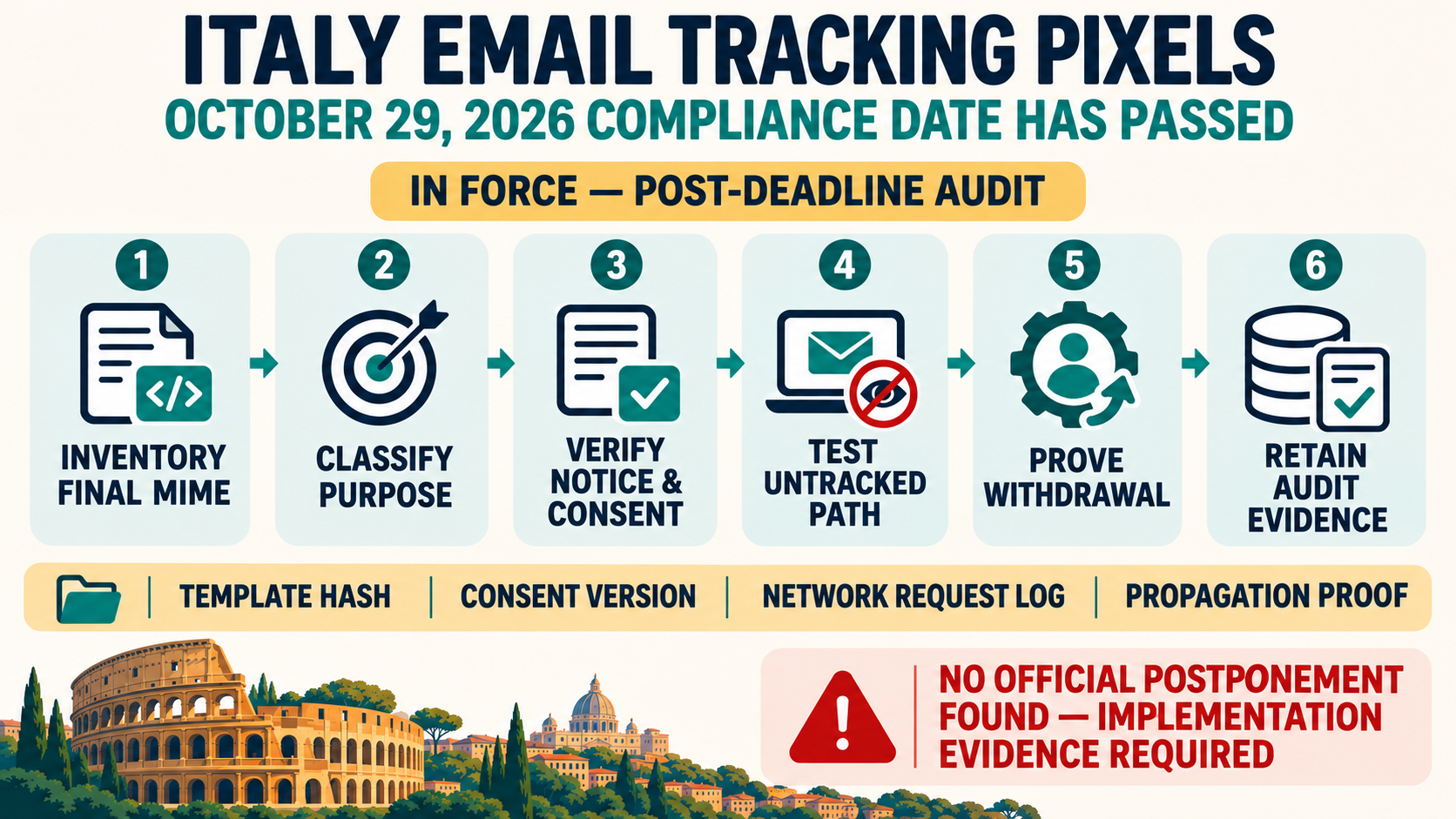
The six-month period ended on October 29, 2026
The guidelines were published in the Italian Official Gazette on April 29, 2026 and provided six months for affected organizations to conform. On October 5, the Garante published a reminder stating that businesses, platforms and newsletters had to update notices, consent and withdrawal systems by October 29. As reviewed on November 16, 2026, that date has passed; this article does not describe it as a future deadline or infer an additional grace period.
The October notice also said verification of the guidelines formed part of the authority’s inspection activity planned for the second half of 2026. Preserve implementation evidence rather than treating a deployed preference-centre screenshot as complete proof.
Who needs to map the processing
The decision addresses public and private senders, online-service providers, email providers, mass-mail platforms and any other party using tracking pixels. Map who chooses the purpose, who creates the identifier, who hosts the image, who receives the request, who retains the event and who activates it. The contractual word processor does not decide the GDPR role when a vendor uses the data for its own purposes.
Role and contract questions
| Actor | Decision to document | Contract or control |
|---|---|---|
| Message sender or service owner | Who decides to use the pixel and for which purpose? | Purpose approval, notice, consent state, campaign release and rights response. |
| ESP or mass-mail platform | Does it act only on instructions or reuse events for its own purpose? | Processor terms, subprocessor inventory, event access, deletion, export and independent-purpose analysis. |
| Analytics or personalization vendor | Does it join identifiers across messages, sites, devices or customers? | Role allocation, data flow, controller or joint-controller assessment, minimization and retention. |
| Email provider or proxy | Does it fetch or cache the image independently of attentive reading? | Measurement limitation, proxy classification and prohibition on treating a fetch as proven human attention. |
| Recipient | What choice was presented and what can be withdrawn? | Notice, proof, tracking-only opt-out, full email opt-out and service-without-tracking path. |
What a pixel operation actually records
The HTML message references an image hosted remotely. When the client, browser or mailbox proxy requests it, the server can receive the URL token, time, network address and client metadata. A unique token can associate that request with a recipient and message. Repeat requests can create a behavioral history.
A resource request is not reliable proof that a person consciously read the message. Image proxies, security scanners, automatic loading, caches and disabled images change the observation. Legal permission and measurement accuracy are separate gates: consent does not make an open metric accurate, and an inaccurate metric is not automatically outside privacy law.
The notice must explain the hidden operation and its purpose
A generic statement that the organization uses analytics is not enough to explain an invisible email request. The notice should identify the controller, the use of tracking pixels, purposes, event and technical fields, recipients or vendor categories, retention, rights, withdrawal path and any relevant cross-context use. It should distinguish individual engagement measurement from genuinely aggregate statistics and from a narrowly documented security operation.
For a new processing operation, provide the information before collecting the event, normally when acquiring the address and tracking choice. For processing that was already active when the guidelines arrived, the decision discussed using the first useful message or another available point of discontinuity to supply the information. That transition does not justify continuing undisclosed tracking after the conformity date.
Do not assume the pixel decision answers every tracked-link question
This article implements the Italian decision’s tracking-pixel analysis. A redirect containing a recipient token, a signed destination, a website analytics parameter or an application deep link can collect different data at a different moment and can involve terminal access or later personal-data processing. Removing the pixel does not make those operations compliant automatically.
Inventory links separately. Record whether the destination is direct or redirected, which identifiers are included, who receives them, whether clicking is necessary to provide the requested function, and how the resulting data is used. Presenting an untracked message while every link remains person-specific is not a credible tracking opt-out.
Classify the exact purpose before selecting a legal route
| Purpose and design | Guideline treatment | Implementation boundary | Evidence |
|---|---|---|---|
| Individual opens used to optimize promotions, frequency or content | Prior consent is required. | Do not emit a recipient-level marker until the approved consent state is active. | Purpose record, notice version, consent event, rendered message and event schema. |
| Individual opens used to infer interests or build commercial profiles | Prior consent is required. | Separate profiling purpose, recipients, features and downstream activation. | DPIA or assessment where applicable, consent scope, model inputs and deletion path. |
| Global campaign open percentage for deliverability or anti-spam purposes | The Garante describes a narrow consent-free route when implemented as aggregate statistical measurement. | Use a campaign-common pixel and anonymize related technical data; do not retain a recipient event and later call it aggregate. | Common asset proof, request-log schema, anonymization test and aggregate-only output. |
| Authentication or account-security operation | A narrow security exception may apply when the pixel is functional to the security process. | Bind it to the exact requested security workflow; do not reuse the event for engagement or promotion. | Threat or control description, necessity test, message type and access restrictions. |
| Legally required institutional or service communication | A narrow exception may apply where actual knowledge is relevant to the required or protective communication. | Document the legal or institutional duty and why the event is necessary and proportionate. | Legal basis, message class, fields, retention and action taken. |
Aggregate deliverability measurement must be aggregate at collection
The Garante describes a narrow route for a global campaign open percentage used for deliverability improvement or anti-spam purposes. It suggests pixels that are the same for every recipient in the campaign and anonymization of related technical data. That design is materially different from collecting recipient events and deleting the identifier later.
Do not use this route to change one recipient’s frequency, remove an individual after repeated non-opens, personalize content, score a lead or build a commercial profile. Those actions reveal that the system needs individual behavior. Keep the aggregate endpoint, logs, access and retention separate from consent-based engagement infrastructure.
Prove that aggregate data cannot be reversed into recipient behavior
Test more than the dashboard. Inspect the asset URL, CDN log, origin log, query string, cookies, request headers, warehouse schema and access paths. The image should be common to the campaign, and no join key should permit an operator or vendor to reconstruct which recipient generated a request. Removing the email address while retaining a recipient-specific message ID is not aggregate design.
Document what is anonymized, when the transformation occurs and whether any party retains the original mapping. If the source remains identifiable and is only aggregated later, manage it as recipient-level processing. Revalidate after CDN, ESP or analytics changes because a vendor can add identifiers without changing the visible template.
A security exception is not a general transactional exception
The guidelines discuss security uses connected with authentication, account activation, password changes and rights requests where confirming access on a known terminal is functional to the requested security process. Document why the pixel is necessary, which fields it uses, how long they remain and what action follows.
A receipt, shipping notice or account email is not automatically exempt merely because it is transactional. If its pixel measures engagement, optimizes future messages or contributes to a profile, evaluate that purpose separately.
Required institutional and service messages remain purpose-bound
The Garante also discusses messages a controller must send where actual knowledge is relevant, including certain security alerts, contractual changes, service notices and institutional communications. The exception depends on the duty, the benefit or protection of recipients and the necessity of the event. It is not permission to add promotional analytics to every operational stream.
Email permission and tracking permission are separate states
| State | Email permitted? | Tracking permitted? | Template action |
|---|---|---|---|
| No valid email permission | No promotional email. | No. | Suppress the send; a tracking choice cannot create email permission. |
| Email allowed, tracking unknown or refused | Yes when another valid route allows the message. | No. | Render the untracked variant with no unique image or tracked redirect added by another vendor. |
| Informed combined consent active | Yes within its scope. | Yes within its scope. | Render the approved tracked variant and record the consent and template versions. |
| Tracking consent withdrawn only | Email may continue if its separate permission remains valid. | No. | Switch immediately to the untracked variant and block downstream engagement activation. |
| All promotional consent withdrawn | No promotional email. | No. | Apply global or scoped suppression and cancel queued messages. |
The Garante allows an informed consent for promotional email and its closely related tracking to be collected together in principle, when the request is neutral and avoids coercion. That simplification does not erase the need for granular withdrawal. A person must be able to stop tracking while continuing to receive an otherwise permitted untracked message.
Worked example: the subscriber keeps the newsletter but stops tracking
A subscriber has an active informed promotional-email and tracking choice. They open the preference centre and disable tracking without unsubscribing from the newsletter. The preference service writes the tracking withdrawal, propagates it to the ESP and automation platform, stops engagement-based segmentation and finds two queued messages that were rendered with unique pixels.
The system must not send those already-rendered tracked copies. It either regenerates them from the approved untracked template or cancels them. The next controlled delivery is inspected: the HTML contains ordinary content images but no unique engagement pixel, its links follow the separately approved link policy, and origin logs show no recipient-linked image request. The subscriber continues to receive the newsletter because email permission remains active.
If the ESP can only remove tracking for an entire account, that product limitation does not erase the recipient’s choice. The controller needs another configuration, a separate untracked stream or a different provider. A preference recorded in the CRM but ignored by the renderer is not effective withdrawal.
Minimum consent and preference record
{
  "recipient_id": "contact-8f31",
  "controller": "Example Italia S.p.A.",
  "email_permission": "active",
  "tracking_permission": "active",
  "purpose": "promotional_email_engagement",
  "notice_version": "it-pixel-2026-04",
  "consent_copy_hash": "sha256:...",
  "affirmative_action_at": "2026-06-18T09:14:00Z",
  "source": "account-preference-centre",
  "tracking_withdrawn_at": null,
  "email_withdrawn_at": null,
  "last_propagation_id": "pref-sync-18427"
}
Store the exact notice and consent wording, not only a boolean. The record must survive movement between the website, ESP, CRM, CDP and automation platform. A vendor migration cannot reset a refusal or turn an unknown state into permission.
Generate tracked and untracked messages deliberately
Campaign audience and message purpose
            |
            v
Resolve email permission and tracking permission separately
      / tracking allowed          \ tracking unavailable or refused
     v                             v
Tracked template               Untracked template
     |                             |
     v                             v
Opaque non-sequential token     No unique pixel and no hidden tracking redirect
     |                             |
     +----------> final MIME inspection <----------+
                              |
                              v
                     controlled release and ledger
The untracked version must be a real production artifact. Removing one image tag is insufficient if the ESP adds an open pixel, rewrites links, injects an analytics SDK or loads personalized remote images later. Inspect the final MIME and observe actual network requests in controlled mailboxes.
Pre-send tracking decision gate
INPUT: recipient, message purpose, controller, template version, send time

1. Resolve whether the email itself may be sent.
2. Classify the exact tracking purpose and claimed exception, if any.
3. If consent is required, verify controller, purpose, notice and withdrawal state.
4. Select tracked or untracked template from the permission state.
5. Render the final MIME after ESP, localization and dynamic-content insertion.
6. Inspect every remote image, redirect and analytics SDK in the final output.
7. Record the decision, rule version, template hash and evidence references.
8. Recheck both email and tracking suppression immediately before release.
9. Fail closed when the purpose, permission or final network behavior is unknown.
Granular withdrawal is a distributed transaction
tracking-only withdrawal
  -> durable preference write
  -> ESP + CRM + CDP + automation propagation
  -> replace queued tracked MIME with approved untracked variant or cancel
  -> stop profile, frequency and segmentation consumers
  -> verify no recipient-linked request in controlled delivery
  -> retain bounded completion evidence

full promotional withdrawal
  -> promotional suppression
  -> cancel queued promotional messages
  -> retain only the minimum evidence needed to prevent reacquisition
The preference centre should distinguish stopping tracking from stopping promotional email. Propagation must reach queued journeys and downstream models, not only the next campaign selection. Refusing tracking must not make the underlying service unavailable solely because of that choice.
Minimize identifiers and technical fields
| Field or behavior | Risk | Safer design |
|---|---|---|
| Email address in image URL | Exposes a direct identifier to logs, CDNs and intermediaries. | Use an unintelligible, non-sequential token and keep the mapping in a restricted internal layer. |
| Sequential recipient ID | Allows enumeration and correlation. | Use high-entropy opaque values with narrow lifetime and scope. |
| Raw IP and full user agent retained indefinitely | Creates unnecessary device and network history. | Collect only fields justified by the purpose; truncate, transform or delete on a defined schedule. |
| One event reused for deliverability and personalization | A narrow aggregate claim silently becomes individual behavioral processing. | Separate collection paths, schemas, access and retention by purpose. |
| Open event treated as human reading | Mailbox proxies, scanners, caching and images-off behavior make the inference unreliable. | Label it as an image-resource request and use stronger outcome evidence separately. |
The Garante suggests an unintelligible, non-sequential identifier mapped to the address in a separate internal layer so the address does not travel in the image request. This reduces exposure but does not by itself anonymize a linkable event. Access, purpose, retention and withdrawal controls still apply.
Audit every vendor that can recreate tracking
Inventory the sending platform, CDN, image host, redirector, analytics warehouse, customer-data platform, personalization engine and support exports. Record data location, subprocessors, controller instructions, independent use, field schema, retention, access and deletion. Test vendor defaults after every major configuration or template change.
A downstream purpose change requires a new decision
An event collected for a narrowly approved security function should not later train an engagement model. An aggregate deliverability count should not be joined to a profile. Put purpose metadata on the dataset and enforce it through separate topics, tables, service accounts and retention jobs. A new consumer must identify its purpose, legal route, fields and withdrawal behavior before receiving access.
Review dashboards and exports as well as production code. Analysts can recreate individual monitoring by joining message IDs, send ledgers and request times even when the event table lacks an address. Access review should test practical linkability, not only column names.
Keep privacy permission separate from metric quality
Report image-resource requests, not verified human opens. Segment known proxy or scanner effects where reliable evidence exists, but do not claim perfect classification from a user-agent string. Use clicks, replies, conversions, task completion and controlled placement evidence as separate measures with their own permission and accuracy limits.
Migrate existing programs without silently extending the transition
The guidelines described a transition for processing already in progress: provide the required information at the first useful send or available discontinuity and implement a visible granular withdrawal mechanism. That transition was not a permanent alternative for new processing. After October 29, a team should be able to show its present compliant design, not only a migration plan.
End-to-end acceptance tests
- Tracking purpose and controller are approved before configuration.
- Email and tracking permission are stored separately.
- The notice and consent wording can be reproduced.
- Tracking refusal selects an untracked message without blocking the permitted service.
- Full withdrawal cancels queued promotional sends.
- Final HTML and text contain no hidden recipient tracker in the untracked path.
- Aggregate measurement uses one campaign asset and cannot resolve a recipient.
- Security and service exceptions have necessity, fields, action and retention evidence.
- Opaque identifiers cannot be enumerated and the address stays out of the request URL.
- ESP, CDN, redirect, CDP and warehouse deletion are reconciled.
- Proxy and scanner fetches are not reported as proven reading.
- A controlled audit can reproduce the decision and network behavior.
Failures that should block release
| Failure | Why it fails | Release-blocking test |
|---|---|---|
| Pixel removed but tracked redirects remain | The system still performs recipient-linked tracking through another mechanism. | Inspect final HTML, text, redirects, remote images and vendor-injected content. |
| Tracking-only withdrawal also unsubscribes email | The user was not given the granular withdrawal path described by the Garante. | Prove the recipient can continue receiving an untracked message. |
| Aggregate exemption built from unique recipient pixels | The collection remains individualized even if a dashboard later shows only a percentage. | Verify identical campaign asset and absence of recipient mapping at collection. |
| Consent copied between brands or purposes | The displayed identity and informed purpose may not cover the new controller or use. | Compare controller, represented entities, purpose and notice version. |
| Untracked template still calls an engagement SDK | A hidden vendor dependency recreates the same event. | Use a controlled mailbox and request logs to prove no recipient-specific tracking call occurs. |
| Open data drives suppression without disclosure | A commercial decision is made from recipient behavior outside the stated purpose. | Trace every consumer of the event and block unapproved activation. |
Respond when tracking occurs after refusal or withdrawal
- Contain: pause the affected template, journey and vendor integration without deleting request logs.
- Preserve: retain final MIME, preference history, render decision, request evidence, vendor configuration and affected time window.
- Scope: identify recipients, controllers, purposes, fields, subprocessors and downstream models.
- Correct: stop the collection, propagate the preference, rebuild queued messages and delete or restrict data according to the approved response.
- Escalate: involve privacy, legal, security and vendor owners for rights, notification and regulatory decisions.
- Verify: repeat negative network tests and search other templates for the same injection path.
Preserve the original state and record remediation separately. Rewriting the preference timestamp or deleting all evidence can prevent the organization from determining when the failure began and which systems received the event.
Build a reproducible audit pack
Retain the purpose and role assessment, legal review, data-flow diagram, notice and consent versions, preference-state model, template hashes, final MIME samples, controlled request logs, vendor configuration, retention rules, propagation acknowledgements, negative tests and remediation history. Minimize recipient data and restrict access while keeping enough evidence to reproduce the decision.
Current status as of November 16, 2026
The April guidelines remain the primary technical and legal source identified by the Garante. The authority’s October notice states that the six-month conformity date was October 29 and refers to inspection activity in the second half of 2026. This article found no official basis for describing the deadline as postponed. Organizations should obtain Italian legal advice for their exact role, recipients, message purpose and claimed exception.
Primary Italian sources
- Garante: Guidelines on tracking pixels in email, decision of April 17, 2026: Primary decision covering terminal access, roles, notices, legal routes, consent, withdrawal, privacy by design and the six-month conformity period.
- Garante: Email marketing tracking-pixel vademecum and October deadline notice: October 5 reminder identifying October 29, 2026 as the conformity date and noting planned inspection activity.