Yahoo Completed the AOL Mailbox Migration in 2019: One Delivery Ecosystem
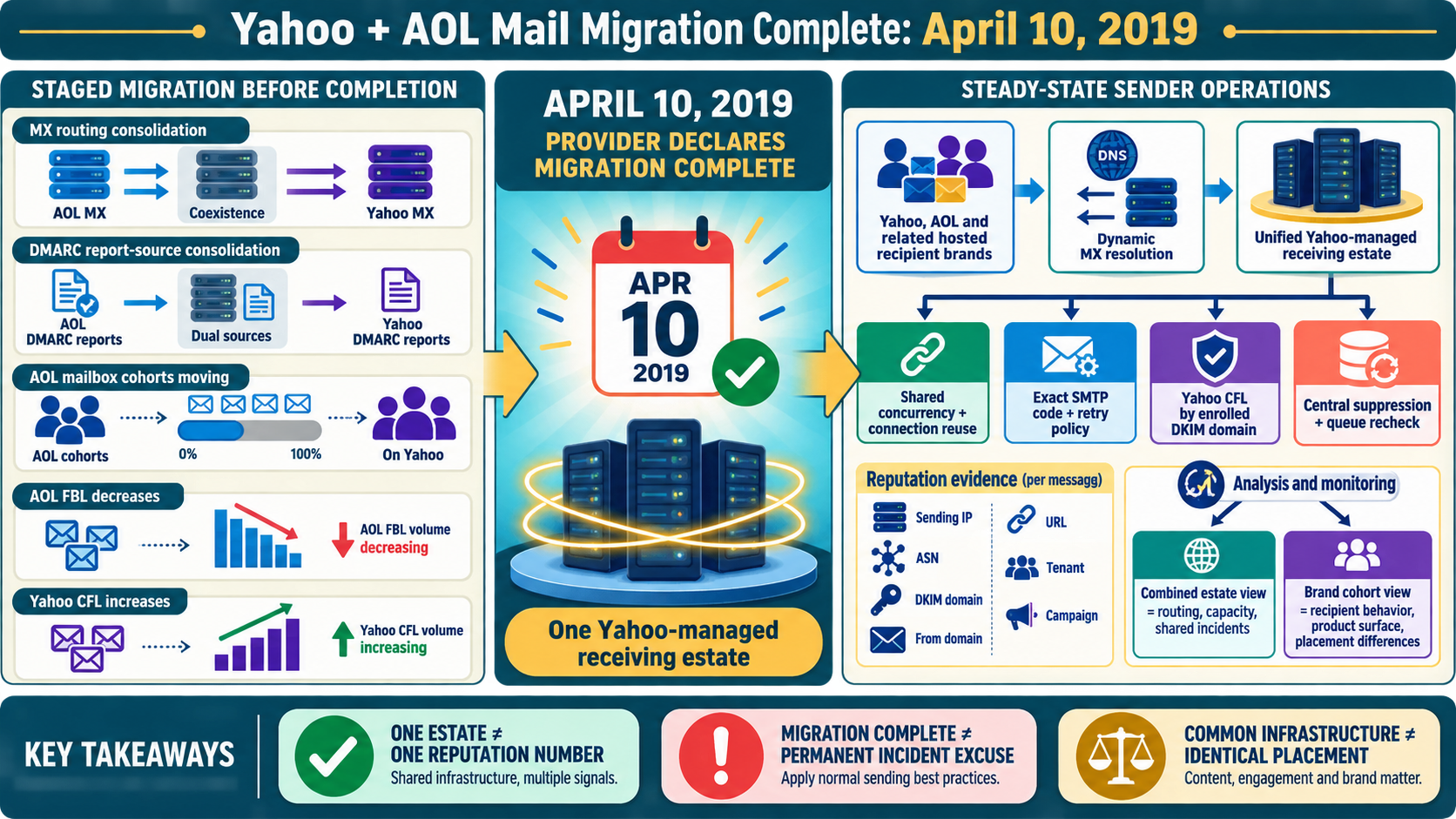
On April 10, 2019, Yahoo Postmaster declared the Yahoo and AOL Mail infrastructure migration complete. The provider described one of the largest consumer-mail migrations as done, with almost no impact to users and partners, and called out ARF, feedback loops, the spam button, DKIM, DMARC and the spam folder as technical foundations that continued in the combined system. For senders, the completion date closed the staged transition period. Yahoo and AOL recipient brands now had to be operated as parts of one Yahoo-managed delivery ecosystem, while still retaining brand and cohort dimensions where evidence showed different recipient outcomes.
The dated mailbox-provider change
| Event field | Verified value | Why it matters |
|---|---|---|
| Historical event date | April 10, 2019 | This is the provider-change date, not the NitWings publication date. |
| Mailbox provider | Yahoo Mail ecosystem | The affected provider estate determines which recipient cohorts require separate evidence. |
| Change area | Infrastructure | This identifies whether the change altered authentication, filtering, visibility, measurement or sender operations. |
| Current status | complete-current-yahoo-managed-mail-estate | Historical instructions are interpreted against the feature or standard that exists now. |
The migration did not happen on one day. Earlier updates documented MX consolidation, common receiving MTAs, consolidated DMARC-report sources and the gradual movement of AOL mailboxes and complaint feedback into Yahoo systems. Each layer followed its own schedule.
That staged sequence made historical analytics difficult. An AOL address could route through common infrastructure while complaint evidence still arrived through a changing feed. A sender could see fewer AOL reports without any improvement in subscriber behavior. By April 2019, the provider was stating that the infrastructure migration itself was complete.
The milestone also represented continuity. ARF complaint reports, feedback-loop concepts, DKIM signatures, DMARC authentication and user spam decisions remained essential. The provider combined systems; it did not erase the signals used to judge whether mail was authentic and wanted.
The operator’s challenge shifted from migration tracking to steady-state governance. Temporary dual ingestion and transition annotations could be retired carefully, but recipient-domain aliases, current MX ownership, DKIM-domain enrollment and unified resource limits still needed accurate management.
How the system worked before the change
During migration, senders maintained parallel assumptions. Some queues followed AOL-specific MX and retry rules, some dashboards ingested AOL feedback, and Yahoo systems handled other cohorts. DMARC sources and complaint feeds changed at different points.
Teams needed transition windows in reports. A fall in one source and rise in another could represent mailbox movement, not a change in complaint propensity. Raw counts were especially misleading when traffic, enrollment and provider coverage differed.
Domain mapping files were often static. They assigned a consumer address suffix to a provider and preserved separate connection pools long after DNS pointed toward common receiving infrastructure. Such rules risked multiplying concurrency against one backend.
Support processes were fragmented as well. Operators consulted separate postmaster destinations and interpreted similar errors through different histories. Root-cause analysis slowed when the organization treated consumer branding as proof of independent systems.
What changed on the provider side
The April announcement closed the provider-declared migration. Senders no longer needed to model the mailbox move as an unfinished event. Current MX evidence and Yahoo-managed documentation became the source of operational truth across the hosted brands.
Completion strengthened the case for shared receiver controls. Concurrency, connection reuse, retries and recovery ramps should be coordinated for the common estate. Opening independent maximum pools for Yahoo and AOL suffixes could create unnecessary aggregate pressure.
Complaint handling converged on Yahoo’s domain-based CFL model. DKIM signing domains became critical attribution keys. Senders and ESPs needed to know who enrolled each domain, where authenticated ARF reports arrived, and how suppression reached the customer stream responsible for the message.
Completion did not make all placement identical. Provider products can use shared infrastructure while user populations, account state, engagement and internal models differ. Keep brand cohorts for analysis, but interpret them inside the combined estate rather than as isolated reputation universes.
Message path before and after
Before
Staged Yahoo and AOL migration
    |
    +----> MX routing changes at one time
    +----> DMARC report source changes by MX movement
    +----> mailbox cohorts migrate progressively
    +----> AOL FBL declines while Yahoo CFL grows
    |
    v
Sender maintains overlap ingestion and migration annotations
After
Yahoo, AOL and related Yahoo-managed recipient brands
    |
    v
Dynamic DNS -> unified Yahoo-managed receiving estate
    |
    +----> shared connection and retry governance
    +----> IP + DKIM + From + campaign reputation evidence
    +----> Yahoo CFL by enrolled DKIM domain
    +----> consolidated provider guidance and SMTP diagnostics
    |
    v
Central suppression, cohort analysis and controlled recovery
Who and what the change affected
| Traffic or stakeholder | What changed | Required interpretation |
|---|---|---|
| Yahoo and AOL mailboxes | The provider declared infrastructure migration complete. | Treat both as one managed estate while preserving cohorts. |
| Sending MTAs | Parallel domain pools could target shared resources. | Coordinate concurrency and retry pressure by current MX ownership. |
| Feedback processors | Transition overlap gave way to Yahoo CFL operations. | Verify every active DKIM domain and destination. |
| DMARC platforms | Provider reports were already consolidated. | Normalize XML by record counts and policy domain. |
| Deliverability analysts | Migration stopped being a default explanation. | Use current SMTP, reputation, complaint and cohort evidence. |
| ESP customers | Platform and customer identities shared responsibility. | Document enrollment, suppression scope and escalation ownership. |
Effect on delivery, placement and recipient visibility
After completion, a sender should not explain a new Yahoo or AOL placement problem merely as migration turbulence. The correct diagnosis begins with current evidence: DNS routing, exact SMTP replies, authentication, traffic shape, complaints, invalid recipients, IP and domain reputation, content identifiers and recipient engagement.
Shared infrastructure increases the risk of retry amplification. If two brand-specific queues independently retry the same provider-wide temporary policy response, aggregate attempts can rise while accepted volume falls. Central receiver governance should cap concurrency, apply backoff with jitter and stop broad replay.
One delivery estate does not imply one reputation number. Yahoo states that it considers multiple factors, including IP, URL, domain, sender, ASN, DKIM and DMARC evidence. ESP platforms must retain customer and stream dimensions so one tenant’s complaint or acquisition problem is not hidden in pooled averages.
Complaint feedback remains one of the strongest actionable recipient signals. A missing report feed after completion is an observability failure until proven otherwise. Verify enrollment, DKIM attribution, destination health, parser authentication and suppression propagation before concluding that complaints are zero.
Current Yahoo requirements add stricter authentication, complaint and unsubscribe expectations. These later requirements should be applied as current operations, not backdated into the April 2019 announcement. The historical event established infrastructure completion; present-day policy governs today’s traffic.
Effect on measurement and diagnosis
Close the migration interval explicitly in historical dashboards on April 10, 2019. Preserve earlier annotations so analysts understand source discontinuities. Do not rewrite old feed names into a seamless series without retaining original provenance.
Build a provider-estate dimension from time-bounded MX evidence and receiving-host logs. Store recipient brand separately. This permits a combined capacity and reputation view alongside cohort comparisons without using the address suffix as infrastructure proof.
Normalize complaint rate using eligible delivered promotional messages for the same estate and interval. Retain report source, DKIM signing domain, campaign and customer. Provider and sender denominators can differ, so label local ratios rather than claiming they reproduce Yahoo’s internal rate.
Measure retries as attempts per accepted recipient, not merely total deferred messages. A recovery loop can generate high connection pressure from a small queue. Track first response, enhanced status code, retry count, connection closure, queue age and eventual outcome.
Maintain control cohorts. If Yahoo and AOL recipients with similar acquisition source, cadence and engagement move together, a shared infrastructure or campaign cause is plausible. If only one cohort changes, investigate population, product surface, authentication identity or sample size before assuming independent receiver systems.
Advantages for email marketers
| Potential advantage | When the advantage is real | Evidence to verify |
|---|---|---|
| Simpler receiver governance | Current MX routes map to one managed estate. | Stable connection pressure and fewer conflicting rules. |
| Unified complaint operations | Enrolled DKIM domains feed Yahoo CFL correctly. | Authenticated reports produce prompt suppression. |
| Cleaner historical analysis | Migration boundaries and provenance are retained. | No false improvement from feed-source movement. |
| Faster incident triage | Teams use one current postmaster evidence model. | Exact SMTP and cohort diagnosis shorten recovery. |
| Platform accountability | ESP and customer responsibilities are explicit. | Every domain and stream has an owner. |
Disadvantages and operational risks
| Cost or risk | How it appears | Control |
|---|---|---|
| Completion is treated as identical placement | Cohort differences are discarded. | Keep recipient-brand and engagement dimensions. |
| Migration remains a permanent excuse | Current faults are not investigated. | Use live DNS, SMTP, authentication and complaint evidence. |
| Limits are multiplied by brand | Parallel queues pressure one estate. | Apply shared receiver concurrency and backoff. |
| AOL feedback ingestion is removed abruptly | Late or retained evidence is lost. | Retire only after reconciled overlap and retention review. |
| Platform averages hide a tenant | One customer damages shared resources. | Measure customer DKIM, From, campaign and acquisition source. |
| Static host maps persist | Routing follows stale infrastructure. | Resolve MX dynamically and retain dated observations. |
What email teams needed to do at the time
- Record the completion date. Close the staged migration interval on April 10, 2019.
- Reconcile feedback feeds. Verify no complaint evidence was lost during retirement.
- Move to shared receiver controls. Coordinate connection and retry limits across brands.
- Verify Yahoo CFL enrollment. Check every production DKIM signing domain.
- Consolidate postmaster operations. Use the provider’s combined guidance and escalation path.
- Preserve historical provenance. Keep source program and migration-stage fields.
- Retain brand cohorts. Do not erase useful recipient-population differences.
- Test suppression. Ensure authenticated complaints stop all eligible streams.
What email teams should do now
- Use current Yahoo Sender Hub guidance. Apply it across domains hosted by Yahoo Mail.
- Resolve MX dynamically. Do not encode 2019 hosts as permanent routing truth.
- Govern common resources. Coordinate concurrency, messages per connection and retry ramps.
- Parse exact SMTP responses. Separate recipient, policy, reputation and resource failures.
- Maintain current authentication. Validate SPF, DKIM and DMARC for each legitimate stream.
- Keep complaint rates low. Reconcile Yahoo CFL coverage with local delivery denominators.
- Support easy unsubscribe. Apply current one-click and body-link requirements where applicable.
- Measure layered reputation. Include IP, ASN, DKIM, From, URL, campaign and tenant.
- Use controlled recovery. Correct root cause, then ramp with guardrails and control cohorts.
- Keep migration history read-only. Do not use it to explain unrelated present-day incidents.
Worked deliverability scenario
An ESP keeps separate Yahoo and AOL connection profiles after April 2019. Each opens aggressive concurrent sessions. When a customer imports a poorly confirmed list, invalid-recipient and complaint evidence rises across both cohorts, followed by temporary deferrals.
The team treats AOL as an isolated problem and increases Yahoo concurrency to recover volume. DNS and connection logs show both groups reaching the same managed estate. The additional Yahoo attempts increase aggregate pressure. One customer DKIM domain is also absent from the active CFL enrollment, leaving a complaint blind spot.
The ESP creates a common receiver policy with conservative concurrency, connection reuse, response-specific backoff and a controlled ramp. It verifies every DKIM domain, restores feedback ingestion and maps complaints to tenant and stream. The offending customer pauses acquisition sources and reconfirms permission rather than rotating IPs.
Deferrals and retry amplification decline. Yahoo and AOL cohorts remain separate in placement reports, but capacity and reputation analysis uses the unified estate. The completion event becomes historical context, while current evidence identifies the actual tenant, list and traffic-shape causes.
Evidence and diagnostics
- Provider mapping: recipient domain, MX answer, TTL, receiving host and observation time.
- Traffic: IP, ASN, DKIM domain, From domain, tenant, stream, campaign and volume curve.
- SMTP: complete reply, enhanced status, connection count, messages per connection and queue action.
- Authentication: SPF, DKIM signatures, DMARC alignment and policy.
- Complaints: Yahoo CFL enrollment, ARF validation, recipient mapping and denominator.
- Suppression: event ID, scope, effective time, acknowledgements and queue recheck.
- Historical source: AOL or Yahoo feed, migration stage, first and last observed records.
- Outcome: acceptance, controlled placement evidence, complaints, unsubscribes and conversion.
Failure modes and incorrect conclusions
- Calling shared infrastructure identical filtering. User and product cohorts can still differ.
- Blaming an active incident on the completed migration. Current evidence must identify the cause.
- Running independent maximum connection pools. Both can pressure one receiver estate.
- Deleting historical source fields. Trend discontinuities become impossible to audit.
- Assuming missing complaints mean zero complaints. Enrollment or ingestion can be broken.
- Using DMARC as inbox-placement evidence. Aggregate XML reports authentication observations.
- Rotating identity during recovery. Reputation fragments and suppressed recipients can be mailed again.
Current status and superseding changes
The Yahoo and AOL infrastructure migration remains complete. Current Yahoo Sender Hub documentation applies to Yahoo-managed consumer brands, while Yahoo Japan remains a separate organization. Senders should verify actual hosting rather than infer ownership from similar branding.
Current Yahoo complaint feedback is tied to DKIM domains. Bulk-sender requirements now include stronger authentication, easy unsubscribe and low complaint rates. These controls build on the shared technical foundations cited in the completion announcement.
The provider does not publish a fixed concurrent-connection number and accepts a limited number of messages per connection. Senders should treat resources respectfully, reconnect after clean connection termination when appropriate, and adapt from exact responses instead of relying on historic universal limits.
The durable model is both unified and multidimensional: one Yahoo-managed receiving estate for routing and capacity governance, with distinct IP, DKIM, From, campaign, tenant and recipient-cohort evidence for reputation and outcomes.
Operator checklist
- Record April 10, 2019 as the provider-declared completion date.
- Close but preserve the staged migration interval in historical reports.
- Map current receiver ownership from DNS and connected-host evidence.
- Coordinate Yahoo and AOL traffic under one receiver policy.
- Retain recipient-brand cohorts for outcome comparison.
- Verify Yahoo CFL enrollment for every active DKIM domain.
- Normalize complaint and DMARC data with correct denominators.
- Parse exact SMTP replies and prevent retry amplification.
- Apply current Yahoo authentication and unsubscribe requirements.
- Use tenant and campaign dimensions to find shared-pool causes.
- Do not use the completed migration as a default current diagnosis.
Primary and contemporaneous references
- Yahoo Postmaster: It’s Done: Primary April 10, 2019 completion announcement.
- Yahoo Sender Hub: Best practices: Current sender requirements and operational guidance.
- Yahoo Sender Hub: Complaint Feedback Loop: Current domain-based complaint program.
- Yahoo Sender Hub: FAQ: Current brand scope and sender-policy details.
- Yahoo Sender Hub: SMTP error codes: Current diagnostic guidance.