DMARC RFC 9991: Failure Reports, Privacy and Safe Processing
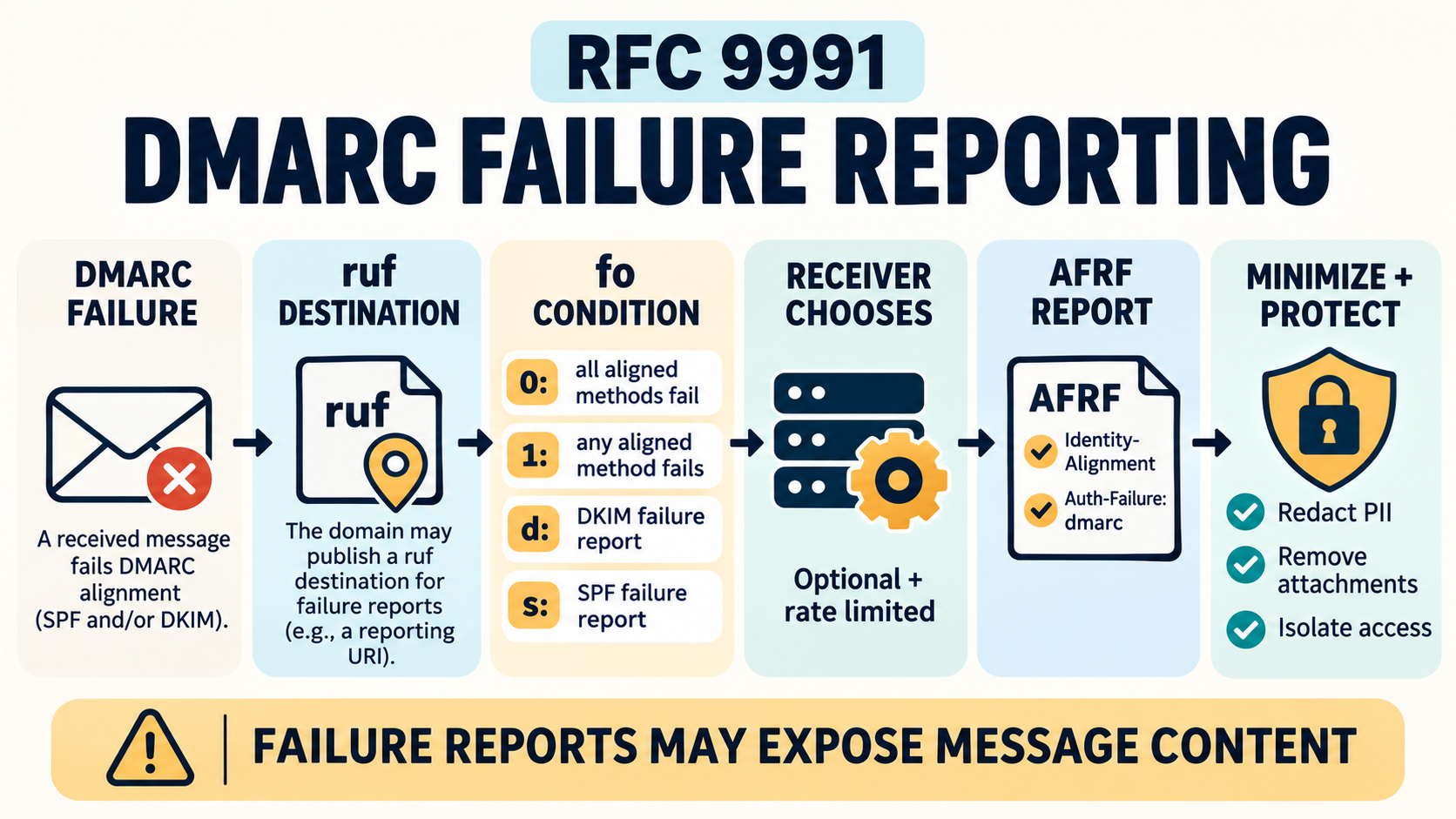
RFC 9991 is the current Standards Track specification for DMARC failure reporting. It defines message-specific authentication failure feedback using the Abuse Reporting Format, updates RFC 6591, and completes the 2026 DMARC family with RFC 9989 core evaluation and RFC 9990 aggregate reporting. Failure reports can accelerate diagnosis, but they can also disclose headers, message content, recipients, forwarding destinations and malicious payloads. They require a narrower, security-led operating model than aggregate reports.
Where RFC 9991 fits
| Layer | Specification | Evidence granularity | Primary risk |
|---|---|---|---|
| DMARC evaluation | RFC 9989 | One received message, authenticated identifiers and alignment result | Incorrect policy discovery or identity interpretation. |
| Aggregate reporting | RFC 9990 | Counts grouped by source, result and identifiers | Unsafe XML ingestion and misleading population analysis. |
| DMARC failure reporting | RFC 9991 with RFC 6591 and RFC 5965 | One failed message or consolidated similar incidents with message-level evidence | PII, confidential content, malware and traffic amplification. |
| DKIM/SPF mechanism reports | RFC 6591, RFC 6651 and RFC 6652 | Failure evidence for the underlying authentication mechanism | Confusing a mechanism failure with a DMARC failure. |
RFC 9991 does not redefine DMARC pass, DNS Tree Walk or policy handling. It begins after message-time evaluation has preserved the evidence required for reporting. It also does not replace aggregate reporting. RFC 9990 remains the recommended broad visibility mechanism because it avoids message content and individual identifiers.
What a failure report can answer
A useful report can show which authentication path failed, whether the failing identity aligned, the source IP, the reported domain and enough of the original headers to distinguish an authorized but broken stream from direct abuse. Reports are normally generated soon after detection, so they can shorten the time between a deployment defect and diagnosis.
The same detail creates risk. A report may reproduce a legitimate private message that failed because of forwarding, modification, DNS error or configuration drift. It may expose recipients the domain owner never knew about. Diagnostic value is not permission to retain everything.
Receiver decision flow
1. Evaluate the message under RFC 9989.
2. Discover a valid ruf destination and parse fo.
3. If ruf is absent, ignore fo and do not generate a requested failure report.
4. Determine whether fo requests DMARC, DKIM and/or SPF failure reporting.
5. Verify every external destination using the RFC 9990 procedure.
6. Apply receiver privacy, security, legal and local-policy decisions.
7. For psd=y, do not consider ruf without a specific agreement.
8. Consolidate like incidents and apply mandatory outbound rate limiting.
9. Minimize/redact message evidence and remove dangerous attachments.
10. Build AFRF, protect transport, record the decision and attempt delivery.
The report generator must rate-limit outbound reports. It may also store similar failures briefly and consolidate them with the ARF Incidents field. The aim is to describe distinct failure conditions, not to copy every failed message into another mailbox.
ruf identifies requested destinations
ruf contains one or more reporting URIs. A receiver that sends failure reports must support mailto:, ignores unsupported schemes and attempts each valid authorized destination subject to its limits. Presence of ruf is a request, not a reporting guarantee.
If ruf is absent, the receiver must not generate requested failure reports for the domain, and fo has no effect. Do not publish a placeholder fo value and assume feedback is enabled.
fo selects requested failure conditions
| fo value | Requested condition | Report family | Important boundary |
|---|---|---|---|
| 0 | All underlying mechanisms fail to produce an aligned pass | DMARC failure report | Default; mutually exclusive with 1. |
| 1 | Any underlying mechanism fails to produce an aligned pass | DMARC failure report | Can request a report even when another aligned mechanism makes DMARC pass. |
| d | A DKIM signature fails evaluation regardless of alignment | DKIM-specific failure report | Uses DKIM reporting rules; not automatically a DMARC failure. |
| s | SPF evaluation fails regardless of alignment | SPF-specific failure report | Uses SPF reporting rules; not automatically a DMARC failure. |
| 0:d, 1:s or similar | Combined DMARC and mechanism-specific requests | More than one possible report type | d and s may accompany 0 or 1; 0 and 1 cannot coexist. |
The default is fo=0. The 0 and 1 values are mutually exclusive. Values can be joined by colons and can appear in any order. The receiver can choose which applicable failure-report type, if any, to transmit based on local policy and the failure.
Why fo=1 can produce reports for DMARC-pass messages
DMARC passes when either an aligned SPF path or an aligned DKIM signature passes. With fo=1, failure of either aligned path can request a report even when the other path produces the final DMARC pass. This is useful for finding fragile authentication, but it substantially increases report volume and privacy exposure.
Dashboards must retain the final DMARC result and the failed aligned method separately. A failure report is not always proof that the message failed DMARC.
d and s request mechanism-specific reports
fo=d concerns DKIM evaluation failure regardless of alignment. fo=s concerns SPF evaluation failure regardless of alignment. Those reports follow DKIM or SPF failure-reporting specifications and can be generated instead of or in addition to a DMARC failure report.
Do not label every ARF authentication report “DMARC failed.” Parse Auth-Failure, Feedback-Type, Identity-Alignment and mechanism fields before classification.
Record examples and their consequences
# DMARC failure reporting at the policy domain.
_dmarc.example.com. IN TXT (
  "v=DMARC1; p=quarantine; "
  "rua=mailto:[email protected]; "
  "ruf=mailto:[email protected]; fo=0"
)

# Request DMARC reports when either aligned path fails and mechanism reports.
# This can produce substantially more and more sensitive feedback.
_dmarc.example.com. IN TXT (
  "v=DMARC1; p=quarantine; "
  "ruf=mailto:[email protected]; fo=1:d:s"
)

# External destination authorization in processor.example.net DNS.
example.com._report._dmarc.processor.example.net. IN TXT "v=DMARC1"
The second policy is intentionally high exposure. It can request DMARC reports when one aligned method fails plus DKIM and SPF mechanism reports. Publish this only for a targeted, approved diagnostic period with a receiving system built for sensitive untrusted content.
Public Suffix Domains need stricter handling
Report generators must not consider ruf in a record carrying psd=y unless the interested parties have a specific agreement. Multi-organization PSD policy records must not include ruf. Failure reports can reveal data about independent registrants, making suffix-level collection especially risky.
External ruf destinations require authorization
Destination stays inside the policy domain
No external authorization owner is required. The URI must still be supported and usable, and the receiver remains free to decline reporting.
example.com sends to processor.example.net
Query example.com._report._dmarc.processor.example.net. At least one valid TXT record must begin with v=DMARC1; otherwise ignore that destination.
Processor authorizes all customers
A TXT record at *._report._dmarc.processor.example.net can provide wildcard authorization. Normal DNS caching and negative-caching behavior still applies.
Processor overrides the mailbox
The authorization record can contain a ruf override only when the replacement URI keeps the same destination host. Reject host changes and redirection loops.
Authorization lookup has a temporary error
A timeout or temporary DNS failure is not positive authorization. Apply documented temporary handling and never silently assume permission.
RFC 9991 reuses the RFC 9990 external-destination procedure, substituting ruf for rua. Authorization prevents a domain owner or attacker from directing sensitive reports and high volumes to an unwilling third party.
Construct the authorization owner exactly
For a policy domain example.com and destination host processor.example.net, query example.com._report._dmarc.processor.example.net. At least one TXT record must parse with v=DMARC1 first. An optional ruf override must remain on the original destination host to avoid loops and indirect redirection.
Protect the report transport and avoid loops
Email streams carrying DMARC failure reports should themselves be DMARC-aligned. Unaligned reports can trigger further authentication reports and create loops. Report generators need rate limits per destination and an explicit rule that authentication feedback does not recursively generate more feedback.
Transport authentication reduces spoofed intake but does not make the report safe or true. Preserve the report message's Authentication-Results and Received chain, then apply content and provenance checks.
RFC 9991 uses augmented AFRF
| Field or MIME part | RFC 9991 requirement | Meaning | Consumer handling |
|---|---|---|---|
| Feedback-Type | Required by ARF | auth-failure for authentication failure reports | Reject or quarantine an unsupported type. |
| Auth-Failure | Use dmarc for a DMARC failure report | Why the report was generated | Do not infer the failing aligned mechanism from this field alone. |
| Identity-Alignment | Required | dkim, spf, both, or none according to failed aligned authentication | Parse as a bounded set; each mechanism appears at most once. |
| Delivery-Result | Optional; delivered, spam, policy, reject or other | Receiver-reported final disposition | Treat as reporter assertion, not universal placement proof. |
| DKIM fields | Required for DKIM failure of an aligned identifier | Domain, identity and selector; canonicalized material is optional | Treat canonicalized data as sensitive untrusted content. |
| SPF-DNS | Required for SPF failure of an aligned identifier | DNS evidence associated with SPF failure | Bound size and parse as data, never execute or resolve embedded content. |
| Human-readable part | Required by ARF | Explanation for an operator | Never use it over conflicting machine/evidence parts. |
| Original message or headers | Required by ARF; may be redacted | Primary evidence for the reported incident | Do not render active HTML or open attachments. |
RFC 9991 updates the authentication failure format rather than inventing a standalone JSON or XML document. Implementers need the MIME and base ARF requirements from RFC 5965, authentication failure fields from RFC 6591, redaction guidance from RFC 6590 and the DMARC-specific additions from RFC 9991.
Delivery-Result is optional and accepts only delivered, spam, policy, reject or other. It records the reporting domain's final disposition: policy means the intended inbox was not used because authentication failed, while other covers a disposition outside the defined set. It is not proof of inbox placement across all recipients.
Three-part MIME structure
From: DMARC Reporter <[email protected]>
To: [email protected]
Subject: FW: Original subject redacted
Content-Type: multipart/report; report-type=feedback-report;
 boundary="=_rfc9991_boundary"

--=_rfc9991_boundary
Content-Type: text/plain; charset=utf-8

Authentication failure report. Sensitive content has been minimized.

--=_rfc9991_boundary
Content-Type: message/feedback-report
Content-Transfer-Encoding: 7bit

Feedback-Type: auth-failure
Version: 1
User-Agent: Receiver-DMARC/2.0
Auth-Failure: dmarc
Authentication-Results: receiver.example; dmarc=fail header.from=example.com
Identity-Alignment: dkim, spf
Source-IP: 192.0.2.44
Reported-Domain: example.com
Incidents: 12

--=_rfc9991_boundary
Content-Type: text/rfc822-headers

From: Redacted Sender <[email protected]>
Subject: [redacted]
Message-ID: <[email protected]>

--=_rfc9991_boundary--
The top level is multipart/report; report-type=feedback-report. Part one is human-readable. Part two is message/feedback-report. Part three is the original message as message/rfc822 or its complete headers as text/rfc822-headers. Privacy redaction can reduce that evidence, but the structure remains explicit.
Identity-Alignment has precise semantics
The required field contains dkim, spf, both, or none. Named mechanisms are those that failed to authenticate an aligned identity. Each mechanism appears at most once. The value none means all attempted methods successfully authenticated an aligned identity, which can occur in a non-DMARC or mechanism-specific reporting context.
Do not infer this field only from raw SPF or DKIM pass/fail. Alignment is a separate comparison against the Author Domain under RFC 9989.
Machine-readable AFRF example
Feedback-Type: auth-failure
Version: 1
User-Agent: Receiver-DMARC/2.0
Auth-Failure: dmarc
Identity-Alignment: dkim
Authentication-Results: receiver.example;
 dmarc=fail header.from=example.com;
 dkim=fail header.d=example.com header.s=mail2026;
 spf=pass smtp.mailfrom=bounces.vendor.example
DKIM-Domain: example.com
DKIM-Identity: @example.com
DKIM-Selector: mail2026
Source-IP: 192.0.2.44
Reported-Domain: example.com
Incidents: 1
This example says the aligned DKIM path failed while SPF passed for an unaligned vendor domain. The final DMARC result therefore fails unless another aligned signature exists. The report consumer must verify that conclusion against the attached or redacted evidence rather than trusting the assertion blindly.
DKIM-specific evidence
For a DKIM failure involving an aligned identifier, the report includes DKIM-Domain, DKIM-Identity and DKIM-Selector. Canonicalized header and body fields are optional. They can expose substantial message material and should be included only when needed for a bounded investigation.
SPF-DNS evidence
For SPF failure of an aligned identifier, SPF-DNS is required. Treat it as captured evidence, not a command to perform new DNS lookups from report content. A consumer can separately reproduce a current DNS evaluation, but it must label the time difference and cache boundary.
Consolidate like failures with Incidents
The ARF Incidents field can represent several like events. Absence implies one incident. Consolidation reduces denial-of-service risk and the number of sensitive message copies, but it must group genuinely similar failure conditions. Preserve the grouping key and sample-selection method.
Privacy is the primary deployment boundary
| Exposure | How it appears | Why it matters | Minimum control |
|---|---|---|---|
| Sender and recipient identity | From, To, RCPT TO, Received and envelope fields | Can expose individuals, aliases, customers and list membership | Redact or omit unnecessary identifiers; restrict access. |
| Message body | Full message/rfc822 third part | Can contain personal, legal, HR, medical or commercial information | Prefer bounded headers-only evidence unless content is necessary and approved. |
| Forwarding destination | Trace and recipient fields after redirection | Reveals destinations unknown to the original sender | Minimize trace and recipient data; document lawful purpose. |
| Mailing-list membership | Repeated reports generated for redistributed mail | Can disclose private list membership at scale | Suppress or heavily redact list-path reports. |
| Malicious payload | HTML, links, attachments or embedded content copied from abuse | Can compromise analysts or downstream tools | Remove attachments, neutralize URI display, sandbox and isolate. |
| Traffic volume | Many incidents or repeated similar failures | Can create denial of service and expand sensitive distribution | Aggregate similar incidents, rate-limit and cap storage. |
Failure reports can expose personally identifiable information and non-public information even when the original message was legitimate. Forwarding and mailing lists can reveal final destinations and membership. A third-party report processor adds another disclosure boundary and contractual responsibility.
Redaction must be deliberate and recorded
Use RFC 6590-compatible redaction where appropriate. Remove recipient local parts, authentication tokens, reset links, message bodies and trace fields that are not necessary for the approved diagnostic purpose. Replace values in a way that makes the redaction visible; do not silently invent plausible content.
Retain a record of what classes were removed, by which policy version, and whether the unredacted original ever entered storage. Redaction after broad storage does not undo the exposure.
Reports can redistribute malware and phishing
A failure report can carry the original phishing HTML, malicious links and attachments. Generators should substitute hxxp for http when exposing suspicious URIs and remove attachments that could contain payloads. Consumers should isolate the report stream, use sandboxes and network segmentation, and limit access to trained staff.
Never open a URI, load a remote image, render message HTML or execute an attachment from a report viewer. Display decoded content as escaped text.
Safe ingestion controls
| Boundary | Control | Reject or quarantine when | Evidence |
|---|---|---|---|
| SMTP intake | Dedicated domain/mailbox, rate limits, message-size cap and sender authentication evidence | Unexpected stream, limit breach or transport policy failure | Envelope, Received chain, Message-ID and Authentication-Results. |
| MIME | Bound parts, nesting, decoded bytes and supported media types | Malformed multipart/report, missing required part or excessive nesting | Part index, media type, size and parser error. |
| AFRF fields | Strict field multiplicity, length, character and enum validation | Required fields are missing or repeated illegally | Parsed values plus validation reason. |
| Original evidence | Never render HTML; never fetch URLs; remove or quarantine attachments | Active content, archive, executable or policy-prohibited material appears | Hash, declared type, detected type and disposition. |
| Storage | Encryption, least privilege, short retention and immutable audit trail | Owner, purpose or expiry is missing | Access events, retention class and deletion result. |
| Analysis | Treat generator assertions as untrusted; correlate with aggregate and sender logs | One report is being used for automatic domain-wide action | Reporter, incident key, confidence and corroborating sources. |
A bounded processing pipeline
receive into dedicated failure-report service
  -> authenticate report message and record provenance
  -> enforce sender, message, MIME-part and decoded-size limits
  -> parse multipart/report without rendering any body
  -> require one human part + one message/feedback-report + one evidence part
  -> validate Feedback-Type, Version, Auth-Failure and Identity-Alignment
  -> strip or quarantine attachments and neutralize displayed URIs
  -> redact data not needed for the approved diagnostic purpose
  -> encrypt retained evidence and assign a short expiry
  -> correlate with RFC 9990 aggregates and internal sending logs
  -> require human approval before blocking a sender, IP or domain
Unlike aggregate XML, the primary resource risks here are MIME recursion, encoded-size expansion, active content, attachments and sensitive retention. The parser needs limits on total bytes, decoded bytes, MIME depth, part count, header count, header-line length and per-field length.
How an automated tool reads failure reports
Dedicated ruf mailbox
  -> authenticated mailbox connector with least privilege
  -> raw-message size and rate gate
  -> bounded MIME parser in an isolated worker
  -> AFRF/RFC 9991 schema and multiplicity validation
  -> attachment removal and evidence redaction
  -> normalized failure event plus encrypted quarantine reference
  -> deduplication and time-window aggregation
  -> correlation with RUA, MTA/ESP logs and deployed DNS
  -> severity policy
  -> privacy-safe notification with a restricted incident link
Use a dedicated mailbox and a read-and-move service identity rather than forwarding reports into an ordinary shared inbox. The collector should fetch through a controlled IMAP, Microsoft Graph or Gmail API connection, preserve a hash of the raw message, enforce limits before decoding, and move processed, invalid and quarantined messages into separate folders. A parser crash must not leave one hostile message at the head of the queue forever.
The normalized event should contain only the fields needed for detection: reporter, policy domain, source IP, failure type, alignment result, selector, disposition, incident count, timestamps and an opaque evidence reference. Store the original body, recipient data and attachments outside the alerting index, or discard them under the approved minimization policy.
Open-source automation with parsedmarc
parsedmarc is an open-source parser that supports RFC 9991 failure reports as well as aggregate DMARC and SMTP TLS reports. Its current documentation describes mailbox collection through IMAP, Microsoft Graph and Gmail API, normalized JSON or CSV output, and delivery to systems including OpenSearch, Elasticsearch, Splunk, PostgreSQL, Kafka, syslog and HTTP webhooks.
Deploy it as a dedicated low-privilege service, pin and review the installed version, set parse timeouts and a persistent failed-attempts file, and enable attachment-payload stripping. Treat failure-report storage as a separate decision from aggregate-report storage: the save_failure path can contain original headers or message bodies and may be inappropriate for a broadly accessible analytics cluster. Test upgrades with synthetic AFRF fixtures before processing the production mailbox.
Create notifications from incidents, not individual emails
if parse_status != "valid":
    quarantine(report)
    increment("ruf_invalid_total", reporter)
    alert only when invalid-rate exceeds the operational baseline

incident_key = sha256(
    reporter + policy_domain + source_ip + auth_failure +
    identity_alignment + dkim_selector + time_bucket
)

if known_production_path and corroborated_authentication_break:
    severity = "critical"
elif distinct_reporters >= 2 and failure_rate_above_baseline:
    severity = "high"
elif new_source_ip or new_selector or new_failure_pattern:
    severity = "warning"
else:
    severity = "record-only"

notify once per incident_key and severity transition
Deduplicate before notifying. A practical incident key combines the reporting organization, policy domain, source IP, authentication failure, aligned mechanism, selector and a bounded time window. Keep the raw message hash outside the key so equivalent reports with different redaction do not create a notification storm. Increase severity when the pattern changes, crosses its normal rate, appears at more than one independent receiver, or matches a known production path and internal logs.
Do not use fixed counts alone. A new transactional selector failing at two receivers can be more urgent than hundreds of repeated reports from one unusual forwarder. Maintain baselines per policy domain, source, selector and reporter, and distinguish first-seen, continuing, worsening and resolved states.
Keep the notification privacy-safe
{
  "severity": "high",
  "incident_id": "ruf-20261119-7f29c1",
  "policy_domain": "example.com",
  "report_type": "dmarc-failure",
  "auth_failure": "dmarc",
  "identity_alignment": ["dkim"],
  "source_ip": "192.0.2.44",
  "dkim_selector": "mail2026",
  "first_seen_utc": "2026-11-19T10:10:00Z",
  "last_seen_utc": "2026-11-19T10:25:00Z",
  "incident_count": 18,
  "distinct_reporters": 2,
  "corroboration": ["aggregate-report", "sender-log"],
  "evidence_url": "https://restricted.example/incidents/ruf-20261119-7f29c1"
}
Send this minimized event to the organization's approved email, chat, SIEM, webhook or on-call channel. Do not place recipient addresses, subject lines, message bodies, authentication tokens or attachments in the notification. Link to a restricted incident view that requires authentication and records access. If the alert channel is email, use a separate aligned notification domain and suppress recursive failure reporting for the report-processing stream.
Alert and resolution lifecycle
- First seen: create an incident record and notify only when the rule reaches warning or higher.
- Continuing: update counts and last-seen time without sending a new message for every report.
- Worsening: notify when severity rises, a new receiver confirms the pattern or a production source becomes affected.
- Acknowledged: record the owner, hypothesis, evidence and next review time; do not stop collection.
- Recovering: require a full observation window without new corroborated failures and confirm normal aggregate and sender-log results.
- Resolved: send one resolution notice containing the cause, affected identities, corrective change and monitoring window. Reopen the same incident if the key returns inside the defined cooldown.
Storage and access model
Keep failure reports outside ordinary support and marketing systems. Encrypt at rest, use a dedicated key and role, log every access, prevent bulk export, and apply short purpose-specific retention. A report mailbox is not an archive.
Store a minimized incident record separately from sensitive evidence: reporter, policy domain, source IP, failure type, aligned mechanism, selector, count, observed time, evidence hash, redaction profile and expiry. Analysts should work from the minimized record unless escalation requires the quarantined evidence.
Correlate before changing sending infrastructure
Compare a failure report with RFC 9990 aggregate rows, internal MTA or ESP logs, the deployed DKIM selector, DNS history and a controlled received header. One report may be forged, malformed or generated from an unusual forwarding path. It does not justify rotating an IP, changing a From domain or suppressing a vendor globally.
A failure report is not a delivery status notification
An RFC 9991 report describes authentication evidence observed by a receiver. It is not an SMTP acceptance record, bounce, non-delivery report or proof that the original message reached a mailbox. The receiver may generate the report while applying local handling that accepts, quarantines, rejects or otherwise processes the message.
Keep failure feedback and DSN processing in separate queues. A report consumer must not suppress the original recipient merely because an authentication report arrived, and a sending MTA must not retry a transaction based on the report. Use the original SMTP reply and DSN action/status fields for delivery decisions.
When failure reporting is justified
Enable ruf only when aggregate reports and sender logs cannot explain a material authentication problem, the receiver population is likely to produce useful reports, and the organization can protect the resulting data. Name the domain, suspected failure, report condition, destination, accountable owner, legal or privacy approval, start time, expiry, maximum volume and the question the evidence must answer.
Do not enable it as permanent “extra telemetry.” A useful diagnostic window ends when the question is answered, reports remain unavailable, the data is disproportionate, or the receiving pipeline cannot keep up safely.
Evidence confidence and allowed conclusions
A syntactically valid AFRF proves only what the report generator asserted. DMARC-aligned transport strengthens provenance but does not validate every field or establish that the attached message is complete. A redacted report can be sufficient to identify a selector or source while remaining insufficient to reconstruct a body-canonicalization failure.
Classify findings as observed, corroborated or inferred. “Observed” means the field or evidence part contains the value. “Corroborated” means aggregate data, sender logs or a controlled sample supports it. “Inferred” means the operator has a plausible explanation that still needs another source. Automated remediation should require corroborated evidence.
Troubleshooting missing reports
- Confirm that the selected RFC 9989 policy record contains a usable
ruf. - Confirm
fomatches the failure condition; absent fo means 0. - Remember that receivers can decline failure reporting completely.
- For an external destination, query the exact authorization owner and review DNS caching.
- Check whether a
psd=yboundary caused ruf to be ignored. - Verify mailbox transport, filtering, size limits and report-message alignment.
- Inspect generator rate limits and consolidation rather than expecting one report per failure.
- Check MIME and AFRF validation quarantine.
- Confirm retention did not expire the evidence before analysis.
Acceptance tests
- Ignore fo when ruf is absent.
- Reject a fo value containing both 0 and 1.
- Distinguish DMARC, DKIM and SPF report triggers.
- Allow fo=1 to request a report when final DMARC passes through the other method.
- Do not consider ruf on psd=y without an explicit agreement.
- Validate external ruf authorization and same-host override.
- Apply outbound rate limits and consolidate like incidents.
- Produce multipart/report with all three required parts.
- Require Feedback-Type, Version, User-Agent, Auth-Failure and Identity-Alignment as applicable.
- Require aligned DKIM fields and aligned SPF-DNS evidence in their cases.
- Accept redacted headers-only evidence while recording redaction.
- Never render HTML, fetch a URI or execute an attachment.
- Reject excessive MIME depth, part count and decoded size.
- Expire sensitive evidence according to the approved retention class.
- Require corroboration before automated sender blocking.
Deployment and rollback
- Begin with RFC 9990 aggregate reporting and a documented diagnostic gap.
- Approve one domain, one failure condition, one destination and a short period.
- Validate external authorization, transport, redaction and retention before publishing ruf.
- Set generator and consumer rate, size and storage limits.
- Run synthetic AFRF fixtures without real personal or customer content.
- Enable a bounded pilot and review every retained report.
- Stop by removing ruf or switching the policy record to the prior value; account for DNS TTL.
- Disable intake separately if the report processor is under attack.
- Preserve the minimum incident log needed to explain the rollback.
Production monitoring
- Reports requested, generated, rate-limited, consolidated, delivered and rejected.
- Report types by fo trigger and final DMARC result.
- External authorization failures and DNS response classes.
- Message, MIME part and decoded byte sizes.
- Redaction classes applied and reports containing attachments.
- Malformed fields, unsupported types and parser quarantine.
- Access events, bulk queries, exports, retention expiry and deletion failures.
- Correlation rate with aggregate reports and internal sending logs.
- Time remaining in each approved diagnostic window.
Current standards status
As reviewed on November 19, 2026, RFC 9991 is the Standards Track DMARC failure-reporting specification. It updates RFC 6591 and, with RFC 9989 and RFC 9990, replaces the DMARC material formerly carried in RFC 7489. Aggregate reporting remains the preferred broad diagnostic mechanism; failure reporting is a targeted, optional and privacy-sensitive control.
Primary standards references
- RFC 9991: DMARC Failure Reporting: Current DMARC failure report triggers, fields, authorization, privacy and security requirements.
- RFC 9989: DMARC Core Protocol: Current ruf and fo tags, DMARC evaluation and PSD constraints.
- RFC 9990: DMARC Aggregate Reporting: External destination authorization procedure and aggregate reporting boundary.
- RFC 5965: Abuse Reporting Format: Multipart feedback report structure and base machine-readable fields.
- RFC 6590: Redaction of Sensitive Data: Standardized redaction guidance for abuse reports.
- RFC 6591: Authentication Failure Reporting: Base authentication failure report format updated by RFC 9991.
- parsedmarc documentation: Open-source RFC 9991 failure-report parsing, mailbox collection, normalized output and integration options.