Gmail Unsubscribe Recommendations in 2018: Frequency and Engagement Pressure
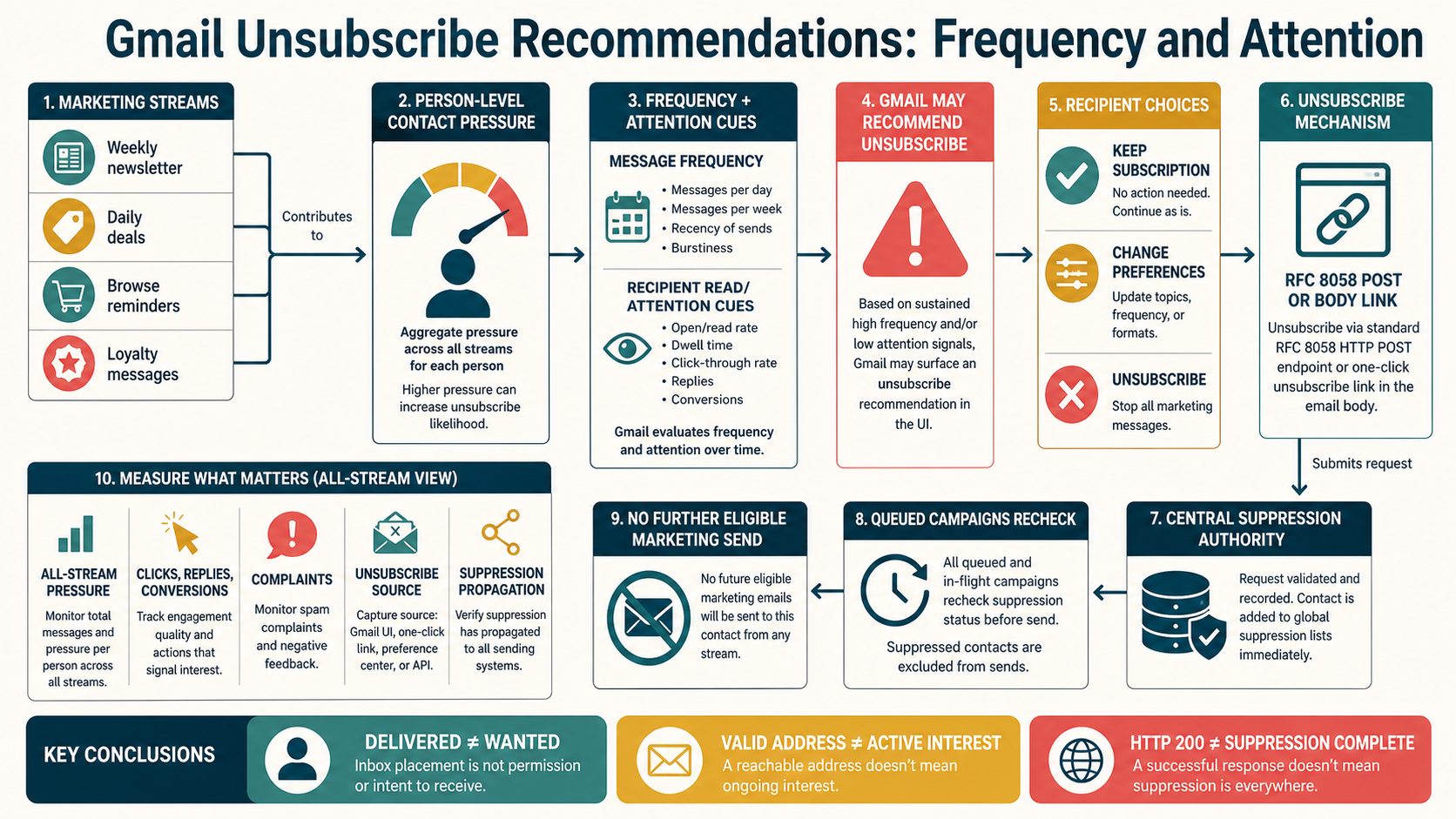
On April 25, 2018, Google announced that Gmail would recommend unsubscribing from mailing lists using cues such as how many messages a recipient received from a sender and how many were actually read. The notifications rolled out with the redesigned Gmail over the following weeks. This created a visible consequence before the recipient reached for the spam button: high frequency combined with weak recipient attention could trigger Gmail to place an unsubscribe decision directly in the inbox experience.
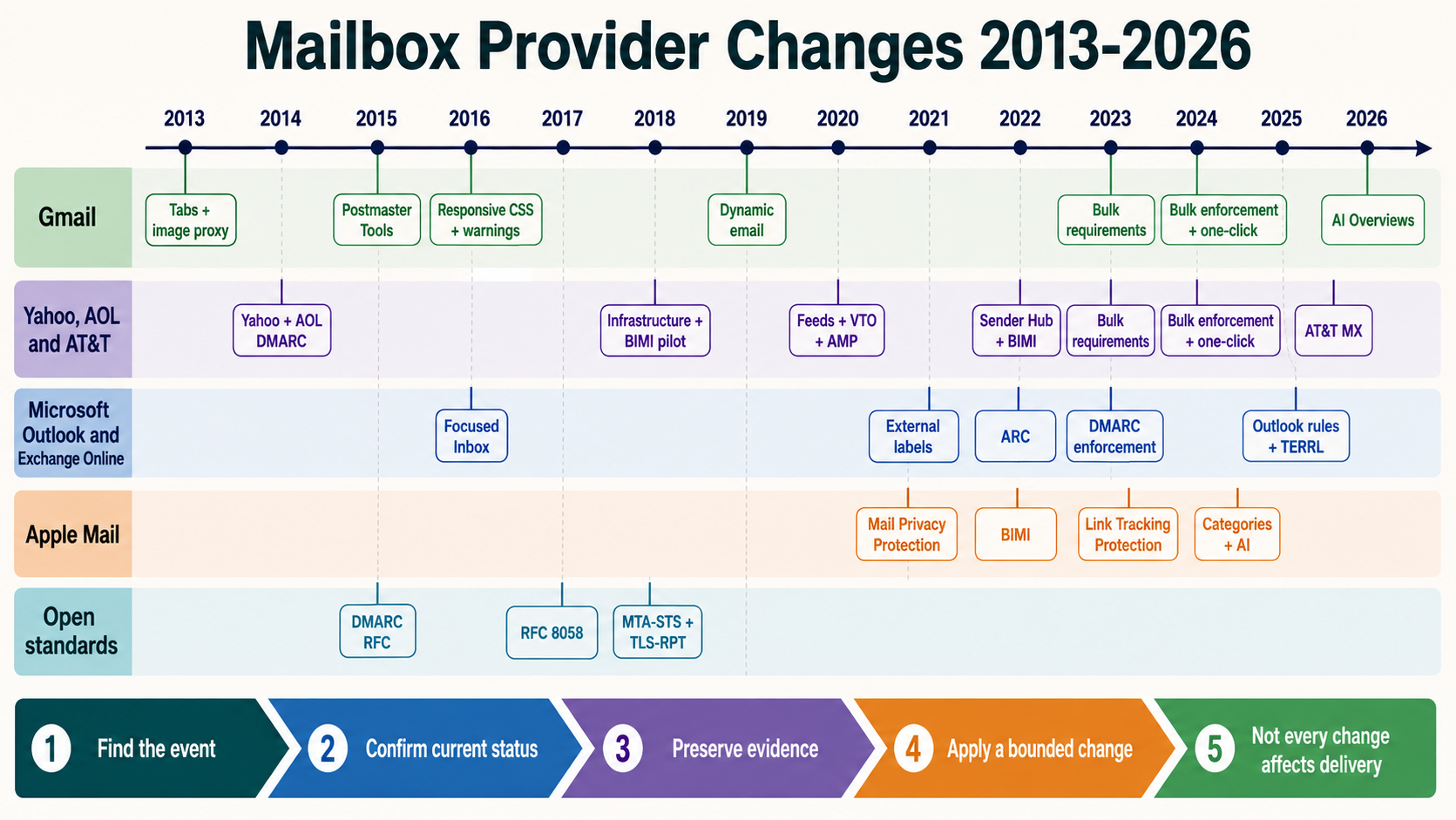
The dated mailbox-provider change
| Event field | Verified value | Why it matters |
|---|---|---|
| Historical event date | April 25, 2018 | This is the provider-change date, not the NitWings publication date. |
| Mailbox provider | Gmail | The affected provider estate determines which recipient cohorts require separate evidence. |
| Change area | Unsubscribe exposure | This identifies whether the change altered authentication, filtering, visibility, measurement or sender operations. |
| Current status | feature-evolved-into-broader-subscription-management-and-bulk-sender-controls | Historical instructions are interpreted against the feature or standard that exists now. |
List-Unsubscribe headers and body links already gave recipients ways to leave a mailing list. Gmail had exposed unsubscribe controls in selected contexts for years. The 2018 change was different because Gmail proactively recommended the action based on recipient-specific patterns rather than waiting for the user to hunt for a link.
Google described two cues publicly: message volume from a sender and how many of those messages the recipient read. The company did not publish a universal threshold or formula. The system therefore represented personalized assistance, not a sender score that marketers could calculate exactly.
The recommendation arrived alongside high-priority notifications and other AI-driven inbox features. Gmail was increasingly managing attention after delivery, not merely sorting accepted mail into folders or tabs. A campaign could reach Promotions successfully and still create visible pressure to unsubscribe.
For marketers, the event reinforced a basic asymmetry. Sending frequency is controlled by the program, while attention is controlled by the recipient. An aggregate open rate could hide a cohort receiving many messages and reading almost none of them.
How the system worked before the change
Before the recommendation, an uninterested subscriber generally ignored messages, searched for the body unsubscribe link, used a provider header control or reported spam. The sender might observe declining opens but had no direct notice that Gmail was about to encourage list exit.
Frequency policies were often defined at campaign level. A person in several overlapping journeys could receive a newsletter, promotional blast, browse reminder and lifecycle message on the same day even when each campaign individually respected its schedule.
Inactive-recipient rules relied heavily on tracking pixels. Image blocking, caching and client behavior already made “not opened” an uncertain observation. Teams sometimes continued indefinitely because no bounce occurred, treating a valid address as an engaged subscriber.
Unsubscribe processing could also be fragmented. A body link updated one preference center, a mailto request went to support, and a provider action reached another endpoint. Delayed propagation allowed another campaign to leave the queue after the recipient had opted out.
What changed on the provider side
Gmail added a proactive inbox notification suggesting that a recipient unsubscribe from a mailing list. Frequency and recipient reading were explicit cues, but Google did not claim they were the only signals. The recommendation was personalized to the mailbox.
The feature exposed an attention mismatch. It did not mean the sender had failed SMTP authentication or been blocked. It meant Gmail believed the recipient might benefit from reducing mail from that source. The sender might see a successful delivery followed by an unsubscribe with no email open.
The correct response was not to hide the unsubscribe mechanism or rename the sender repeatedly. It was to consolidate frequency across streams, honor permission scope, provide easy preference choices, and remove recipients who no longer wanted the content.
Modern Gmail policy adds a technical layer. Qualifying bulk marketing and subscription traffic must support RFC 8058 one-click unsubscribe, include a visible body link and process requests promptly. The 2018 recommendation and current sender requirements are related recipient-control mechanisms but are not the same rollout.
Message path before and after
Before
Subscribed recipient receives repeated campaigns
    |
    +----> reads some messages
    +----> ignores messages
    +----> searches for body unsubscribe
    +----> reports spam
    |
    v
Sender sees delayed aggregate engagement or complaint evidence
After
Gmail observes recipient-specific subscription pattern
    |
    +----> message frequency from sender
    +----> how often recipient reads the mail
    +----> other mailbox context
    |
    v
Gmail may show unsubscribe recommendation
    |
    +----> recipient keeps subscription
    +----> recipient unsubscribes
                    |
                    v
          sender suppression must propagate before next eligible send
Who and what the change affected
| Traffic or stakeholder | What changed | Required interpretation |
|---|---|---|
| Frequent promotional programs | High message volume gained an additional recipient-control surface. | Measure total person-level pressure across campaigns. |
| Low-engagement subscribers | Gmail could suggest leaving before a spam complaint. | Reduce, pause or reconfirm based on permission and outcomes. |
| Lifecycle automation | Overlapping journeys could create hidden frequency. | Use a central contact policy and priority rules. |
| Transactional senders | Critical mail needed separation from optional subscriptions. | Keep identities, purpose and opt-out scope explicit. |
| Suppression platforms | Provider-generated requests needed prompt durable processing. | Propagate idempotently to every send system. |
| Deliverability analysts | Unsubscribes became partly an inbox-interface outcome. | Compare frequency, attention, complaints and retention. |
Effect on delivery, placement and recipient visibility
An unsubscribe is generally preferable to a spam complaint because it gives the sender a direct way to stop optional mail. However, a rising recommendation-driven opt-out rate can reveal that the program is overmailing or failing to meet expectations. It should not be dismissed as a Gmail interface artifact.
The feature did not itself reject messages or move them to spam. It operated after mail reached the mailbox interface. Yet the same underlying wantedness problem can also raise complaints and weaken reputation, so attention pressure and deliverability risk can share causes.
Reducing frequency indiscriminately is not always correct. A daily market alert, security digest or job notification may be explicitly requested. The control must use the promised cadence, subscription type, recipient action and business outcome rather than a universal messages-per-week number.
Changing From addresses to avoid accumulated signals can confuse recipients and fragment reputation. A stable, recognizable purpose-specific identity with transparent preferences is more defensible. Keep critical transactional streams separate so a marketing opt-out does not suppress required account communications.
Current Gmail mitigation eligibility can depend on meeting sender requirements, including proper one-click behavior for applicable mail. A broken endpoint, missing headers or delayed processing compounds unwantedness. Technical compliance and permission quality must operate together.
Effect on measurement and diagnosis
Build a person-level contact-pressure metric across every platform. Count eligible marketing sends, delivered messages and time since last meaningful action. Do not calculate frequency only inside one campaign tool when other systems contact the same address.
Separate unsubscribe sources: body link, preference center, RFC 8058 POST, mailto, support request and provider interface. Normalize them into one event model while preserving source. Different sources can reveal accessibility or endpoint failures.
Read cues are provider-private and tracking opens is imperfect. Use clicks, replies, conversions, recent subscription confirmation, preference updates and complaints alongside image events. A recipient can value a message without loading images, and a proxy fetch can occur without attention.
Measure processing time from request receipt to effective exclusion in each system. Include queued campaigns, journeys, batch exports and vendors. The important proof is not an HTTP 200 response but the absence of a later eligible send.
Use cohort experiments for frequency. Hold audience, content and identity stable while testing cadence, then observe complaints, unsubscribes, clicks, conversion and long-term retention. Define guardrails before the test and exclude critical mail.
Advantages for email marketers
| Potential advantage | When the advantage is real | Evidence to verify |
|---|---|---|
| Lower complaint pressure | Recipients can exit before using report spam. | Complaint and unsubscribe rates by cohort. |
| Cleaner active audience | Suppression is prompt and accurate. | Future eligible sends exclude the recipient. |
| Better frequency governance | All campaigns share person-level caps. | Contact pressure and outcomes across platforms. |
| More transparent preferences | Recipients can select topics or cadence without friction. | Preference completion and retained engagement. |
| Clearer stream separation | Optional and essential messages have distinct purposes. | Correct opt-out scope and stable identities. |
Disadvantages and operational risks
| Cost or risk | How it appears | Control |
|---|---|---|
| Recommendation is treated as a block | Teams change infrastructure instead of frequency. | Recognize it as a post-delivery recipient-control event. |
| Sender identity is rotated | Mail appears from new addresses to escape history. | Use stable transparent purpose-specific identities. |
| Open data drives automatic deletion | Proxying or images-off behavior mislabels wanted users. | Use multi-signal inactivity and cautious policy. |
| Suppression propagation is delayed | Another campaign sends after unsubscribe. | Use immediate central events and reconciliation. |
| Global suppression is overapplied | A marketing exit blocks required account notices. | Define subscription and legal scope explicitly. |
| Universal cadence is imposed | Requested high-frequency products lose value. | Honor the promised use case and recipient settings. |
What email teams needed to do at the time
- Inventory all subscription streams. Map From identity, cadence, audience and owner.
- Calculate person-level pressure. Combine scheduled and automated campaigns.
- Make unsubscribe obvious. Keep body links accessible and provider headers functional.
- Centralize suppression. Propagate every opt-out source to all sending systems.
- Separate essential mail. Do not mix promotions into receipts or security notices.
- Review inactive cohorts. Reduce, pause or reconfirm according to permission and value.
- Keep identity stable. Do not rotate From addresses to hide unwantedness.
- Measure outcomes beyond opens. Use clicks, replies, complaints and conversions.
What email teams should do now
- Implement RFC 8058 correctly. Use signed one-click headers for applicable subscription traffic.
- Honor requests promptly. Target immediate exclusion and verify within current provider timelines.
- Retain a visible body link. Let recipients reach preferences without login obstacles.
- Use a contact-policy service. Resolve cross-channel and cross-journey priority before send.
- Track Manage subscriptions exposure indirectly. Expect high-frequency senders to be more visible to recipient controls.
- Use consented cadence choices. Offer daily, weekly, topic-specific or pause options when appropriate.
- Reconcile suppression stores. Audit queues, exports, vendors and regional replicas.
- Monitor Gmail complaint and compliance signals. Correlate them with local frequency and opt-outs.
- Protect transactional boundaries. Define exactly which messages continue after a marketing unsubscribe.
- Review acquisition sources. A technically valid address is not proof of ongoing interest.
Worked deliverability scenario
A retailer sends a weekly newsletter, daily deals, browse reminders and loyalty messages from the same identity. Each team believes its cadence is reasonable. Gmail unsubscribes rise even though SMTP acceptance remains stable.
A contact-level audit shows that active shoppers can receive twelve optional messages in seven days. Many have not clicked or purchased in months. The unsubscribe endpoint works, but a nightly export allows one more message after the request.
The retailer introduces a cross-program cap, prioritizes triggered service messages, reduces promotional mail for inactive cohorts and offers weekly digest preferences. Unsubscribe events publish immediately to every platform, and queued campaigns recheck suppression before delivery.
Complaints and repeat post-opt-out sends decline. Revenue per delivered message improves even though gross send volume falls. The team interprets Gmail’s recommendation as an attention-governance signal, not an infrastructure block.
Evidence and diagnostics
- Subscription: source, confirmation, promised cadence, topic and legal basis.
- Contact pressure: all messages sent and scheduled across platforms and identities.
- Recipient outcomes: clicks, replies, conversions, complaints, unsubscribes and retention.
- Unsubscribe source: body, preference center, RFC 8058, mailto, support or provider UI.
- Endpoint: headers, DKIM coverage, POST validation, response and processing time.
- Suppression: scope, effective timestamp, downstream acknowledgements and queue recheck.
- Message stream: promotional, lifecycle, transactional or mixed.
- Gmail evidence: SMTP outcome, Compliance dashboard and complaint trend kept separate.
- Experiment: cadence variant, holdout, guardrails, observation window and rollback.
Failure modes and incorrect conclusions
- Calling the suggestion a spam-folder event. It is an inbox recipient-control surface.
- Searching for a universal threshold. Google described cues, not a public fixed formula.
- Hiding unsubscribe. Friction pushes uninterested recipients toward spam complaints.
- Using opens as the only inactivity signal. Client privacy and rendering distort them.
- Counting campaigns instead of contact pressure. Overlapping journeys remain invisible.
- Acknowledging before suppression. Another eligible send proves processing failed.
- Mixing transactions and promotions. Opt-out scope and reputation become unsafe.
Current status and superseding changes
Gmail’s recipient-control environment has expanded beyond the 2018 recommendation. Current Gmail includes one-click requirements for qualifying bulk subscription traffic and a Manage subscriptions view that groups active subscriptions and highlights frequent senders.
Google’s current sender documentation requires applicable marketing and subscription messages to include RFC 8058 one-click handling and a visible body link. The provider recommends honoring requests within 48 hours, while strong programs should suppress much faster.
The 2018 feature remains important historically because it made frequency and weak recipient attention visible as an inbox-level unsubscribe decision. It did not publish a threshold, score or guaranteed remediation formula.
Operations teams should also distinguish three clocks. The first is the recipient request time, the second is the moment the suppression authority records the request, and the third is the last time every campaign queue and vendor audience was refreshed. A fast web response is not sufficient when an exported audience can still send. Store an immutable request identifier, subscription scope, source, effective timestamp and downstream acknowledgement. Test the complete path with controlled addresses, including messages already queued before the request.
Reporting needs a stable denominator. Compare unsubscribes with delivered subscription messages for the same stream and interval, then segment by acquisition source, cadence, tenure and recent meaningful action. Raw counts rise naturally with volume. A small aggregate rate can also hide a damaged high-frequency cohort, so percentile contact pressure and cohort-level outcomes belong beside the headline rate.
The enduring strategy is recipient-centered: send only expected mail, coordinate total frequency, make preferences easy, process exits durably, and judge success by wanted outcomes rather than maximum send volume.
Operator checklist
- Record April 25, 2018 as the announcement date.
- State that rollout occurred over following weeks.
- Describe frequency and messages read as cues, not a fixed formula.
- Measure total person-level pressure across every campaign system.
- Keep marketing and transactional streams separate.
- Implement current RFC 8058 and visible body-link requirements.
- Process every unsubscribe source through one durable suppression model.
- Recheck queued and exported audiences after suppression.
- Use clicks, complaints, conversions and consent alongside opens.
- Test cadence with holdouts, guardrails and rollback.
Primary and contemporaneous references
- Google Workspace: New Gmail features: Primary April 25, 2018 announcement.
- Google: Email sender guidelines: Current one-click and subscription requirements.
- Google: Sender guidelines FAQ: Current scope and unsubscribe processing.
- Google: Manage subscriptions: Current recipient subscription-management experience.