
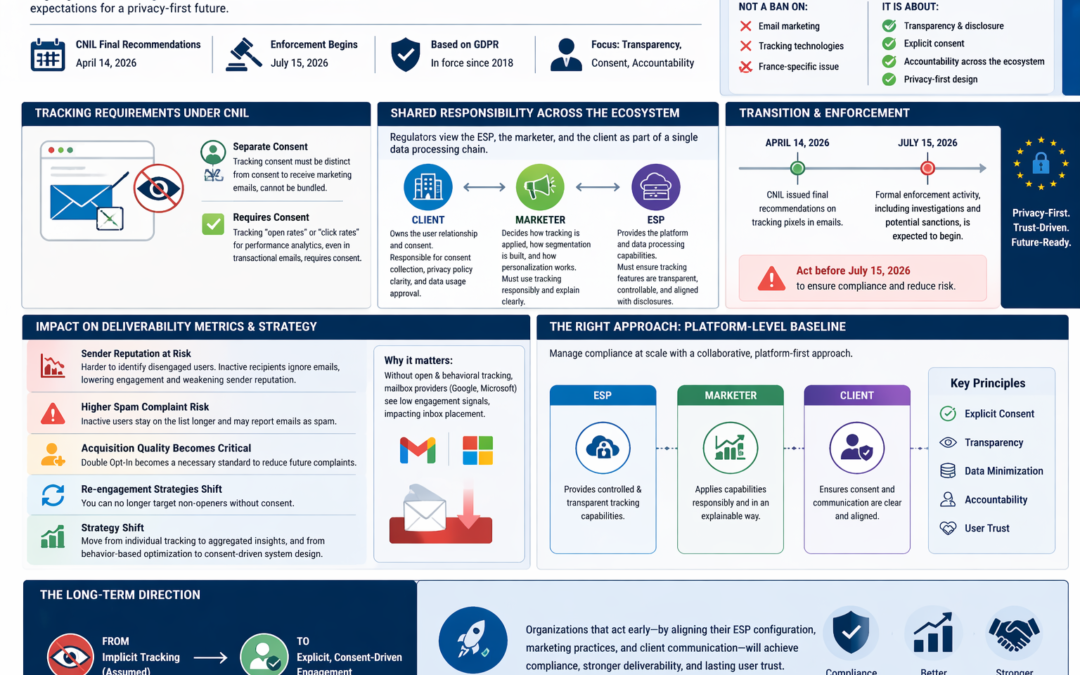
The CNIL released its final recommendations regarding tracking pixels in emails on April 14, 2026. While these rules are technically based on GDPR requirements in force since 2018, the CNIL has established a formal transition period for compliance. July 15, 2026: Formal enforcement activity, including investigations and potential sanctions, is expected to begin.
Separate Consent: This tracking consent must be distinct from the consent to receive marketing emails; you cannot “bundle” them together.
Requires Consent: Tracking “open rates” or “click rates” for performance analytics, even within a transactional email (like a password reset or order confirmation).
The recent CNIL discussion has created significant attention across the industry, with many ESPs positioning it as a major shift. In reality, this is not a new regulation, but a continuation of an existing direction where expectations around data usage, tracking, and accountability are becoming more explicit.
What is evolving is how responsibility is distributed across the ecosystem.
Historically, the model was relatively simple. The client owned the user relationship and consent, the marketer executed campaigns, and the ESP acted as infrastructure. Compliance was often viewed as primarily a client responsibility.
That model is no longer sufficient.Regulators are increasingly viewing the ESP, the marketer, and the client as part of a single data processing chain, where each plays an active role in how user data is collected, tracked, and used.From an ESP perspective, this means moving beyond the idea of being a neutral platform. Features such as open tracking, click tracking, and data storage are not just technical capabilities. They are part of the data processing layer and must be transparent, controllable, and aligned with how data is disclosed.
From a marketer perspective, the shift is even more operational. Marketers are the ones deciding how tracking is applied, how segmentation is built, and how personalization logic works. This means there is now a clear expectation that tracking and profiling are not only used effectively, but also explained clearly and used in a way that can be justified.
From a client perspective, the responsibility remains foundational. Consent collection, privacy policy clarity, and overall data usage approval sit with the client. If consent is unclear or weak at this level, the entire downstream chain, including marketer and ESP, is exposed.
It is important to be equally clear about what this development does not mean.
This is not a ban on email marketing.
This is not a ban on tracking technologies.
This is not a short-term France-specific issue.
Instead, it aligns with broader global shifts, including privacy-first design and the gradual move away from passive tracking signals.
The practical impact is not immediate disruption, but a structural shift in how email marketing systems are designed and measured.
Open rates are already becoming unreliable due to ecosystem changes. This accelerates the need to focus on stronger, first-party signals such as clicks, conversions, and direct engagement.At the same time, there is increasing pressure to ensure that behavioral tracking and profiling are transparent, disclosed, and explainable.
For organizations operating at scale, this cannot be managed on a client-by-client basis. The effective approach is to establish a platform-level baseline, where:
- The ESP provides controlled and transparent tracking capabilities
- The marketer applies these capabilities in a responsible and explainable way
- The client ensures that consent and communication are clear and aligned
The long-term direction is clear. Email marketing is moving from a model built on implicit tracking to one built on explicit, consent-driven engagement.
Organizations that recognize this early and align their ESP configuration, marketing practices, and client communication accordingly will be better positioned not only for compliance, but also for sustainable deliverability and user trust.
Impact on Deliverability Metrics & Strategy under CNIL Enforcement
- Under CNIL enforcement of the General Data Protection Regulation, user-level tracking is restricted, especially open tracking without consent.
- Sender reputation becomes harder to manage because you can no longer clearly identify disengaged users. Without open and behavioral tracking, inactive recipients remain on your list, and you continue sending emails to them unknowingly. From the perspective of mailbox providers like Google and Microsoft, these users appear to consistently ignore your emails. This lowers your overall engagement rate and generates negative signals, which gradually weaken your sender reputation and can impact inbox placement.
- Spam complaint risk increases, since inactive users remain on the list longer and may eventually report emails as spam.
- Acquisition quality becomes critical, making Double Opt-In a necessary standard to reduce future complaints.
- Re-engagement strategies shift, as you can no longer target non-openers without consent.
- Overall, the strategy moves from individual tracking to aggregated insights, and from behavior-based optimization to consent-driven system design.
CNIL & Email Marketing Compliance Guide
This document explains, in clear and practical terms, how email marketing should be handled under the evolving expectations of CNIL and broader EU regulations. It is written so that both technical and non-technical stakeholders can understand their role and take the right actions without confusion.
The goal is not to stop marketing activity, but to ensure that data usage, tracking, and communication are transparent, justified, and aligned with user expectations.
Understanding the Core Change
Over time, email marketing evolved with heavy reliance on tracking technologies such as open pixels, click tracking, and behavioral analysis. These were often enabled by default and rarely explained clearly to users.
Today, the expectation has shifted.
Instead of tracking first and explaining later, organizations are now expected to clearly explain what data is being collected and why, before any tracking takes place. This is not a sudden regulatory shock. It is a continuation of the same direction seen in cookie regulations, Apple Mail Privacy Protection, and broader privacy-first design.
The Three Key Roles in Email Marketing
To manage compliance correctly, it is important to clearly understand the responsibilities of each party involved.
| Role | Description | Example |
| ESP | Technology platform that sends emails and enables tracking | SendGrid, Amazon SES |
| Marketer | Team or individual managing campaigns, targeting, and logic | Internal marketing team or agency |
| Client | Business or brand that owns the customer relationship | eCommerce brand |
Each of these roles plays a part in how data is collected, processed, and used. Responsibility is no longer isolated. It is shared.
What Counts as Tracking (With Examples)
Tracking is not limited to one simple activity. It exists at different levels, each with increasing sensitivity.
| Tracking Type | Description | Example | Risk Level |
| Basic Tracking | Measures interaction with emails | Open rate, click rate | Low |
| Behavioral Tracking | Tracks user actions beyond the email | Visiting product pages after clicking | Medium |
| Profiling | Uses behavior to predict or influence decisions | “User is interested in shoes → send shoe offers” | High |
The “Separation” Rule: You must allow a user to receive emails (Marketing or Transactional) without forcing them to be tracked. Consent to receive the email
Consent to be tracked.
The “Granular” Rule: On your signup forms, you should ideally have two checkboxes: one for the newsletter subscription and one for “personalized experience/tracking.”
The “Retroactive” Rule: If a user clicks “Unsubscribe” or “Stop Tracking,” you must ensure that pixels in old emails still sitting in their inbox stop sending data back to your server.
B2B Context: These rules apply to professional email addresses (e.g., [email protected]) just as strictly as personal ones (e.g., [email protected]).
| Email Type | Tracking Trigger (The “Why”) | Category | Specific Activity Included | Consent Needed? | CNIL Requirement Details |
| Transactional | Security | Essential | Detecting login from new IP/Device; bot prevention. | NO | Must be strictly for protecting the user account or service. |
| Transactional | Hygiene | Essential | Identifying “Hard Bounces” (invalid address) to clean lists. | NO | Allowed to maintain “list health” only; cannot be used to trigger ads. |
| Any Type | Delivery | Essential | Confirming the email physically reached the recipient server. | NO | Technical confirmation that the “pipe” worked. |
| Transactional | Analytics | Behavioral | Measuring Open Rates for “Customer Success” or UX stats. | YES | If you can provide the service without knowing they opened it, you need consent. |
| Transactional | Upselling | Behavioral | Tracking clicks on “Recommended Products” in a receipt. | YES | Considered marketing intent, even inside a transactional message. |
| Transactional | Behavioral | Behavioral | Tracking “Time Spent Reading” an invoice or statement. | YES | Individual reading habits are never considered “strictly necessary.” |
| Marketing | Analytics | Behavioral | Individual Open Rates & Click-through Rates (KPIs). | YES | Standard marketing metrics now require an explicit opt-in. |
| Marketing | Optimization | Behavioral | A/B testing different subject lines/content for individuals. | YES | Measuring which version “performed” better on a user requires consent. |
| Marketing | Optimization | Behavioral | “Best Time to Send” (tracking when a user usually opens). | YES | Monitoring habits to time future messages is a behavioral track. |
| Marketing | Profiling | Profiling | Building a profile of user interests based on click history. | YES | High-level data enrichment; requires the most transparent disclosure. |
| Marketing | Profiling | Profiling | Dynamic content (changing offers based on past tracking). | YES | You cannot use past tracking data to alter future emails without consent. |
| Marketing | Retargeting | Profiling | Abandoned Cart triggers or cross-channel ad syncing. | YES | Linking email clicks to website behavior or social media ads. |
Example If a user clicks a link in an email and lands on a product page, and later receives emails based on that product category, this moves from basic tracking to profiling.
Where Disclosure Must Happen
A common misconception is that tracking disclosures need to appear in every email. This is not correct.
Disclosure must happen at the point of data collection and in supporting documentation.
| Location | Purpose | Example |
| Signup Form | Inform user before they subscribe | “We track opens and clicks to improve communication” |
| Privacy Policy | Provide full explanation | Details on tracking, profiling, and data usage |
| Email Body | Not required for tracking disclosure | Only unsubscribe and identity needed |
Example (Recommended Consent Line)
“We send marketing emails and track interactions such as opens, clicks, and website visits to understand your interests and provide personalized communication.”
This line is clear, simple, and covers both tracking and personalization.
ESP Responsibilities (Platform Perspective)
Platforms such as SendGrid and Amazon SES provide the infrastructure that makes tracking and email delivery possible.
They are no longer considered neutral tools. They are part of the data processing chain.
| Function | What Happens | Example |
| Open Tracking | Pixel added to email | Detects when email is opened |
| Click Tracking | Links rewritten | Tracks user clicks |
| Data Storage | Engagement data stored | Click history, open logs |
| Segmentation Support | Enables targeting | Audience filtering |
Practical Example
A link like: https://tracking.domain.com/click?user_id=123&campaign=abc
This is not just a link. It is a tracking mechanism. The ESP must ensure that such tracking is controlled and understood.
Marketer Responsibilities (Operational Control)
The marketer is the decision-maker. This role defines how data is used in real campaigns.
Key Responsibilities
| Area | Responsibility | Example |
| Consent | Ensure user clearly agrees | Clean signup forms |
| Tracking | Use only what is disclosed | Avoid hidden tracking |
| Segmentation | Keep logic explainable | “Clicked shoes → send shoe offers” |
| Campaign Logic | Avoid unexpected behavior | No surprise targeting |
Example
If a marketer builds a segment like: Users who visited high-value products in last 7 days”
This must be: Disclosed in policy and Understandable if questioned.
Client Responsibilities (Ownership)
The client owns the relationship with the end user.
Even if the marketer and ESP do everything correctly, weak consent or unclear communication at the client level creates risk.
Key Responsibilities
| Area | Responsibility | Example |
| Consent Collection | Must be clear and valid | No pre-checked boxes |
| Privacy Policy | Must reflect actual practices | Includes tracking + profiling |
| Data Use Approval | Align with business purpose | No unnecessary data use |
Tracking Configuration (What Should Be Done)
Most ESPs enable tracking by default. This must be managed intentionally.
| Tracking Type | Recommended Approach | Example |
| Open Tracking | Keep enabled but reduce reliance | Do not use as primary KPI |
| Click Tracking | Keep enabled with transparency | Track engagement clearly |
| Behavioral Tracking | Use only if disclosed | Website visit tracking |
Key Rule If a feature cannot be clearly explained to a user, it should not be used.
Data Retention (Simple but Critical)
Many systems store data indefinitely. This is no longer acceptable without justification.
Recommended Approach
| Data Category | Action |
| Active Users | Keep relevant engagement data |
| Inactive Users | Reduce or clean periodically |
| Old Data | Archive, anonymize, or delete |
Profiling and Personalization (High Attention Area)
Profiling is when you use user behavior to influence communication.
Examples:-Recommending products based on past clicks or Sending category-specific offers or Predicting user interests
Requirements
| Requirement | Explanation |
| Transparency | User must know profiling exists |
| Logic clarity | You must explain how it works |
| No hidden decisions | Avoid silent classification |
Automation Flows (Real Use Case)
Automation is common in eCommerce marketing.
Examples
| Flow Type | Trigger |
| Cart Abandonment | User adds product but does not purchase |
| Browse Abandonment | User views product but leaves |
| Re-engagement | User inactive for a period |
Unsubscribe and Suppression
This remains a core requirement.
Expectations
| Requirement | Description |
| Clear Unsubscribe | Visible and easy |
| No Login Required | Simple process |
| Immediate Action | Stop sending instantly |
Important Note After unsubscribe: Tracking and profiling must stop.
Managing Compliance at Scale (1000+ Clients)
It is not practical to review each client manually. Instead, control must be built into the system.
Scalable Model
| Layer | Approach |
| Templates | Standard consent and policy text |
| Onboarding | Mandatory compliance checks |
| ESP Settings | Global tracking configuration |
| Audits | Focus on high-risk clients |
Example Instead of checking 1000 privacy policies, you: Provide one approved template and Require all clients to use it.
Common Mistakes
| Mistake | Why It’s Risky |
| Vague consent language | Not transparent |
| Over-reliance on open rate | Unreliable + sensitive |
| Hidden profiling | High regulatory risk |
| Unlimited data storage | Not justified |
| Ignoring signup forms | Risk starts here |
Final Summary
Email marketing is not being restricted. It is being refined.
The direction is clear: Be transparent , Be intentional and Be accountable .
Final Thought
Trust is becoming the foundation of email marketing. Organizations that clearly explain what they do, and why they do it, will not only meet regulatory expectations but will also build stronger and more sustainable relationships with their users.
CNIL & Email Marketing Compliance Guide
Practical A–Z Guide for ESPs, Marketers, and Clients
This document explains, in clear and practical terms, how email marketing should be handled under the evolving expectations of CNIL and broader EU regulations. It is written so that both technical and non-technical stakeholders can understand their role and take the right actions without confusion.The goal is not to stop marketing activity, but to ensure that data usage, tracking, and communication are transparent, justified, and aligned with user expectations.